PUBLISHER: Mordor Intelligence | PRODUCT CODE: 2113379

PUBLISHER: Mordor Intelligence | PRODUCT CODE: 2113379
Malaysia Textile Manufacturing - Market Share Analysis, Industry Trends & Statistics, Growth Forecasts (2026 - 2031)
According to Mordor Intelligence, the Malaysia textile manufacturing market size is projected to be USD 3.5 billion in 2025, USD 3.67 billion in 2026, and reach USD 4.71 billion by 2031, growing at a CAGR of 5.12% from 2026 to 2031.
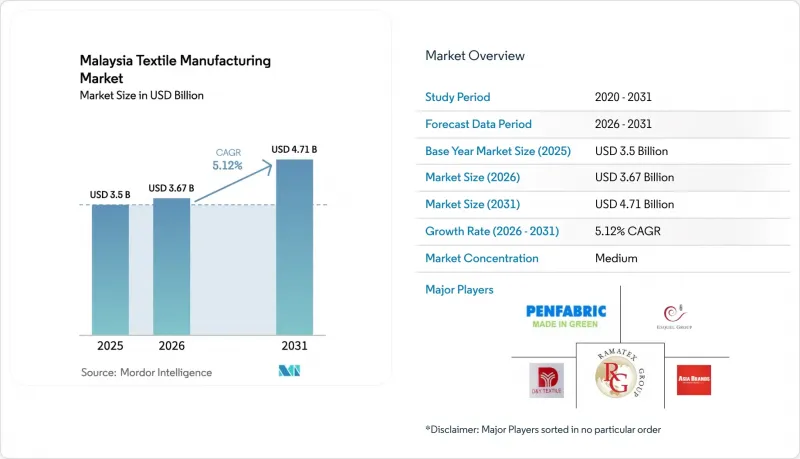
This report is Segmented by Application (Fashion & Apparel, Industrial/Technical, Hand More), by Raw Material (Natural Fibers, Synthetic Fibers, and More), by Process (Woven, Knitted, Non-Woven, 3D Weaving & Spacer Fabrics), and by Geography (Northern, Central, Southern, East Coast, East Malaysia). Market Forecasts are Provided in Value (USD).
Malaysia Textile Manufacturing Market Trends and Insights
RCEP Tariff Eliminations Accelerating Yarn Exports
Preferential access under RCEP has lowered Malaysian yarn duties in China, Japan, South Korea, and Australia, lifting margins by 5-8 percentage points for compliant suppliers. Producers may combine Australian wool or Chinese polyester chips without losing origin status, a benefit already exploited by mid-scale spinners in Penang and Kedah. Foreign direct investment approvals for textile projects jumped 8% of Malaysia's 2024 manufacturing total, signaling confidence in a yarn-export hub. Capacity gains disproportionately reward integrated mills that spin in-house, though cut-make-trim contractors capture upside only if contracts allow pass-through pricing. Continued tariff phase-outs to 2026 keep this tailwind intact.
E-commerce-Driven Resurgence in ASEAN Fast-Fashion Demand
Regional gross merchandise value for online marketplaces touched USD 139 billion in 2024, with apparel as the second-largest category. Platforms such as Shopee and Lazada now aggregate small-lot orders in Malaysian hubs, cutting turnaround times to 21 days and rewarding agile knitters who invested in automated cutting and digital patterning. ZALORA's 33% jump in modest-wear sales benefits local batik and jersey makers that offer cultural design advantages. However, Vietnamese and Cambodian sourcing networks are expanding, so Malaysian firms must lock multi-year platform agreements before 2027.
Stricter 2025 Migrant-Worker Quota Causing Skilled-Labor Gaps
A phased cut from 15% to 10% foreign-labor allocation by 2026 threatens mills where migrant dependence exceeds 40%. Unfilled vacancies already affect 35% of textile plants, pushing operator wages up 26.7% to USD 475/month in 2025. Larger players accelerate automation - Ramatex has deployed programmable sewing modules - yet SMEs struggle with financing despite the ITA window. Without faster technical-training rollouts, labor scarcity will cap output growth even as orders rebound.
Other drivers and restraints analyzed in the detailed report include:
- Reinstated Textile Investment Tax Allowance (ITA) 2025
- PPE Stockpile Renewal Boosting Healthcare Textile Orders
- Escalating Natural-Gas Tariffs Under ICPT 2025 Review
For complete list of drivers and restraints, kindly check the Table Of Contents.
Segment Analysis
Fashion and apparel applications commanded 54.1% of 2025 revenue, underscoring the historical backbone of the Malaysia textile manufacturing market. Industrial and technical textiles, however, are set to grow at a 6.54% CAGR, the highest among applications, propelled by PPE restocking and automotive interior fabric localization for Proton and Perodua lines. The segment's robust trajectory positions it to narrow the share gap with apparel by 2031.
Oceancash Pacific's plan to double non-woven output to 16,000 tpa exemplifies capacity shifts toward spunbond and meltblown fabrics for surgical masks and gowns. Automotive interior supplier Chori Trading Malaysia is expanding its Selangor weaving lines to support electric-vehicle programs requiring flame-retardant, lightweight materials. Household textiles follow at a 4.8% pace, anchored by Malaysia's housing starts, yet price-sensitive consumers keep Chinese and Indian imports competitive.
Complete Report Scope:
- By Application
- Fashion & Apparel
- Industrial/Technical Textiles
- Household & Home Textiles
- Medical & Healthcare Textiles
- Automotive & Transport Textiles
- Others (Protective, Sports Textiles, etc.)
- By Raw Material
- Natural Fibers
- Cotton
- Wool
- Silk
- Synthetic Fibers
- Polyester
- Nylon
- Rayon / Viscose
- Acrylic
- Polypropylene
- Recycled Fibers
- Others (Speciality High-Performance Fibers (Aramid, Carbon, UHMWPE))
- Natural Fibers
- By Process / Technology
- Woven
- Knitted
- Non-woven
- Spunlaid (Spunbond / Melt-blown)
- Dry-laid Hydro-entangled
- Wet-Laid
- Needle-punched
- 3-D Weaving & Spacer Fabrics
- By Geography
- Northern (Penang, Kedah, Perlis, and Perak)
- Central (Selangor, Kuala Lumpur, Negeri Sembilan, and Putrajaya)
- Southern (Johor, Melaka)
- East Coast (Kelantan, Terengganu, Pahang, and Labuan)
- East Malaysia (Sabah, Sarawak)
List of Companies Covered in this Report:
- Ramatex Textiles Industrial Sdn Bhd
- Penfabric Sdn Berhad
- D&Y Textile (Malaysia) Sdn Bhd
- Esquel Malaysia Sdn Berhad
- Asia Brands Berhad
- Kamunting Spinning Industries Sdn Bhd
- KIB Textiles Bhd
- Vicmark Fashion Sdn Bhd
- San Miguel Yamamura Woven Products Sdn Bhd
- Manwira Manufacturing Sdn Bhd
- Kima Sdn Bhd
- Oceanic Fabric Mill Sdn Bhd
- Maxim Textile Technology Sdn Bhd
- Hytex Integrated Bhd
- Padini Holdings Berhad
- Furniweb Holdings Ltd
- Batek Malaysia Berhad
- Usha Yarns (Malaysia)
- Titan Petrochemicals (M) Sdn Bhd
- Skreen Fabric (M) Sdn Bhd
- Choon Giap Knitting Ind. Sdn Bhd
Additional Benefits:
- The market estimate (ME) sheet in Excel format
- 3 months of analyst support
TABLE OF CONTENTS
1 Introduction
- 1.1 Study Assumptions & Market Definition
- 1.2 Scope of the Study
2 Research Methodology
3 Executive Summary
4 Market Landscape
- 4.1 Market Overview
- 4.2 Market Drivers
- 4.2.1 RCEP tariff eliminations accelerating yarn exports
- 4.2.2 E-commerce-driven resurgence in ASEAN fast-fashion demand
- 4.2.3 Reinstated textile Investment Tax Allowance (ITA) 2025
- 4.2.4 PPE stockpile renewal boosting healthcare textile orders
- 4.2.5 Penang Circularity Industrial Park supplying recycled fibers
- 4.2.6 Early blockchain traceability adoption for EU Digital Product Passport
- 4.3 Market Restraints
- 4.3.1 Escalating natural-gas tariffs under ICPT 2025 review
- 4.3.2 Stricter 2025 migrant-worker quota causing skilled-labour gaps
- 4.3.3 Ringgit volatility raising imported fiber & dye costs
- 4.3.4 Logistics bottlenecks from delayed Johor Port textile upgrades
- 4.4 Value / Supply-Chain Analysis
- 4.5 Regulatory Landscape
- 4.6 Technological Outlook
- 4.7 Industry Attractiveness - Porter's Five Forces
- 4.7.1 Threat of New Entrants
- 4.7.2 Bargaining Power of Buyers
- 4.7.3 Bargaining Power of Suppliers
- 4.7.4 Threat of Substitutes
- 4.7.5 Intensity of Competitive Rivalry
5 Market Size & Growth Forecasts(Values, In USD Billion)
- 5.1 By Application
- 5.1.1 Fashion & Apparel
- 5.1.2 Industrial/Technical Textiles
- 5.1.3 Household & Home Textiles
- 5.1.4 Medical & Healthcare Textiles
- 5.1.5 Automotive & Transport Textiles
- 5.1.6 Others (Protective, Sports Textiles, etc.)
- 5.2 By Raw Material
- 5.2.1 Natural Fibers
- 5.2.1.1 Cotton
- 5.2.1.2 Wool
- 5.2.1.3 Silk
- 5.2.2 Synthetic Fibers
- 5.2.2.1 Polyester
- 5.2.2.2 Nylon
- 5.2.2.3 Rayon / Viscose
- 5.2.2.4 Acrylic
- 5.2.2.5 Polypropylene
- 5.2.3 Recycled Fibers
- 5.2.4 Others (Speciality High-Performance Fibers (Aramid, Carbon, UHMWPE))
- 5.2.1 Natural Fibers
- 5.3 By Process / Technology
- 5.3.1 Woven
- 5.3.2 Knitted
- 5.3.3 Non-woven
- 5.3.3.1 Spunlaid (Spunbond / Melt-blown)
- 5.3.3.2 Dry-laid Hydro-entangled
- 5.3.3.3 Wet-Laid
- 5.3.3.4 Needle-punched
- 5.3.4 3-D Weaving & Spacer Fabrics
- 5.4 By Geography
- 5.4.1 Northern (Penang, Kedah, Perlis, and Perak)
- 5.4.2 Central (Selangor, Kuala Lumpur, Negeri Sembilan, and Putrajaya)
- 5.4.3 Southern (Johor, Melaka)
- 5.4.4 East Coast (Kelantan, Terengganu, Pahang, and Labuan)
- 5.4.5 East Malaysia (Sabah, Sarawak)
6 Competitive Landscape
- 6.1 Market Concentration
- 6.2 Strategic Moves
- 6.3 Market Share Analysis
- 6.4 Company Profiles (includes Global level Overview, Market level overview, Core Segments, Financials as available, Strategic Information, Products & Services, Recent Developments)
- 6.4.1 Ramatex Textiles Industrial Sdn Bhd
- 6.4.2 Penfabric Sdn Berhad
- 6.4.3 D&Y Textile (Malaysia) Sdn Bhd
- 6.4.4 Esquel Malaysia Sdn Berhad
- 6.4.5 Asia Brands Berhad
- 6.4.6 Kamunting Spinning Industries Sdn Bhd
- 6.4.7 KIB Textiles Bhd
- 6.4.8 Vicmark Fashion Sdn Bhd
- 6.4.9 San Miguel Yamamura Woven Products Sdn Bhd
- 6.4.10 Manwira Manufacturing Sdn Bhd
- 6.4.11 Kima Sdn Bhd
- 6.4.12 Oceanic Fabric Mill Sdn Bhd
- 6.4.13 Maxim Textile Technology Sdn Bhd
- 6.4.14 Hytex Integrated Bhd
- 6.4.15 Padini Holdings Berhad
- 6.4.16 Furniweb Holdings Ltd
- 6.4.17 Batek Malaysia Berhad
- 6.4.18 Usha Yarns (Malaysia)
- 6.4.19 Titan Petrochemicals (M) Sdn Bhd
- 6.4.20 Skreen Fabric (M) Sdn Bhd
- 6.4.21 Choon Giap Knitting Ind. Sdn Bhd
7 Market Opportunities & Future Outlook
- 7.1 White-space & Unmet-need Assessment

