PUBLISHER: Mordor Intelligence | PRODUCT CODE: 2114158

PUBLISHER: Mordor Intelligence | PRODUCT CODE: 2114158
Asia-Pacific Oral Care - Market Share Analysis, Industry Trends & Statistics, Growth Forecasts (2026 - 2031)
According to Mordor Intelligence, the Asia-Pacific oral care market size was valued at USD 17.56 billion in 2025 and estimated to grow from USD 18.84 billion in 2026 to reach USD 26.77 billion by 2031, at a CAGR of 7.28% during the forecast period (2026-2031).
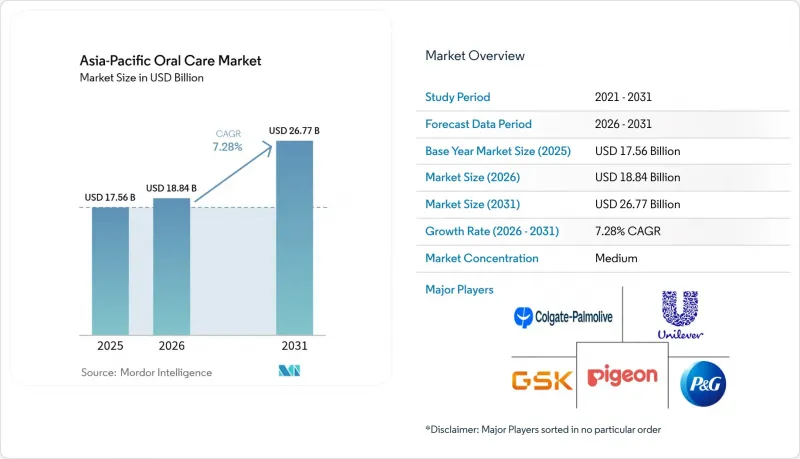
This report is Segmented by Product Type (Toothpaste, Mouthwash/Rinses, Toothbrush [Electric, Manual], Other Product Types), Ingredient (Conventional, Natural/Organic), End User (Kids/Children, Adult), Distribution Channel (Supermarkets/Hypermarket, and More), and Geography (China, Japan, India, Thailand, Singapore, Indonesia, and More). Market Forecasts are Provided in Value (USD).
Asia-Pacific Oral Care Market Trends and Insights
Rising oral-health awareness and preventive-care adoption
Government-led dental screening programs in schools, along with WHO-supported oral health initiatives, are encouraging a shift from occasional treatments to regular preventive care. India's National Oral Health Programme has expanded its scope, requiring biannual check-ups and fluoride varnish applications for schoolchildren, thereby promoting early intervention. In 2024, the Indian government allocated INR 858 Crores to the National Oral Health Programme, according to the Public Health Department. In Japan, the growing number of dental clinics has led to an increase in adults seeking preventive cleanings instead of emergency treatments. For example, the number of dental clinics in Japan reached 66,820 in 2023, as reported by the Statistics Bureau of Japan. This change in behavior is driving demand for specialized products, such as remineralizing toothpastes, interdental brushes, and alcohol-free mouthwashes, that address issues like enamel erosion and gingival inflammation. Compliance with ISO 11609:2017 standards enhances the credibility of product efficacy claims, reducing consumer skepticism and encouraging the adoption of premium formulations.
Growing disposable incomes and urbanization
With rising per capita incomes in tier-2 and tier-3 cities across India, Indonesia, and Vietnam, households are increasingly allocating higher budgets to oral care. This shift reflects a transition from reliance on basic commodity toothpaste to adopting more comprehensive, multi-product oral care regimens. China's National Bureau of Statistics reported that, nationwide, per capita disposable income in China reached CNY 41,314 in 2024, representing a nominal increase of 5.3% compared to the previous year. This upward trend in income levels has significantly influenced consumer behavior, particularly in the electric toothbrush segment, which has seen notable growth. Additionally, urbanization has played a pivotal role in exposing consumers to Western lifestyle habits and dental aesthetics, such as teeth whitening treatments and orthodontic aligners, thereby creating new revenue opportunities in adjacent markets. For instance, Indonesia's Klar, a startup specializing in aligners, successfully raised USD 4.5 million in funding in 2022. This development highlights how rising incomes are unlocking demand for discretionary oral health services that were previously inaccessible to many consumers.
Prevalence of traditional tooth cleaning methods
In rural India, Indonesia, and parts of Southeast Asia, cultural traditions and economic factors continue to drive the preference for miswak sticks, charcoal powder, and salt-based scrubs over commercial toothpaste. Many households in these regions rely on neem twigs or ash for their daily oral hygiene routines, viewing these options as both natural and cost-effective. This deeply ingrained behavior creates significant barriers to market growth, particularly in areas with high population density but low penetration of commercial oral care products. Although some brands, such as Dabur, have attempted to bridge the gap by incorporating traditional ingredients like clove and camphor into their products (e.g., Dabur's Red Paste), the transition from free or nearly free methods to paid alternatives remains a challenge. Achieving this shift requires sustained efforts, including comprehensive educational campaigns to raise awareness about the benefits of commercial products. Additionally, companies must address logistical challenges by establishing distribution networks that can effectively reach remote villages, where retail infrastructure is often underdeveloped or entirely absent.
Other drivers and restraints analyzed in the detailed report include:
- Integration of smart technologies in electric toothbrush
- Elevated consumer demand for natural and herbal oral care products
- Price sensitivity in emerging economies
For complete list of drivers and restraints, kindly check the Table Of Contents.
Segment Analysis
Toothpaste holds the largest market share at 45.90% in 2025, supported by frequent repurchases and low per-unit costs. However, growth in this category is slowing as it approaches maturity. To address this, brands are expanding their portfolios to meet the demand for natural ingredients and sustainability. At the same time, mouthwash and rinses are gaining popularity in Japan and South Korea. Consumers in these markets prefer alcohol-free formulations with probiotics and peptides, which help prevent biofilm without the discomfort associated with traditional rinses. Other dental products, such as interdental brushes and tongue cleaners, remain niche but are growing in markets with high dental awareness. For example, in Australia, where the Therapeutic Goods Administration (TGA) regulates therapeutic claims, these products are seeing increased adoption.
Between 2026 and 2031, toothbrush sales are anticipated to grow at a robust CAGR of 7.66%, marking the highest growth rate among all product types. This significant expansion is primarily attributed to the rising adoption of electric toothbrushes, which are increasingly equipped with advanced AI-powered features. These innovations, combined with a price point below USD 50, are making electric toothbrushes more accessible in key markets such as China and South Korea. Despite this shift, manual toothbrushes continue to dominate in terms of unit sales due to their affordability and widespread availability. However, their revenue contribution is showing signs of stagnation as consumers gradually transition to higher-end options like sonic and oscillating models, which offer enhanced performance and appeal to a growing preference for premium dental care solutions.
Conventional formulations still hold 89.80% of the market share in 2025, reflecting established consumer preferences and the cost-effectiveness of synthetic ingredients. However, increasing concerns about ingredients like sodium lauryl sulfate (SLS), triclosan, and microplastics are prompting reformulations. In Japan and South Korea, fluoride is being replaced with hydroxyapatite, a biomimetic mineral. Clinical studies show that hydroxyapatite provides similar remineralization benefits without the ingestion risks associated with fluoride, particularly for children. Additionally, peptides are emerging as a solution for enamel repair, while probiotics are being adopted for their role in preventing biofilm formation. These innovations create a scientific balance between the efficacy of natural and conventional products. Compliance with ISO 11609:2017 standards ensures that natural products meet the same performance benchmarks as conventional ones, reducing the risk of greenwashing and enhancing consumer confidence.
Between 2026 and 2031, natural and organic oral care products are expected to grow at a CAGR of 8.17%, nearly twice the growth rate of conventional products. This growth is fueled by consumers increasingly examining ingredient labels and choosing plant-based alternatives. India is leading this trend, with a growing number of toothpaste launches highlighting herbal and Ayurvedic ingredients. Herbal toothpaste has become a dominant segment in India's oral care market. Brands such as Dabur and Himalaya Wellness have achieved organic certifications and are expanding exports to markets like Australia and New Zealand. In China, the GB 8372-2017 standard, which classifies toothpaste as a special cosmetic under NMPA regulation, requires full ingredient disclosure. This regulation has driven a shift toward natural surfactants and sweeteners, such as stevia, in toothpaste formulations.
Complete Report Scope:
- By Product Type
- Toothpaste
- Mouthwash/Rinses
- Toothbrush
- Electric Toothbrush
- Manual Toothbrush
- Other Product Types
- By Ingredient
- Conventional
- Natural/Organic
- By End User
- Kids/Children
- Adult
- By Distribution Channel
- Supermarkets/Hypermarket
- Drug Stores/Pharmacies
- Online Retail Stores
- Others Distribution Channel
- By Country
- China
- Japan
- India
- Thailand
- Singapore
- Indonesia
- South Korea
- Australia
- New Zealand
- Rest of Asia-Pacific
List of Companies Covered in this Report:
- Colgate-Palmolive Company
- Procter and Gamble Company (Oral-B, Crest)
- Unilever Plc (Signal, Close-Up)
- GlaxoSmithKline plc / Haleon (Sensodyne, Parodontax)
- Kenvue
- Lion Corporation
- LG Household and Health Care
- Sunstar Suisse SA
- Church and Dwight Co., Inc.
- Henkel AG and Co. KGaA
- Dabur India Ltd
- Pigeon Corporation
- Kao Corporation
- GC Corporation
- Oral Essentials Inc.
- Hawley and Hazel (Darlie)
- Chongqing Textile Holding (Sanxiao)
- Himalaya Wellness
- Burst Oral Care
- Quip
Additional Benefits:
- The market estimate (ME) sheet in Excel format
- 3 months of analyst support
TABLE OF CONTENTS
1 INTRODUCTION
- 1.1 Study Assumptions and Market Definition
- 1.2 Scope of the Study
2 RESEARCH METHODOLOGY
3 EXECUTIVE SUMMARY
4 MARKET LANDSCAPE
- 4.1 Market Overview
- 4.2 Market Drivers
- 4.2.1 Rising oral-health awareness and preventive-care adoption
- 4.2.2 Growing disposable incomes and urbanization
- 4.2.3 Integration of smart technologies in electric toothbrush
- 4.2.4 The growing prevalence of dental diseases is creating demand
- 4.2.5 Elevated consumer demand for natural and herbal oral care products
- 4.2.6 Increasing penetration of digital marketing and influencer endorsements
- 4.3 Market Restraints
- 4.3.1 Prevalence of the traditional way of tooth cleaning
- 4.3.2 Limited access to professional dental care
- 4.3.3 Concern over chemical ingredients used
- 4.3.4 Price sensitivity in emerging economies
- 4.4 Consumer Behaviour Analysis
- 4.5 Regulatory Landscape
- 4.6 Porter's Five Forces
- 4.6.1 Threat of New Entrants
- 4.6.2 Bargaining Power of Buyers
- 4.6.3 Bargaining Power of Suppliers
- 4.6.4 Threat of Substitutes
- 4.6.5 Intensity of Competitive Rivalry
5 MARKET SIZE AND GROWTH FORECASTS (VALUE )
- 5.1 By Product Type
- 5.1.1 Toothpaste
- 5.1.2 Mouthwash/Rinses
- 5.1.3 Toothbrush
- 5.1.3.1 Electric Toothbrush
- 5.1.3.2 Manual Toothbrush
- 5.1.4 Other Product Types
- 5.2 By Ingredient
- 5.2.1 Conventional
- 5.2.2 Natural/Organic
- 5.3 By End User
- 5.3.1 Kids/Children
- 5.3.2 Adult
- 5.4 By Distribution Channel
- 5.4.1 Supermarkets/Hypermarket
- 5.4.2 Drug Stores/Pharmacies
- 5.4.3 Online Retail Stores
- 5.4.4 Others Distribution Channel
- 5.5 By Country
- 5.5.1 China
- 5.5.2 Japan
- 5.5.3 India
- 5.5.4 Thailand
- 5.5.5 Singapore
- 5.5.6 Indonesia
- 5.5.7 South Korea
- 5.5.8 Australia
- 5.5.9 New Zealand
- 5.5.10 Rest of Asia-Pacific
6 COMPETITIVE LANDSCAPE
- 6.1 Market Concentration
- 6.2 Strategic Moves
- 6.3 Market Share Analysis
- 6.4 Company Profiles (includes Global level Overview, Market level overview, Core Segments, Financials as available, Strategic Information, Market Rank/Share for key companies, Products and Services, and Recent Developments)
- 6.4.1 Colgate-Palmolive Company
- 6.4.2 Procter and Gamble Company (Oral-B, Crest)
- 6.4.3 Unilever Plc (Signal, Close-Up)
- 6.4.4 GlaxoSmithKline plc / Haleon (Sensodyne, Parodontax)
- 6.4.5 Kenvue
- 6.4.6 Lion Corporation
- 6.4.7 LG Household and Health Care
- 6.4.8 Sunstar Suisse SA
- 6.4.9 Church and Dwight Co., Inc.
- 6.4.10 Henkel AG and Co. KGaA
- 6.4.11 Dabur India Ltd
- 6.4.12 Pigeon Corporation
- 6.4.13 Kao Corporation
- 6.4.14 GC Corporation
- 6.4.15 Oral Essentials Inc.
- 6.4.16 Hawley and Hazel (Darlie)
- 6.4.17 Chongqing Textile Holding (Sanxiao)
- 6.4.18 Himalaya Wellness
- 6.4.19 Burst Oral Care
- 6.4.20 Quip
7 MARKET OPPORTUNITIES AND FUTURE OUTLOOK

