PUBLISHER: Mordor Intelligence | PRODUCT CODE: 2122691

PUBLISHER: Mordor Intelligence | PRODUCT CODE: 2122691
China Oral Care - Market Share Analysis, Industry Trends & Statistics, Growth Forecasts (2026 - 2031)
According to Mordor Intelligence, the China oral care market size was valued at USD 7.21 billion in 2025 and estimated to grow from USD 7.67 billion in 2026 to reach USD 10.45 billion by 2031, at a CAGR of 6.38% during the forecast period (2026-2031).
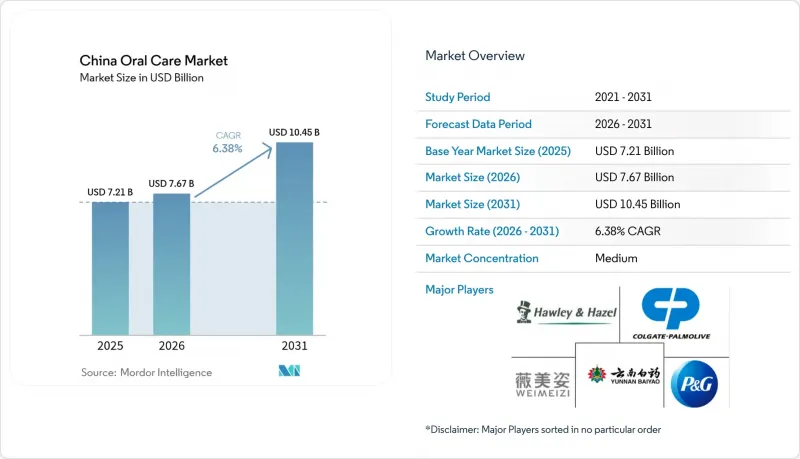
This report is Segmented by Product Type (Toothpaste, Mouthwashes and Rinses, Toothbrushes, Others), Ingredient (Conventional, Natural/Organic), End User (Kids/Children, Adult), Distribution Channel (Supermarkets/Hypermarkets, Convenience/Grocery Stores, Pharmacies and Drug Stores, Online Retail Stores, Other Channels), and Geography (China). The Market Forecasts are Provided in Terms of Value (USD).
China Oral Care Market Trends and Insights
Premiumisation Wave Led by Gen-Z Consumers
Gen-Z consumers are reshaping China's oral care landscape through their willingness to pay premium prices for products that align with their values and aesthetic preferences. This demographic shift extends beyond traditional oral hygiene to encompass skinification trends, where oral care products incorporate beauty ingredients like niacinamide and botanical extracts previously reserved for cosmetics. The premiumization wave has enabled brands to command higher margins while investing in sophisticated packaging, sustainable formulations, and personalized product offerings that resonate with digitally native consumers who research ingredients extensively before purchasing.
Government-Led Oral Health Education Campaigns (Healthy China 2030)
The Healthy China 2030 initiative has transformed oral health from an individual concern into a systematic public health priority, with government-sponsored education campaigns reaching rural populations previously underserved by preventive dental care messaging. This policy framework has established oral health metrics within broader healthcare quality indicators, incentivizing local governments to invest in community education programs and school-based preventive initiatives. The campaign's emphasis on early intervention and regular dental checkups has created sustained demand for daily oral care products, particularly in regions where traditional attitudes toward dental care were reactive rather than preventive.
Stricter Fluoride & Whitening-Agent Limits Under CSAR
Enhanced regulatory oversight under CSAR's toothpaste notification system has imposed stricter limits on fluoride concentrations and whitening agents, forcing manufacturers to reformulate products while maintaining efficacy claims. These regulatory changes reflect growing consumer safety concerns and alignment with international standards, yet create compliance costs and potential performance trade-offs that impact product positioning and pricing strategies. The fluoride limits particularly affect children's toothpaste formulations, where manufacturers must balance safety requirements with cavity prevention efficacy, while whitening agent restrictions challenge brands that built market presence on cosmetic benefits rather than therapeutic outcomes.
Other drivers and restraints analyzed in the detailed report include:
- Regulatory Shift: CSAR Toothpaste Notification Tightening Quality Standards
- Functional & Probiotic Formulations Backed by Local R&D
- Proliferation of Copy-Cat Brands Causing Price Erosion and IP Disputes
For complete list of drivers and restraints, kindly check the Table Of Contents.
Segment Analysis
Toothpaste maintains commanding market leadership with 49.42% share in 2025, yet mouthwashes and rinses are emerging as the fastest-growing segment at 6.52% CAGR through 2031, reflecting consumer adoption of comprehensive oral care routines beyond basic brushing. This diversification trend is driven by increased awareness of gum health, bad breath concerns, and the convenience of portable oral care solutions for busy urban lifestyles. Toothbrushes represent a stable but mature segment focused on electric toothbrush adoption and premium manual brush innovations, while the "Others" category encompasses emerging formats like oral care tablets, foam formulations, and specialized products for specific conditions.
The product type evolution reflects broader consumer sophistication in oral health management, with mouthwashes gaining traction as complementary products rather than occasional-use items. Lion Corporation's recent launch of Systema SP-T Mouthrinse with dual antiseptics (cetylpyridinium chloride and isopropyl methylphenol) exemplifies the scientific advancement driving category growth. Water-scarcity concerns are also spurring innovation in water-free formats, including chewable tablets and mousse formulations that appeal to environmentally conscious consumers while addressing practical usage constraints in water-stressed regions.
Conventional formulations retain overwhelming market dominance with 89.45% share in 2025, yet natural and organic variants are accelerating at 6.88% CAGR through 2031, driven by Gen-Z consumer preferences for clean-label products and sustainability concerns. This growth trajectory reflects a fundamental shift in consumer values, where ingredient transparency and environmental impact increasingly influence purchasing decisions alongside traditional efficacy considerations. The natural segment encompasses botanical extracts, mineral-based formulations, and probiotic ingredients that appeal to health-conscious consumers seeking alternatives to synthetic chemicals.
The ingredient landscape is experiencing innovation pressure from both directions, with conventional formulations incorporating more sophisticated active ingredients while natural products enhance their efficacy through advanced extraction techniques and synergistic combinations. CEELIKE's 5% hydroxyapatite toothpaste tablets demonstrate how natural mineral ingredients can deliver clinical benefits traditionally associated with synthetic compounds. The regulatory environment under CSAR's enhanced notification requirements favors manufacturers who can substantiate ingredient claims through clinical evidence, regardless of whether formulations are conventional or natural, creating opportunities for science-backed natural products while challenging unsubstantiated traditional claims.
Complete Report Scope:
- By Product Type
- Toothpaste
- Mouthwashes and Rinses
- Toothbrushes
- Others
- By Ingredient
- Conventional
- Natural/Organic
- By End User
- Kids/Children
- Adult
- By Distribution Channel
- Supermarkets / Hypermarkets
- Convenience / Grocery Stores
- Pharmacies and Drug Stores
- Online Retail Stores
- Other Channels
List of Companies Covered in this Report:
- Procter & Gamble (Crest, Oral-B)
- Colgate-Palmolive
- GlaxoSmithKline (Sensodyne)
- Lion Corporation
- Hawley & Hazel (Darlie)
- Unilever (Zhong Hua)
- Sunstar Suisse (Ora2)
- Church & Dwight (Arm & Hammer)
- Johnson & Johnson (Listerine)
- Yunnan Baiyao Group
- Guangzhou Weimeizi (Saky)
- Usmile (Simple Future Tech)
- Canban Oral Care
- White Cat (Shanghai Jahwa)
- Shanghai Maxam
- Nice Group (Blue Sky/Nice)
- Blispring
- NYSCPS
- BOP Toothpaste
- Avec Moi
Additional Benefits:
- The market estimate (ME) sheet in Excel format
- 3 months of analyst support
TABLE OF CONTENTS
1 Introduction
- 1.1 Study Assumptions and Market Definition
- 1.2 Scope of the Study
2 Research Methodology
3 Executive Summary
4 Market Landscape
- 4.1 Market Overview
- 4.2 Market Drivers
- 4.2.1 Premiumisation wave led by Gen-Z consumers
- 4.2.2 Government-led oral-health education campaigns (Healthy China 2030)
- 4.2.3 Regulatory shift: CSAR toothpaste notification tightening quality standards
- 4.2.4 Functional & probiotic formulations backed by local R&D
- 4.2.5 Water-scarcity push for water-free chewable & mousse formats
- 4.2.6 Rapid growth of cross-border social-commerce platforms boosting niche brands
- 4.3 Market Restraints
- 4.3.1 Rising raw-material costs (sorbitol, packaging resin)
- 4.3.2 Stricter fluoride & whitening-agent limits under CSAR
- 4.3.3 Growing consumer scepticism of TCM efficacy claims
- 4.3.4 Proliferation of copy-cat brands causing price erosion and IP disputes
- 4.4 Consumer Behavour Analysis
- 4.5 Regulatory Landscape
- 4.6 Technological Outlook
- 4.7 Porter's Five Forces
- 4.7.1 Threat of New Entrants
- 4.7.2 Bargaining Power of Buyers/Consumers
- 4.7.3 Bargaining Power of Suppliers
- 4.7.4 Threat of Substitute Products
- 4.7.5 Intensity of Competitive Rivalry
5 Market Size & Growth Forecasts (Value)
- 5.1 By Product Type
- 5.1.1 Toothpaste
- 5.1.2 Mouthwashes and Rinses
- 5.1.3 Toothbrushes
- 5.1.4 Others
- 5.2 By Ingredient
- 5.2.1 Conventional
- 5.2.2 Natural/Organic
- 5.3 By End User
- 5.3.1 Kids/Children
- 5.3.2 Adult
- 5.4 By Distribution Channel
- 5.4.1 Supermarkets / Hypermarkets
- 5.4.2 Convenience / Grocery Stores
- 5.4.3 Pharmacies and Drug Stores
- 5.4.4 Online Retail Stores
- 5.4.5 Other Channels
6 Competitive Landscape
- 6.1 Market Concentration
- 6.2 Strategic Moves
- 6.3 Market Share Analysis
- 6.4 Company Profiles (includes Global level Overview, Market level overview, Core Segments, Financials as available, Strategic Information, Market Rank/Share for key companies, Products & Services, and Recent Developments)
- 6.4.1 Procter & Gamble (Crest, Oral-B)
- 6.4.2 Colgate-Palmolive
- 6.4.3 GlaxoSmithKline (Sensodyne)
- 6.4.4 Lion Corporation
- 6.4.5 Hawley & Hazel (Darlie)
- 6.4.6 Unilever (Zhong Hua)
- 6.4.7 Sunstar Suisse (Ora2)
- 6.4.8 Church & Dwight (Arm & Hammer)
- 6.4.9 Johnson & Johnson (Listerine)
- 6.4.10 Yunnan Baiyao Group
- 6.4.11 Guangzhou Weimeizi (Saky)
- 6.4.12 Usmile (Simple Future Tech)
- 6.4.13 Canban Oral Care
- 6.4.14 White Cat (Shanghai Jahwa)
- 6.4.15 Shanghai Maxam
- 6.4.16 Nice Group (Blue Sky/Nice)
- 6.4.17 Blispring
- 6.4.18 NYSCPS
- 6.4.19 BOP Toothpaste
- 6.4.20 Avec Moi
7 Market Opportunities and Future Outlook

