PUBLISHER: Mordor Intelligence | PRODUCT CODE: 2097153

PUBLISHER: Mordor Intelligence | PRODUCT CODE: 2097153
Asia-Pacific Defense - Market Share Analysis, Industry Trends & Statistics, Growth Forecasts (2026 - 2031)
According to Mordor Intelligence, the Asia-Pacific defense market size is expected to grow from USD 228.74 billion in 2025 to USD 237.66 billion in 2026 and is forecasted to reach USD 287.76 billion by 2031 at a 3.9% CAGR over 2026-2031.
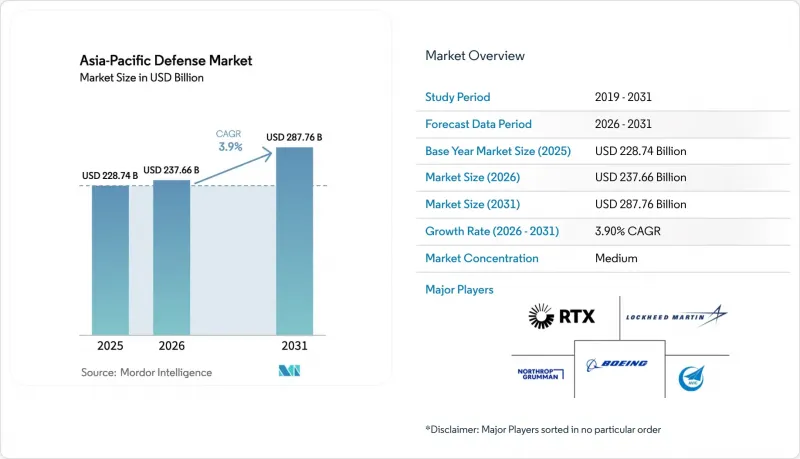
This report is Segmented by Armed Forces (Air Force, Army, and Navy), Type (Personnel Training and Protection, C4ISR and Electronic Warfare, Vehicles, Weapons and Ammunition, Unmanned Systems, and More), Domain (Land, Air, Naval, and More), and Procurement Nature (Indigenous Production and Foreign Procurement), and Geography (China, and More). The Market Forecasts are Provided in Terms of Value (USD).
Asia-Pacific Defense Market Trends and Insights
Strategic Pivot to Contested Indo-Pacific Sea Lanes
Freedom-of-navigation operations in the South China Sea and Taiwan Strait have redirected budgets from land armor to maritime strike, mine countermeasures (MCM), and anti-submarine warfare (ASW). China commissioned eight 10,000-ton coast guard cutters in 2025, blurring the lines between civilian and military roles and prompting neighbors to upgrade their frigates and offshore patrol vessels. Japan added Mogami-class frigates with vertical-launch cells, while Australia reallocated USD 7.20 billion from armored vehicles to destroyer upgrades and MH-60R helicopters. The Philippines and Vietnam accelerated the acquisition of patrol ships and the development of logistics hubs to sustain more extended deployments. A USD 9.90 billion US Pacific Deterrence Initiative for pre-positioned stocks further drives the adoption of common data links across allied navies.
Indigenous Defense-Industrialization Policies
Revised offset schemes now emphasize intellectual-property co-development over screwdriver assembly. India reserves 68% of capital spending for "Buy Indian" categories and blocks exports of co-developed platforms without local majority content, pushing Lockheed Martin and GE to transfer wing-box and engine hot-section know-how. South Korea mandates 70% local content on the KF-21, enabling the production of domestic AESA radar that halves the unit cost compared to Western alternatives. Japan relaxed export curbs on jointly built systems, positioning Mitsubishi Electric to sell air-defense radars across the region. Australia's Sovereign Guided Weapons Enterprise establishes a southern-hemisphere missile hub, while Indonesia's tank program with Turkey highlights the risk of execution when local maturity is lower.
Export-Control Squeeze on Chips and Advanced Weapons
US and allied curbs on gallium-nitride semiconductors and AI accelerators have pushed back the schedules for next-generation fighters and missiles by up to three years. India's Uttam AESA radar slipped when 7 nm RF modules were blocked at TSMC, and Japan's F-35 sustainment costs climbed 22% as spare parts awaited export licenses. Australia's Loyal Wingman drone has been equipped with commercial GPUs, accepting lower processing speeds to meet its schedule. South Korea undertook a costly indigenous IMU program after US suppliers declined to export IMUs that met ITAR specifications.
Other drivers and restraints analyzed in the detailed report include:
- Proliferation of Unmanned and Autonomous Systems
- AI-Enabled C4ISR and Decision Platforms
- Budget Pressure from Post-Pandemic Debt Loads
For complete list of drivers and restraints, kindly check the Table Of Contents.
Segment Analysis
Naval programs account for 45.23% of spending in 2025 and are growing at a 4.76% CAGR as littoral states reinforce sea-lane security and undersea cable protection. The Asia-Pacific defense market size for naval platforms is set to overtake incremental land-system budgets by 2029. Army systems remain sizable, driven by artillery upgrades along the Himalayas and South Korean armored-vehicle recapitalization, yet see only 3.68% growth. India's USD 2.80 billion Future Infantry Combat Vehicle (FICV) order and Japan's 105-strong F-35 fleet illustrate ongoing investments in both ground and air capabilities, but the strategic narrative favors blue-water denial capabilities.
The adoption of nuclear propulsion under SSN-AUKUS, Li-ion submarine batteries in South Korea, and F-35B carriers in Japan signals a shift toward distributed maritime strike. Australia's eight SSN-AUKUS boats, valued at AUD 368 billion (USD 246.14 billion), will transform regional undersea balances, while South Korea's Dosan Ahn Changho subs add vertical-launch strike options. India's Project 75I lags in offsets, yet the commissioning of the BrahMos-armed INS Imphal underscores indigenous progress. Smaller ASEAN navies are pursuing offshore patrol vessels and mobile coastal defense missiles to quickly close capability gaps.
Weapons and ammunition commanded 31.25% of the Asia-Pacific defense market share in 2025, underpinned by missile stockpiles along flashpoints. Growth moderates as export controls bite, while unmanned platforms earn the fastest 5.98% CAGR. Swarm drones, loitering munitions, and autonomous surface craft are shifting force-structure doctrine and consuming 8-12% of new capital budgets by 2028. C4ISR and electronic-warfare (EW) systems, which already account for 22% of spending, are expected to rise steadily through the use of AI-enabled sensor fusion. Space and cyber systems, though small today, receive priority as militaries seek resilient communications and spectrum dominance.
Demand for precision artillery sustains South Korea's K9 howitzer exports and India's BrahMos missile orders, yet planners increasingly pair these with AI targeting from low Earth orbit (LEO) satellites. Japan's FPS-7 radar and Australia's LAND 400 Phase 3 programs show continued sensor and vehicle refresh. At the same time, India's Ghatak UCAV and Australia's Ghost Shark UUV mark the transition from manned to autonomous strike assets.
Complete Report Scope:
- By Armed Forces
- Air Force
- Army
- Navy
- By Type
- Personnel Training and Protection
- C4ISR and Electronic Warfare (EW)
- Vehicles
- Weapons and Ammunition
- Unmanned Systems
- Space and Cyber Systems
- By Domain
- Land
- Air
- Naval
- Space
- Cyber and Electromagnetic Spectrum
- By Procurement Nature
- Indigenous Production
- Foreign Procurement
- By Geography
- China
- India
- Japan
- South Korea
- Australia
- Rest of Asia-Pacific
List of Companies Covered in this Report:
- Lockheed Martin Corporation
- The Boeing Company
- RTX Corporation
- General Dynamics Corporation
- Northrop Grumman Corporation
- L3Harris Technologies, Inc.
- BAE Systems plc
- Honeywell Aerospace Inc.
- China North Industries Group Corporation Limited
- Aviation Industry Corporation of China
- Israel Aerospace Industries Ltd.
- Elbit Systems Ltd.
- Hindustan Aeronautics Limited
- Mitsubishi Heavy Industries, Ltd.
- Korea Aerospace Industries, Ltd.
- Hanwha Corporation
- Saab AB
- Naval Group
- HENSOLDT AG
- Rostec
- Bharat Electronics Limited
- PT Len Industri (Persero)
Additional Benefits:
- The market estimate (ME) sheet in Excel format
- 3 months of analyst support
TABLE OF CONTENTS
1 INTRODUCTION
- 1.1 Study Assumptions and Market Definition
- 1.2 Scope of the Study
2 RESEARCH METHODOLOGY
3 EXECUTIVE SUMMARY
4 MARKET LANDSCAPE
- 4.1 Market Overview
- 4.2 Market Drivers
- 4.2.1 Strategic pivot to contested Indo-Pacific sea lanes
- 4.2.2 Indigenous defense-industrialization policies
- 4.2.3 Proliferation of unmanned and autonomous systems
- 4.2.4 China's force-modernization ripple effect
- 4.2.5 AI-enabled C4ISR and decision-advantage platforms
- 4.2.6 AUKUS and Quad technology-sharing initiatives
- 4.3 Market Restraints
- 4.3.1 Export-control squeeze on chips and advanced weapons
- 4.3.2 Budget pressure from post-pandemic debt loads
- 4.3.3 Fragmented offsets and localization rules
- 4.3.4 Defense-engineering/cyber-talent shortages
- 4.4 Value Chain Analysis
- 4.5 Regulatory Landscape
- 4.6 Technological Outlook
- 4.7 Porter's Five Forces Analysis
- 4.7.1 Threat of New Entrants
- 4.7.2 Bargaining Power of Buyers
- 4.7.3 Bargaining Power of Suppliers
- 4.7.4 Threat of Substitutes
- 4.7.5 Intensity of Competitive Rivalry
5 MARKET SIZE AND GROWTH FORECASTS (VALUE)
- 5.1 By Armed Forces
- 5.1.1 Air Force
- 5.1.2 Army
- 5.1.3 Navy
- 5.2 By Type
- 5.2.1 Personnel Training and Protection
- 5.2.2 C4ISR and Electronic Warfare (EW)
- 5.2.3 Vehicles
- 5.2.4 Weapons and Ammunition
- 5.2.5 Unmanned Systems
- 5.2.6 Space and Cyber Systems
- 5.3 By Domain
- 5.3.1 Land
- 5.3.2 Air
- 5.3.3 Naval
- 5.3.4 Space
- 5.3.5 Cyber and Electromagnetic Spectrum
- 5.4 By Procurement Nature
- 5.4.1 Indigenous Production
- 5.4.2 Foreign Procurement
- 5.5 By Geography
- 5.5.1 China
- 5.5.2 India
- 5.5.3 Japan
- 5.5.4 South Korea
- 5.5.5 Australia
- 5.5.6 Rest of Asia-Pacific
6 COMPETITIVE LANDSCAPE
- 6.1 Market Concentration
- 6.2 Strategic Moves
- 6.3 Market Share Analysis
- 6.4 Company Profiles (includes Global-level Overview, Market-level Overview, Core Segments, Financials, Strategic Information, Market Rank/Share, Products and Services, and Recent Developments)
- 6.4.1 Lockheed Martin Corporation
- 6.4.2 The Boeing Company
- 6.4.3 RTX Corporation
- 6.4.4 General Dynamics Corporation
- 6.4.5 Northrop Grumman Corporation
- 6.4.6 L3Harris Technologies, Inc.
- 6.4.7 BAE Systems plc
- 6.4.8 Honeywell Aerospace Inc.
- 6.4.9 China North Industries Group Corporation Limited
- 6.4.10 Aviation Industry Corporation of China
- 6.4.11 Israel Aerospace Industries Ltd.
- 6.4.12 Elbit Systems Ltd.
- 6.4.13 Hindustan Aeronautics Limited
- 6.4.14 Mitsubishi Heavy Industries, Ltd.
- 6.4.15 Korea Aerospace Industries, Ltd.
- 6.4.16 Hanwha Corporation
- 6.4.17 Saab AB
- 6.4.18 Naval Group
- 6.4.19 HENSOLDT AG
- 6.4.20 Rostec
- 6.4.21 Bharat Electronics Limited
- 6.4.22 PT Len Industri (Persero)
7 MARKET OPPORTUNITIES AND FUTURE OUTLOOK
- 7.1 White-space and Unmet-Need Assessment

