PUBLISHER: Mordor Intelligence | PRODUCT CODE: 2114561

PUBLISHER: Mordor Intelligence | PRODUCT CODE: 2114561
Middle East And Africa Defense - Market Share Analysis, Industry Trends & Statistics, Growth Forecasts (2026 - 2031)
According to Mordor Intelligence, the Middle East and Africa defense market size is expected to grow from USD 67.79 billion in 2025 to USD 73.42 billion in 2026 and is forecasted to reach USD 109.38 billion by 2031 at an 8.30% CAGR over 2026-2031.
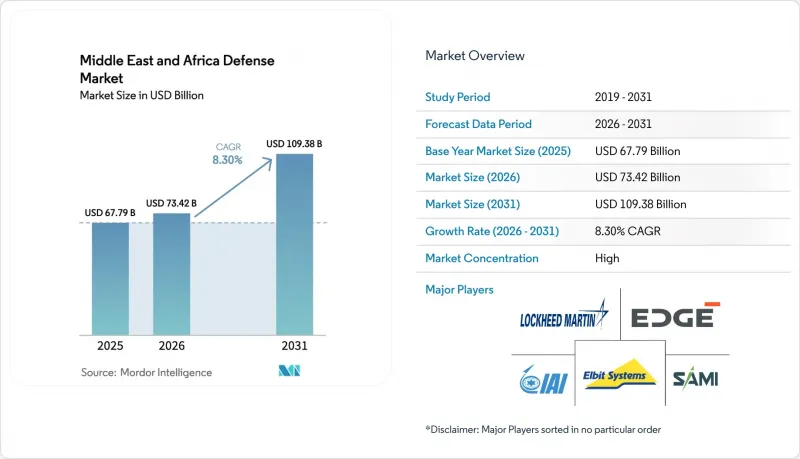
This report is Segmented by Armed Forces (Air Force, Army, and Navy), Type (Personnel Training and Protection, C4ISR and Electronic Warfare, Vehicles, Weapons and Ammunition, and More), Domain (Land, Air, Naval, Space, and More), Procurement Nature (Indigenous Production and Foreign Procurement), and Geography (Middle East and Africa). The Market Forecasts are Provided in Terms of Value (USD).
Middle East And Africa Defense Market Trends and Insights
Sustained Geopolitical Instability Driving Continuous Defense Preparedness
Persistent conflict in Yemen, Syria, and Gaza keeps regional forces on high alert, ensuring steady demand for munitions, EW upgrades, and counter-rocket systems. Israel placed a USD 210 million order with Elbit Systems in November 2025 to upgrade Merkava tanks with artificial-intelligence sights, reflecting lessons learned in recent Gaza operations. Houthi attacks on Red Sea shipping have accelerated Saudi and Egyptian naval purchases, while Sahel insurgencies spur African requirements for light armored vehicles and secure communications. Each new clash underscores the need for next-generation capabilities, insulating defense budgets from broader austerity measures and keeping the Middle East and Africa defense market on an upward trajectory.
Oil- and Gas-Backed Defense Spending Across GCC Modernization Programs
Hydrocarbon revenue continues to underwrite the majority of Gulf budgets. Riyadh's USD 142 billion framework with the US for F-15 fighters, THAAD interceptors, and maritime patrol aircraft was structured to ride out short-term oil-price volatility. Qatar added more than USD 800 million in Boeing training and sustainment contracts for its F-15QA fleet. The UAE ordered four Airbus A330 Multi-Role Tanker Transport (MRTT) aircraft in July 2024, including technology-transfer clauses that channel knowledge to local firms. Because these programs also create advanced-manufacturing jobs, they remain politically untouchable even during commodity downturns.
Exposure of Defense Budgets to Hydrocarbon Price Volatility
When Brent crude dropped below USD 40 per barrel in 2020, Riyadh deferred multiple programs and renegotiated milestone payments with US contractors. Algeria likewise trimmed 2024 procurement after natural gas revenues dipped, delaying negotiations for Su-57 fighters. Although sovereign wealth funds buffer shocks, a two-year stretch under USD 60 would still force Gulf states to shift spending from modernization toward payroll and readiness.
Other drivers and restraints analyzed in the detailed report include:
- National Defense Localization and Industrialization Mandates
- Accelerated Adoption of Unmanned, Autonomous, and Precision Strike Systems
- Export-Control Restrictions and Sanctions on Advanced Defense Subsystems
For complete list of drivers and restraints, kindly check the Table Of Contents.
Segment Analysis
Naval acquisition budgets are growing at a 9.23% CAGR, eclipsing the expansions of the air force and the army as states prioritize control of the Strait of Hormuz, the Suez Canal, and the Bab el-Mandeb. L3Harris Technologies, Inc., and SAMI signed an agreement in April 2025 with Zamil Shipyards to build modular unmanned surface vessels, a clear indicator that littoral security now drives platform roadmaps. In contrast, the army, despite accounting for 47.21% of 2025 expenditure, faces slower growth because most of its heavy-armor inventory has already been recapitalized. Ongoing upgrades to the M1A1 and Merkava emphasize digital fire-control and active-protection systems over raw tonnage. Naval spending also benefits from multinational task forces that share operational costs, enabling smaller Gulf states to field higher-end corvettes and mine-countermeasure (MCM) ships within collective frameworks. The Middle East and Africa defense market, therefore, concentrates new-build activity along coastlines while armies pivot to sustaining platforms already in service.
A second growth lever is the migration from crewed hulls to optionally manned or fully autonomous vessels. Saudi trials of unmanned surface craft signal appetite for persistent surveillance and cost-effective deterrence. Israel's Iron Beam laser program, although primarily focused on air defense, will transition to shipboard testing, reinforcing naval modernization with directed energy capabilities. Because sea lanes carry most regional trade, even brief disruptions in the Red Sea or Gulf of Aden incur outsized economic penalties, prompting defense ministries to allocate budget headroom toward hulls, sensors, and missile systems that ensure open passage.
Vehicles still accounted for 24.45% of 2025 spending, while unmanned systems are rising at an 11.54% CAGR. The Middle East and Africa defense market for unmanned platforms is projected to surpass USD 25 billion by 2031, reflecting global shifts toward lower-risk, 24/7 ISR and precision-strike capabilities. Israeli, Turkish, and Chinese producers dominate medium-altitude long-endurance (MALE) exports, while Gulf states are seeding indigenous designs to hedge against export-license risks. Parallel investment in counter-UAS suites, such as Elbit's ReDrone system, ensures that every new offensive capability spurs equal demand for defense.
C4ISR and EW budgets are also rising as militaries integrate sensors, edge computing, and artificial intelligence. Because network-centric doctrines require resilient data links, spending on hardened communications and passive detection gear increases in lockstep. Ammunition remains a volume business, driven by attrition warfare in Yemen and Gaza, yet stocks are shifting toward smart artillery and guided rockets. Emerging subcategories, including space and cyber tools, combine for a modest base today but carry steep growth curves, particularly as satellite data becomes central to targeting.
Complete Report Scope:
- By Armed Forces
- Air Force
- Army
- Navy
- By Type
- Personnel Training and Protection
- C4ISR and Electronic Warfare (EW)
- Vehicles
- Weapons and Ammunition
- Unmanned Systems
- Space and Cyber Systems
- By Domain
- Land
- Air
- Naval
- Space
- Cyber and Electromagnetic Spectrum
- By Procurement Nature
- Indigenous Production
- Foreign Procurement
- By Geography
- Middle East
- United Arab Emirates
- Saudi Arabia
- Qatar
- Israel
- Kuwait
- Rest of Middle East
- Africa
- South Africa
- Egypt
- Algeria
- Rest of Africa
- Middle East
List of Companies Covered in this Report:
- Lockheed Martin Corporation
- The Boeing Company
- EDGE Group PJSC
- Saudi Arabian Military Industries
- Israel Aerospace Industries Ltd.
- BAE Systems plc
- Rafael Advanced Defense Systems Ltd.
- Elbit Systems Ltd.
- RTX Corporation
- Rheinmetall AG
- ASELSAN A.S.
- BAYKAR MAKINA SANAYI VE TICARET A.S.
- Northrop Grumman Corporation
- Leonardo S.p.A.
- General Dynamics Corporation
- Airbus SE
- FNSS Savunma Sistemleri A.S.
- Oshkosh Defense LLC
- Rostec
- Thales Group
Additional Benefits:
- The market estimate (ME) sheet in Excel format
- 3 months of analyst support
TABLE OF CONTENTS
1 INTRODUCTION
- 1.1 Study Assumptions and Market Definition
- 1.2 Scope of the Study
2 RESEARCH METHODOLOGY
3 EXECUTIVE SUMMARY
4 MARKET LANDSCAPE
- 4.1 Market Overview
- 4.2 Market Drivers
- 4.2.1 Sustained geopolitical instability driving continuous defense preparedness
- 4.2.2 Oil- and gas-backed defense spending across GCC modernization programs
- 4.2.3 National defense localization and industrialization mandates
- 4.2.4 Accelerated adoption of unmanned, autonomous, and precision-strike systems
- 4.2.5 Sovereign wealth fund-led defense investment and export financing into Africa
- 4.2.6 Emergence of regional space-based ISR capabilities
- 4.3 Market Restraints
- 4.3.1 Exposure of defense budgets to hydrocarbon price volatility
- 4.3.2 Export-control restrictions and sanctions on advanced defense subsystems
- 4.3.3 Rising ESG-related constraints on defense-sector financing
- 4.3.4 Shortages of skilled labor and secure electronics supply chains
- 4.4 Value Chain Analysis
- 4.5 Regulatory Landscape
- 4.6 Technological Outlook
- 4.7 Porter's Five Forces Analysis
- 4.7.1 Bargaining Power of Buyers
- 4.7.2 Bargaining Power of Suppliers
- 4.7.3 Threat of New Entrants
- 4.7.4 Threat of Substitutes
- 4.7.5 Intensity of Competitive Rivalry
5 MARKET SIZE AND GROWTH FORECASTS (VALUE)
- 5.1 By Armed Forces
- 5.1.1 Air Force
- 5.1.2 Army
- 5.1.3 Navy
- 5.2 By Type
- 5.2.1 Personnel Training and Protection
- 5.2.2 C4ISR and Electronic Warfare (EW)
- 5.2.3 Vehicles
- 5.2.4 Weapons and Ammunition
- 5.2.5 Unmanned Systems
- 5.2.6 Space and Cyber Systems
- 5.3 By Domain
- 5.3.1 Land
- 5.3.2 Air
- 5.3.3 Naval
- 5.3.4 Space
- 5.3.5 Cyber and Electromagnetic Spectrum
- 5.4 By Procurement Nature
- 5.4.1 Indigenous Production
- 5.4.2 Foreign Procurement
- 5.5 By Geography
- 5.5.1 Middle East
- 5.5.1.1 United Arab Emirates
- 5.5.1.2 Saudi Arabia
- 5.5.1.3 Qatar
- 5.5.1.4 Israel
- 5.5.1.5 Kuwait
- 5.5.1.6 Rest of Middle East
- 5.5.2 Africa
- 5.5.2.1 South Africa
- 5.5.2.2 Egypt
- 5.5.2.3 Algeria
- 5.5.2.4 Rest of Africa
- 5.5.1 Middle East
6 COMPETITIVE LANDSCAPE
- 6.1 Market Concentration
- 6.2 Strategic Moves
- 6.3 Market Share Analysis
- 6.4 Company Profiles (includes Global level Overview, Market level overview, Core Segments, Financials as available, Strategic Information, Market Rank/Share for key companies, Products and Services, and Recent Developments)
- 6.4.1 Lockheed Martin Corporation
- 6.4.2 The Boeing Company
- 6.4.3 EDGE Group PJSC
- 6.4.4 Saudi Arabian Military Industries
- 6.4.5 Israel Aerospace Industries Ltd.
- 6.4.6 BAE Systems plc
- 6.4.7 Rafael Advanced Defense Systems Ltd.
- 6.4.8 Elbit Systems Ltd.
- 6.4.9 RTX Corporation
- 6.4.10 Rheinmetall AG
- 6.4.11 ASELSAN A.S.
- 6.4.12 BAYKAR MAKINA SANAYI VE TICARET A.S.
- 6.4.13 Northrop Grumman Corporation
- 6.4.14 Leonardo S.p.A.
- 6.4.15 General Dynamics Corporation
- 6.4.16 Airbus SE
- 6.4.17 FNSS Savunma Sistemleri A.S.
- 6.4.18 Oshkosh Defense LLC
- 6.4.19 Rostec
- 6.4.20 Thales Group
7 MARKET OPPORTUNITIES AND FUTURE OUTLOOK
- 7.1 White-space and Unmet-need Assessment

