PUBLISHER: Mordor Intelligence | PRODUCT CODE: 2115204

PUBLISHER: Mordor Intelligence | PRODUCT CODE: 2115204
Southeast Asia Defense - Market Share Analysis, Industry Trends & Statistics, Growth Forecasts (2026 - 2031)
According to Mordor Intelligence, the Southeast Asia defense market size is expected to grow from USD 17.16 billion in 2025 to USD 18.42 billion in 2026 and is forecasted to reach USD 23.02 billion by 2031 at a 4.56% CAGR over 2026-2031.
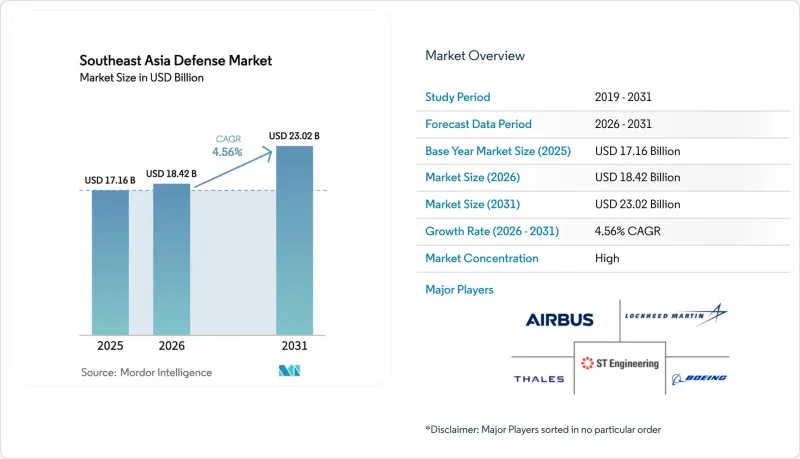
This report is Segmented by Armed Forces (Air Force, Army, Navy, and Space Force), Type (Personnel Training and Protection, C4ISR and Electronic Warfare, Vehicles, and More), Domain (Land, Air, Naval, Space, and More), Procurement Nature (Indigenous Production and Foreign Procurement), and Geography (Indonesia, Singapore, Thailand, and More). The Market Forecasts are Provided in Terms of Value (USD).
Southeast Asia Defense Market Trends and Insights
Escalating Territorial Disputes in the South China Sea
China's expanded coast-guard patrols have reduced the procurement cycle from a decade to just 18 months as frontline states prioritize missiles, maritime-patrol UAVs, and multi-role fighters that impose cost without escalating to open conflict. The Philippine Coast Guard recorded 187 Chinese interference episodes in 2024, a 34% increase over 2023, prompting Manila to fast-track the acquisition of BrahMos shore batteries and Hermes 900 UAVs. Vietnam discreetly expanded its Kilo-class submarine inventory, while Indonesia accelerated the delivery of 42 Rafale fighters to patrol the Natuna Sea. Budget reallocations are shifting money away from legacy armor toward ISR, anti-access, and long-range strike capabilities, anchoring the Southeast Asia defense market to those that deter gray-zone incursions. Consequently, procurement dialogue now begins with sensor fusion, precision engagement, and interoperability, relegating traditional platform counts to secondary status.
Modernization of ASEAN Defense Budgets
Defense allocations across ASEAN increased by 7.5% to USD 54.9 billion in 2024, outpacing global growth and signaling a sustained political commitment despite macroeconomic and fiscal headwinds. Indonesia alone spends USD 20.3 billion annually under its Minimum Essential Force blueprint, which aims to procure 8 submarines, 12 frigates, and 144 fighters by 2029. Singapore, with the region's highest per-capita defense bill, is integrating F-35Bs, Aster 30 missiles, and autonomous surface craft into a seamless multi-layer shield. Thailand is repurposing a flat THB 227 billion (USD 6.5 billion) budget toward network-enabled artillery and counter-drone systems. At the same time, the Philippines has enacted a 5% R&D reinvestment clause to prime its budding defense industrial base. These moves underscore how modernization now straddles capability ambition and economic multiplier, hardwiring domestic-industry incentives into every significant order.
Fiscal Pressures Constraining Defense Outlays
Tourism-led revenue softness kept Thailand's 2025 budget flat at THB 227 billion (USD 7.31 billion), forcing the army to postpone a second VT-4 tank tranche and suspend submarine talks with China. Malaysia's MYR 9 billion (USD 2.31 billion) Littoral Combat Ship program is five years late after corruption probes froze payments, leaving only four operational frigates to cover a 4,675 km coastline. The Philippines missed 2025 disbursement targets by 18% as debt service swallowed 9.3% of GDP, stretching BrahMos payments across three fiscal years. Indonesia's plan assumes 5% annual growth, but 2025 allocations rose just 3.2%, nudging frigate and tank projects into the 2027-2029 window. These funding squeezes are trimming near-term procurement appetites and could shave almost 1 percentage point off the Southeast Asia defense market's five-year growth trajectory.
Other drivers and restraints analyzed in the detailed report include:
- Shift Toward Network-Centric Warfare and C4ISR Procurement
- Rising Counterterrorism and Maritime Security Needs
- Dependence on Foreign Technology and Related Delays
For complete list of drivers and restraints, kindly check the Table Of Contents.
Segment Analysis
The Air Force segment is expected to grow at a 5.29% CAGR, driven by the rapid procurement of multi-role fighters, maritime patrol aircraft, and integrated air defense networks. Singapore's eight-unit F-35B package, Indonesia's 42 Rafales, and Malaysia's FA-50s collectively represent more than USD 8 billion in near-term obligations, a testament to the primacy of the air domain. In contrast, the Army held 48.87% of 2025 spending, but heavy-armor programs are plateauing as capitals favor network-enabled, quick-reaction vehicles such as Strykers and MRAPs. The Navy's roughly 28% share is protected by submarine and frigate pipelines that now include local workshare provisions.
Growth momentum in the Air Force lineage is anchored in contested-airspace scenarios over the South China Sea, driving demand for AESA radars, beyond-visual-range missiles, and Link 16 connectivity. Thailand is negotiating for six additional Gripen E fighters that can integrate into Saab-led C2 networks, while the Philippines is weighing the Gripen E against the F-16V for a 12-jet requirement with a focus on anti-ship strike capabilities. The Southeast Asia defense market size for Air Force assets is projected to reach USD 9.1 billion by 2031, marking a significant increase that will further shift regional power balances.
In 2025, vehicles accounted for 42.87% of the expenditure. However, with slowing armor refresh cycles and a shift toward lighter protected mobility, growth is expected to level off. Unmanned systems, by contrast, will expand at a 6.22% CAGR, becoming the standout gainer inside the Southeast Asia defense market. Twelve Hermes 900s for the Philippines, six Anka-S UAVs for Malaysia, and the upcoming Elang Hitam production run in Indonesia demonstrate how governments are embracing drones to patrol vast maritime zones without risking their crews.
C4ISR and EW allocations now account for 18% of spending and are expected to increase as joint-force data fusion becomes standard practice. Weapons and ammunition hover at 15% but will escalate once the Philippines and Vietnam lock in surface-to-surface missile options. Personnel Training and Protection account for around 8%, yet immersive simulation suites linked to remote-learning nodes could unlock new demand. Space and cyber systems remain embryonic but are increasingly bundled into network-centric bids, ensuring they claim a growing slice of the Southeast Asia defense market over the long run.
Complete Report Scope:
- By Armed Forces
- Air Force
- Army
- Navy
- Space Force
- By Type
- Personnel Training and Protection
- C4ISR and Electronic Warfare (EW)
- Vehicles
- Weapons and Ammunition
- Unmanned Systems
- Space and Cyber Systems
- By Domain
- Land
- Air
- Naval
- Space
- Cyber and Electromagnetic Spectrum
- By Procurement Nature
- Indigenous Production
- Foreign Procurement
- By Geography
- Indonesia
- Singapore
- Thailand
- Malaysia
- Vietnam
- Philippines
- Rest of Southeast Asia
List of Companies Covered in this Report:
- Lockheed Martin Corporation
- Airbus SE
- The Boeing Company
- THALES Group
- Leonardo S.p.A.
- Saab AB
- Singapore Technologies Engineering Ltd.
- Elbit Systems Ltd.
- Israel Aerospace Industries Ltd.
- Russian State Corporation Rostec
- Hanwha Corporation
- PT Pindad (Persero)
- Korea Aerospace Industries, Ltd.
- MBDA
- Naval Group
- Bharat Electronics Ltd.
Additional Benefits:
- The market estimate (ME) sheet in Excel format
- 3 months of analyst support
TABLE OF CONTENTS
1 INTRODUCTION
- 1.1 Study Assumptions and Market Definition
- 1.2 Scope of the Study
2 RESEARCH METHODOLOGY
3 EXECUTIVE SUMMARY
4 MARKET LANDSCAPE
- 4.1 Market Overview
- 4.2 Market Drivers
- 4.2.1 Escalating territorial disputes in the South China Sea
- 4.2.2 Modernization of ASEAN defense budgets
- 4.2.3 Shift toward network-centric warfare and C4ISR procurement
- 4.2.4 Rising counterterrorism and maritime security needs
- 4.2.5 Incentives for indigenous defence-industrial capabilities
- 4.2.6 Regional joint-procurement and interoperability initiatives
- 4.3 Market Restraints
- 4.3.1 Fiscal pressures constraining defense outlays
- 4.3.2 Dependence on foreign technology and related delays
- 4.3.3 US-China strategic hedging slowing major programs
- 4.3.4 Supply-chain vulnerability for critical components
- 4.4 Value Chain Analysis
- 4.5 Regulatory Landscape
- 4.6 Technological Outlook
- 4.7 Porter's Five Forces Analysis
- 4.7.1 Threat of New Entrants
- 4.7.2 Bargaining Power of Buyers/Consumers
- 4.7.3 Bargaining Power of Suppliers
- 4.7.4 Threat of Substitute Products
- 4.7.5 Intensity of Competitive Rivalry
5 MARKET SIZE AND GROWTH FORECASTS (VALUE)
- 5.1 By Armed Forces
- 5.1.1 Air Force
- 5.1.2 Army
- 5.1.3 Navy
- 5.1.4 Space Force
- 5.2 By Type
- 5.2.1 Personnel Training and Protection
- 5.2.2 C4ISR and Electronic Warfare (EW)
- 5.2.3 Vehicles
- 5.2.4 Weapons and Ammunition
- 5.2.5 Unmanned Systems
- 5.2.6 Space and Cyber Systems
- 5.3 By Domain
- 5.3.1 Land
- 5.3.2 Air
- 5.3.3 Naval
- 5.3.4 Space
- 5.3.5 Cyber and Electromagnetic Spectrum
- 5.4 By Procurement Nature
- 5.4.1 Indigenous Production
- 5.4.2 Foreign Procurement
- 5.5 By Geography
- 5.5.1 Indonesia
- 5.5.2 Singapore
- 5.5.3 Thailand
- 5.5.4 Malaysia
- 5.5.5 Vietnam
- 5.5.6 Philippines
- 5.5.7 Rest of Southeast Asia
6 COMPETITIVE LANDSCAPE
- 6.1 Market Concentration
- 6.2 Strategic Moves
- 6.3 Market Share Analysis
- 6.4 Company Profiles (includes Global level Overview, Market level overview, Core Segments, Financials as available, Strategic Information, Market Rank/Share for key companies, Products and Services, and Recent Developments)
- 6.4.1 Lockheed Martin Corporation
- 6.4.2 Airbus SE
- 6.4.3 The Boeing Company
- 6.4.4 THALES Group
- 6.4.5 Leonardo S.p.A.
- 6.4.6 Saab AB
- 6.4.7 Singapore Technologies Engineering Ltd.
- 6.4.8 Elbit Systems Ltd.
- 6.4.9 Israel Aerospace Industries Ltd.
- 6.4.10 Russian State Corporation Rostec
- 6.4.11 Hanwha Corporation
- 6.4.12 PT Pindad (Persero)
- 6.4.13 Korea Aerospace Industries, Ltd.
- 6.4.14 MBDA
- 6.4.15 Naval Group
- 6.4.16 Bharat Electronics Ltd.
7 MARKET OPPORTUNITIES AND FUTURE OUTLOOK
- 7.1 White-space and Unmet-Need Assessment

