PUBLISHER: Mordor Intelligence | PRODUCT CODE: 2097190

PUBLISHER: Mordor Intelligence | PRODUCT CODE: 2097190
Asia-Pacific Medium and Large Caliber Ammunition - Market Share Analysis, Industry Trends & Statistics, Growth Forecasts (2026 - 2031)
According to Mordor Intelligence, the Asia-Pacific medium and large caliber ammunition market size is expected to grow from USD 1.82 billion in 2025 to USD 1.92 billion in 2026 and is forecasted to reach USD 2.47 billion by 2031 at a 5.16% CAGR over 2026-2031.
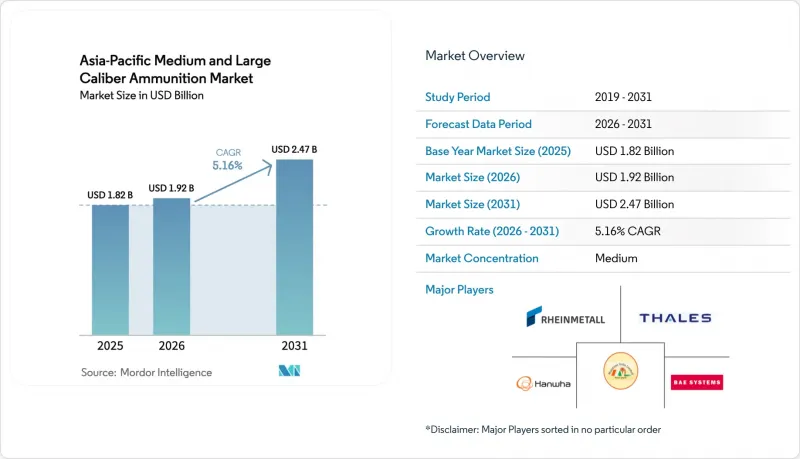
This report is Segmented by Caliber (Medium Caliber and Large Caliber), Product (Rounds, Artillery Shells and Mortars, and Aerial Bombs and Grenades), Guidance (Guided and Unguided), End-User (Military and Law Enforcement), Platform (Land, Naval, and Airborne), and Geography (China, Japan, India, South Korea, and More). The Market Forecasts are Provided in Terms of Value (USD).
Asia-Pacific Medium and Large Caliber Ammunition Market Trends and Insights
2026+ Re-Armament Cycles Across Indo-Pacific Defence Forces
Tokyo's record USD 58 billion fiscal-2025 defense budget includes ammunition purchases equivalent to the combined total of the previous three years. This scale compels suppliers to secure copper and propellant contracts two years in advance to mitigate spot-market volatility. Taiwan's USD 11.1 billion FMS letter incorporates surge clauses that allow for quarterly call-offs, which enhance flexibility but complicate production scheduling for US prime contractors. South Korea increased its 155mm war-reserve target by 125,000 rounds for 2025, converting Poongsan's optional capacity expansion into committed throughput. The Philippines, an early-cycle participant, introduced 40% local-content requirements for ATMOS howitzer ammunition, prompting Israeli prime Elbit to collaborate with the government-owned Government Arsenal for filling operations. Across these nations, procurement activity is concentrated in 2026-2028, driving overtime shifts and forging-press utilization above 95% capacity. Post-2028, replenishment declines, but sustainment orders maintain baseline activity. This multi-year visibility supports a stable 1.2-point increase in the CAGR of the Asia-Pacific medium and large caliber ammunition market.
Surge in Indigenous Production and Export Hubs
India's Munitions India Limited (MIL) operates six hot-strip rolling lines for 155mm shell bodies and introduced automated ultrasonic flaw detection in 2025, resulting in a 30% reduction in rejection rates. Kalyani's NATO-grade exports demonstrated compliance with rigorous STANAG 4110 lot-acceptance standards, leading Poland to submit a follow-up inquiry for 25,000 rounds. South Korea's Poongsan doubled brass-case production and vertically integrated extrusion press maintenance to minimize downtime, a strategic response to elevated LME copper volatility. Australia's Thales-operated Benalla plant secured green power from a nearby solar farm, mitigating carbon-pricing penalties and reinforcing Canberra's industrial-sovereignty objectives. Collectively, these hubs reduce shipping times and ITAR-related risks, contributing a 1-point structural gain to the growth trajectory of the Asia-Pacific medium and large caliber ammunition market.
Tight ITAR-Like Export Controls Within Quad and EU
Australian project officers report an average wait of 270 days for US export licenses for forging dies used in 155mm shell production, necessitating interim reliance on legacy tooling. Taiwan's dependence on FMS has delayed shell deliveries, prompting discussions with India and South Korea for alternative supply chains. Japan eased its export regulations in 2025 but remains constrained by the ITAR for US-origin guidance kits, which delays the co-production of Excalibur rounds by at least 12 months. These export control challenges collectively reduce near-term CAGR by 0.4 points but simultaneously drive indigenous investments that offset the impact in the long term.
Other drivers and restraints analyzed in the detailed report include:
- Rapid Naval Modernisation Driving 76-127mm and 155mm Rounds
- AI-Enabled Fire-Control Systems Unlock Demand for "Smart" Shells
- Persistent Copper/Brass Cost Inflation
For complete list of drivers and restraints, kindly check the Table Of Contents.
Segment Analysis
Large caliber rounds accounted for 46.77% of 2025 revenue and are projected to grow at a 6.55% CAGR, potentially reaching parity with medium caliber by 2030. For instance, India's ATAGS and Dhanush howitzers consume approximately 70,000 155mm shells annually during training, with guided upgrades significantly increasing the value per round. Additionally, Australia's plan to deploy 75 M1A2 SEPv3 tanks necessitates an annual demand of around 18,000 120mm rounds, which were previously imported but will soon be produced domestically. This shift highlights the growing importance of local production capabilities in meeting the increasing demand for heavy-caliber ammunition.
Medium-caliber ammunition, ranging from 20mm to 57mm, supports infantry fighting vehicles, attack helicopters, and CIWS mounts. In 2025, the Directorate of Ordnance (Coordination & Services) supplied 2 million rounds of 30mm ammunition for the BMP-2 fleet, accounting for 12% of its annual ammunition revenue. However, the growing importance of networked fires and guided kits is driving the value of large-caliber ammunition, underscoring that future revenue splits will prioritize lethality over sheer volume in the Asia-Pacific medium- and large-caliber ammunition market. The shift toward guided and networked systems underscores the evolving nature of modern warfare and its impact on ammunition demand.
Artillery shells and mortars accounted for 38.95% of total sales in 2025, with the Asia-Pacific medium and large caliber ammunition market for this category expected to grow steadily as military doctrines emphasize sustained fires. South Korea exported 800,000 155mm shells tied to K9 packages in 2025, demonstrating a production capacity capable of scaling up to meet NATO replenishment orders. This steady growth in artillery shells and mortars reflects the increasing reliance on sustained firepower in modern military strategies, particularly in regions with heightened geopolitical tensions.
Aerial bombs and grenades, though smaller in scale, are projected to achieve the fastest growth at a 6.04% CAGR. Taiwan's deployment of 40mm programmable grenades at forward island garrisons highlights how niche counter-UAV requirements can evolve into significant procurement volumes. Additionally, India's adoption of Rheinmetall's AHEAD fuze in 35mm rounds establishes a recurring aftermarket for canister reloads, demonstrating how technology transfer fosters supplier dependency. Recoilless rifle ammunition, such as Saab's Carl Gustaf 84mm rounds delivered to Australia, further diversifies revenue streams and provides a flexible procurement option unaffected by artillery barrel life cycles. These developments underscore the increasing significance of technological advancements and diversified product offerings in shaping the Asia-Pacific medium and large caliber ammunition market.
Complete Report Scope:
- By Caliber
- Medium Caliber
- Large Caliber
- By Product
- Rounds
- Artillery Shells and Mortars
- Aerial Bombs and Grenades
- By Guidance
- Guided
- Unguided
- By End-User
- Military
- Law Enforcement
- By Platform
- Land
- Naval
- Airborne
- By Geography
- China
- Japan
- India
- South Korea
- Australia
- Rest of Asia-Pacific
List of Companies Covered in this Report:
- Munitions India Limited
- Kalyani Strategic Systems Ltd. (Bharat Forge Limited)
- Poongsan Co., Ltd.
- Rheinmetall Denel Munition (Pty) Ltd. (Rheinmetall AG)
- Saab AB
- Rostec
- Bharat Electronics Ltd.
- Hanwha Corporation
- Singapore Technologies Engineering Ltd.
- General Dynamics Corporation
- KNDS N.V.
- Directorate of Ordnance (Coordination & Services)
- Thales Group
- Nammo AS
- BAE Systems plc
Additional Benefits:
- The market estimate (ME) sheet in Excel format
- 3 months of analyst support
TABLE OF CONTENTS
1 INTRODUCTION
- 1.1 Study Assumptions and Market Definition
- 1.2 Scope of the Study
2 RESEARCH METHODOLOGY
3 EXECUTIVE SUMMARY
4 MARKET LANDSCAPE
- 4.1 Market Overview
- 4.2 Market Drivers
- 4.2.1 2026+ rearmament cycles across Indo-Pacific defense forces
- 4.2.2 Surge in indigenous production and export hubs
- 4.2.3 Rapid naval modernization driving 76-127mm and 155mm naval rounds
- 4.2.4 AI-enabled fire-control systems unlock demand for "Smart" shells
- 4.2.5 Stockpile replenishment after Ukraine conflict lessons
- 4.2.6 Niche requirement for counter-UAV air-burst ammunition
- 4.3 Market Restraints
- 4.3.1 Tight ITAR-like export controls within Quad and EU
- 4.3.2 Persistent copper/brass cost inflation
- 4.3.3 Emerging directed-energy alternatives
- 4.3.4 Environmental push for lead-free formulations
- 4.4 Value Chain Analysis
- 4.5 Regulatory Landscape
- 4.6 Technological Outlook
- 4.7 Porter's Five Forces Analysis
- 4.7.1 Bargaining Power of Buyers
- 4.7.2 Bargaining Power of Suppliers
- 4.7.3 Threat of New Entrants
- 4.7.4 Threat of Substitutes
- 4.7.5 Competitive Rivalry
5 MARKET SIZE AND GROWTH FORECASTS (VALUE)
- 5.1 By Caliber
- 5.1.1 Medium Caliber
- 5.1.2 Large Caliber
- 5.2 By Product
- 5.2.1 Rounds
- 5.2.2 Artillery Shells and Mortars
- 5.2.3 Aerial Bombs and Grenades
- 5.3 By Guidance
- 5.3.1 Guided
- 5.3.2 Unguided
- 5.4 By End-User
- 5.4.1 Military
- 5.4.2 Law Enforcement
- 5.5 By Platform
- 5.5.1 Land
- 5.5.2 Naval
- 5.5.3 Airborne
- 5.6 By Geography
- 5.6.1 China
- 5.6.2 Japan
- 5.6.3 India
- 5.6.4 South Korea
- 5.6.5 Australia
- 5.6.6 Rest of Asia-Pacific
6 COMPETITIVE LANDSCAPE
- 6.1 Market Concentration
- 6.2 Strategic Moves
- 6.3 Market Share Analysis
- 6.4 Company Profiles (includes Global level Overview, Market level overview, Core Segments, Financials as available, Strategic Information, Market Rank/Share for key companies, Products and Services, and Recent Developments)
- 6.4.1 Munitions India Limited
- 6.4.2 Kalyani Strategic Systems Ltd. (Bharat Forge Limited)
- 6.4.3 Poongsan Co., Ltd.
- 6.4.4 Rheinmetall Denel Munition (Pty) Ltd. (Rheinmetall AG)
- 6.4.5 Saab AB
- 6.4.6 Rostec
- 6.4.7 Bharat Electronics Ltd.
- 6.4.8 Hanwha Corporation
- 6.4.9 Singapore Technologies Engineering Ltd.
- 6.4.10 General Dynamics Corporation
- 6.4.11 KNDS N.V.
- 6.4.12 Directorate of Ordnance (Coordination & Services)
- 6.4.13 Thales Group
- 6.4.14 Nammo AS
- 6.4.15 BAE Systems plc
7 MARKET OPPORTUNITIES AND FUTURE OUTLOOK
- 7.1 White-space and Unmet-Need Assessment

