PUBLISHER: Mordor Intelligence | PRODUCT CODE: 2097193

PUBLISHER: Mordor Intelligence | PRODUCT CODE: 2097193
North America Hydropower - Market Share Analysis, Industry Trends & Statistics, Growth Forecasts (2026 - 2031)
According to Mordor Intelligence, the North America hydropower market size was valued at 199.91 gigawatt in 2025 and estimated to grow from 201.78 gigawatt in 2026 to reach 211.32 gigawatt by 2031, at a CAGR of 0.93% during the forecast period (2026-2031).
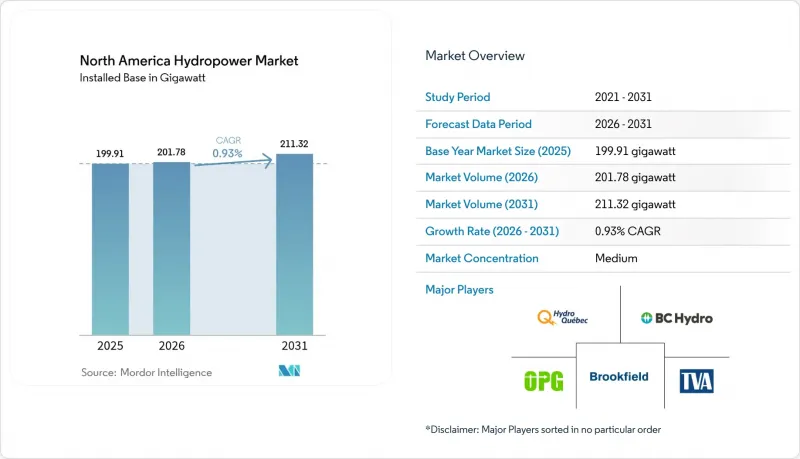
This report is Segmented by Capacity (Large Hydro, Medium Hydro, and Small and Micro Hydro), Technology (Reservoir-Based, Run-Of-River, Pumped-Storage, and In-Stream and Micro-Conduit), End-User (Utilities, Independent Power Producers, and Industrial and Captive), and Geography (United States, Canada, and Mexico). The Market Size and Forecasts are Provided in Terms of Installed Capacity (GW).
North America Hydropower Market Trends and Insights
Modernization Funding via U.S. BIL & IRA Incentives
Federal law released USD 430 million in 2024 strictly for hydro refurbishments, with 30% investment tax credits covering qualified mechanical and digital upgrades. Owners are redirecting capex from new dams to higher-efficiency runners, generator rewinds, and dam-safety retrofits that extend useful life by 30 years. Domestic-content provisions embedded in the legislation spur local turbine manufacturing, reducing supply-chain exposure to overseas vendors. These rules also raise component prices, requiring utilities to sharpen project-level returns through advanced performance analytics. The funding pipeline, therefore, underwrites the near-term momentum of the North America hydropower market, especially at legacy multipurpose sites that anchor regional grid reliability.
Canada-to-U.S. Clean-Power Import Contracts
Long-term power purchase agreements now funnel 1,200 MW of Quebec hydro to Massachusetts via the New England Clean Energy Connect line, locking in 20 years of predictable cash flows. Seasonal flow surpluses north of the border dovetail with winter demand peaks in New England, enhancing grid adequacy without additional U.S. reservoir buildout. The contracts justify further upstream watershed projects in Quebec while slashing fossil peaker dispatch in New England. They also underpin bilateral investments in transmission corridors that strengthen continental trading depth across the North America hydropower market.
Multi-Year FERC Licensing Timelines & Litigation Risk
New projects averaged 7.2 years in the federal queue during 2024, while 40% of filings faced court challenges that stretched approvals by another two to three years. The uncertainty inflates interest during construction costs and complicates revenue modeling for investors. Pumped-storage proposals are disproportionately affected because environmental assessments must address both water reuse and site alterations. Developers therefore pivot toward brownfield upgrades, diverting fresh megawatt ambitions away from the North America hydropower market's greenfield space.
Other drivers and restraints analyzed in the detailed report include:
- PSH Surge to Balance Growing Wind & Solar
- Digital-Twin Retrofits Lifting Plant Efficiency
- Aging Civil Infrastructure Above 50 Years
For complete list of drivers and restraints, kindly check the Table Of Contents.
Segment Analysis
Installations above 100 MW delivered the bulk of continental output and captured 85.60% of the North America hydropower market share in 2025. These assets benefit most from federal modernization dollars, as one percentage-point efficiency gain yields gigawatt-hour scale dividends. Variable-speed runners, generator rewinds, and digital twins combine to lift annual energy production without reservoir expansion, aligning with stringent environmental norms. Medium plants between 10-100 MW provide sub-regional reliability, often tied to industrial off-takers that value 24/7 baseload. Revenue stacking from capacity, energy, and ancillary services buttresses refurbishment economics, anchoring their steady, although slower, growth trajectory.
Small and micro facilities below 10 MW headline the growth narrative at a 3.28% CAGR to 2031, aided by expedited FERC review and state-level feed-in tariffs. Conversions of non-powered dams supply shovel-ready sites complete with civil works, slashing payback periods. Modular equipment packages manufactured domestically now reach 92% average efficiency, rivaling larger units. Rural cooperatives and municipal utilities adopt these distributed plants to hedge against transmission congestion and wildfire-related outages. Such decentralization pushes the North America hydropower market toward a more diversified asset mix, mitigating single-point failure risks across the grid.
Complete Report Scope:
- By Capacity
- Large Hydro (Above 100 MW)
- Medium Hydro (10 to 100 MW)
- Small and Micro Hydro (Below 10 MW)
- By Technology
- Reservoir-Based
- Run-of-River
- Pumped-Storage
- In-Stream and Micro-conduit
- By Component (Qualitative Analysis only)
- Turbines
- Generators
- Control and Automation
- Balance-of-Plant
- By End-User
- Utilities (State and Public)
- Independent Power Producers
- Industrial and Captive
- By Country
- United States
- Canada
- Mexico
List of Companies Covered in this Report:
- Hydro-Quebec
- Ontario Power Generation
- Tennessee Valley Authority
- BC Hydro
- Duke Energy
- Brookfield Renewable Partners
- Andritz AG
- GE Vernova (ex-GE Renewable Energy)
- Voith Hydro
- Toshiba Energy Systems
- SNC-Lavalin / AtkinsRealis
- Alstom Hydro Canada
- FirstLight Power
- Innergex Renewable Energy
- Pattern Energy
- Georgia Power
- Absaroka Energy
- American Municipal Power
- Voith Siemens Hydro Canada
- Mavel Americas
Additional Benefits:
- The market estimate (ME) sheet in Excel format
- 3 months of analyst support
TABLE OF CONTENTS
1 Introduction
- 1.1 Study Assumptions & Market Definition
- 1.2 Scope of the Study
2 Research Methodology
3 Executive Summary
4 Market Landscape
- 4.1 Market Overview
- 4.2 Market Drivers
- 4.2.1 Modernization funding via U.S. BIL & IRA incentives
- 4.2.2 Canada-to-U.S. clean-power import contracts
- 4.2.3 PSH surge to balance growing wind & solar
- 4.2.4 Digital twin retrofits lifting plant efficiency
- 4.2.5 Non-powered-dam retrofit pipeline unlocking >10 GW
- 4.2.6 Western drought resiliency megaproject spending
- 4.3 Market Restraints
- 4.3.1 Multi-year FERC licensing timelines & litigation risk
- 4.3.2 Aging civil infrastructure >50 yrs
- 4.3.3 Competing tribal & fisheries water-rights claims
- 4.3.4 Supply-chain crunch for large turbines >300 MW
- 4.4 Supply-Chain Analysis
- 4.5 Regulatory Landscape
- 4.6 Technological Outlook
- 4.7 Porter's Five Forces
- 4.7.1 Bargaining Power of Suppliers
- 4.7.2 Bargaining Power of Consumers
- 4.7.3 Threat of New Entrants
- 4.7.4 Threat of Substitutes
- 4.7.5 Competitive Rivalry
5 Market Size & Growth Forecasts
- 5.1 By Capacity
- 5.1.1 Large Hydro (Above 100 MW)
- 5.1.2 Medium Hydro (10 to 100 MW)
- 5.1.3 Small and Micro Hydro (Below 10 MW)
- 5.2 By Technology
- 5.2.1 Reservoir-Based
- 5.2.2 Run-of-River
- 5.2.3 Pumped-Storage
- 5.2.4 In-Stream and Micro-conduit
- 5.3 By Component (Qualitative Analysis only)
- 5.3.1 Turbines
- 5.3.2 Generators
- 5.3.3 Control and Automation
- 5.3.4 Balance-of-Plant
- 5.4 By End-User
- 5.4.1 Utilities (State and Public)
- 5.4.2 Independent Power Producers
- 5.4.3 Industrial and Captive
- 5.5 By Country
- 5.5.1 United States
- 5.5.2 Canada
- 5.5.3 Mexico
6 Competitive Landscape
- 6.1 Market Concentration
- 6.2 Strategic Moves (M&A, Partnerships, PPAs)
- 6.3 Market Share Analysis (Market Rank/Share for key companies)
- 6.4 Company Profiles (includes Global level Overview, Market level overview, Core Segments, Financials as available, Strategic Information, Products & Services, and Recent Developments)
- 6.4.1 Hydro-Quebec
- 6.4.2 Ontario Power Generation
- 6.4.3 Tennessee Valley Authority
- 6.4.4 BC Hydro
- 6.4.5 Duke Energy
- 6.4.6 Brookfield Renewable Partners
- 6.4.7 Andritz AG
- 6.4.8 GE Vernova (ex-GE Renewable Energy)
- 6.4.9 Voith Hydro
- 6.4.10 Toshiba Energy Systems
- 6.4.11 SNC-Lavalin / AtkinsRealis
- 6.4.12 Alstom Hydro Canada
- 6.4.13 FirstLight Power
- 6.4.14 Innergex Renewable Energy
- 6.4.15 Pattern Energy
- 6.4.16 Georgia Power
- 6.4.17 Absaroka Energy
- 6.4.18 American Municipal Power
- 6.4.19 Voith Siemens Hydro Canada
- 6.4.20 Mavel Americas
7 Market Opportunities & Future Outlook
- 7.1 White-Space & Unmet-Need Assessment

