PUBLISHER: Mordor Intelligence | PRODUCT CODE: 2100546

PUBLISHER: Mordor Intelligence | PRODUCT CODE: 2100546
Hydropower - Market Share Analysis, Industry Trends & Statistics, Growth Forecasts (2026 - 2031)
According to Mordor Intelligence, hydropower market size in 2026 is estimated at 1.5 terawatt, growing from 2025 value of 1.47 terawatt with 2031 projections showing 1.67 terawatt, growing at 2.19% CAGR over 2026-2031.
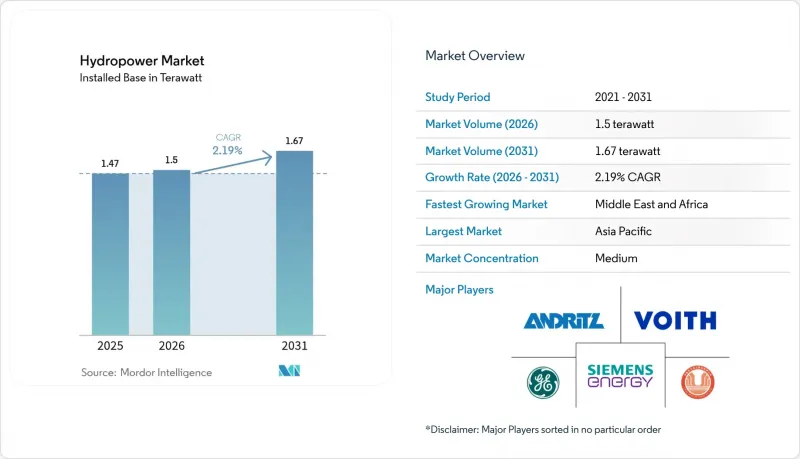
This report is Segmented by Capacity (Large Hydro, Medium Hydro, and Small and Micro Hydro), Technology (Reservoir-Based, Run-Of-River, Pumped-Storage, and In-Stream and Micro-Conduit), End-User (Utilities, Independent Power Producers, and Industrial and Captive), and Geography (North America, Europe, Asia Pacific, and More). The Market Sizes and Forecasts are Provided in Terms of Installed Capacity (GW).
Global Hydropower Market Trends and Insights
Surge in Pumped-Storage Retrofits of Ageing Dams
Retrofit programs are upgrading conventional dams with reversible pump-turbines, cutting capital outlays by up to 60% relative to greenfield storage projects and doubling response speeds for grid balancing. European utilities lead deployments as variable renewables exceed 50% of peak load, while North American operators target reservoirs inside transmission-constrained valleys to defer new peaker plants. The 880 MW Cruachan expansion demonstrates how modernized units start in six minutes, a feature system operators increasingly monetize through ancillary-service markets. Digital twin platforms allow planners to model water, turbine fatigue, and market prices in real time, turning legacy infrastructure into flexible storage hubs that extend asset lives beyond 2050.
Declining Levelized Cost Versus Gas-Peaking Plants
Existing hydropower plants run below USD 50/MWh, while gas-peaking facilities exceed USD 80/MWh in fuel-driven price spikes, widening the cost gap each quarter. Carbon pricing mechanisms further penalize gas, and hydropower's zero-fuel profile generates bonus revenues through emissions-free certificates. Capacity-factor superiority keeps hydropower dispatchable for twice as many hours per year as gas peakers, and operators can stack frequency-regulation payments on top of energy sales. Utilities in the Midcontinent Independent System Operator cleared 3.2 GW of hydropower upgrades in 2025 interconnection queues, reversing a decade-long gas-peaking build-out trend.
Escalating Social-Licence Risk & Indigenous Opposition
Project delays average three years when developers fail to secure free, prior, and informed consent from affected communities. High-profile cancellations such as the Kaliwa dam underscore reputational danger, and insurers now exclude social-licence disputes from standard policies. Developers allocate up to 25% of capital budgets for benefit-sharing, while lenders demand detailed human-rights risk assessments. Investors foresee a tilt toward community-scale run-of-river schemes that bypass contested territories and minimize resettlement challenges.
Other drivers and restraints analyzed in the detailed report include:
- Climate-Resilience Mandates Strengthening Baseload Renewables
- Grid-Forming Inverter Integration Enabling Hybrid Hydro-Solar Plants
- Long Permitting Lead-Times in OECD Markets
For complete list of drivers and restraints, kindly check the Table Of Contents.
Segment Analysis
Small and micro facilities below 10 MW captured 9.20% of annual installs in 2025 and are forecast to expand more than any other class through 2031 as utilities and mini-grid developers pursue decentralized electrification. Meanwhile, stations above 100 MW still dominate absolute totals, holding 72.85% of the hydropower market share in 2025. Asset owners in this tier concentrate on turbine-efficiency upgrades that lift water-to-wire yields by 3-5 percentage points and extend lifespans to 80 years.
Easier installation logistics push small hydro developers to bundle equipment in containerized kits, cutting civil works costs and widening viable head ranges. Machine-learning-enabled digital twins predict cavitation and adjust wicket-gate angles to reduce fatigue by 99%. Large dams now compete in ancillary-service auctions rather than energy-only markets, and rising pumped-storage retrofits mean many high-head plants will operate more like batteries than base-load generators by 2031. Medium-sized (10-100 MW) projects bridge these strategies, balancing economies of scale against lower social-licence hurdles.
Complete Report Scope:
- By Capacity
- Large Hydro (Above 100 MW)
- Medium Hydro (10 to 100 MW)
- Small and Micro Hydro (Below 10 MW)
- By Technology
- Reservoir-Based
- Run-of-River
- Pumped-Storage
- In-Stream and Micro-conduit
- By Component (Qualitative Analysis only)
- Turbines
- Generators
- Control and Automation
- Balance-of-Plant
- By End-User
- Utilities (State and Public)
- Independent Power Producers
- Industrial and Captive
- By Geography
- North America
- United States
- Canada
- Mexico
- Europe
- Russia
- Norway
- Turkey
- France
- Italy
- Spain
- Switzerland
- Sweden
- Austria
- Rest of Europe
- Asia Pacific
- China
- India
- Japan
- Pakistan
- Laos
- Rest of Asia-Pacific
- South America
- Brazil
- Argentina
- Colombia
- Venezuela
- Rest of South America
- Middle East and Africa
- Iran
- Ethiopia
- Angola
- South Africa
- Rest of Middle East and Africa
- North America
Geography Analysis
Asia Pacific keeps setting the pace for hydropower. The region controlled 45.60% of global capacity in 2025, thanks largely to China's USD 137 billion Tibet mega-dam, the biggest single hydropower project ever attempted. Total regional capacity reached 519 GW last year as China pushed ahead with high-elevation schemes and India added dozens of small plants that bring reliable power to rural districts while cutting ecological footprints. Japan is pouring money into overhauling its aging dams, swapping out turbines and layering in digital controls that push equipment lifetimes well past the usual 50-year mark. Countries such as Laos and Pakistan are building dams aimed at exporting power to neighbors, turning water into a traded regional commodity. Because so much of the world's hydropower manufacturing know-how sits in the Asia-Pacific, developers everywhere benefit from faster lead times and lower costs.
The Middle East and Africa might be small today, just 2 GW of new capacity came online in 2024, but it is the fastest-growing pocket of the market, on track for a 6.95% CAGR through 2031. Big-ticket ventures like the USD 5 billion Batoka Gorge project and Ethiopia's Grand Ethiopian Renaissance Dam show how hydropower is being used to power factories and knit together regional grids. Angola and South Africa are modernizing existing plants to squeeze out extra megawatts while they line up funding for new ones. Even oil majors are taking notice: TotalEnergies recently bought Scatec's African hydropower portfolio, a clear signal that the money is shifting toward renewables. Development banks are backing many of these efforts, viewing dams as critical for both electrification and climate resilience.
North America and Europe are further along the curve. Most of their best river sites are already dammed, so the focus has turned to squeezing more output from what's there. The United States expects hydropower production to bounce back in 2025 as reservoirs recover from drought, while new federal rules aim to speed up license amendments for upgrades. Canada's clean-energy push is sending ever more hydro-generated electrons south of the border. In Europe, Norway is courting investors to turn surplus water power into green hydrogen for export. South America sits somewhere in the middle: Brazil is refurbishing big plants such as Sao Simao even as climate-driven droughts make long-term output harder to plan. Across the continent, governments are trying to balance the undeniable benefits of cheap, steady hydropower with the mounting challenges of changing rainfall patterns.
- GE Renewable Energy
- Siemens Energy AG
- Andritz AG
- Voith GmbH & Co. KGaA
- China Yangtze Power Co. Ltd
- PJSC RusHydro
- EDF SA
- Iberdrola SA
- Power Construction Corp of China
- Alstom Hydro China
- Toshiba Energy Systems
- Harbin Electric Corporation
- BC Hydro
- Statkraft AS
- Engie SA
- Kansai Electric Power
- Hydro-Quebec
- Voith Hydro (India)
- Andritz Hydro (Germany)
- Duke Energy Corp
Additional Benefits:
- The market estimate (ME) sheet in Excel format
- 3 months of analyst support
TABLE OF CONTENTS
1 Introduction
- 1.1 Study Assumptions & Market Definition
- 1.2 Scope of the Study
2 Research Methodology
3 Executive Summary
4 Market Landscape
- 4.1 Market Overview
- 4.2 Market Drivers
- 4.2.1 Surge in pumped-storage retrofits of ageing dams
- 4.2.2 Declining levelized cost versus gas-peaking plants
- 4.2.3 Climate-resilience mandates strengthening baseload renewables
- 4.2.4 Grid-forming inverter integration enabling hybrid hydro-solar plants
- 4.2.5 Corporate 24/7 clean-power procurement for data-centre clusters
- 4.3 Market Restraints
- 4.3.1 Escalating social licence risk & indigenous opposition
- 4.3.2 Long permitting lead-times in OECD markets
- 4.3.3 Sedimentation-induced capacity loss in tropical basins
- 4.3.4 Rising insurance premiums for extreme-weather dam failures
- 4.4 Supply-Chain Analysis
- 4.5 Regulatory Landscape
- 4.6 Technological Outlook
- 4.7 Porter's Five Forces
- 4.7.1 Bargaining Power of Suppliers
- 4.7.2 Bargaining Power of Buyers
- 4.7.3 Threat of New Entrants
- 4.7.4 Threat of Substitutes
- 4.7.5 Competitive Rivalry
5 Market Size & Growth Forecasts
- 5.1 By Capacity
- 5.1.1 Large Hydro (Above 100 MW)
- 5.1.2 Medium Hydro (10 to 100 MW)
- 5.1.3 Small and Micro Hydro (Below 10 MW)
- 5.2 By Technology
- 5.2.1 Reservoir-Based
- 5.2.2 Run-of-River
- 5.2.3 Pumped-Storage
- 5.2.4 In-Stream and Micro-conduit
- 5.3 By Component (Qualitative Analysis only)
- 5.3.1 Turbines
- 5.3.2 Generators
- 5.3.3 Control and Automation
- 5.3.4 Balance-of-Plant
- 5.4 By End-User
- 5.4.1 Utilities (State and Public)
- 5.4.2 Independent Power Producers
- 5.4.3 Industrial and Captive
- 5.5 By Geography
- 5.5.1 North America
- 5.5.1.1 United States
- 5.5.1.2 Canada
- 5.5.1.3 Mexico
- 5.5.2 Europe
- 5.5.2.1 Russia
- 5.5.2.2 Norway
- 5.5.2.3 Turkey
- 5.5.2.4 France
- 5.5.2.5 Italy
- 5.5.2.6 Spain
- 5.5.2.7 Switzerland
- 5.5.2.8 Sweden
- 5.5.2.9 Austria
- 5.5.2.10 Rest of Europe
- 5.5.3 Asia Pacific
- 5.5.3.1 China
- 5.5.3.2 India
- 5.5.3.3 Japan
- 5.5.3.4 Pakistan
- 5.5.3.5 Laos
- 5.5.3.6 Rest of Asia-Pacific
- 5.5.4 South America
- 5.5.4.1 Brazil
- 5.5.4.2 Argentina
- 5.5.4.3 Colombia
- 5.5.4.4 Venezuela
- 5.5.4.5 Rest of South America
- 5.5.5 Middle East and Africa
- 5.5.5.1 Iran
- 5.5.5.2 Ethiopia
- 5.5.5.3 Angola
- 5.5.5.4 South Africa
- 5.5.5.5 Rest of Middle East and Africa
- 5.5.1 North America
6 Competitive Landscape
- 6.1 Market Concentration
- 6.2 Strategic Moves (M&A, Partnerships, PPAs)
- 6.3 Market Share Analysis (Market Rank/Share for key companies)
- 6.4 Company Profiles (includes Global level Overview, Market level overview, Core Segments, Financials as available, Strategic Information, Products & Services, and Recent Developments)
- 6.4.1 GE Renewable Energy
- 6.4.2 Siemens Energy AG
- 6.4.3 Andritz AG
- 6.4.4 Voith GmbH & Co. KGaA
- 6.4.5 China Yangtze Power Co. Ltd
- 6.4.6 PJSC RusHydro
- 6.4.7 EDF SA
- 6.4.8 Iberdrola SA
- 6.4.9 Power Construction Corp of China
- 6.4.10 Alstom Hydro China
- 6.4.11 Toshiba Energy Systems
- 6.4.12 Harbin Electric Corporation
- 6.4.13 BC Hydro
- 6.4.14 Statkraft AS
- 6.4.15 Engie SA
- 6.4.16 Kansai Electric Power
- 6.4.17 Hydro-Quebec
- 6.4.18 Voith Hydro (India)
- 6.4.19 Andritz Hydro (Germany)
- 6.4.20 Duke Energy Corp
7 Market Opportunities & Future Outlook
- 7.1 White-space & Unmet-need Assessment

