PUBLISHER: Mordor Intelligence | PRODUCT CODE: 2097222

PUBLISHER: Mordor Intelligence | PRODUCT CODE: 2097222
United Kingdom Nuclear Imaging - Market Share Analysis, Industry Trends & Statistics, Growth Forecasts (2026 - 2031)
According to Mordor Intelligence, the UK nuclear imaging market size was valued at USD 389.65 million in 2025 and estimated to grow from USD 417.98 million in 2026 to reach USD 593.47 million by 2031, at a CAGR of 7.27% during the forecast period (2026-2031).
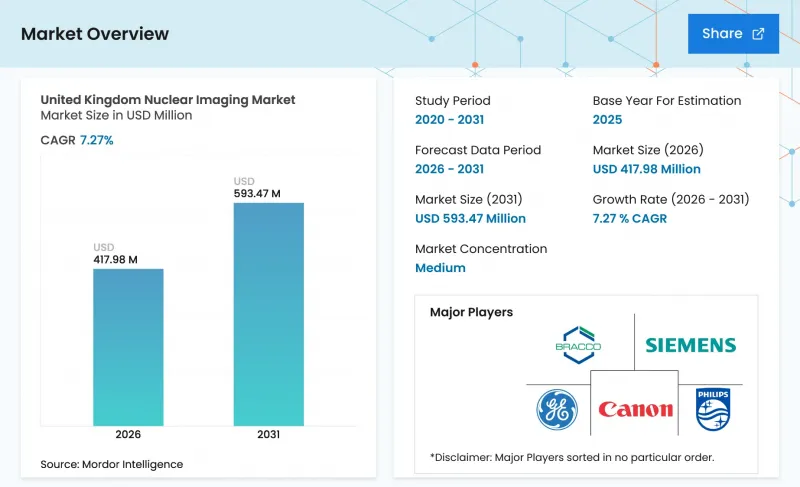
This report is Segmented by Product (Equipment - PET/CT Scanners, SPECT/CT Scanners, PET/MRI Scanners; Radioisotopes - SPECT and PET Radioisotopes), Application (Cardiology, Neurology, Thyroid, Oncology, Other Applications), End User (Hospitals, Diagnostic Imaging Centres, Academic & Research Institutes), and Geography (UK). The Market Forecasts are Provided in Terms of Value (USD).
United Kingdom Nuclear Imaging Market Trends and Insights
Rising Cancer Prevalence and PET-CT Adoption
Cancer diagnoses continue to climb, with 66,000 incidental cases recorded in the past year, representing one in five total diagnoses. Only 58.2% of patients received treatment within the 62-day referral-to-treatment window, well below the 85% target. NHS England responded by allocating GBP 70 million for radiotherapy equipment upgrades and launching the EDITH AI breast-cancer trial involving 700,000 women across 30 sites. Diagnostic waiting lists have swelled to 1.66 million, with nearly 500,000 patients awaiting CT or MRI, prompting wider adoption of nuclear medicine alternatives. Alliance Medical now delivers more than 50% of UK PET-CT scans through 46 static centers and 64 mobile scanners.
NHS Early-Diagnosis Funding Boosts Imaging Capacity
The National Cancer Plan prioritizes earlier detection, channeling GBP 130 million toward radiotherapy modernization that will replace 69 Linear Accelerators over three years. In November 2024, a total-body PET scanner was installed at St Thomas' Hospital, achieving scan times below five minutes and feeding data into the National PET Imaging Platform. Siemens Healthineers has structured more than 30 Value Partnerships with NHS trusts to finance equipment and optimize workflows.
High Upfront Cost of Scanners & Cyclotron Facilities
The GBP 130 million Radiotherapy Modernisation Fund illustrates the scale of capital outlays confronting NHS trusts, with individual linear accelerators costing several million pounds. Siemens Healthineers' GBP 250 million MRI factory in Oxford highlights the high expense of domestic manufacturing investments. Project Arthur's GBP 400 million price tag represents the upper bound of infrastructure spending required for sovereign isotope production. Although NHS Supply Chain saved GBP 17.1 million through group purchasing, smaller trusts still struggle to finance state-of-the-art equipment without vendor partnerships.
Other drivers and restraints analyzed in the detailed report include:
- Rapid Detector Advances (Digital CZT, SiPM)
- Pipeline of Novel PET/SPECT Radiotracers & Theranostics
- Workforce Shortage of Nuclear-Medicine Technologists
For complete list of drivers and restraints, kindly check the Table Of Contents.
Segment Analysis
Radioisotopes captured 61.62% of UK nuclear imaging market share in 2025, while the segment is forecast to grow at a 9.42% CAGR through 2031. The UK nuclear imaging market size for radioisotopes is on track to rise markedly as Project Arthur and private fusion initiatives bring local supply online. Technetium-99m shortages underscore dependency risks, prompting accelerated investment in PET and SPECT isotope manufacturing. Alliance Medical operates five radiopharmacies and distribution centers to stabilize supply, whereas equipment growth remains constrained by funding cycles. Nevertheless, King's College London's ultra-sensitive PET installation signals sustained demand for advanced scanners.
Limited capital budgets cause hospitals to stagger equipment upgrades, but the shift to digital detectors and combined PET/MRI systems will steadily lift the equipment sub-segment over the forecast. Cyclotron rollouts at major academic sites, coupled with MHRA approvals of tracers such as piflufolastat, will broaden local isotope portfolios and further enlarge the UK nuclear imaging market .
Complete Report Scope:
- By Product (Value)
- Equipment
- PET/CT Scanners
- SPECT/CT Scanners
- PET/MRI Scanners
- Radioisotopes
- SPECT Radioisotopes
- Technetium-99m (Tc-99m)
- Thallium-201 (Tl-201)
- Gallium-67 (Ga-67)
- Iodine-123 (I-123)
- Other SPECT Isotopes
- PET Radioisotopes
- Fluorine-18 (F-18)
- Rubidium-82 (Rb-82)
- Other PET Isotopes
- SPECT Radioisotopes
- Equipment
- By Application (Value)
- Cardiology
- Neurology
- Thyroid
- Oncology
- Other Applications
- By End User (Value)
- Hospitals
- Diagnostic Imaging Centres
- Academic & Research Institutes
List of Companies Covered in this Report:
- GE Healthcare
- Siemens Healthineers
- Canon
- Koninklijke Philips
- Curium Pharma
- Cardinal Health
- Bracco Imaging S.p.A.
- Telix Pharmaceuticals Ltd.
- Alliance Medical (Life Healthcare Group)
- Advanced Accelerator Applications S.A. (Novartis)
- Blue Earth Diagnostics Ltd.
- Eckert & Ziegler AG
- Theragnostics Ltd.
Additional Benefits:
- The market estimate (ME) sheet in Excel format
- 3 months of analyst support
TABLE OF CONTENTS
1 Introduction
- 1.1 Study Assumptions & Market Definition
- 1.2 Scope of the Study
2 Research Methodology
3 Executive Summary
4 Market Landscape
- 4.1 Market Overview
- 4.2 Market Drivers
- 4.2.1 Rising cancer prevalence and PET-CT adoption
- 4.2.2 NHS early-diagnosis funding boosts imaging capacity
- 4.2.3 Rapid detector advances (digital CZT, SiPM)
- 4.2.4 Pipeline of novel PET/SPECT radiotracers & theranostics
- 4.2.5 Sovereign radioisotope-production initiatives post-Brexit
- 4.2.6 Integrated NHS Imaging Networks sharing scanner loads
- 4.3 Market Restraints
- 4.3.1 High upfront cost of scanners & cyclotron facilities
- 4.3.2 Complex UK reimbursement for new radiopharmaceuticals
- 4.3.3 Workforce shortage of nuclear-medicine technologists
- 4.3.4 UK vulnerability to global Mo-99 supply disruptions
- 4.4 Value / Supply-Chain Analysis
- 4.5 Regulatory Landscape
- 4.6 Technological Outlook
- 4.7 Porter's Five Forces
- 4.7.1 Bargaining Power of Suppliers
- 4.7.2 Bargaining Power of Buyers
- 4.7.3 Threat of New Entrants
- 4.7.4 Threat of Substitutes
- 4.7.5 Competitive Rivalry
5 Market Size & Growth Forecasts (Value)
- 5.1 By Product (Value)
- 5.1.1 Equipment
- 5.1.1.1 PET/CT Scanners
- 5.1.1.2 SPECT/CT Scanners
- 5.1.1.3 PET/MRI Scanners
- 5.1.2 Radioisotopes
- 5.1.2.1 SPECT Radioisotopes
- 5.1.2.1.1 Technetium-99m (Tc-99m)
- 5.1.2.1.2 Thallium-201 (Tl-201)
- 5.1.2.1.3 Gallium-67 (Ga-67)
- 5.1.2.1.4 Iodine-123 (I-123)
- 5.1.2.1.5 Other SPECT Isotopes
- 5.1.2.2 PET Radioisotopes
- 5.1.2.2.1 Fluorine-18 (F-18)
- 5.1.2.2.2 Rubidium-82 (Rb-82)
- 5.1.2.2.3 Other PET Isotopes
- 5.1.2.1 SPECT Radioisotopes
- 5.1.1 Equipment
- 5.2 By Application (Value)
- 5.2.1 Cardiology
- 5.2.2 Neurology
- 5.2.3 Thyroid
- 5.2.4 Oncology
- 5.2.5 Other Applications
- 5.3 By End User (Value)
- 5.3.1 Hospitals
- 5.3.2 Diagnostic Imaging Centres
- 5.3.3 Academic & Research Institutes
6 Competitive Landscape
- 6.1 Market Concentration
- 6.2 Market Share Analysis
- 6.3 Company Profiles (includes Global level Overview, Market level overview, Core Segments, Financials as available, Strategic Information, Market Rank/Share for key companies, Products & Services, and Recent Developments)
- 6.3.1 GE HealthCare
- 6.3.2 Siemens Healthineers
- 6.3.3 Canon Medical Systems Corporation
- 6.3.4 Koninklijke Philips N.V.
- 6.3.5 Curium Pharma
- 6.3.6 Cardinal Health Inc.
- 6.3.7 Bracco Imaging S.p.A.
- 6.3.8 Telix Pharmaceuticals Ltd.
- 6.3.9 Alliance Medical (Life Healthcare Group)
- 6.3.10 Advanced Accelerator Applications S.A. (Novartis)
- 6.3.11 Blue Earth Diagnostics Ltd.
- 6.3.12 Eckert & Ziegler AG
- 6.3.13 Theragnostics Ltd.
7 Market Opportunities & Future Outlook
- 7.1 White-space & Unmet-Need Assessment

