PUBLISHER: Mordor Intelligence | PRODUCT CODE: 2123108

PUBLISHER: Mordor Intelligence | PRODUCT CODE: 2123108
China Nuclear Imaging - Market Share Analysis, Industry Trends & Statistics, Growth Forecasts (2026 - 2031)
According to Mordor Intelligence, the China nuclear imaging market size is expected to grow from USD 547.71 million in 2025 to USD 598.21 million in 2026 and is forecast to reach USD 929.74 million by 2031 at 9.22% CAGR over 2026-2031.
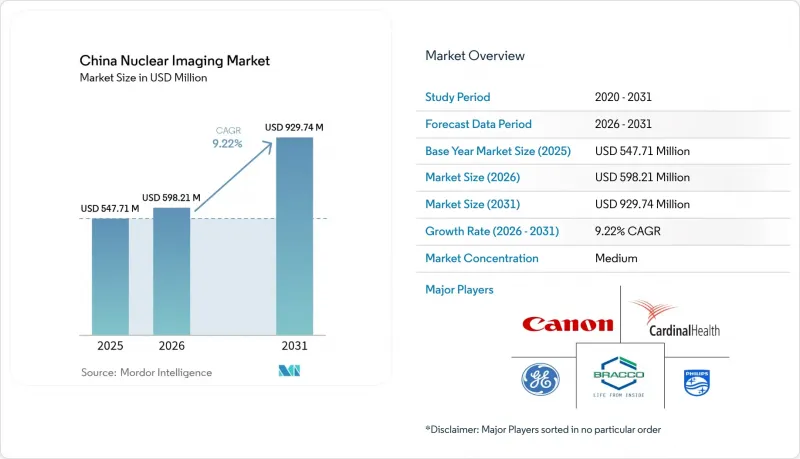
This report is Segmented by Product (Equipment and Radio-Isotope [SPECT Radio-Isotopes and PET Radio-Isotopes]), Application (Cardiology, Neurology, Thyroid, Oncology, and Other Applications), and End User (Hospitals, Diagnostic Imaging Centres, and Academic & Research Institutes). Market Forecasts are Provided in Terms of Value (USD).
China Nuclear Imaging Market Trends and Insights
Increasing Oncology and Cardiology Disease Burden
China registered 4.82 million new cancer cases and 2.57 million deaths in 2022, reshaping demand for the China nuclear imaging market. Lung cancer alone contributed 1.06 million diagnoses, ensuring sustained PET/CT utilization for thoracic oncology. A 2024 trial showed that the nectin-4 tracer [68Ga]Ga-N188 matched 18F-FDG sensitivity while improving specificity for triple-negative breast cancer, signaling the diversification of tracers. Cardiology imaging remains nascent, yet autopsy data indicating 68.2% latent coronary disease in HFpEF patients position SPECT and PET perfusion protocols for growth. Clinical guidelines that endorse SPECT myocardial perfusion imaging as a first-line diagnosis, plus the emergence of 68Ga-FAPI for cardiac fibrosis, add incremental volume. Combined, these disease trends are expected to lift annual nuclear medicine exam penetration above the 0.28% baseline recorded in 2024.
National Healthcare Reform and Policy Support
The December 2024 Circular No. 53 cut clinical-trial review windows to 30 days in pilot provinces and shifted reimbursement assessment toward cost-effectiveness. As a result, NMPA approvals for radiopharmaceuticals rose from ≈30 agents in 2022 to >40 by 2025. Fast-track licensing for Class IV user facilities also eased hospital entry barriers, although only 65 institutions held these permits in 2025. The Mid- and Long-Term Development Plan for Medical Isotopes (2021-2035) mandates nuclear medicine departments across all 2,749 Class 3 hospitals plus 2,000 additional sites, effectively doubling the addressable footprint for the China nuclear imaging market. While fragmented, reimbursement now accommodates cost-utility metrics, encouraging provinces to pilot coverage for expensive modalities such as total-body PET.
High Capital Expenditure and Reimbursement Constraints
Total-body PET units cost RMB 70-100 million (USD 9.8-14 million), roughly triple the cost of conventional PET/CT, straining hospital capex cycles when provincial reimbursement lists still price scans at RMB 6,000-9,000. Volume-based purchasing further squeezed 18F-FDG tariffs by 33% between 2022 and 2024, stretching equipment payback to eight-plus years. Catastrophic out-of-pocket ceilings of RMB 400,000-450,000 discourage multi-cycle 177Lu therapies, muting consumable pull-through. Independent imaging centers navigate multi-agency licensing that may take 18 months, delaying revenue realization and trimming the CAGR of the China nuclear imaging market by 1.4 percentage points.
Other drivers and restraints analyzed in the detailed report include:
- Demographic Aging and Rising Healthcare Expenditure
- Expansion of Domestic Radioisotope Production Capacity
- Logistical Challenges of Short-Half-Life Isotopes
For complete list of drivers and restraints, kindly check the Table Of Contents.
Segment Analysis
Equipment generated 64.23% of the China nuclear imaging market share in 2025, buoyed by ≈20 total-body PET installations and photon-counting CT launches. However, radioisotopes are on track for an 11.54% CAGR through 2031 as Qinshan's Lu-177 and future Mo-99 reactors underpin supply. Consequently, the China nuclear imaging market size for consumables is expected to surpass equipment sales by 2029. Competitive dynamics favor state-owned CNNC and growing private players that secure long-term supply contracts with academic centers.
The projected shift toward a consumables-driven model supports recurring revenue streams, stabilizing profitability despite price compression in scanners. Y-90 glass microsphere rollouts and Ac-225 partnerships add high-margin therapy isotopes that deepen the moat for early movers. United Imaging's strategy now pairs hardware with tracer-agnostic service bundles, a logical hedge as the China nuclear imaging market transitions to isotope-led growth.
Complete Report Scope:
- By Product
- Equipment
- Radio-isotope
- SPECT Radio-isotopes
- Technetium-99m (TC-99m)
- Thallium-201 (TI-201)
- Gallium (Ga-67)
- Iodine (I-123)
- Other SPECT Radioisotopes
- PET Radio-isotopes
- Fluorine-18 (F-18)
- Rubidium-82 (RB-82)
- Other PET Radioisotopes
- SPECT Radio-isotopes
- By Application
- Cardiology
- Neurology
- Thyroid
- Oncology
- Other Applications
- By End User
- Hospitals
- Diagnostic Imaging Centres
- Academic & Research Institutes
List of Companies Covered in this Report:
- Advanced Accelerator Applications
- Canon
- China Isotope & Radiation Corporation
- China National Nuclear Corporation
- Curium Pharma
- Eckert & Ziegler Strahlen
- GE Healthcare
- Jiangsu Atom High Tech
- Jubilant Group
- Mindray Bio-Medical Electronics
- Neusoft Medical Systems
- Koninklijke Philips
- Positron
- Shanghai YZ Radiopharma
- Shenzhen Anke High-Tech
- Siemens Healthineers
- United Imaging Healthcare
Additional Benefits:
- The market estimate (ME) sheet in Excel format
- 3 months of analyst support
TABLE OF CONTENTS
1 Introduction
- 1.1 Study Assumptions & Market Definition
- 1.2 Scope of the Study
2 Research Methodology
3 Executive Summary
4 Market Landscape
- 4.1 Market Overview
- 4.2 Market Drivers
- 4.2.1 Increasing Oncology and Cardiology Disease Burden
- 4.2.2 National Healthcare Reform and Policy Support
- 4.2.3 Demographic Aging and Rising Healthcare Expenditure
- 4.2.4 Expansion of Domestic Radioisotope Production Capacity
- 4.2.5 Technological Advancements in Nuclear Imaging Modalities
- 4.2.6 Export-Oriented Government Incentives for Radiopharmaceuticals
- 4.3 Market Restraints
- 4.3.1 High Capital Expenditure and Reimbursement Constraints
- 4.3.2 Logistical Challenges of Short-Half-Life Isotopes
- 4.3.3 Regulatory Bottlenecks for Cyclotron Commissioning
- 4.3.4 Shortage of Skilled Nuclear Medicine Workforce
- 4.4 Value / Supply-Chain Analysis
- 4.5 Regulatory Landscape
- 4.6 Technological Outlook
- 4.7 Porter's Five Forces Analysis
- 4.7.1 Threat of New Entrants
- 4.7.2 Bargaining Power of Buyers
- 4.7.3 Bargaining Power of Suppliers
- 4.7.4 Threat of Substitutes
- 4.7.5 Industry Rivalry
5 Market Size & Growth Forecasts (Value, USD)
- 5.1 By Product
- 5.1.1 Equipment
- 5.1.2 Radio-isotope
- 5.1.2.1 SPECT Radio-isotopes
- 5.1.2.1.1 Technetium-99m (TC-99m)
- 5.1.2.1.2 Thallium-201 (TI-201)
- 5.1.2.1.3 Gallium (Ga-67)
- 5.1.2.1.4 Iodine (I-123)
- 5.1.2.1.5 Other SPECT Radioisotopes
- 5.1.2.2 PET Radio-isotopes
- 5.1.2.2.1 Fluorine-18 (F-18)
- 5.1.2.2.2 Rubidium-82 (RB-82)
- 5.1.2.2.3 Other PET Radioisotopes
- 5.1.2.1 SPECT Radio-isotopes
- 5.2 By Application
- 5.2.1 Cardiology
- 5.2.2 Neurology
- 5.2.3 Thyroid
- 5.2.4 Oncology
- 5.2.5 Other Applications
- 5.3 By End User
- 5.3.1 Hospitals
- 5.3.2 Diagnostic Imaging Centres
- 5.3.3 Academic & Research Institutes
6 Competitive Landscape
- 6.1 Market Concentration
- 6.2 Market Share Analysis
- 6.3 Company Profiles {(Includes Global Level Overview, Market Level Overview, Core Segments, Financials As Available, Strategic Information, Market Rank/Share For Key Companies, Products & Services, And Recent Developments)}
- 6.3.1 Advanced Accelerator Applications
- 6.3.2 Canon Medical Systems
- 6.3.3 China Isotope & Radiation Corporation
- 6.3.4 China National Nuclear Corporation
- 6.3.5 Curium Pharma
- 6.3.6 Eckert & Ziegler Strahlen
- 6.3.7 GE Healthcare
- 6.3.8 Jiangsu Atom High Tech
- 6.3.9 Jubilant Pharma
- 6.3.10 Mindray Bio-Medical Electronics
- 6.3.11 Neusoft Medical Systems
- 6.3.12 Philips Healthcare
- 6.3.13 Positron Corporation
- 6.3.14 Shanghai YZ Radiopharma
- 6.3.15 Shenzhen Anke High-Tech
- 6.3.16 Siemens Healthineers
- 6.3.17 United Imaging Healthcare
7 Market Opportunities & Future Outlook
- 7.1 White-Space & Unmet-Need Assessment

