
PUBLISHER: Mordor Intelligence | PRODUCT CODE: 2097240

PUBLISHER: Mordor Intelligence | PRODUCT CODE: 2097240
Japan Used Car - Market Share Analysis, Industry Trends & Statistics, Growth Forecasts (2026 - 2031)
According to Mordor Intelligence, the Japan used car market size is expected to grow from USD 155.21 billion in 2025 to USD 159.32 billion in 2026, and is forecast to reach USD 181.57 billion by 2031, at a 2.65% CAGR over 2026-2031.
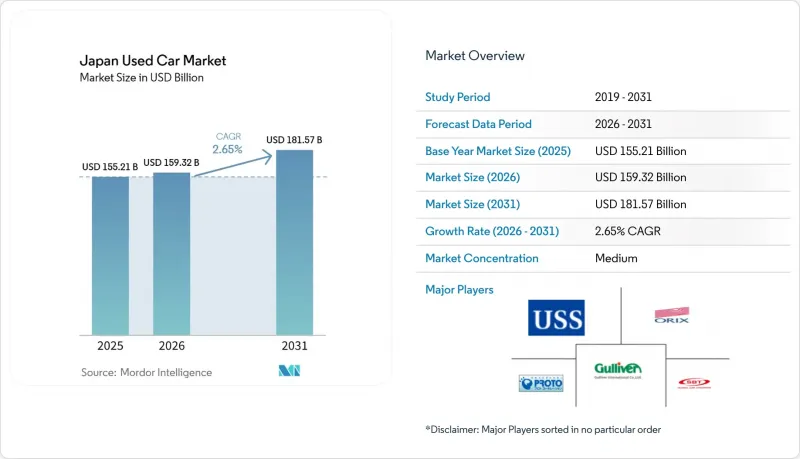
This report is Segmented by Vehicle Type (Hatchback, Sedan, Sport Utility Vehicle, and More), Fuel (Gasoline, Diesel, and More), Vehicle Age (0 -2 Years, 3 -5 Years, and More), Booking Channel (Online, OEM Certified or Authorized Dealerships, Multi-Brand Dealerships, and More), and Transaction Type (Full Payment and Finance). The Market Forecasts are Provided in Terms of Value (USD) and Volume (Units).
Japan Used Car Market Trends and Insights
Soaring New Car Prices Widen Affordability Gap
Persistently high factory-gate prices have shifted buyers toward used vehicles, a trend reinforced by a 2.5-3% CPI outlook, which keeps new-car ownership out of reach for many households. Toyota's FY2025 domestic volume fell by 10.8%, underscoring price resistance and shifting demand toward pre-owned channels. Late-model cars in the 3-5-year bracket now combine modern driver-assistance features with lower capital costs, strengthening their appeal. As wages inch upward but still trail vehicle inflation, the Japanese used car market continues to absorb buyers who might otherwise delay purchasing.
Accelerated 3 Year Depreciation Cycles Release High Quality Stock
Corporate fleet programs and subscription models have shortened replacement intervals, sending newer, low-mileage vehicles into resale lanes every 36 months. Honda and Mitsubishi's ALTNA joint venture exemplifies this pattern by leasing batteries and repurposing returned EVs. Tokyo Century's automobility division posted record earnings in 2024, reflecting brisk secondary-market turnover of these high-spec units. The resulting breadth of inventory bolsters consumer confidence and limits price spikes, even when new-car supply remains tight.
Tight Domestic Supply After Pandemic Era Production Cuts
Japanese output touched a 45-year low of 7.85 million units in 2021, and those missing vehicles are now absent from the 3-5 year-old pool. With fewer trade-ins and lease returns entering the auction market, wholesale prices have firmed, forcing retailers to seek right-hand-drive imports abroad. Although overseas production rebounded, domestic scarcity still limits stock diversity, slowing growth in the Japanese used car market.
Other drivers and restraints analyzed in the detailed report include:
- Online First Dealer Platforms Scale Nationwide Inventory
- Kei Car Tax Advantage Sustains Demand for Used Micro Cars
- Odometer Fraud Scandals Erode Consumer Trust
For complete list of drivers and restraints, kindly check the Table Of Contents.
Segment Analysis
Hatchbacks retained a 34.86% share of the Japanese used car market in 2025, anchored by tight urban parking and narrow streets. Compact SUVs, however, are set to post a 6.02% CAGR to 2031, propelled by lifestyle shifts toward higher seating and versatile cargo layouts. Used-car auctions now list more late-model SUVs as three-year depreciation cycles deliver stock with autonomous-driving aids and infotainment upgrades.
Rural migration to urban centers supports hatchback turnover, yet rising disposable income among young families favors two-row crossovers that combine maneuverability with extra ride height. Dealers stocking both categories hedge risk while capturing the broadening taste spectrum in the Japanese used car market.
Gasoline vehicles held 53.92% of 2025 sales, but battery electric and plug-in hybrids will clip that lead by 14.15% annually to 2031. Government rebates of up to JPY 850,000 per EV lower entry barriers. The Japanese used car market for electric models will expand rapidly once the current fleet leases mature.
Battery-leasing schemes address resale-value anxiety, providing structured pathways for second owners. Meanwhile, diesel demand wanes as emission rules tighten in major cities, and hybrids bridge the transition by offering familiar refueling habits with incremental efficiency gains.
Complete Report Scope:
- By Vehicle Type
- Hatchbacks
- Sedan
- Sport-Utility Vehicle (SUV)
- Multi-Purpose Vehicle (MPV)
- By Fuel Type
- Gasoline
- Diesel
- Hybrid
- Battery Electric Vehicle (BEV)
- Plug-in Hybrid Electric Vehicle (PHEV)
- By Vehicle Age
- 0-2 Years
- 3-5 Years
- 6-8 Years
- Above 8 Years
- By Booking Channel
- Online
- OEM Certified / Authorised Dealerships
- Multi-Brand Dealerships
- C2C Digital Marketplaces
- By Transaction Type
- Full Payment
- Finance (Loan / Lease)
List of Companies Covered in this Report:
- USS Co., Ltd.
- PROTO Corporation
- IDOM Inc. (Gulliver)
- ORIX Auto Corporation
- SBT Japan
- Trust Co. Ltd.
- Yokohama Toyopet
- Mobilico Inc.
- Autocom Japan Inc.
- Crown Japan Co.
- Aucnet Inc.
- Toyota Auto Auction (TAA)
- NAA Nagoya Auto Auction
- HAA Kobe
- BIGMOTOR Co.
- CarSeven Co.
- Nextage Co.
- BAYAUC Co.
- BeForward Japan
- Carsensor.net
Additional Benefits:
- The market estimate (ME) sheet in Excel format
- 3 months of analyst support
TABLE OF CONTENTS
1 Introduction
- 1.1 Study Assumptions & Market Definition
- 1.2 Scope of the Study
2 Research Methodology
3 Executive Summary
4 Market Landscape
- 4.1 Market Overview
- 4.2 Market Drivers
- 4.2.1 Soaring New-car Prices Widen Affordability Gap
- 4.2.2 Accelerated 3-year Depreciation Cycles release high-quality stock
- 4.2.3 Online-first Dealer Platforms Scale Nationwide Inventory
- 4.2.4 Kei-car Tax Advantage Sustains Demand for Used Micro-Cars
- 4.2.5 End-Of-Lease OEM Subscription Fleets Flood Secondary Market
- 4.2.6 Circular-Economy Incentives Favor Vehicle Reuse Over Scrappage
- 4.3 Market Restraints
- 4.3.1 Tight Domestic Supply After Pandemic-Era Production Cuts
- 4.3.2 Odometer Fraud Scandals Erode Consumer Trust
- 4.3.3 Shrinking Licensed-Driver Pool Amid Rapid Ageing
- 4.3.4 Stricter 2027 Emission Norms May De-Value Older ICE Stock
- 4.4 Value-Chain Analysis
- 4.5 Regulatory Landscape
- 4.6 Technological Outlook
- 4.7 Porter's Five Forces
- 4.7.1 Threat of New Entrants
- 4.7.2 Bargaining Power of Buyers
- 4.7.3 Bargaining Power of Suppliers
- 4.7.4 Threat of Substitutes
- 4.7.5 Competitive Rivalry
5 Market Size & Growth Forecasts (Value (USD), Volume (Units))
- 5.1 By Vehicle Type
- 5.1.1 Hatchbacks
- 5.1.2 Sedan
- 5.1.3 Sport-Utility Vehicle (SUV)
- 5.1.4 Multi-Purpose Vehicle (MPV)
- 5.2 By Fuel Type
- 5.2.1 Gasoline
- 5.2.2 Diesel
- 5.2.3 Hybrid
- 5.2.4 Battery Electric Vehicle (BEV)
- 5.2.5 Plug-in Hybrid Electric Vehicle (PHEV)
- 5.3 By Vehicle Age
- 5.3.1 0-2 Years
- 5.3.2 3-5 Years
- 5.3.3 6-8 Years
- 5.3.4 Above 8 Years
- 5.4 By Booking Channel
- 5.4.1 Online
- 5.4.2 OEM Certified / Authorised Dealerships
- 5.4.3 Multi-Brand Dealerships
- 5.4.4 C2C Digital Marketplaces
- 5.5 By Transaction Type
- 5.5.1 Full Payment
- 5.5.2 Finance (Loan / Lease)
6 Competitive Landscape
- 6.1 Market Concentration
- 6.2 Strategic Moves
- 6.3 Market Share Analysis
- 6.4 Company Profiles (includes Global level Overview, Market level overview, Core Segments, Financials as available, Strategic Information, Market Rank/Share for key companies, Products & Services, and Recent Developments)
- 6.4.1 USS Co., Ltd.
- 6.4.2 PROTO Corporation
- 6.4.3 IDOM Inc. (Gulliver)
- 6.4.4 ORIX Auto Corporation
- 6.4.5 SBT Japan
- 6.4.6 Trust Co. Ltd.
- 6.4.7 Yokohama Toyopet
- 6.4.8 Mobilico Inc.
- 6.4.9 Autocom Japan Inc.
- 6.4.10 Crown Japan Co.
- 6.4.11 Aucnet Inc.
- 6.4.12 Toyota Auto Auction (TAA)
- 6.4.13 NAA Nagoya Auto Auction
- 6.4.14 HAA Kobe
- 6.4.15 BIGMOTOR Co.
- 6.4.16 CarSeven Co.
- 6.4.17 Nextage Co.
- 6.4.18 BAYAUC Co.
- 6.4.19 BeForward Japan
- 6.4.20 Carsensor.net
7 Market Opportunities & Future Outlook
- 7.1 White-space & Unmet-Need Assessment

