PUBLISHER: Mordor Intelligence | PRODUCT CODE: 2073584

PUBLISHER: Mordor Intelligence | PRODUCT CODE: 2073584
Thailand Used Car - Market Share Analysis, Industry Trends & Statistics, Growth Forecasts (2026 - 2031)
According to Mordor Intelligence, the thailand used car market size was valued at USD 5.51 billion in 2025 and estimated to grow from USD 5.86 billion in 2026 to reach USD 8.27 billion by 2031, at a CAGR of 7.13% during the forecast period (2026-2031).
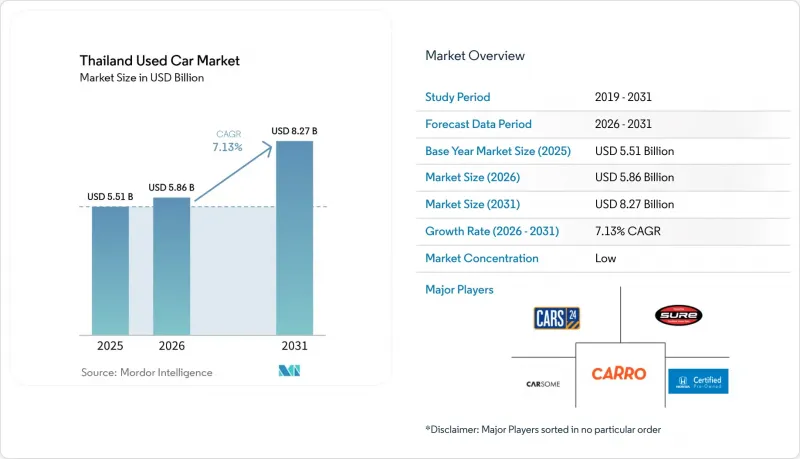
This report is Segmented by Vehicle Type (Hatchbacks, Sedans, and More), Fuel Type (Petrol, Diesel, Hybrid Electric, Battery Electric, and Others), Booking Type (Online and Offline), Vendor Type (Organized and Unorganized), Vehicle Age (0-2 Years, 3-8 Years, and More Than 8 Years), and Price Band. The Market Forecasts are Provided in Terms of Value (USD) and Volume (Units).
Thailand Used Car Market Trends and Insights
Cost-Conscious Consumers Amid Economic Headwinds
With household debt nearing record highs and loan rejection rates remaining significantly high, consumers are increasingly turning to affordable pre-owned vehicles. These are often several years old, providing reliability without the steep depreciation of new cars. In recent times, repossessions have risen considerably, allowing dealers to stock up at lower prices compared to pre-pandemic levels, a saving they readily passed on to buyers. Sales of pickups have seen a substantial decline, flooding the market with trucks now available to rural operators at more accessible prices. The Bank of Thailand's Used Vehicle Price Index has shown a notable rebound, hinting at a tighter supply once new-car production sees a modest recovery. This counter-cyclical trend underscores the Thai used car market's role as a safety valve during broader economic stresses .
Rapid Rise of Digital Used-Car Marketplaces
In recent years, online channels have accounted for a significant portion of trades and are growing at a faster pace compared to offline channels. Krungsri Auto's GO Auto Station features a vast inventory of vehicles, offers quick loan approvals through its PromptStart workflow, and provides integrated services such as insurance renewal and maintenance scheduling within the app. Over the past year, the platform has seen a notable increase in monthly active users, solidifying the bank's position as a leader in the national used-car finance market. The adoption of virtual inspection protocols and standardized grading has effectively reduced odometer fraud risks, aligning with the trust mechanisms familiar to Thai mobile shoppers, most of whom already make purchases via smartphones. With a large portion of the population now online, the digital landscape is expanding its influence beyond Bangkok into secondary cities .
Counterfeit and Illegally Imported Vehicles
Gray-market cars that bypass Thai Industrial Standards Institute (TISI) certification erode buyer trust, expose owners to the risk of registration denial, and impose retrofitting costs to meet safety regulations. Enforcement has tightened, yet the majority of trade still runs through unorganized vendors where oversight is weak. Buyers wary of non-compliant units may delay purchases or default to certified platforms, trimming overall demand in the Thailand used car market. Compliance burdens favor organized dealers but also raise transaction expenses that can dampen price-sensitive segments.
Other drivers and restraints analyzed in the detailed report include:
- Expansion of OEM-Backed Certified-Pre-Owned Programs
- Repatriated Expat-Owned Vehicles Enlarging Supply Pool
- Battery-Health Uncertainty in Used EVs and Hybrids
For complete list of drivers and restraints, kindly check the Table Of Contents.
Segment Analysis
Sport utility vehicles and multi-purpose vehicles accounted for 37.81% of 2025 volume, and this cohort is forecast to post a 7.15% CAGR through 2031. The Thailand used car market share tilted toward spacious cabins and flexible seating, reflecting demographic shifts toward nuclear families and dual-use business needs. Sedans surrendered ground as crossovers deliver comparable fuel economy, and hatchbacks retain urban niches where parking is scarce. Luxury cars remain a thin slice after new-vehicle imports fell 25% in 2024, tightening supply and elevating certified residuals.
Resilience in this segment arises from broad utility: families commute during the week and travel on weekends, while SMEs repurpose multi-purpose vehicles for light cargo. Chinese-brand sport utility vehicles entering off-lease cycles add fresh stock, though dealers still price residuals cautiously. Pickup trucks, counted separately, overflow into this demand after the 41.6% sales collapse in October 2024, supplying rural buyers. Government guarantees for pickup loans could stabilize this spill-over, but remain untested.
Petrol models accounted for 63.47% of trades in 2025, yet battery electric vehicles are the fastest climber at a 7.24% CAGR through 2031. Diesel share is tapering as Euro-5 rules raise compliance costs, while hybrids fill a middle ground for buyers wary of range anxiety. The Thailand used car market size for BEVs will grow off a small base, as new electric vehicle registrations in the first seven months of 2025 begin flowing into trade-ins. BYD's Rayong factory and government EV 3.0 incentives until 2026 underpin future supply.
Excise tax hikes on BEVs slightly after subsidies expire could slow fresh entries and keep petrol leadership intact. LPG and CNG conversions remain niche, handicapped by retrofit compliance costs under TIS 3055-2563. Persistent uncertainty about battery health tempers battery electric vehicle liquidity; however, the development of standardized grading would accelerate adoption.
Complete Report Scope:
- By Vehicle Type
- Hatchbacks
- Sedans
- Sport Utility Vehicle and Multi-Purpose Vehicle
- Luxury Cars
- By Fuel Type
- Petrol
- Diesel
- Hybrid Electric
- Battery Electric
- Others
- By Booking Type
- Online
- Offline
- By Vendor Type
- Organized
- Unorganized
- By Vehicle Age
- 0 - 2 Years
- 3 - 8 Years
- More than 8 Years
- By Price Band (USD)
- Less than 10,000
- 10,001 - 20,000
- More than 20,000
List of Companies Covered in this Report:
- Carsome Thailand
- CARS24 Thailand
- Carro Thailand
- Toyota Sure
- Honda Certified Used Car
- iCarAsia / One2Car
- SiamMotorworld
- Motors.co.th
- Chobrod.com
- Fast2car.com
- GuruCar Thailand
Additional Benefits:
- The market estimate (ME) sheet in Excel format
- 3 months of analyst support
TABLE OF CONTENTS
1 Introduction
- 1.1 Study Assumptions and Market Definition
- 1.2 Scope of the Study
2 Research Methodology
3 Executive Summary
4 Market Landscape
- 4.1 Market Overview
- 4.2 Market Drivers
- 4.2.1 Cost-Conscious Consumers Amid Economic Headwinds
- 4.2.2 Rapid Rise of Digital Used-Car Marketplaces
- 4.2.3 Diverse Model Availability Across Price-Points
- 4.2.4 Usage-Based Insurance and Fintech Lending Boosting Affordability
- 4.2.5 Expansion of OEM-Backed Certified-Pre-Owned Programmes
- 4.2.6 Repatriated Expat-Owned Vehicles Enlarging Supply Pool
- 4.3 Market Restraints
- 4.3.1 Stricter AI-Driven Credit-Scoring Limiting Auto Loans
- 4.3.2 Fragmented Vehicle-History and Odometer Fraud
- 4.3.3 Counterfeit and Illegally Imported Vehicles
- 4.3.4 Battery-Health Uncertainty in Used EVs and Hybrids
- 4.4 Value / Supply-Chain Analysis
- 4.5 Regulatory Landscape
- 4.6 Technological Outlook
- 4.7 Porter's Five Forces
- 4.7.1 Bargaining Power of Suppliers
- 4.7.2 Bargaining Power of Buyers
- 4.7.3 Threat of New Entrants
- 4.7.4 Threat of Substitutes
- 4.7.5 Competitive Rivalry
5 Market Size and Growth Forecasts (Value (USD) and Volume (Units))
- 5.1 By Vehicle Type
- 5.1.1 Hatchbacks
- 5.1.2 Sedans
- 5.1.3 Sport Utility Vehicle and Multi-Purpose Vehicle
- 5.1.4 Luxury Cars
- 5.2 By Fuel Type
- 5.2.1 Petrol
- 5.2.2 Diesel
- 5.2.3 Hybrid Electric
- 5.2.4 Battery Electric
- 5.2.5 Others
- 5.3 By Booking Type
- 5.3.1 Online
- 5.3.2 Offline
- 5.4 By Vendor Type
- 5.4.1 Organized
- 5.4.2 Unorganized
- 5.5 By Vehicle Age
- 5.5.1 0 - 2 Years
- 5.5.2 3 - 8 Years
- 5.5.3 More than 8 Years
- 5.6 By Price Band (USD)
- 5.6.1 Less than 10,000
- 5.6.2 10,001 - 20,000
- 5.6.3 More than 20,000
6 Competitive Landscape
- 6.1 Market Concentration
- 6.2 Strategic Moves
- 6.3 Market Share Analysis
- 6.4 Company Profiles (Includes Global Level Overview, Market Level Overview, Core Segments, Financials as Available, Strategic Information, Market Rank/Share for Key Companies, Products and Services, SWOT Analysis, and Recent Developments)
- 6.4.1 Carsome Thailand
- 6.4.2 CARS24 Thailand
- 6.4.3 Carro Thailand
- 6.4.4 Toyota Sure
- 6.4.5 Honda Certified Used Car
- 6.4.6 iCarAsia / One2Car
- 6.4.7 SiamMotorworld
- 6.4.8 Motors.co.th
- 6.4.9 Chobrod.com
- 6.4.10 Fast2car.com
- 6.4.11 GuruCar Thailand
7 Market Opportunities and Future Outlook
- 7.1 White-space and Unmet-need Assessment

