PUBLISHER: Mordor Intelligence | PRODUCT CODE: 2097299

PUBLISHER: Mordor Intelligence | PRODUCT CODE: 2097299
GRNA - Market Share Analysis, Industry Trends & Statistics, Growth Forecasts (2025 - 2030)
According to Mordor Intelligence, the GRNA market size touched USD 0.70 billion in 2025 and is projected to reach USD 1.64 billion by 2030, implying an 18.4% CAGR that keeps the segment ahead of most other genome-engineering inputs in absolute growth and velocity.
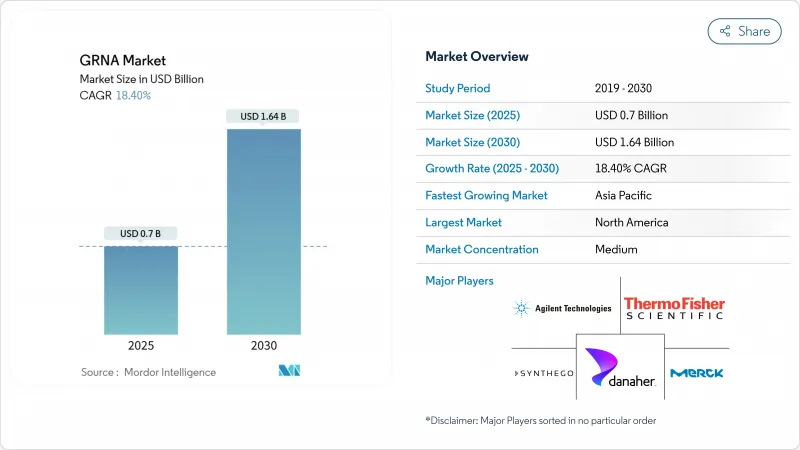
This report is Segmented by Product Type (Synthetic GRNA, In-Vitro Transcribed GRNA, and More), Application (Genome Editing, Functional Genomics Screens, and More), End User (Academic & Research Institutes, Biotechnology & Pharmaceutical Companies, and More), and Geography (North America, Europe, Asia Pacific, Middle East & Africa, South America). The Market Forecasts are Provided in Terms of Value (USD).
Global GRNA Market Trends and Insights
Surge in CRISPR-Based Therapeutics Pipeline
More than 85 active CRISPR trials now span oncology, rare blood disorders, and metabolic diseases, each pulling high-purity materials from the GRNA market.The FDA's umbrella guidance for gene-editing products streamlines pre-IND review, encouraging biopharma groups like Vertex and Regeneron to lock in multi-year master supply agreements for GMP-grade guides. Early evidence of complete responses in solid-tumor settings underscores the scale of clinical ambitions that will demand larger production lots from the GRNA market. Pipeline breadth also extends into prime-editing and base-editing approaches that rely on longer RNA constructs, raising per-dose consumption levels. The therapeutic cascade, therefore, keeps the GRNA market on a rising demand trajectory across forecast years.
Falling Costs and Turnaround Time for Custom GRNA Synthesis
Template-independent enzymatic chemistry now doubles achievable oligo lengths while removing hazardous solvents, compressing delivery windows from weeks to mere days. Synthego's 18,000 ft2 GMP facility, commissioned in April 2025, illustrates the automation wave sweeping the GRNA market, even though subsequent restructuring highlights the capital burden of staying compliant. 3TC scaffold tweaks increase transcript stability, letting therapeutic developers cut dose levels without sacrificing efficacy, which stimulates follow-on orders for optimized sequences. These advances extend purchasing power beyond top-tier pharma to mid-sized biotech ventures, enlarging the total addressable GRNA market.
Off-Target Effects and Safety Concerns
Extended RNA scaffolds and high-fidelity Cas variants reduce unintended edits, yet regulators now require multi-platform detection assays, adding cost and time burdens for entrants into the GRNA market. AI-driven tools like DeepCRISPR refine sequence design but still need clinical validation across diverse genomic contexts, prolonging lock-in periods for material specifications.The EMA and FDA both expect orthogonal off-target evaluations, which stretch pre-clinical timelines and force redundancy in guide redesign cycles. These additional steps slow first-mover advantage, temporarily dampening growth in the GRNA market.
Other drivers and restraints analyzed in the detailed report include:
- Expanding Funding for Genome-Engineering Research
- Growing Use of Agricultural Biotechnology
- Complex Intellectual-Property Landscape
For complete list of drivers and restraints, kindly check the Table Of Contents.
Segment Analysis
Synthetic formats represented 45.8% of the GRNA market in 2024 because cGMP alignment, batch consistency, and tight length tolerances match regulatory expectations. Multiplex libraries log the fastest 17.7% CAGR, mirroring pharmaceutical demand for pooled knockout screens that uncover druggable pathways. RNP complexes offering Cas-RNA pre-assembly win favor in ex vivo cell therapy workflows, where brief cellular exposure mitigates genotoxicity. IVT guides remain popular for low-budget research, yet a lot of heterogeneity and residual template contaminants limit penetration into regulated trials. Enzymatic synthesis eliminates phosphoramidite waste streams, positioning itself as a greener challenger that could pull future orders from high-volume buyers in the GRNA market.
Second-generation chemical tweaks extend in vivo half-life, freeing systemic doses from hepatic confines and broadening therapeutic use cases, which enlarges the GRNA market size tied to non-liver disorders. Plasmid-encoded constructs serve niche cell-line creation but rarely scale into commercial volumes. The collapse of pure-play supplier Synthego and the acquisition of its assets by EditCo Bio illustrate consolidation forces that are likely to alter vendor rosters in the GRNA market.
Complete Report Scope:
- By Product Type
- Synthetic GRNA
- In-vitro Transcribed (IVT) GRNA
- Plasmid-Encoded GRNA Constructs
- RNP Complexes (GRNA + Cas)
- Multiplex GRNA Libraries
- By Application
- Genome Editing
- Functional Genomics Screens
- Diagnostics
- Cell & Gene Therapy
- Agricultural Biotechnology
- By End User
- Academic & Research Institutes
- Biotechnology & Pharmaceutical Companies
- Contract Research Organizations (CROs)
- Hospitals & Diagnostic Laboratories
- Agro-industrial Firms
- By Geography
- North America
- United States
- Canada
- Mexico
- Europe
- Germany
- United Kingdom
- France
- Italy
- Spain
- Rest of Europe
- Asia Pacific
- China
- Japan
- India
- South Korea
- Australia
- Rest of Asia Pacific
- Middle East & Africa
- GCC
- South Africa
- Rest of Middle East & Africa
- South America
- Brazil
- Argentina
- Rest of South America
- North America
Geography Analysis
North America captured 48.5% of the GRNA market in 2024, underpinned by FDA validation, federal grants, and dense biotech clusters in Boston and the Bay Area. More than 200 U.S. companies operate in gene editing, creating a robust domestic customer list for guide suppliers. Canada's regulatory clarity in agriculture adds incremental volumes for crop-focused guides.
Asia Pacific posts the fastest 18.6% CAGR as Chinese, Japanese, and Indian regulators adopt science-based frameworks that distinguish gene editing from transgenesis. Provincial Chinese grants fund new CRISPR industrial parks, while Japan's IP High Court ruling in July 2025 influences local licensing behavior. India aligns biosafety assessments with U.S. precedents, smoothing import lines and encouraging multinational setups.
Europe remains a sizable but slower-growing node within the GRNA market. The European Patent Office's March 2024 reinstatement of Broad claims clarified freedom-to-operate, nudging some hesitant programs forward. The European Parliament's pro-NGT stance signals a lighter approach for plant approvals, though member-state specifics still impose administrative lag. Switzerland and the United Kingdom leverage independent regimes to expedite clinical-grade manufacturing, offering alternative gateways into the European GRNA market.
- Thermo Fisher Scientific
- Integrated DNA Technologies (Danaher)
- Merck KGaA - Sigma-Aldrich
- Synthego Corporation
- Agilent Technologies
- Twist Bioscience
- Eurofins
- GenScript Biotech
- Horizon Discovery (Revvity)
- CRISPR Therapeutic
- Editas Medicine
- Intellia Therapeutics
- Beam Therapeutics
- OriGene Technologies
- Applied Biological Materials (abm)
- Dharmacon (Horizon)
- Bioneer
- Sangamo Therapeutics
- Takara Bio
- Lonza Group
Additional Benefits:
- The market estimate (ME) sheet in Excel format
- 3 months of analyst support
TABLE OF CONTENTS
1 Introduction
- 1.1 Study Assumptions & Market Definition
- 1.2 Scope of the Study
2 Research Methodology
3 Executive Summary
4 Market Landscape
- 4.1 Market Overview
- 4.2 Market Drivers
- 4.2.1 Surge In CRISPR-Based Therapeutics Pipeline
- 4.2.2 Falling Costs & Turnaround Time For Custom gRNA Synthesis
- 4.2.3 Expanding Funding For Genome-Engineering Research
- 4.2.4 Growing Use of Agricultural Biotechnology
- 4.2.5 AI-Driven gRNA Design Platforms Enhance On-Target Efficiency
- 4.2.6 Chemically-Modified gRNAs Enable In-Vivo Delivery Beyond Liver
- 4.3 Market Restraints
- 4.3.1 Off-Target Effects & Safety Concerns
- 4.3.2 Complex Intellectual-Property Landscape
- 4.3.3 Supply-Chain Vulnerability For Synthetic RNA Feedstocks
- 4.3.4 Regulatory Uncertainty For CRISPR-Edited Crop Release
- 4.4 Supply-Chain Analysis
- 4.5 Regulatory Landscape
- 4.6 Technological Outlook
- 4.7 Porter's Five Forces Analysis
- 4.7.1 Bargaining Power of Suppliers
- 4.7.2 Bargaining Power of Buyers
- 4.7.3 Threat of New Entrants
- 4.7.4 Threat of Substitutes
- 4.7.5 Competitive Rivalry
5 Market Size & Growth Forecasts (Value)
- 5.1 By Product Type
- 5.1.1 Synthetic gRNA
- 5.1.2 In-vitro Transcribed (IVT) gRNA
- 5.1.3 Plasmid-Encoded gRNA Constructs
- 5.1.4 RNP Complexes (gRNA + Cas)
- 5.1.5 Multiplex gRNA Libraries
- 5.2 By Application
- 5.2.1 Genome Editing
- 5.2.2 Functional Genomics Screens
- 5.2.3 Diagnostics
- 5.2.4 Cell & Gene Therapy
- 5.2.5 Agricultural Biotechnology
- 5.3 By End User
- 5.3.1 Academic & Research Institutes
- 5.3.2 Biotechnology & Pharmaceutical Companies
- 5.3.3 Contract Research Organizations (CROs)
- 5.3.4 Hospitals & Diagnostic Laboratories
- 5.3.5 Agro-industrial Firms
- 5.4 By Geography
- 5.4.1 North America
- 5.4.1.1 United States
- 5.4.1.2 Canada
- 5.4.1.3 Mexico
- 5.4.2 Europe
- 5.4.2.1 Germany
- 5.4.2.2 United Kingdom
- 5.4.2.3 France
- 5.4.2.4 Italy
- 5.4.2.5 Spain
- 5.4.2.6 Rest of Europe
- 5.4.3 Asia Pacific
- 5.4.3.1 China
- 5.4.3.2 Japan
- 5.4.3.3 India
- 5.4.3.4 South Korea
- 5.4.3.5 Australia
- 5.4.3.6 Rest of Asia Pacific
- 5.4.4 Middle East & Africa
- 5.4.4.1 GCC
- 5.4.4.2 South Africa
- 5.4.4.3 Rest of Middle East & Africa
- 5.4.5 South America
- 5.4.5.1 Brazil
- 5.4.5.2 Argentina
- 5.4.5.3 Rest of South America
- 5.4.1 North America
6 Competitive Landscape
- 6.1 Market Concentration
- 6.2 Market Share Analysis
- 6.3 Company Profiles {(includes Global level Overview, Market level overview, Core Segments, Financials as available, Strategic Information, Market Rank/Share for key companies, Products & Services, and Recent Developments)}
- 6.3.1 Thermo Fisher Scientific
- 6.3.2 Integrated DNA Technologies (Danaher)
- 6.3.3 Merck KGaA - Sigma-Aldrich
- 6.3.4 Synthego Corporation
- 6.3.5 Agilent Technologies
- 6.3.6 Twist Bioscience
- 6.3.7 Eurofins Genomics
- 6.3.8 GenScript Biotech
- 6.3.9 Horizon Discovery (Revvity)
- 6.3.10 CRISPR Therapeutics
- 6.3.11 Editas Medicine
- 6.3.12 Intellia Therapeutics
- 6.3.13 Beam Therapeutics
- 6.3.14 OriGene Technologies
- 6.3.15 Applied Biological Materials (abm)
- 6.3.16 Dharmacon (Horizon)
- 6.3.17 Bioneer Corporation
- 6.3.18 Sangamo Therapeutics
- 6.3.19 Takara Bio Inc.
- 6.3.20 Lonza Group
7 Market Opportunities & Future Outlook
- 7.1 White-space & Unmet-Need Assessment

