PUBLISHER: Mordor Intelligence | PRODUCT CODE: 2097364

PUBLISHER: Mordor Intelligence | PRODUCT CODE: 2097364
India Wallpapers - Market Share Analysis, Industry Trends & Statistics, Growth Forecasts (2025 - 2030)
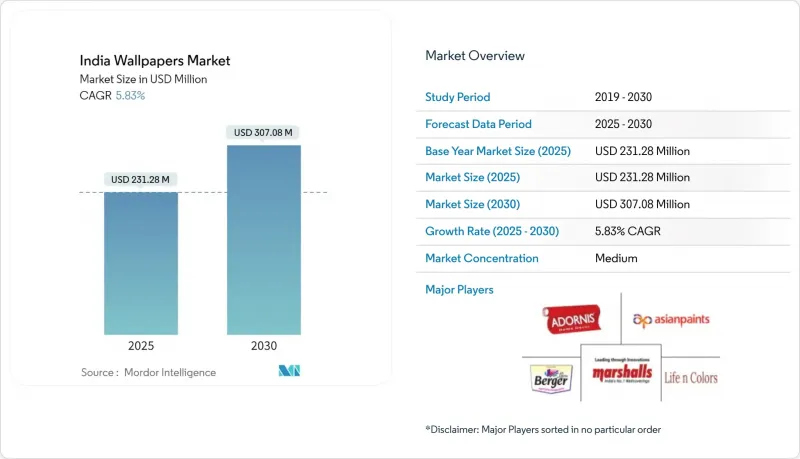
According to Mordor Intelligence, the India wallpapers market size accounted for USD 231.28 million in 2025 and is projected to reach USD 307.08 million by 2030, translating into a 5.83% CAGR.
This report is Segmented by Type (Vinyl-Based, Non-Woven, Paper/Traditional, and Fabric (Textile)), Distribution Channel (E-Commerce, and Retail), End User (Residential, and Commercial), Print Technology (Gravure, Digital Inkjet, and More), and Geography. The Market Forecasts are Provided in Terms of Value (USD).
India Wallpapers Market Trends and Insights
Infrastructural Boom and Rising Home-Ownership
The government cleared 3 crore new dwellings under PMAY, channelling USD 3.67 billion toward affordable housing that directly lifts wallpaper consumption. Housing loans outstanding touched INR 33.53 lakh crore in 2024, signalling deeper mortgage penetration that fosters interior upgrades. Rural completions of 2.69 crore houses, 74% in women's names, expand the aesthetic decision pool. A 6.8% annual increase in the Housing Price Index supports higher refurbishment budgets. Smart Cities Mission funds of INR 1.64 lakh crore across 8,000 projects add commercial opportunities in command centres and civic halls.
Growing Preference for Wallpapers Over Paint
Durability and design range give wallpapers an edge over traditional coatings in premium spaces. High-profile hospitality refurbishments such as the Maharaja Suite at Taj Mahal Delhi showcase bespoke murals that command premium tariffs. Asian Paints' ColourNext 2025 flagged "Spring Tune" as Wallpaper of the Year, confirming mainstream adoption. HP Latex and other water-based digital systems enable custom short runs with low VOC emissions, matching rising sustainability expectations. Hotel projects emphasise handmade and regionally inspired motifs, reinforcing cultural resonance. Urban household expenditure climbed to INR 6,996 per capita in 2023-24, releasing discretionary funds for decor.
Short Lifespan Under Heat and Humidity
Tropical moisture weakens adhesives and discolors many paper-based wallpapers, curbing adoption in coastal states. Non-woven options breathe better and dry faster, but adoption costs remain higher. Vinyl resists water yet restricts airflow, sparking indoor air-quality debates. UDC Homes' waterproof "Memuraa" range tackles moisture ingress while preserving visual fidelity. R&D in polymer blends and primer systems continues to extend service life outside climate-controlled interiors.
Other drivers and restraints analyzed in the detailed report include:
- Expansion of Organised Retail and E-commerce
- Disposable-Income Led Premiumisation
- Competition from Decorative Paints and Laminates
For complete list of drivers and restraints, kindly check the Table Of Contents.
Segment Analysis
Vinyl accounted for 32.67% of the India wallpapers market share in 2024, underpinned by water resistance suited to kitchens and baths. Non-woven products are expanding at a 9.11% CAGR as urban buyers seek breathable, eco-aligned interiors. The India wallpapers market size within non-wovens is forecast to accelerate once local converting lines add capacity. Non-woven fibers permit easier removal, lowering renovation downtime. Traditional paper and textile coverings keep niche appeal in heritage restorations and luxury villas. Eximus Wallpaper's rotogravure output illustrates manufacturing precision that sustains premium status. Material compliance oversight by the Bureau of Indian Standards lifts consumer confidence and curbs sub-standard imports.
Innovations include VOC-free coatings and antimicrobial treatments responding to post-pandemic hygiene awareness. WallKalakar's children-centric launch employs 100% non-toxic inks, a feature that resonates with urban parents. Consumers weigh lifecycle costs against upfront price, tilting preferences toward substrates promising durability without sacrificing indoor air quality.
Retail outlets retained 53.79% value share in 2024, reflecting the enduring need for tactile inspection and decor consultation. Yet the Indian wallpaper market registers an 8.12% CAGR online as consumers gain trust in digital visualization tools. Virtual room-preview software streamlines selection and reduces sample wastage. Self-adhesive SKUs travel well, overcoming prior logistics limitations. iDecorwala.com scales through a hub-and-spoke network where online orders are channel to regional franchisees for last-mile service. Asian Paints integrates e-commerce into its website, capturing cross-sell synergies with paint and furniture lines.
Unorganised mom-and-pop stores still dominate smaller towns, but organised chains promise quality and warranty, tempting upgrade buyers. The Indian wallpaper industry continues to invest in showroom formats that marry digital catalogs with sample walls, reducing inventory overhead yet satisfying consumer touchpoints.
Complete Report Scope:
- By Type
- Vinyl-based
- Non-woven
- Paper / Traditional
- Fabric (Textile)
- By Distribution Channel
- E-commerce
- Retail
- By End User
- Residential
- Commercial
- Hospitality
- Corporate Offices
- Salons and Spas
- Hospitals
- Other Commercial Users
- By Print Technology
- Gravure
- Digital Inkjet
- Other Print Technology
List of Companies Covered in this Report:
- Marshalls Wallcoverings
- Elementto Lifestyle Wallcoverings Pvt Ltd
- Excel Wallcoverings
- Eximus Wallpaper
- Adornis Wallpapers
- Gratex Industries Ltd
- Woltop India Pvt Ltd
- Ultra Walls (Sonu Art)
- Asian Paints Ltd (Nilaya & Beautiful Homes)
- Berger Paints Ltd
- D'Decor Home Fabrics Pvt Ltd
- Life n Colors Private Limited
- Wallskin (Green Apple Design Pvt Ltd)
- Jaypore E-Commerce Pvt Ltd
- India Circus (Godrej)
- Gloob Decor
- iDecorwala.com
- Kajaria Decor Solutions
- A.S. Creation Tapeten AG (India Import)
- Muraspec India
Additional Benefits:
- The market estimate (ME) sheet in Excel format
- 3 months of analyst support
TABLE OF CONTENTS
1 INTRODUCTION
- 1.1 Study Assumptions and Market Definition
- 1.2 Scope of the Study
2 RESEARCH METHODOLOGY
3 EXECUTIVE SUMMARY
4 MARKET LANDSCAPE
- 4.1 Market Overview
- 4.2 Market Drivers
- 4.2.1 Infrastructural Boom and Rising Home-Ownership
- 4.2.2 Growing Preference for Wallpapers Over Paint
- 4.2.3 Expansion of Organised Retail and E-Commerce
- 4.2.4 Disposable-Income Led Premiumisation
- 4.2.5 Short-Stay Rental and Co-Living Refurb Demand
- 4.2.6 Tenant-Friendly Peel-and-Stick Innovation
- 4.3 Market Restraints
- 4.3.1 Short Lifespan Under Heat and Humidity
- 4.3.2 Competition from Decorative Paints and Laminates
- 4.3.3 Import-driven Raw-material FX Volatility
- 4.3.4 Shortage of Certified Installers
- 4.4 Supply-Chain Analysis
- 4.5 Regulatory Landscape
- 4.6 Technological Outlook
- 4.7 Porter's Five Forces Analysis
- 4.7.1 Bargaining Power of Suppliers
- 4.7.2 Bargaining Power of Buyers
- 4.7.3 Threat of New Entrants
- 4.7.4 Threat of Substitutes
- 4.7.5 Intensity of Competitive Rivalry
5 MARKET SIZE AND GROWTH FORECASTS (VALUES)
- 5.1 By Type
- 5.1.1 Vinyl-based
- 5.1.2 Non-woven
- 5.1.3 Paper / Traditional
- 5.1.4 Fabric (Textile)
- 5.2 By Distribution Channel
- 5.2.1 E-commerce
- 5.2.2 Retail
- 5.3 By End User
- 5.3.1 Residential
- 5.3.2 Commercial
- 5.3.2.1 Hospitality
- 5.3.2.2 Corporate Offices
- 5.3.2.3 Salons and Spas
- 5.3.2.4 Hospitals
- 5.3.2.5 Other Commercial Users
- 5.4 By Print Technology
- 5.4.1 Gravure
- 5.4.2 Digital Inkjet
- 5.4.3 Other Print Technology
6 COMPETITIVE LANDSCAPE
- 6.1 Market Concentration
- 6.2 Strategic Moves
- 6.3 Market Share Analysis
- 6.4 Company Profiles (includes Global-level Overview, Market-level Overview, Core Segments, Financials, Strategic Info, Market Rank/Share, Products and Services, Recent Developments)
- 6.4.1 Marshalls Wallcoverings
- 6.4.2 Elementto Lifestyle Wallcoverings Pvt Ltd
- 6.4.3 Excel Wallcoverings
- 6.4.4 Eximus Wallpaper
- 6.4.5 Adornis Wallpapers
- 6.4.6 Gratex Industries Ltd
- 6.4.7 Woltop India Pvt Ltd
- 6.4.8 Ultra Walls (Sonu Art)
- 6.4.9 Asian Paints Ltd (Nilaya & Beautiful Homes)
- 6.4.10 Berger Paints Ltd
- 6.4.11 D'Decor Home Fabrics Pvt Ltd
- 6.4.12 Life n Colors Private Limited
- 6.4.13 Wallskin (Green Apple Design Pvt Ltd)
- 6.4.14 Jaypore E-Commerce Pvt Ltd
- 6.4.15 India Circus (Godrej)
- 6.4.16 Gloob Decor
- 6.4.17 iDecorwala.com
- 6.4.18 Kajaria Decor Solutions
- 6.4.19 A.S. Creation Tapeten AG (India Import)
- 6.4.20 Muraspec India
7 MARKET OPPORTUNITIES AND FUTURE OUTLOOK
- 7.1 White-Space and Unmet-need Assessment

