PUBLISHER: Mordor Intelligence | PRODUCT CODE: 2184974

PUBLISHER: Mordor Intelligence | PRODUCT CODE: 2184974
North America Vinyl Wallpaper - Market Share Analysis, Industry Trends & Statistics, Growth Forecasts (2026 - 2031)
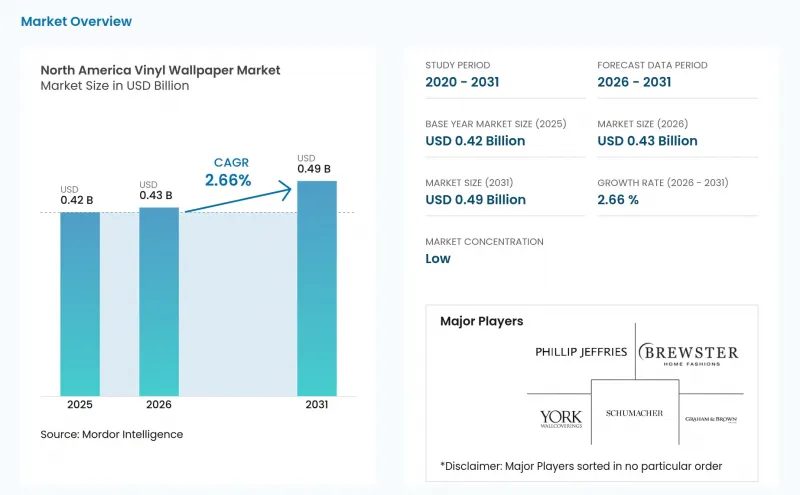
According to Mordor Intelligence, the North America vinyl wallpaper market size was valued at USD 0.42 billion in 2025, is estimated at USD 0.43 billion in 2026, and is forecast to reach USD 0.49 billion by 2031, growing at a 2.66% CAGR during 2026-2031.
North America Vinyl Wallpaper Market Trends and Insights
Residential Renovation and Remodeling Activity Sustains Baseline Demand
Higher mortgage rates have kept many homeowners in their current homes, directing spending toward interior improvements. NAHB forecast 3% inflation-adjusted remodeling growth for 2026 and 2% growth for 2027. The association reported 128,000 remodeling firms at the start of 2025, compared with 69,000 in 2000. Bathroom, kitchen, and whole-house renovations create regular opportunities to replace wall surfaces. Aging-in-place work also favors finishes that are durable, moisture-resistant, and easy to maintain. This makes renovation activity a consistent source of demand for the North America vinyl wallpaper market. Homeowners can use wallcoverings to update rooms without undertaking structural changes. Remodelers can also recommend products that match moisture, cleaning, and visual requirements within a single project. This recurring work supports demand across both professionally installed and do-it-yourself formats.
Durable and Washable Wallcovering Demand Anchors Commercial Specification Cycles
Commercial facilities require wall finishes that can handle repeated cleaning and daily wear. The Wallcoverings Association specifies 16 performance tests for Type II vinyl products, including abrasion, stain, tear, and adhesion requirements. Hotels, health care facilities, and offices use these standards when selecting wallcoverings. Products with performance documentation can remain on preferred supplier lists through replacement cycles. This shifts some purchasing decisions away from aesthetic preference and toward maintenance needs. The North America vinyl wallpaper market, therefore, benefits when project teams prioritize lifecycle performance. Washable surfaces can reduce the burden of maintaining common areas and high-contact spaces. Buyers can also compare products based on their ability to retain appearance after regular cleaning. This favors suppliers that pair design choice with tested performance information.
Competition from Paint and Digital Wall Printing Caps Price Expansion
Paint remains the most widely used interior wall finish in North America. Textured and faux-finish paint can reproduce some wallpaper effects with a simpler installation process. Digital wall printing also serves custom mural projects in hospitality and retail spaces. These alternatives can reduce the appeal of wallpaper where cost and installation speed are the main criteria. Vinyl retains a clearer position in settings that require documented washability, durability, and fire performance. The North America vinyl wallpaper market remains strongest where those technical needs are part of the specification. Paint also benefits from wide contractor familiarity and a well-established retail supply chain. Digital printing offers flexibility for single-site murals, but it does not necessarily provide the same performance record as specified vinyl. Suppliers need to explain the maintenance and compliance advantages that distinguish performance wallcovering from decorative alternatives.
Other drivers and restraints analyzed in the detailed report include:
- Hospitality, Healthcare, and Office Refurbishment Accelerates High-Performance Vinyl Adoption
- Peel-and-Stick and DIY Installation Opens a Structurally New Consumer Channel
- Installation Labor Requirements Constrain Project Velocity and Channel Reach
For complete list of drivers and restraints, kindly check the Table Of Contents.
Segment Analysis
Solid vinyl held 42.0% of the North America vinyl wallpaper market share in 2025. Its familiar construction and broad design range support use in residential renovation and light commercial settings. A one-piece vinyl face can keep production and purchase costs accessible for volume projects. Vinyl-coated paper remains relevant for buyers seeking limited washability at a lower price. Non-woven vinyl products offer paste-the-wall installation, which can simplify work in furnished interiors. These constructions allow suppliers to serve different budgets and installation needs.
Fabric-backed vinyl is forecast to grow at a 3.60% CAGR through 2031. Woven backings improve dimensional stability and tear resistance in high-traffic locations. Hotels and health care facilities use these properties when wall surfaces face frequent contact and cleaning. Type II performance criteria are particularly relevant for corridors, lobbies, and institutional interiors. Suppliers are also introducing lighter constructions to improve handling and project scheduling. Product development, therefore, moves toward performance formats that remain practical for installers.
Traditional and non-self-adhesive products held 67.0% of the 2025 installation market value. These formats remain common in commercial, health care, and high-end residential work. Paste-applied products are suited to installations where permanence and documented Type II performance matter. Professional installers and design teams use them for projects with defined durability requirements. Paste-the-wall non-woven formats can reduce some preparation steps for residential projects. Traditional installation will remain important where technical performance drives the purchase decision.
Self-adhesive vinyl is projected to be the fastest-growing installation type, at an 3.80% CAGR during 2026-2031. Removable formats appeal to renters and homeowners who want faster updates. The products are sold through home centers, specialty retailers, and direct online channels. Their lower dependence on skilled labor changes the economics of small projects. Digital preview tools can help shoppers evaluate patterns before ordering. This has created a consumer-led growth path within the North America vinyl wallpaper market.
Complete Report Scope:
- By Product Type/Construction Type
- Solid Vinyl Wallpaper
- Vinyl Coated Paper
- Fabric Backed Vinyl
- Non-Woven Vinyl Wallpapers
- Other Product Type
- By Installation Type
- Traditional/Non Self-Adhesive
- Self-Adhesive / Peel-and-Stick Vinyl Wallpaper
- By Application
- New Construction
- Renovation and Remodeling
- By End User
- Residential
- Living Room
- Kitchen
- Bedroom
- Bathroom
- Kids Room
- Commercial
- Residential
- By Distribution Channel
- B2C Channels
- Hypermarkets and Supermarkets
- Specialty Wallpaper Stores
- Home Centers
- Online
- Local Shops (unorganized channels)
- Other Distribution Channels
- B2B Channels (Contractors and Installers, Interior Designers and Architects, Project Procurement and Institutional Sales)
- B2C Channels
- By Geography
- United States
- Canada
- Mexico
List of Companies Covered in this Report:
- York Wallcoverings
- Brewster Home Fashions LLC
- WallPops
- Tempaper & Co.
- F. Schumacher & Co.
- Phillip Jeffries Ltd.
- Wallquest Inc.
- Koroseal Interior Products
- Seabrook Designs
- 4Walls
- Graham & Brown Ltd
- Sanderson Design Group plc
- A.S. Creation Tapeten AG
- RoomMates Decor
- Osborne & Little
- The Romo Group
- MDC Wallcoverings (MDCWall)
- Len-Tex Corporation
- Maya Romanoff Corporation
- Flavor Paper
Additional Benefits:
- The market estimate (ME) sheet in Excel format
- 3 months of analyst support
TABLE OF CONTENTS
1 Introduction
- 1.1 Study Assumptions & Market Definition
- 1.2 Scope of the Study
2 Research Methodology
3 Executive Summary
4 Market Landscape
- 4.1 Market Overview
- 4.2 Market Drivers
- 4.2.1 Durable and Washable Wallcovering Demand
- 4.2.2 Residential Renovation and Remodeling Activity
- 4.2.3 Hospitality, Healthcare, and Office Refurbishment
- 4.2.4 Growth of Peel-and-Stick and DIY Installation
- 4.2.5 Digital Printing and Short-Run Customization
- 4.2.6 Compliance-Led Demand for Low-Emission Commercial Wallcoverings
- 4.3 Market Restraints
- 4.3.1 Competition from Paint and Digital Wall Printing
- 4.3.2 Installation Labor Requirements
- 4.3.3 Vinyl Resin, Plasticizer, and Freight Cost Volatility
- 4.3.4 Recycling and End-of-Life Constraints for PVC Wallcoverings
- 4.4 Industry Value Chain Analysis
- 4.5 Porter's Five Forces Analysis
- 4.5.1 Threat of New Entrants
- 4.5.2 Bargaining Power of Suppliers
- 4.5.3 Bargaining Power of Buyers
- 4.5.4 Threat of Substitutes
- 4.5.5 Competitive Rivalry
- 4.6 Insights into the Latest Trends and Innovations in the Industry
- 4.7 Insights into the Recent Developments (New Product Launches, Strategic Initiatives, Investments, Partnerships, JVs, Expansion, M&As, etc.) in the Industry
5 Market Size & Growth Forecasts (Value in USD Billion)
- 5.1 By Product Type/Construction Type
- 5.1.1 Solid Vinyl Wallpaper
- 5.1.2 Vinyl Coated Paper
- 5.1.3 Fabric Backed Vinyl
- 5.1.4 Non-Woven Vinyl Wallpapers
- 5.1.5 Other Product Type
- 5.2 By Installation Type
- 5.2.1 Traditional/Non Self-Adhesive
- 5.2.2 Self-Adhesive / Peel-and-Stick Vinyl Wallpaper
- 5.3 By Application
- 5.3.1 New Construction
- 5.3.2 Renovation and Remodeling
- 5.4 By End User
- 5.4.1 Residential
- 5.4.1.1 Living Room
- 5.4.1.2 Kitchen
- 5.4.1.3 Bedroom
- 5.4.1.4 Bathroom
- 5.4.1.5 Kids Room
- 5.4.2 Commercial
- 5.4.1 Residential
- 5.5 By Distribution Channel
- 5.5.1 B2C Channels
- 5.5.1.1 Hypermarkets and Supermarkets
- 5.5.1.2 Specialty Wallpaper Stores
- 5.5.1.3 Home Centers
- 5.5.1.4 Online
- 5.5.1.5 Local Shops (unorganized channels)
- 5.5.1.6 Other Distribution Channels
- 5.5.2 B2B Channels (Contractors and Installers, Interior Designers and Architects, Project Procurement and Institutional Sales)
- 5.5.1 B2C Channels
- 5.6 By Geography
- 5.6.1 United States
- 5.6.2 Canada
- 5.6.3 Mexico
6 Competitive Landscape
- 6.1 Market Concentration Overview
- 6.2 Strategic Moves
- 6.3 Market Share Analysis
- 6.4 Company Profiles (includes Global level Overview, Market level overview, Core Segments, Financials as available, Strategic Information, Market Rank/Share for key companies, Products & Services, and Recent Developments)
- 6.4.1 York Wallcoverings
- 6.4.2 Brewster Home Fashions LLC
- 6.4.3 WallPops
- 6.4.4 Tempaper & Co.
- 6.4.5 F. Schumacher & Co.
- 6.4.6 Phillip Jeffries Ltd.
- 6.4.7 Wallquest Inc.
- 6.4.8 Koroseal Interior Products
- 6.4.9 Seabrook Designs
- 6.4.10 4Walls
- 6.4.11 Graham & Brown Ltd
- 6.4.12 Sanderson Design Group plc
- 6.4.13 A.S. Creation Tapeten AG
- 6.4.14 RoomMates Decor
- 6.4.15 Osborne & Little
- 6.4.16 The Romo Group
- 6.4.17 MDC Wallcoverings (MDCWall)
- 6.4.18 Len-Tex Corporation
- 6.4.19 Maya Romanoff Corporation
- 6.4.20 Flavor Paper
7 Market Opportunities & Future Outlook
- 7.1 Low-VOC and PVC-Reduced Commercial Vinyl Wallcoverings
- 7.2 Recyclable and Take-Back-Ready Vinyl Systems

