PUBLISHER: Mordor Intelligence | PRODUCT CODE: 2163484

PUBLISHER: Mordor Intelligence | PRODUCT CODE: 2163484
Italy Vinyl Wallpaper - Market Share Analysis, Industry Trends & Statistics, Growth Forecasts (2026 - 2031)
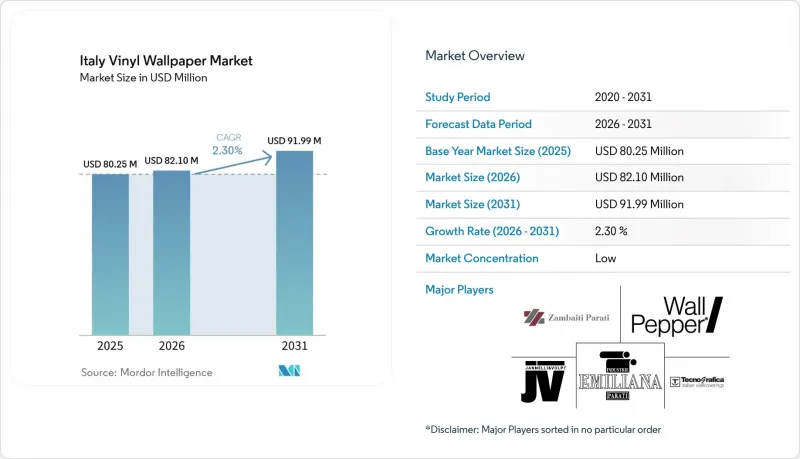
According to Mordor Intelligence, the Italy vinyl wallpaper market was valued at USD 80.25 million in 2025, is estimated at USD 82.10 million in 2026, and is forecast to reach USD 91.99 million by 2031, growing at a 2.30% CAGR during 2026-2031.
Italy Vinyl Wallpaper Market Trends and Insights
Premium Renovation and Interior-Design Spending
The Italy vinyl wallpaper market is supported by household spending that favors interior quality even when structural renovation budgets are under pressure. The end of the Superbonus scheme reduced the appeal of large structural projects, including insulation and HVAC upgrades. It also redirected some spending toward decorative work that can refresh a room with fewer disruptions. ANCE expects housing renovation investment to recover by 3.5% in 2026, after an 18% decline in 2025. The extension of renovation tax deductions in the 2026 budget supports the timing of household improvement decisions. This setting favors vinyl wallcoverings where homeowners seek a durable, high-visibility finish rather than a complete rebuild.
Demand for Washable and Durable Wall Finishes
Washability and longevity remain central reasons for choosing vinyl in the Italy vinyl wallpaper market. Commercial-grade Type II vinyl can withstand 5,000 to 10,000 scrub cycles under ASTM testing, while standard emulsion paint can withstand fewer than 50 wash events. EN 15102 provides a European performance and CE-marking framework for wallcoverings placed on the market under the Construction Products Regulation. These requirements give architects and contractors a clear basis for comparing specified surfaces. Moisture-resistant formats also fit bathroom and other wet-area applications, where cleaning and surface performance matter more than low initial cost. Infrequent renovation cycles make this maintenance benefit more important for apartment owners and professional specifiers.
Paint as a Lower-Cost Substitute
Paint remains the default option for budget-sensitive residential projects because installation is simpler and does not normally require specialist labor. This places the strongest pressure on mass-market wallpaper purchases and small cosmetic projects. The effect is less pronounced in hospitality, healthcare, and premium residential work, where surface durability and design detail carry greater weight. The Italy vinyl wallpaper market also faces an uneven supply of specialist installers, particularly in Southern Italy and the Islands. Professional installation remains important for high-specification formats because poor application can undermine the finished result. Producers can address this constraint by communicating lifecycle value through architects, contractors, and specialist retailers rather than competing only on upfront price.
Other drivers and restraints analyzed in the detailed report include:
- Digitally Printed Wallcoverings and Italian Design Differentiation
- Hospitality and Commercial Refurbishment Cycles
- PVC Resin and Additive Cost Volatility
For complete list of drivers and restraints, kindly check the Table Of Contents.
Segment Analysis
Vinyl-coated paper held 42.50% of the Italy vinyl wallpaper market share in 2025, while fabric-backed vinyl is projected to grow at a 3.94% CAGR during 2026-2031. Vinyl-coated paper remains widely used in residential settings and mid-market commercial spaces. Its cost position and digital-print compatibility support broad demand. Fabric-backed vinyl serves hospitality and healthcare buyers who need wipe-resistant, contract-grade products. Its dual-layer construction also reduces the risk of tearing during professional installation. The difference reflects a split between volume-oriented decorative applications and demanding environments that prioritize product performance. Nonwoven vinyl and non-PVC nonwoven substrates continue to gain share in residential projects, limiting growth in vinyl-coated paper.
Solid vinyl wallpaper addresses premium homes and commercial settings where embossed textures and relief surfaces support a higher-value finish. Non-woven vinyl wallpaper has a role in lower-disruption projects because paste-the-wall formats simplify application. The paste-the-wall installation can reduce labor time by 25% compared with paste-the-paper formats. Other product types include glass-fiber-backed and specialty substrates for more specific performance needs. Zambaiti Parati has organized its offer around Z Waterproof, Z Acoustic, Z Pareti Vive, and Z Protection. This approach presents substrates as functional platforms that address moisture, acoustics, visual texture, and surface protection.
Traditional/non-self-adhesive wallpaper accounted for 71.00% of the Italian vinyl wallpaper market share in 2025, while self-adhesive and peel-and-stick vinyl is projected to grow at a 3.94% CAGR during 2026-2031. Traditional application remains the usual choice for hospitality and high-specification residential projects. Architects, interior designers, and specialist contractors often regard professional installation as part of the quality standard. The method gives installers greater control over alignment, seams, and a consistent finish. It is also more closely associated with certified project delivery under EN 15102.
Self-adhesive products appeal to renters, short-term rental property owners, and homeowners seeking a removable decorative change. These formats reduce the disruption of installation and can suit small projects with limited downtime. Their moisture resistance and dimensional stability make vinyl an important material within the peel-and-stick category. Online room-visualization tools can also reduce uncertainty when users select a pattern remotely. The Italy vinyl wallpaper market is likely to retain traditional installation as the core format because contract work depends on professional application. Self-adhesive demand nonetheless broadens the addressable customer base for decorative and temporary uses.
Complete Report Scope:
- By Product Type/Construction Type
- Solid Vinyl Wallpaper
- Vinyl Coated Paper
- Fabric Backed Vinyl
- Non-Woven Vinyl Wallpapers
- Other Product Type
- By Installation Type
- Traditional/Non Self-Adhesive
- Self-Adhesive / Peel-and-Stick Vinyl Wallpaper
- By Application
- New Construction
- Renovation and Remodeling
- By End User
- Residential
- Living Room
- Kitchen
- Bedroom
- Bathroom
- Kids Room
- Commercial
- Residential
- By Distribution Channel
- B2C Channels
- Hypermarkets and Supermarkets
- Specialty Wallpaper Stores
- Home Centers
- Online
- Local Shops (unorganized channels)
- Other Distribution Channels
- B2B Channels (Contractors and Installers, Interior Designers and Architects, Project Procurement and Institutional Sales)
- B2C Channels
- By Geography
- North-West
- North-East
- Central
- South
- Islands (Sicily and Sardinia)
List of Companies Covered in this Report:
- Jv S.p.A.
- Zambaiti Parati Srl
- Industrie Emiliana Parati S.p.A.
- Tecnografica S.p.A.
- WallPepper Group S.r.l.
- SIRPI S.p.A.
- Glamora Srl
- Inkiostro Bianco S.r.l.
- Manarti Design
- Eko Design Srl
- Wallpaper Dream
- Fabscarte Srl
- Parati Lanteri
- A.S. Creation Tapeten AG
- Grandeco Wallfashion Group Belgium NV
- Tapetenfabrik Gebr. Rasch GmbH and Co. KG
- Erismann and Cie. GmbH
- Graham and Brown Ltd
- Wall and Deco Srl
- Vescom B.V.
Additional Benefits:
- The market estimate (ME) sheet in Excel format
- 3 months of analyst support
TABLE OF CONTENTS
1 Introduction
- 1.1 Study Assumptions & Market Definition
- 1.2 Scope of the Study
2 Research Methodology
3 Executive Summary
4 Market Landscape
- 4.1 Market Overview
- 4.2 Market Drivers
- 4.2.1 Premium Renovation and Interior-Design Spending
- 4.2.2 Demand for Washable and Durable Wall Finishes
- 4.2.3 Digitally Printed and Customized Wallcoverings
- 4.2.4 Hospitality and Commercial Refurbishment Cycles
- 4.2.5 Bathroom and Wet-Area Vinyl Applications
- 4.2.6 Italian Design Differentiation Through Made-in-Italy Production
- 4.3 Market Restraints
- 4.3.1 Paint as a Lower-Cost Substitute
- 4.3.2 PVC Resin and Additive Cost Volatility
- 4.3.3 PVC Sustainability and Indoor-Air-Quality Concerns
- 4.3.4 Installer Availability and Project-Specific Application Complexity
- 4.4 Industry Value Chain Analysis
- 4.5 Porter's Five Forces Analysis
- 4.5.1 Threat of New Entrants
- 4.5.2 Bargaining Power of Suppliers
- 4.5.3 Bargaining Power of Buyers
- 4.5.4 Threat of Substitutes
- 4.5.5 Competitive Rivalry
- 4.6 Insights into the Latest Trends and Innovations in the Industry
- 4.7 Insights into the Recent Developments (New Product Launches, Strategic Initiatives, Investments, Partnerships, JVs, Expansion, M&As, etc.) in the Industry
5 Market Size & Growth Forecasts (Value in USD)
- 5.1 By Product Type/Construction Type
- 5.1.1 Solid Vinyl Wallpaper
- 5.1.2 Vinyl Coated Paper
- 5.1.3 Fabric Backed Vinyl
- 5.1.4 Non-Woven Vinyl Wallpapers
- 5.1.5 Other Product Type
- 5.2 By Installation Type
- 5.2.1 Traditional/Non Self-Adhesive
- 5.2.2 Self-Adhesive / Peel-and-Stick Vinyl Wallpaper
- 5.3 By Application
- 5.3.1 New Construction
- 5.3.2 Renovation and Remodeling
- 5.4 By End User
- 5.4.1 Residential
- 5.4.1.1 Living Room
- 5.4.1.2 Kitchen
- 5.4.1.3 Bedroom
- 5.4.1.4 Bathroom
- 5.4.1.5 Kids Room
- 5.4.2 Commercial
- 5.4.1 Residential
- 5.5 By Distribution Channel
- 5.5.1 B2C Channels
- 5.5.1.1 Hypermarkets and Supermarkets
- 5.5.1.2 Specialty Wallpaper Stores
- 5.5.1.3 Home Centers
- 5.5.1.4 Online
- 5.5.1.5 Local Shops (unorganized channels)
- 5.5.1.6 Other Distribution Channels
- 5.5.2 B2B Channels (Contractors and Installers, Interior Designers and Architects, Project Procurement and Institutional Sales)
- 5.5.1 B2C Channels
- 5.6 By Geography
- 5.6.1 North-West
- 5.6.2 North-East
- 5.6.3 Central
- 5.6.4 South
- 5.6.5 Islands (Sicily and Sardinia)
6 Competitive Landscape
- 6.1 Market Concentration Overview
- 6.2 Strategic Moves
- 6.3 Market Share Analysis
- 6.4 Company Profiles {(includes Global level Overview, Market level overview, Core Segments, Financials as available, Strategic Information, Market Rank/Share for key companies, Products & Services, and Recent Developments)}
- 6.4.1 Jv S.p.A.
- 6.4.2 Zambaiti Parati Srl
- 6.4.3 Industrie Emiliana Parati S.p.A.
- 6.4.4 Tecnografica S.p.A.
- 6.4.5 WallPepper Group S.r.l.
- 6.4.6 SIRPI S.p.A.
- 6.4.7 Glamora Srl
- 6.4.8 Inkiostro Bianco S.r.l.
- 6.4.9 Manarti Design
- 6.4.10 Eko Design Srl
- 6.4.11 Wallpaper Dream
- 6.4.12 Fabscarte Srl
- 6.4.13 Parati Lanteri
- 6.4.14 A.S. Creation Tapeten AG
- 6.4.15 Grandeco Wallfashion Group Belgium NV
- 6.4.16 Tapetenfabrik Gebr. Rasch GmbH and Co. KG
- 6.4.17 Erismann and Cie. GmbH
- 6.4.18 Graham and Brown Ltd
- 6.4.19 Wall and Deco Srl
- 6.4.20 Vescom B.V.
7 Market Opportunities & Future Outlook
- 7.1 PVC-Reduced Commercial Wallcoverings
- 7.2 Digitally Customized Small-Batch Contract Products

