PUBLISHER: Mordor Intelligence | PRODUCT CODE: 2097374

PUBLISHER: Mordor Intelligence | PRODUCT CODE: 2097374
India Securities Brokerage - Market Share Analysis, Industry Trends & Statistics, Growth Forecasts (2025 - 2031)
According to Mordor Intelligence, the India securities brokerage market size is expected to grow from USD 6.18 billion in 2025 to USD 6.98 billion in 2026 and is forecast to reach USD 13.09 billion by 2031 at 13.33% CAGR over 2026-2031.
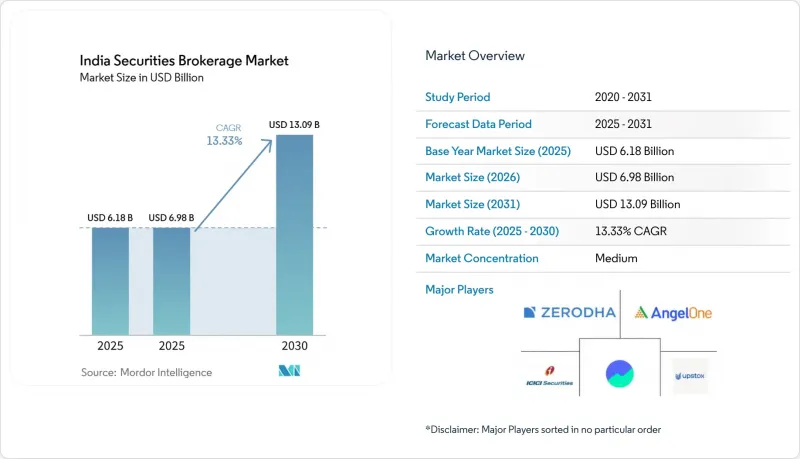
This report is Segmented by Type of Security (Bonds, Stocks, Treasury Notes, Derivatives, Others), Type of Brokerage Service (Stock, Insurance, Mortgage, Real Estate, Forex, Leasing, Others), Type of Service (Full-Service, and Other), Client Type (Retail, and Other), and Geography (North India, and Other). The Market Forecasts are Provided in Terms of Value (USD).
India Securities Brokerage Market Trends and Insights
Surge in Demat Account Growth Transforms Market Access
Post-2020 demat account proliferation has fundamentally altered India's investment landscape, with accounts growing from 40 million to over 120 million by August 2025. SEBI's digital KYC rationalization and e-sign integration eliminated traditional paperwork barriers, enabling account opening within minutes rather than days . This democratization effect extends beyond urban centers, with tier-2 and tier-3 cities contributing 45% of new account openings in 2024. The velocity of account creation has outpaced global benchmarks, positioning India as the world's fastest-growing retail investment market. However, account activation rates remain below 60%, indicating significant latent capacity for revenue conversion as financial literacy programs expand and product awareness increases.
Mobile-First Trading Platforms Reshape Client Acquisition
The migration to mobile-first trading platforms has created a structural shift in client acquisition costs and engagement patterns. Over 95% of new brokerage accounts originate from mobile applications, with average client acquisition costs dropping 40% compared to traditional branch-based models. Zerodha's Kite platform processes over 6 million orders daily, while Angel One's SuperApp strategy integrates trading with mutual funds, insurance, and loans to increase client lifetime value. The mobile-centric approach has enabled brokers to reach previously underserved markets, with rural and semi-urban areas contributing 35% of new client additions. This technological leverage allows discount brokers to maintain profitability despite zero-brokerage models through scale economics and cross-selling opportunities.
Zero-Brokerage Competition
The race-to-zero brokerage pricing has fundamentally altered industry economics, with leading players eliminating equity delivery charges to attract price-sensitive retail clients. This strategic shift has compressed per-client revenue by 35-40% across the industry, forcing brokers to achieve profitability through scale and ancillary services. Zerodha's zero-brokerage model, generating revenue through interest on client funds and currency trading spreads, has become the industry template that competitors must match to remain competitive. The margin compression particularly impacts full-service brokers whose advisory and research capabilities command a limited premium in a commoditized trading environment. Regulatory frameworks under SEBI oversight ensure fair competition while preventing predatory pricing that could destabilize market structure.
Other drivers and restraints analyzed in the detailed report include:
- UPI Integration Accelerates Trading Velocity
- Exchange Product Innovation Expands Revenue Opportunities
- Exchange Infrastructure Concentration Creates Systemic Risk
For complete list of drivers and restraints, kindly check the Table Of Contents.
Segment Analysis
Stock trading maintains its dominant position at 46% market share in 2024, reflecting India's equity-centric investment culture and retail preference for direct ownership over complex instruments. However, derivatives trading emerges as the fastest-growing segment at 8.9% CAGR through 2030, driven by sophisticated retail participation and institutional hedging requirements despite SEBI's regulatory tightening. The derivatives segment's resilience stems from its role in price discovery and risk management, with F&O turnover exceeding cash market volumes by 3:1 ratios during volatile periods at NSE. Bonds represent 6.5% market share but face structural headwinds from corporate credit concerns and interest rate volatility, while ETFs and mutual funds capture growing systematic investment plan flows.
Treasury notes and government securities trading remains constrained at 1.1% market share, primarily serving institutional participants and high-net-worth individuals seeking fixed-income exposure. The segment's limited retail penetration reflects complexity barriers and minimum investment thresholds that exclude smaller investors. SEBI's regulatory influence through margin requirements and position limits continues to shape derivatives participation, with new delta-based open interest calculations (FutEq) providing more accurate risk measurement frameworks that could enhance market stability while maintaining growth momentum.
Stock brokerage services dominate the market at a 40.2% share in 2024, encompassing equity delivery, intraday, and derivatives trading that form the core revenue base for most brokers. Forex trading emerges as the fastest-growing service category at 7.4% CAGR, propelled by NSE IFSC's dollar-rupee futures contracts and GIFT City's international trading infrastructure that enables 24-hour currency trading. This growth trajectory reflects India's increasing integration with global financial markets and NRI investment flows that require currency hedging capabilities.
Commodities trading maintains a 3.1% market share through the MCX and NCDEX platforms, serving agricultural producers and industrial consumers seeking price risk management tools. Insurance brokerage represents a 2.7% share but faces regulatory constraints from IRDAI guidelines that limit cross-selling opportunities between securities and insurance products. Real estate and mortgage brokerage services capture 5.2% combined share, benefiting from property market recovery and home loan demand in tier-2 cities. The regulatory framework under SEBI oversight ensures service quality standards while enabling innovation in product delivery and client engagement models.
Complete Report Scope:
- By Type of Security
- Bonds
- Stocks
- Treasury Notes
- Derivatives
- Others (ETFs, Mutual Funds)
- By Type of Brokerage Service
- Stock
- Insurance
- Mortgage
- Real Estate
- Forex
- Leasing
- Others (Commodities)
- By Type of Service
- Full-Service
- Discount
- Online
- Robo Advisor
- Broker-Dealers
- By Client Type
- Retail
- High Net Worth Individuals
- Institutional
- Small & Mid-Sized Enterprises
- By Geography
- North India
- West India
- South India
- East India
- Central India
- North-East India
List of Companies Covered in this Report:
- Zerodha
- Angel One
- ICICI Securities
- HDFC Securities
- Kotak Securities
- Upstox
- Groww
- Sharekhan
- Motilal Oswal
- Axis Securities
- 5paisa
- SBICAP Securities
- IIFL Securities
- Edelweiss Broking
- Geojit Financial
- Religare Broking
- Paytm Money
- Alice Blue
- Ventura Securities
- Nirmal Bang
Additional Benefits:
- The market estimate (ME) sheet in Excel format
- 3 months of analyst support
TABLE OF CONTENTS
1 Introduction
- 1.1 Study Assumptions & Market Definition
- 1.2 Scope of the Study
2 Research Methodology
3 Executive Summary
4 Market Landscape
- 4.1 Market Overview
- 4.2 Market Drivers
- 4.2.1 Surge in demat account openings post-2020
- 4.2.2 Growth of low-cost mobile trading platforms
- 4.2.3 UPI-enabled instant fund transfer
- 4.2.4 Expanded exchange product suite
- 4.2.5 Tokenization of sovereign gold bonds
- 4.2.6 Wealth-tech partnerships with neo-banks
- 4.3 Market Restraints
- 4.3.1 Zero-brokerage price wars
- 4.3.2 Exchange infrastructure dependency
- 4.3.3 Inadequate cyber-resilience frameworks at mid-tier brokers
- 4.3.4 Limited capital-market literacy outside Tier-1 cities
- 4.4 Value / Supply-Chain Analysis
- 4.5 Regulatory Landscape
- 4.6 Technological Outlook
- 4.7 Porter's Five Forces
- 4.7.1 Threat of New Entrants
- 4.7.2 Bargaining Power of Buyers
- 4.7.3 Bargaining Power of Suppliers
- 4.7.4 Threat of Substitutes
- 4.7.5 Intensity of Rivalry
5 Market Size & Growth Forecasts (Value, USD billion)
- 5.1 By Type of Security
- 5.1.1 Bonds
- 5.1.2 Stocks
- 5.1.3 Treasury Notes
- 5.1.4 Derivatives
- 5.1.5 Others (ETFs, Mutual Funds)
- 5.2 By Type of Brokerage Service
- 5.2.1 Stock
- 5.2.2 Insurance
- 5.2.3 Mortgage
- 5.2.4 Real Estate
- 5.2.5 Forex
- 5.2.6 Leasing
- 5.2.7 Others (Commodities)
- 5.3 By Type of Service
- 5.3.1 Full-Service
- 5.3.2 Discount
- 5.3.3 Online
- 5.3.4 Robo Advisor
- 5.3.5 Broker-Dealers
- 5.4 By Client Type
- 5.4.1 Retail
- 5.4.2 High Net Worth Individuals
- 5.4.3 Institutional
- 5.4.4 Small & Mid-Sized Enterprises
- 5.5 By Geography
- 5.5.1 North India
- 5.5.2 West India
- 5.5.3 South India
- 5.5.4 East India
- 5.5.5 Central India
- 5.5.6 North-East India
6 Competitive Landscape
- 6.1 Market Concentration
- 6.2 Strategic Moves
- 6.3 Market Share Analysis
- 6.4 Company Profiles
- 6.4.1 Zerodha
- 6.4.2 Angel One
- 6.4.3 ICICI Securities
- 6.4.4 HDFC Securities
- 6.4.5 Kotak Securities
- 6.4.6 Upstox
- 6.4.7 Groww
- 6.4.8 Sharekhan
- 6.4.9 Motilal Oswal
- 6.4.10 Axis Securities
- 6.4.11 5paisa
- 6.4.12 SBICAP Securities
- 6.4.13 IIFL Securities
- 6.4.14 Edelweiss Broking
- 6.4.15 Geojit Financial
- 6.4.16 Religare Broking
- 6.4.17 Paytm Money
- 6.4.18 Alice Blue
- 6.4.19 Ventura Securities
- 6.4.20 Nirmal Bang
7 Market Opportunities & Future Outlook
- 7.1 Embedded-brokerage APIs within super-apps
- 7.2 Expansion of ESG-linked thematic investing platforms

