PUBLISHER: Mordor Intelligence | PRODUCT CODE: 2098459

PUBLISHER: Mordor Intelligence | PRODUCT CODE: 2098459
United States AI-powered Energy Management Software - Market Share Analysis, Industry Trends & Statistics, Growth Forecasts (2026 - 2031)
According to Mordor Intelligence, the United States AI-powered energy management software market size was valued at USD 1.19 billion in 2025 and estimated to grow from USD 1.40 billion in 2026 to reach USD 3.19 billion by 2031, at a CAGR of 18.00% during the forecast period 2026 to 2031.
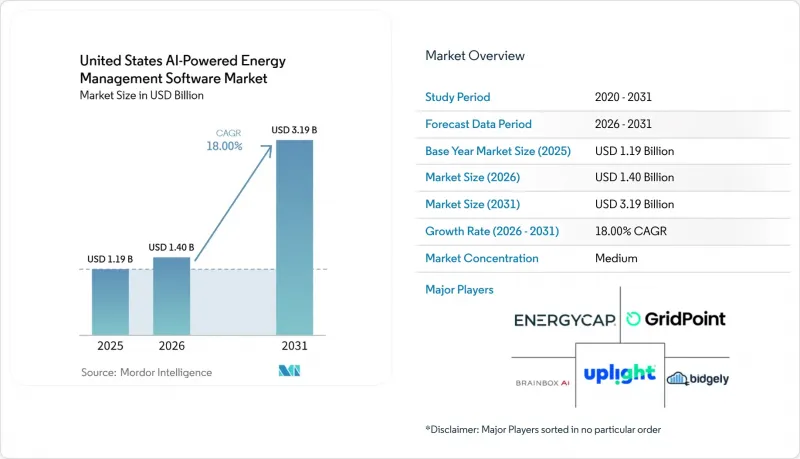
This report is Segmented by Component (Software, and Services), Deployment Mode (Cloud-Based, On-Premises, and Hybrid), Application (Energy Consumption and Demand Optimization, Asset Performance and Predictive Maintenance, and More), and End User (Utilities, Commercial Buildings, Industrial Facilities, and Residential Buildings). Market Forecasts are Provided in Value (USD).
United States AI-powered Energy Management Software Market Trends and Insights
Rapid Utility Data Digitization and Grid Modernization Programs
Utilities are expanding digital grid programs at the same time that large loads from AI infrastructure are becoming harder to manage with older operating models. The U.S. Department of Energy stated in 2024 that domestic data center electricity consumption is expected to double or triple by 2028 and reach 325TWh to 580TWh, which raises the need for better monitoring and control across both grid and customer assets. GridPoint stated that utilities filed USD 18.2 billion in aggregate rate increase requests in 2025 to support grid investment, which supports demand for software that can turn interval data and operating signals into load flexibility. Argonne National Laboratory introduced GridMind in 2026 as an AI co-pilot for power system operators, which shows that utility-side AI adoption is moving from concept to operating use. In the United States AI-powered Energy Management Software Market, that shift matters because utilities that modernize their own control environments also create demand for customer-side software that can respond to grid conditions in real time.
Federal and State Decarbonization Targets for Commercial Buildings and Industry
Building performance standards are widening the compliance burden for commercial property owners and pushing continuous monitoring into routine operations. The Institute for Market Transformation reported that by 2025, 4 states and at least 9 local jurisdictions had enacted building performance standards, while around 30 additional governments had committed to adoption. Washington State enacted House Bill 1543 in 2025, and Evanston, Illinois, passed its Healthy Buildings Ordinance in 2025, extending the policy push beyond the largest coastal cities. These rules create a recurring need for measurement, reporting, and operational adjustment rather than a single benchmarking exercise. In the United States AI-powered Energy Management Software Market, that makes subscription platforms more useful than periodic audit tools for owners managing large building portfolios.
High Brownfield Integration Cost with Legacy OT and Building Controls
Brownfield integration remains a major brake on deployment, especially in older commercial and industrial sites. Many facilities still run proprietary automation systems that need gateways, middleware, and custom engineering before AI tools can ingest and use the data. The cost is higher when building operators cannot accept long maintenance windows or downtime during control system work. The problem becomes harder in multi-site portfolios because utility interval data, billing formats, and demand charge structures still vary across service territories. In the United States AI-powered Energy Management Software Market, this keeps adoption faster among technically sophisticated enterprise buyers than among smaller owners with limited internal resources.
Other drivers and restraints analyzed in the detailed report include:
- AI-Enabled Peak Demand Reduction and Automated Load Flexibility
- Cloud-Native Integration with Existing BMS, EMS, and IoT Stacks
- Cybersecurity and Critical Infrastructure Compliance Burden
For complete list of drivers and restraints, kindly check the Table Of Contents.
Segment Analysis
Software accounted for 74.50% of the 2025 segment mix, while services is projected to expand at a 20.80% CAGR through 2031. This split shows that the United States AI-powered Energy Management Software Market still draws most revenue from the core platform layer, but growth is moving toward implementation and post-deployment support. Buyers are asking for more than dashboards because integration, optimization, and reporting now affect realized savings and compliance outcomes. That makes professional and managed services more central to vendor strategy than in earlier phases of adoption.
The services opportunity includes system integration, AI model tuning, ongoing performance monitoring, and carbon reporting support. In the United States AI-powered energy management software industry, this reflects a shift from software procurement alone to outcome-based engagements that remain active after installation. Bidgely's 2025 launch of UtilityAI Pro across AWS, Snowflake, and Databricks environments supports this direction because it lets utilities run proprietary models within their own data environments while leaning on vendor expertise. As building owners face recurring compliance and optimization needs, vendors with strong service delivery can hold relationships longer and defend pricing more effectively.
Cloud-based deployment held 58.20% of the market in 2025 and also posts the fastest projected CAGR at 21.10% through 2031. This leadership reflects the advantage of real-time data ingestion, centralized updates, and benchmarking across multi-site portfolios. The United States AI-powered Energy Management Software Market has favored cloud platforms because large users need a single operating view across buildings, devices, and utility interfaces. That is especially useful when companies manage many sites with different demand profiles and compliance obligations.
On-premises deployments still matter in industrial and utility settings where direct cloud exposure remains limited by operating policy or security design. Hybrid models are gaining importance because they allow latency-sensitive controls at the edge while sending portfolio data to the cloud for analytics and reporting. The United States AI-powered Energy Management Software Market is therefore not moving toward cloud in a simple way, but toward architecture choices that match site-level risk and control needs. Vendors that support flexible deployment models are better positioned to serve utilities, critical facilities, and large enterprises with mixed asset bases. Hybrid architectures are also being reinforced by vendor partnerships that connect edge and cloud capabilities. Honeywell's 2026 collaboration with Tata Consultancy Services points to broader OT and IT convergence for autonomous operations.
Complete Report Scope:
- By Component
- Software
- Services
- By Deployment Mode
- Cloud-Based
- On-Premises
- Hybrid
- By Application
- Energy Consumption and Demand Optimization
- Asset Performance and Predictive Maintenance
- Smart Grid and Distributed Energy Resource (DER) Management
- Renewable Energy Forecasting and Integration
- Energy Trading, Pricing and Market Intelligence
- By End User
- Utilities
- Commercial Buildings
- Industrial Facilities
- Residential Buildings
List of Companies Covered in this Report:
- GridPoint, Inc.
- Bidgely, Inc.
- Uplight, Inc.
- EnergyCAP, LLC
- BrainBox AI Inc.
- 75F, Inc.
- Verdigris Technologies, Inc.
- CopperTree Analytics Inc.
- Metrikus Limited
- SkyFoundry, LLC
- Enertiv, Inc.
- Prospects Software Inc.
- PacifiQ, Inc.
- Schneider Electric SE
- Siemens AG
- Johnson Controls International plc
- Honeywell International Inc.
- ABB Ltd
- Emerson Electric Co.
- Schneider Electric Buildings Americas, Inc.
- Trane Technologies plc
- Itron, Inc.
Additional Benefits:
- The market estimate (ME) sheet in Excel format
- 3 months of analyst support
TABLE OF CONTENTS
1 INTRODUCTION
- 1.1 Study Assumptions And Market Definition
- 1.2 Scope Of The Study
2 RESEARCH METHODOLOGY
3 EXECUTIVE SUMMARY
4 MARKET LANDSCAPE
- 4.1 Market Overview
- 4.2 Market Drivers
- 4.2.1 Rapid Utility Data Digitization and Grid Modernization Programs
- 4.2.2 Federal and State Decarbonization Targets for Commercial Buildings and Industry
- 4.2.3 AI-Enabled Peak Demand Reduction and Automated Load Flexibility
- 4.2.4 Cloud Native Integration With Existing BMS, EMS, and IoT Stacks
- 4.2.5 Portfolio-Level Carbon Reporting Pressure from Enterprise Buyers
- 4.2.6 Data Center Energy Intensity and Continuous Optimization Needs
- 4.3 Market Restraints
- 4.3.1 High Brownfield Integration Cost With Legacy OT and Building Controls
- 4.3.2 Cybersecurity and Critical Infrastructure Compliance Burden
- 4.3.3 Fragmented Energy Data Across Sites, Utilities, and Vendors
- 4.3.4 Shortage Of AI, Controls, and Energy Management Implementation Talent
- 4.4 Industry Value Chain Analysis
- 4.5 Regulatory Landscape
- 4.6 Technological Outlook
- 4.7 Porter's Five Forces Analysis
- 4.7.1 Bargaining Power Of Suppliers
- 4.7.2 Bargaining Power Of Buyers
- 4.7.3 Threat Of New Entrants
- 4.7.4 Threat Of Substitutes
- 4.7.5 Intensity of Competitive Rivalry
- 4.8 Impact Of Macroeconomic Factors On The Market
5 MARKET SIZE AND GROWTH FORECASTS (VALUE)
- 5.1 By Component
- 5.1.1 Software
- 5.1.2 Services
- 5.2 By Deployment Mode
- 5.2.1 Cloud-Based
- 5.2.2 On-Premises
- 5.2.3 Hybrid
- 5.3 By Application
- 5.3.1 Energy Consumption and Demand Optimization
- 5.3.2 Asset Performance and Predictive Maintenance
- 5.3.3 Smart Grid and Distributed Energy Resource (DER) Management
- 5.3.4 Renewable Energy Forecasting and Integration
- 5.3.5 Energy Trading, Pricing and Market Intelligence
- 5.4 By End User
- 5.4.1 Utilities
- 5.4.2 Commercial Buildings
- 5.4.3 Industrial Facilities
- 5.4.4 Residential Buildings
6 COMPETITIVE LANDSCAPE
- 6.1 Market Concentration
- 6.2 Strategic Moves
- 6.3 Market Share Analysis
- 6.4 Company Profiles (includes Global Level Overview, Market Level Overview, Core Segments, Financials as available, Strategic Information, Market Rank/Share, Products and Services, Recent Developments)
- 6.4.1 GridPoint, Inc.
- 6.4.2 Bidgely, Inc.
- 6.4.3 Uplight, Inc.
- 6.4.4 EnergyCAP, LLC
- 6.4.5 BrainBox AI Inc.
- 6.4.6 75F, Inc.
- 6.4.7 Verdigris Technologies, Inc.
- 6.4.8 CopperTree Analytics Inc.
- 6.4.9 Metrikus Limited
- 6.4.10 SkyFoundry, LLC
- 6.4.11 Enertiv, Inc.
- 6.4.12 Prospects Software Inc.
- 6.4.13 PacifiQ, Inc.
- 6.4.14 Schneider Electric SE
- 6.4.15 Siemens AG
- 6.4.16 Johnson Controls International plc
- 6.4.17 Honeywell International Inc.
- 6.4.18 ABB Ltd
- 6.4.19 Emerson Electric Co.
- 6.4.20 Schneider Electric Buildings Americas, Inc.
- 6.4.21 Trane Technologies plc
- 6.4.22 Itron, Inc.
7 MARKET OPPORTUNITIES AND FUTURE OUTLOOK
- 7.1 White-Space And Unmet-Need Assessment

