PUBLISHER: Mordor Intelligence | PRODUCT CODE: 2098490

PUBLISHER: Mordor Intelligence | PRODUCT CODE: 2098490
Green IT Software For Healthcare - Market Share Analysis, Industry Trends & Statistics, Growth Forecasts (2026 - 2031)
According to Mordor Intelligence, the green IT software for healthcare market size is expected to increase from USD 1.59 billion in 2025 to USD 1.82 billion in 2026 and reach USD 3.95 billion by 2031, growing at a CAGR of 16.76% over 2026-2031.
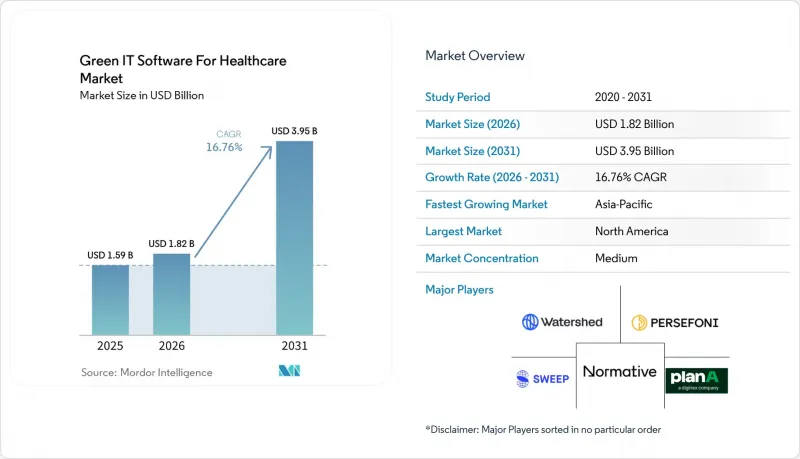
This report is Segmented by Component (Software and Services), Deployment Mode (Cloud-Based, On-Premise, and Hybrid), Organization Size (Large Enterprises and SMEs), Application (Carbon Footprint, Energy Optimization, ESG Reporting, and IT Infrastructure), End User (Hospitals, Ambulatory, Imaging, Payers, and Life Sciences), and Geography. The Market Forecasts are Provided in Terms of Value (USD).
Global Green IT Software For Healthcare Market Trends and Insights
Rising Energy Cost Pressure Across Healthcare Digital Estates
Rising power use across imaging storage, clinical servers, and connected digital workflows is making the Green IT software for healthcare market more urgent for provider boards. A 2025 study in European Radiology showed that long-term CT data storage consumes significant electricity across storage systems, servers, and network infrastructure, providing hospitals with a clear operating baseline for sustainability action. As digital care expands, energy management and carbon tracking increasingly sit within the same operating workflow rather than in separate teams. That shift favors platforms that can integrate asset selection, workload placement, and reporting outputs into a single system. The immediate effect is a stronger demand for software that can show where energy is consumed and how operational changes can lower both cost and emissions.
Carbon Reporting Requirements Tied To Health System Procurement
Procurement rules are moving the Green IT software for the healthcare market from optional spending to contract-linked spending. From April 6, 2026, NHS Supply Chain required suppliers to complete the Evergreen Sustainable Supplier Assessment Level 1 and to hold a PPN 006-compliant Carbon Reduction Plan covering Scope 1, Scope 2, and relevant Scope 3 emissions. That requirement matters because it pushes carbon data collection into ordinary vendor qualification, renewal, and tender activity. The Journal of Medical Internet Research also documented that unproven generative AI in UK primary care creates a reporting gap because AI-related emissions are not consistently captured in current disclosures. As procurement standards and disclosure expectations tighten together, platforms that support audit-ready reporting gain a clearer path into healthcare budgets.
Fragmented Sustainability Data Across Clinical And Nonclinical Systems
Fragmented data remains the largest barrier inside the Green IT software for healthcare market because sustainability records are spread across clinical, facilities, procurement, and enterprise software systems. Hospitals often keep energy, asset, and operating data in separate environments, which slows the creation of a consistent emissions baseline. That weak starting point makes reporting more difficult and lengthens platform deployment cycles, especially when organizations want a single view across multiple sites. Sana Kliniken AG's 2025 shift to Osapiens for ESG data management underscores why large operators are formalizing enterprise systems rather than relying on disconnected workflows. Until data models and interfaces become more standardized, the Green IT software for the healthcare market will face slower adoption across multisite providers and mid-sized institutions.
Other drivers and restraints analyzed in the detailed report include:
- Cloud Migration Demand For Lower-Emission IT Operations
- Need For Sustainable AI And Data Center Workloads In Healthcare
- Weak Green IT ROI Benchmarking For Mid-Sized Providers
For complete list of drivers and restraints, kindly check the Table Of Contents.
Segment Analysis
Software held 58% of the market in 2025, while services are projected to grow at an 18.12% CAGR through 2031. Software remained the structural anchor because healthcare buyers need a documented and continuously updated platform rather than a one-time consulting exercise. That position is reinforced by disclosure requirements that demand repeatable data collection, audit support, and workflow consistency across reporting periods. In the Green IT software for the healthcare industry, this makes software the base layer that other implementation and advisory services sit around.
Services are still set for the fastest expansion because integration, configuration, validation, and reporting support remain essential for many buyers in the Green IT software for healthcare market. As disclosure scope widens to include supply chain data, AI-related emissions, and multi-framework reporting, organizations need more help turning software outputs into usable compliance records. SAP announced in May 2026 that its new sustainability AI agents can cut packaging compliance hours by more than 50% and reduce scenario simulation time from 1 day to 20 minutes, demonstrating how vendors are automating work that previously required deeper service engagement. This pattern suggests services demand will remain strong in the near term, but more of that work will gradually be shaped by automation.
Cloud-based deployment captured 64% of the Green IT software for healthcare market size in 2025, while hybrid deployment is projected to grow at a 17.50% CAGR through 2031. Cloud remained the largest mode because it aligns with the push to move sustainability analytics away from energy-intensive local infrastructure. Hybrid is growing faster because many healthcare organizations still need local connections to clinical systems, building controls, and sensitive data environments. In the Green IT software for healthcare market, durable demand is created for architectures that combine central reporting tools with controlled local data access.
On-premises deployment is losing relative weight, but it still has a role where strict latency, privacy, and internal control requirements remain. Kurashiki Central Hospital's March 2025 move to the Nutanix Cloud Platform demonstrated how healthcare providers can modernize core systems while supporting broader IT sustainability goals. The practical effect is that buyers are not choosing between legacy and cloud in a simple way, because many are moving through staged transition models instead. The Green IT software for the healthcare market, therefore, favors vendors that can support mixed environments without disrupting existing clinical operations.
Complete Report Scope:
- By Component
- Software
- Services
- By Deployment Mode
- Cloud-Based
- On-Premise
- Hybrid
- By Organization Size
- Large Enterprises
- Small and Medium-Sized Enterprises
- By Application
- Carbon Footprint Management
- Energy and Resource Optimization
- ESG Reporting and Regulatory Compliance
- IT Infrastructure Sustainability Management
- By End User
- Hospitals
- Ambulatory Care Centers
- Diagnostic and Imaging Centers
- Healthcare Payers
- Life Sciences Organizations
- By Geography
- North America
- United States
- Canada
- Mexico
- South America
- Brazil
- Argentina
- Rest of South America
- Europe
- United Kingdom
- Germany
- France
- Rest of Europe
- Asia-Pacific
- China
- Japan
- India
- South Korea
- Australia
- Rest of Asia-Pacific
- Middle East
- United Arab Emirates
- Saudi Arabia
- Rest of Middle East
- Africa
- South Africa
- Kenya
- Rest of Africa
- North America
Geography Analysis
North America accounted for 38% of the Green IT software market share in the healthcare market in 2025. The region led because it combines a strong base of enterprise software vendors, large integrated health systems, and mature digital infrastructure. The United States remained the core demand center because sustainability programs increasingly intersect with cloud modernization, bond scrutiny, and enterprise reporting needs. Mayo Clinic and Microsoft announced a strategic collaboration in June 2026 to develop a frontier AI model for healthcare, underscoring how large U.S. care systems and technology firms are advancing digital workloads that require stronger carbon oversight. The Green IT software for the healthcare market is therefore more operationally mature in North America than in most other regions.
Europe remained the second-largest regional bloc in the Green IT software for healthcare market. Demand in the region is being shaped by mandatory sustainability reporting, procurement-linked disclosure expectations, and wider pressure for auditable enterprise data. Large health systems are moving from fragmented sustainability workflows to formal software environments that can support repeatable reporting cycles. Sana Kliniken AG's 2025 adoption of osapiens for ESG data management showed how major hospital operators are putting these requirements into enterprise systems. The region's buying pattern favors platforms that can combine governance, emissions accounting, and operational integration without creating another disconnected reporting layer.
Asia-Pacific is projected to expand at a 17.85% CAGR through 2031, making it the fastest-growing region in the Green IT software for healthcare market. Growth is being supported by rising disclosure expectations, cloud modernization, and local software development linked to ESG reporting needs. Fujitsu's May 2026 launch of an AI-powered ESG disclosure analysis service and Kurashiki Central Hospital's earlier cloud migration illustrate how reporting and digital infrastructure changes are advancing at the same time in Japan. South America, the Middle East, and Africa remain smaller in current value, but adoption is still moving forward where multinational healthcare groups extend enterprise sustainability programs across local operations.
- Watershed, Inc.
- Persefoni AI, Inc.
- Sweep SAS
- Normative AB
- Plan A Earth GmbH
- Greenly SAS
- Emitwise Limited
- Measurabl, Inc.
- Sinai Technologies, Inc.
- Dcycle, S.L.
- osapiens Holding GmbH
- Sphera Solutions, Inc.
- Benchmark Gensuite LLC
- Novisto Inc.
- Cority Software Inc.
- FigBytes Inc.
- IBM Corporation
- Salesforce, Inc.
- Microsoft Corporation
- SAP SE
- Schneider Electric SE
- Johnson Controls International plc
- Siemens AG
- Honeywell International Inc.
- Oracle Corporation
Additional Benefits:
- The market estimate (ME) sheet in Excel format
- 3 months of analyst support
TABLE OF CONTENTS
1 INTRODUCTION
- 1.1 Study Assumptions and Market Definition
- 1.2 Scope of the Study
2 RESEARCH METHODOLOGY
3 EXECUTIVE SUMMARY
4 MARKET LANDSCAPE
- 4.1 Market Overview
- 4.2 Market Drivers
- 4.2.1 Rising Energy Cost Pressure Across Healthcare Digital Estates
- 4.2.2 Carbon Reporting Requirements Tied to Health System Procurement
- 4.2.3 Cloud Migration Demand for Lower-Emission IT Operations
- 4.2.4 Need for Sustainable AI and Data Center Workloads in Healthcare
- 4.2.5 Hospital ESG Budget Linking IT Efficiency to Clinical Resilience
- 4.2.6 Growing Preference for Audit-Ready Sustainability Analytics
- 4.3 Market Restraints
- 4.3.1 Fragmented Sustainability Data Across Clinical and Nonclinical Systems
- 4.3.2 Weak Green IT ROI Benchmarking for Mid-Sized Providers
- 4.3.3 Cybersecurity and Privacy Controls Raising Implementation Complexity
- 4.3.4 Integration Difficulty With Legacy EMR and Facility Systems
- 4.4 Industry Value Chain Analysis
- 4.5 Impact of Macroeconomic Factors on the Market
- 4.6 Regulatory Landscape
- 4.7 Technological Outlook
- 4.8 Porter's Five Forces Analysis
- 4.8.1 Bargaining Power of Suppliers
- 4.8.2 Bargaining Power of Buyers
- 4.8.3 Threat of New Entrants
- 4.8.4 Threat of Substitutes
- 4.8.5 Competitive Rivalry
5 MARKET SIZE AND GROWTH FORECASTS (VALUE)
- 5.1 By Component
- 5.1.1 Software
- 5.1.2 Services
- 5.2 By Deployment Mode
- 5.2.1 Cloud-Based
- 5.2.2 On-Premise
- 5.2.3 Hybrid
- 5.3 By Organization Size
- 5.3.1 Large Enterprises
- 5.3.2 Small and Medium-Sized Enterprises
- 5.4 By Application
- 5.4.1 Carbon Footprint Management
- 5.4.2 Energy and Resource Optimization
- 5.4.3 ESG Reporting and Regulatory Compliance
- 5.4.4 IT Infrastructure Sustainability Management
- 5.5 By End User
- 5.5.1 Hospitals
- 5.5.2 Ambulatory Care Centers
- 5.5.3 Diagnostic and Imaging Centers
- 5.5.4 Healthcare Payers
- 5.5.5 Life Sciences Organizations
- 5.6 By Geography
- 5.6.1 North America
- 5.6.1.1 United States
- 5.6.1.2 Canada
- 5.6.1.3 Mexico
- 5.6.2 South America
- 5.6.2.1 Brazil
- 5.6.2.2 Argentina
- 5.6.2.3 Rest of South America
- 5.6.3 Europe
- 5.6.3.1 United Kingdom
- 5.6.3.2 Germany
- 5.6.3.3 France
- 5.6.3.4 Rest of Europe
- 5.6.4 Asia-Pacific
- 5.6.4.1 China
- 5.6.4.2 Japan
- 5.6.4.3 India
- 5.6.4.4 South Korea
- 5.6.4.5 Australia
- 5.6.4.6 Rest of Asia-Pacific
- 5.6.5 Middle East
- 5.6.5.1 United Arab Emirates
- 5.6.5.2 Saudi Arabia
- 5.6.5.3 Rest of Middle East
- 5.6.6 Africa
- 5.6.6.1 South Africa
- 5.6.6.2 Kenya
- 5.6.6.3 Rest of Africa
- 5.6.1 North America
6 COMPETITIVE LANDSCAPE
- 6.1 Market Concentration
- 6.2 Strategic Moves
- 6.3 Market Share Analysis
- 6.4 Company Profiles (includes Global Level Overview, Market Level Overview, Core Segments, Financials as available, Strategic Information, Market Rank/Share, Products and Services, Recent Developments)
- 6.4.1 Watershed, Inc.
- 6.4.2 Persefoni AI, Inc.
- 6.4.3 Sweep SAS
- 6.4.4 Normative AB
- 6.4.5 Plan A Earth GmbH
- 6.4.6 Greenly SAS
- 6.4.7 Emitwise Limited
- 6.4.8 Measurabl, Inc.
- 6.4.9 Sinai Technologies, Inc.
- 6.4.10 Dcycle, S.L.
- 6.4.11 osapiens Holding GmbH
- 6.4.12 Sphera Solutions, Inc.
- 6.4.13 Benchmark Gensuite LLC
- 6.4.14 Novisto Inc.
- 6.4.15 Cority Software Inc.
- 6.4.16 FigBytes Inc.
- 6.4.17 IBM Corporation
- 6.4.18 Salesforce, Inc.
- 6.4.19 Microsoft Corporation
- 6.4.20 SAP SE
- 6.4.21 Schneider Electric SE
- 6.4.22 Johnson Controls International plc
- 6.4.23 Siemens AG
- 6.4.24 Honeywell International Inc.
- 6.4.25 Oracle Corporation
7 MARKET OPPORTUNITIES AND FUTURE OUTLOOK
- 7.1 White-Space and Unmet-Need Assessment

