
PUBLISHER: Mordor Intelligence | PRODUCT CODE: 2098580

PUBLISHER: Mordor Intelligence | PRODUCT CODE: 2098580
Recycled Furniture - Market Share Analysis, Industry Trends & Statistics, Growth Forecasts (2026 - 2031)
According to Mordor Intelligence, the recycled furniture market size is projected to expand from USD 11.63 billion in 2025 and USD 12.28 billion in 2026 to USD 17.40 billion by 2031, registering a CAGR of 7.21% between 2026 and 2031.
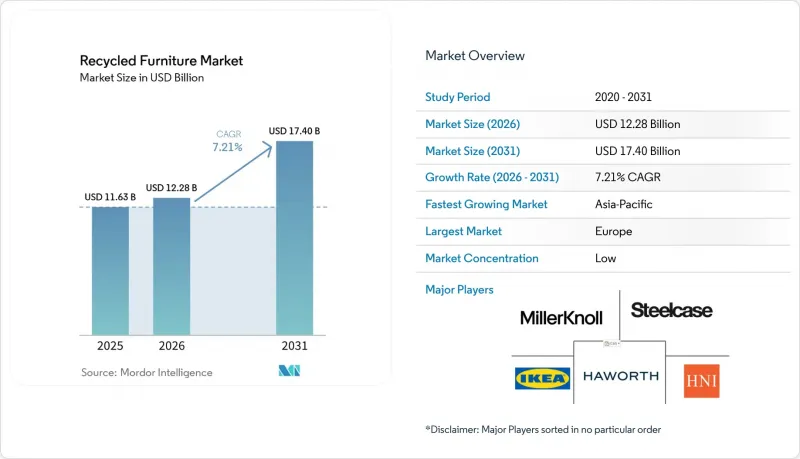
This report is Segmented by Product Type (Home, Office, Hospitality, Educational, Healthcare, and Other), Material Type (Reclaimed/Recycled Wood, Recycled Metal, and Other), Distribution Channel (Online, Specialty Resale, and Other), and Geography (North America, South America, Europe, Asia-Pacific, Middle East and Africa). Forecasts are in Value (USD).
Global Recycled Furniture Market Trends and Insights
Rising Corporate ESG Procurement for Furniture
Corporate procurement policies are becoming stricter, and that is giving the recycled furniture market a more stable demand base. The University of California updated its Sustainable Procurement Guidelines in February 2026 and embedded green spend rules for indoor furniture, recycled-content expectations, chemical disclosure requirements, and take-back service requirements into its purchasing practices. That kind of framework makes sustainability documentation part of vendor qualification rather than a soft preference. As more institutional buyers use similar rules, the recycled furniture market gains stronger access to budgeted and recurring procurement flows. Certified suppliers are also better positioned to protect margins because buyers cannot easily trade away compliance-linked features once they are written into contract terms.
Expansion of Recommerce, Buyback, and Reverse Logistics Models
The recycled furniture market is also growing as resale and recovery channels become more organized and less informal. Large furniture companies are building formal take-back and resale systems, and IKEA's FY2025 circularity update showed continued progress in buyback, resale, and spare-parts support across its system. Steelcase has also developed a long-running recovery and reconditioning model through Circular by Steelcase, which helps extend product life and keep more furniture in managed reuse channels. Vitra has widened access to pre-owned and buy-back options through its Vitra Circle model for both private and contract customers. As these systems spread, the recycled furniture market gets better control over supply quality, customer trust, and value retention.
Inconsistent Feedstock Quality and Provenance Verification
The recycled furniture market still faces a major operational constraint: inconsistent inbound supply. Research from Chalmers University found that remanufacturing remains uncommon in the Swedish furniture sector because reverse logistics are underdeveloped, product designs are often not suited to circular recovery, and procurement systems are not yet aligned with these flows. That problem matters because used furniture often enters secondary channels without clear material records or service history. The absence of reliable provenance makes quality control slower and can weaken customer confidence. It also favors larger firms that control both the first-sale and take-back channels, leaving smaller recyclers at a structural disadvantage in the recycled furniture market.
Other drivers and restraints analyzed in the detailed report include:
- Premiumization of Traceable Reclaimed and Upcycled Materials
- Digital Product Passports and Traceability Infrastructure
- High Refurbishment, Sorting, and Logistics Costs
For complete list of drivers and restraints, kindly check the Table Of Contents.
Segment Analysis
Home Furniture led the product mix with 55.25% of the recycled furniture market share in 2025, while office furniture is projected to grow at 7.95% CAGR through 2031. Home Furniture remains the largest segment because household buyers are already familiar with second-hand tables, seating, storage units, and bedroom furniture. That familiarity is helping the recycled furniture market maintain a broad volume base even as buyers become more selective about appearance and condition. Office Furniture is growing faster as it enters reuse channels in larger, more standardized lots. Hybrid work is releasing more commercial furniture from corporate sites, which gives refurbishers access to premium inventory that can be resold with clear performance value.
Commercial furniture also has a design advantage for circular recovery. The 2026 EPJ Web of Conferences study confirmed that modular design and design-for-disassembly methods support component recovery and longer material use cycles in furniture systems. That suits office chairs, workstations, and desks better than many mixed-material household items. In the recycled furniture industry, that means office products can move into a premium refurbishment tier with stronger margins and clearer technical claims. Hospitality, education, and healthcare furniture still represent smaller shares, but each of these categories benefits when tender-based buying, durability requirements, and budget pressure align around verified reuse.
Complete Report Scope:
- By Product Type
- Home Furniture
- Chairs
- Tables (side tables, coffee tables, dressing tables, etc.)
- Beds
- Wardrobes
- Sofas
- Dining Tables/Dining Sets
- Kitchen Cabinets
- Other Home Furniture (bathroom furniture, outdoor furniture, etc.)
- Office Furniture
- Chairs
- Tables
- Storage Cabinets
- Desks
- Sofas and Other Soft Seating
- Other Office Furniture
- Hospitality Furniture
- Educational Furniture
- Healthcare Furniture
- Other Applications
- Home Furniture
- By Material Type
- Reclaimed/Recycled Wood
- Recycled Metal
- Recycled Plastic
- Recycled and Composite Materials
- Other Materials
- By Distribution Channel
- Online Marketplaces
- Specialty Re-Sale Stores
- Brand-Owned Buyback and Refurbishment Channels
- Offline Retail and Project Sales
- Other Distribution Channels
- By Geography
- North America
- Canada
- United States
- Mexico
- South America
- Brazil
- Peru
- Chile
- Argentina
- Rest of South America
- Europe
- United Kingdom
- Germany
- France
- Spain
- Italy
- BENELUX (Belgium, Netherlands, and Luxembourg)
- NORDICS (Denmark, Finland, Iceland, Norway, and Sweden)
- Rest of Europe
- Asia-Pacific
- India
- China
- Japan
- Australia
- South Korea
- South East Asia (Singapore, Malaysia, Thailand, Indonesia, Vietnam, and the Philippines)
- Rest of Asia-Pacific
- Middle East and Africa
- United Arab Emirates
- Saudi Arabia
- South Africa
- Nigeria
- Rest of the Middle East and Africa
- North America
Geography Analysis
Europe held 33.54% of the recycled furniture market in 2025 and accounted for 33.54% share of the recycled furniture market size in the same year. The region leads because regulation, procurement policy, and refurbishment capacity are more developed than in most other regions. The EU Ecodesign for Sustainable Products Regulation has increased the importance of repairability, recycled content, and product information in furniture-related compliance planning. Kinnarps is participating in the GRACE research project and continues to position circular product development as part of its wider sustainability work. NORNORM is also operating a profitable circular subscription model across multiple European countries, which shows that reuse-led furniture service models can scale within the region.
Asia-Pacific is the fastest-growing region, with the recycled furniture market in this geography projected to grow at a 8.42% CAGR through 2031. Japan is an important driver because its circular-economy policies and development of recycled wood are supporting new material applications in furniture manufacturing. The region also benefits from urban growth, expanding corporate office footprints, and rising acceptance of structured reuse channels in major cities. That combination supports the simultaneous creation of both supply and demand. The recycled furniture market grows faster here because newer business districts, higher office churn, and the adoption of digital resale create favorable conditions for organized recovery and resale.
North America remains a mature but active region in the recycled furniture market, supported by institutional procurement and growing circular service models. The University of California's 2026 guidelines show how public and quasi-public buyers are embedding formal sustainability conditions into furniture sourcing. Massachusetts also showed the reuse potential of public-sector office assets by repurposing 3,364 workstations and diverting more than 841 tons of material from landfill between 2022 and 2025. South America remains earlier in development, while the Middle East and Africa present longer-term opportunities as sustainability standards, urbanization, and modern procurement systems deepen. Across these regions, the recycled furniture market tends to accelerate where procurement rules, refurbishment networks, and verified reuse channels develop together.
- IKEA
- Steelcase Inc.
- MillerKnoll, Inc.
- Haworth, Inc.
- HNI Corporation
- Teknion Corporation
- Kinnarps AB
- Vitra International AG
- Sedus Stoll AG
- Nowy Styl Group
- KI
- Fursys Co., Ltd.
- Martela Oyj
- Ahrend
- Vepa The Furniture Factory
- NORNORM
- Wilkhahn
- Inter IKEA Systems B.V.
- Green Standards
- Emeco
Additional Benefits:
- The market estimate (ME) sheet in Excel format
- 3 months of analyst support
TABLE OF CONTENTS
1 Introduction
- 1.1 Study Assumptions & Market Definition
- 1.2 Scope of the Study
2 Research Methodology
3 Executive Summary
4 Market Landscape
- 4.1 Market Overview
- 4.2 Market Drivers
- 4.2.1 Rising Corporate ESG Procurement for Furniture
- 4.2.2 Expansion of Recommerce, Buyback, and Reverse Logistics Models
- 4.2.3 Premiumization of Traceable Reclaimed and Upcycled Materials
- 4.2.4 Modular, Repairable Furniture Extending Product Life Cycles
- 4.2.5 Hybrid Work and Space Compression
- 4.2.6 Digital Product Passports and Traceability Infrastructure
- 4.3 Market Restraints
- 4.3.1 Inconsistent Feedstock Quality and Provenance Verification
- 4.3.2 High Refurbishment, Sorting, and Logistics Costs
- 4.3.3 Limited Standardization for Safety, Durability, and Fire Compliance
- 4.3.4 Brand Perception Gaps in Used and Refurbished Furniture
- 4.4 Industry Value Chain Analysis
- 4.5 Porter's Five Forces Analysis
- 4.5.1 Bargaining Power of Suppliers
- 4.5.2 Bargaining Power of Buyers
- 4.5.3 Threat of New Entrants
- 4.5.4 Threat of Substitutes
- 4.5.5 Intensity of Competitive Rivalry
- 4.6 Insights into the Latest Trends and Innovations in the Industry
- 4.7 Insights into the Recent Developments (New Product Launches, Strategic Initiatives, Investments, Partnerships, JVs, Expansion, M&As, etc.) in the Industry
5 Market Size & Growth Forecasts (Value in USD Billion)
- 5.1 By Product Type
- 5.1.1 Home Furniture
- 5.1.1.1 Chairs
- 5.1.1.2 Tables (side tables, coffee tables, dressing tables, etc.)
- 5.1.1.3 Beds
- 5.1.1.4 Wardrobes
- 5.1.1.5 Sofas
- 5.1.1.6 Dining Tables/Dining Sets
- 5.1.1.7 Kitchen Cabinets
- 5.1.1.8 Other Home Furniture (bathroom furniture, outdoor furniture, etc.)
- 5.1.2 Office Furniture
- 5.1.2.1 Chairs
- 5.1.2.2 Tables
- 5.1.2.3 Storage Cabinets
- 5.1.2.4 Desks
- 5.1.2.5 Sofas and Other Soft Seating
- 5.1.2.6 Other Office Furniture
- 5.1.3 Hospitality Furniture
- 5.1.4 Educational Furniture
- 5.1.5 Healthcare Furniture
- 5.1.6 Other Applications
- 5.1.1 Home Furniture
- 5.2 By Material Type
- 5.2.1 Reclaimed/Recycled Wood
- 5.2.2 Recycled Metal
- 5.2.3 Recycled Plastic
- 5.2.4 Recycled and Composite Materials
- 5.2.5 Other Materials
- 5.3 By Distribution Channel
- 5.3.1 Online Marketplaces
- 5.3.2 Specialty Re-Sale Stores
- 5.3.3 Brand-Owned Buyback and Refurbishment Channels
- 5.3.4 Offline Retail and Project Sales
- 5.3.5 Other Distribution Channels
- 5.4 By Geography
- 5.4.1 North America
- 5.4.1.1 Canada
- 5.4.1.2 United States
- 5.4.1.3 Mexico
- 5.4.2 South America
- 5.4.2.1 Brazil
- 5.4.2.2 Peru
- 5.4.2.3 Chile
- 5.4.2.4 Argentina
- 5.4.2.5 Rest of South America
- 5.4.3 Europe
- 5.4.3.1 United Kingdom
- 5.4.3.2 Germany
- 5.4.3.3 France
- 5.4.3.4 Spain
- 5.4.3.5 Italy
- 5.4.3.6 BENELUX (Belgium, Netherlands, and Luxembourg)
- 5.4.3.7 NORDICS (Denmark, Finland, Iceland, Norway, and Sweden)
- 5.4.3.8 Rest of Europe
- 5.4.4 Asia-Pacific
- 5.4.4.1 India
- 5.4.4.2 China
- 5.4.4.3 Japan
- 5.4.4.4 Australia
- 5.4.4.5 South Korea
- 5.4.4.6 South East Asia (Singapore, Malaysia, Thailand, Indonesia, Vietnam, and the Philippines)
- 5.4.4.7 Rest of Asia-Pacific
- 5.4.5 Middle East and Africa
- 5.4.5.1 United Arab Emirates
- 5.4.5.2 Saudi Arabia
- 5.4.5.3 South Africa
- 5.4.5.4 Nigeria
- 5.4.5.5 Rest of the Middle East and Africa
- 5.4.1 North America
6 Competitive Landscape
- 6.1 Market Concentration
- 6.2 Strategic Moves
- 6.3 Market Share Analysis
- 6.4 Company Profiles {(includes Global level Overview, Market level overview, Core Segments, Financials as available, Strategic Information, Market Rank/Share for key companies, Products & Services, and Recent Developments)}
- 6.4.1 IKEA
- 6.4.2 Steelcase Inc.
- 6.4.3 MillerKnoll, Inc.
- 6.4.4 Haworth, Inc.
- 6.4.5 HNI Corporation
- 6.4.6 Teknion Corporation
- 6.4.7 Kinnarps AB
- 6.4.8 Vitra International AG
- 6.4.9 Sedus Stoll AG
- 6.4.10 Nowy Styl Group
- 6.4.11 KI
- 6.4.12 Fursys Co., Ltd.
- 6.4.13 Martela Oyj
- 6.4.14 Ahrend
- 6.4.15 Vepa The Furniture Factory
- 6.4.16 NORNORM
- 6.4.17 Wilkhahn
- 6.4.18 Inter IKEA Systems B.V.
- 6.4.19 Green Standards
- 6.4.20 Emeco
7 Market Opportunities & Future Outlook
- 7.1 ESG-Driven Procurement & Corporate Sustainability Mandates
- 7.2 Rapid Expansion of Circular Economy & Urban Waste Valorization Ecosystem

