PUBLISHER: Mordor Intelligence | PRODUCT CODE: 2098586

PUBLISHER: Mordor Intelligence | PRODUCT CODE: 2098586
North America Scaffolding - Market Share Analysis, Industry Trends & Statistics, Growth Forecasts (2026 - 2031)
According to Mordor Intelligence, the North America scaffolding market size is expected to grow from USD 7.08 billion in 2025 to USD 7.34 billion in 2026 and is forecast to reach USD 9.93 billion by 2031 at 6.23% CAGR over 2026-2031.
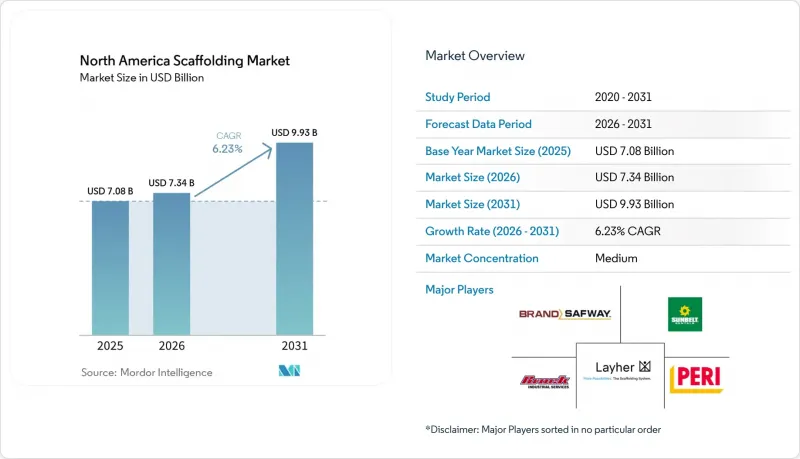
This report is Segmented by Type (Supported, Suspended, and Mobile), System (Tube & Coupler, and More), Business Model (Sales and Rental), Material (Timber / Plywood, Steel, Aluminum, Plastic / Fibreglass, and Others), Sector (Residential, Commercial, Industrial & Logistics, and Infrastructure), and Country (United States, Canada, and Mexico). The Market Forecasts are Provided in Terms of Value (USD).
North America Scaffolding Market Trends and Insights
Infrastructure Renewal and Retrofit Activity Drives Scaffolding Demand
Infrastructure renewal remains the strongest demand base for the North America scaffolding market because repair and rehabilitation work is continuous across transport, utility, and industrial assets. Public highway construction spending reflects a large and visible pipeline for access work on bridges, elevated roads, and related structures. Retrofit activity also tends to use more scaffolding per job than new construction because crews must work around existing structures, tighter access points, and partial occupancy conditions. This pattern is also relevant in Canada, where transit projects, municipal bridge programs, and facility upgrades keep demand steady across major provinces. The result is a demand floor for the North America scaffolding market that is less exposed to short-term swings in private construction cycles.
Rental Model Preference Enhances Cost Efficiency and Flexibility
Rental remains central to the North America scaffolding market because contractors prefer to treat access equipment as a project cost rather than a long-term owned asset. Rental continues to lead the market because it offers a combination of financial flexibility and operational efficiency across a wide range of project durations. International Financial Reporting Standards (IFRS) and Generally Accepted Accounting Principles (GAAP) make rental more attractive for many firms that want to limit capital intensity and keep fleet maintenance off their balance sheet. The model also allows rental providers to spread the costs of transport, storage, inspection, and replacement across multiple projects simultaneously. As a result, the North America scaffolding market continues to favor operators with large fleets, high utilization, and service packages that include inspection records and reliable delivery.
Skilled Scaffolding Labor Shortages Constrain Project Execution
Labor availability is the most immediate operating constraint in the North America scaffolding market because access to work depends on trained crews and careful site execution. The construction sector continues to need a large number of additional workers to maintain a balance between labor supply and expected demand. Many firms report project delays caused by worker shortages, which directly affect scaffold erection and dismantling and project timing. For scaffolding contractors, this problem affects mobilization speed and the ability to serve multiple jobs simultaneously. It also reinforces the move toward modular systems and rental partners that can reduce labor intensity inside the North America scaffolding market.
Other drivers and restraints analyzed in the detailed report include:
- OSHA Safety Compliance Requirements Support Scaffolding Adoption
- Modular and Quick-Assembly Systems Accelerate Market Adoption
- High Capital and Maintenance Costs Increase Fleet Ownership Burden
For complete list of drivers and restraints, kindly check the Table Of Contents.
Segment Analysis
Supported scaffold held 47% of the North America scaffolding market share in 2025, making it the core system for construction, maintenance, and retrofit work across the region. Its lead came from broad job-site fit, ease of deployment on standard projects, and the load-bearing performance needed in many industrial and commercial settings. Contractors also rely on supported systems because they work across new construction and rehabilitation scopes with fewer access limitations than specialized alternatives. In the North America scaffolding industry, this gives supported scaffold a broad installed base across urban construction, infrastructure repair, and plant maintenance. The segment also benefits from the rental model because large fleets of standardized components are easier to rotate between projects and regions.
Suspended scaffolding is forecast to grow at a 6.7% CAGR through 2031, which puts it ahead of supported systems in growth terms. That faster pace reflects rising demand in facade restoration, bridge soffit access, dam inspection, and other vertical or underside applications where supported systems are less practical. Older glass curtain wall buildings and urban towers now require ongoing access for maintenance and repair, which expands the use case for suspended equipment. Mobile scaffolding plays a role in fit-out work and light maintenance, but supported and suspended systems shape the main direction of the North America scaffolding market. The contrast between supported scaffold scale and suspended scaffold growth shows how demand is shifting toward harder-to-reach assets and more specialized access work.
Frame / H-frame systems accounted for 32% of the market by system type in 2025, making them the largest system category in the North America scaffolding market. Their position reflects wide use in residential buildings, standard commercial facades, and lighter-duty jobs where familiarity and ready availability matter more than design flexibility. These systems remain attractive because crews know them well, and many contractors can source them quickly through local rental networks. In the North America scaffolding industry, that familiarity supports steady repeat demand on routine projects with simpler shapes and lower customization needs. Tube / coupler systems also remain relevant on industrial sites where crews need custom layouts around fixed equipment and process lines.
Modular / ringlock systems are projected to grow at a 7.2% CAGR through 2031, making them the fastest-growing system type. Their appeal lies in faster assembly, greater adaptability to complex layouts, and a stronger fit for data centers, semiconductor plants, and long-duration civil works. Cuplock remains a useful middle ground because it offers faster setup than tube-and-coupler while still supporting larger project volumes. Suppliers are investing in this category because it aligns with tighter schedules and labor constraints. The system mix in the North America scaffolding market is therefore moving from standard configuration toward higher-productivity formats that save time and reduce skilled labor pressure.
Complete Report Scope:
- By Type
- Supported Scaffold
- Suspended Scaffold
- Mobile Scaffold
- By System
- Tube & Coupler
- Cuplock
- Modular / Ringlock
- Frame / H-Frame
- By Business Model
- Sales
- Rental
- By Material Type
- Timber / Plywood
- Steel
- Aluminum
- Plastic / Fibreglass
- Others
- By Sector
- Residential
- Commercial
- Industrial & Logistics
- Infrastructure
- By Country
- United States
- Canada
- Mexico
List of Companies Covered in this Report:
- BrandSafway
- Sunbelt Rentals, Inc.
- The Brock Group
- Layher Holding GmbH and Co. KG
- PERI SE
- ULMA Construction
- Altrad
- Waco International
- Atlantic Pacific Equipment, LLC
- Associated Scaffolding Company, Inc.
- Apache Industrial Services, Inc.
- Excel Modular Scaffold
- United Scaffolding, Inc.
- Universal Builders Supply Inc.
- Waco Scaffolding and Equipment Co.
- Petrin, LLC
- BETCO Scaffolds
- Brewer Equipment Co.
- Classic Industrial Services, Inc.
- Contractors Access Equipment, Inc.
Additional Benefits:
- The market estimate (ME) sheet in Excel format
- 3 months of analyst support
TABLE OF CONTENTS
1 Introduction
- 1.1 Study Assumptions & Market Definition
- 1.2 Scope of the Study
2 Research Methodology
3 Executive Summary
4 Market Insights and Dynamics
- 4.1 Market Overview
- 4.2 Market Drivers
- 4.2.1 Infrastructure Renewal and Retrofit Activity Drives Scaffolding Demand
- 4.2.2 OSHA Safety Compliance Requirements Support Scaffolding Adoption
- 4.2.3 Rental Model Preference Enhances Cost Efficiency and Flexibility
- 4.2.4 Modular and Quick-Assembly Systems Accelerate Market Adoption
- 4.2.5 Wind, Energy, and Industrial Maintenance Projects Increase Access Equipment Demand
- 4.2.6 Growth in Data Center Construction Expands Scaffolding Requirements
- 4.3 Market Restraints
- 4.3.1 Skilled Scaffolding Labor Shortages Constrain Project Execution
- 4.3.2 High Capital and Maintenance Costs Increase Fleet Ownership Burden
- 4.3.3 Freight, Storage, and Site Logistics Complexity Raises Operating Costs
- 4.3.4 Exposure to Construction Cycle Volatility Impacts Market Demand
- 4.4 Value / Supply-Chain Analysis
- 4.5 Regulatory Landscape
- 4.6 Technological Outlook
- 4.7 Cost Structure Analysis
- 4.8 Porter's Five Forces
- 4.8.1 Threat of New Entrants
- 4.8.2 Bargaining Power of Suppliers
- 4.8.3 Bargaining Power of Buyers
- 4.8.4 Threat of Substitutes
- 4.8.5 Intensity of Competitive Rivalry
- 4.9 Impact of Geopolitics
- 4.9.1 Raw Material Price Volatility
- 4.9.2 Supply Chain Disruptions and Longer Lead Times
- 4.9.3 Rising Energy and Logistics Costs
- 4.9.4 Infrastructure, Energy Security, and Defense-Led Demand
5 Market Size & Growth Forecasts (Value, USD)
- 5.1 By Type
- 5.1.1 Supported Scaffold
- 5.1.2 Suspended Scaffold
- 5.1.3 Mobile Scaffold
- 5.2 By System
- 5.2.1 Tube & Coupler
- 5.2.2 Cuplock
- 5.2.3 Modular / Ringlock
- 5.2.4 Frame / H-Frame
- 5.3 By Business Model
- 5.3.1 Sales
- 5.3.2 Rental
- 5.4 By Material Type
- 5.4.1 Timber / Plywood
- 5.4.2 Steel
- 5.4.3 Aluminum
- 5.4.4 Plastic / Fibreglass
- 5.4.5 Others
- 5.5 By Sector
- 5.5.1 Residential
- 5.5.2 Commercial
- 5.5.3 Industrial & Logistics
- 5.5.4 Infrastructure
- 5.6 By Country
- 5.6.1 United States
- 5.6.2 Canada
- 5.6.3 Mexico
6 Competitive Landscape
- 6.1 Market Concentration
- 6.2 Strategic Moves
- 6.3 Market Share Analysis
- 6.4 Company Profiles (Includes Global Level Overview, Market Level Overview, Core Segments, Financials as Available, Strategic Information, Products & Services, and Recent Developments)
- 6.4.1 BrandSafway
- 6.4.2 Sunbelt Rentals, Inc.
- 6.4.3 The Brock Group
- 6.4.4 Layher Holding GmbH and Co. KG
- 6.4.5 PERI SE
- 6.4.6 ULMA Construction
- 6.4.7 Altrad
- 6.4.8 Waco International
- 6.4.9 Atlantic Pacific Equipment, LLC
- 6.4.10 Associated Scaffolding Company, Inc.
- 6.4.11 Apache Industrial Services, Inc.
- 6.4.12 Excel Modular Scaffold
- 6.4.13 United Scaffolding, Inc.
- 6.4.14 Universal Builders Supply Inc.
- 6.4.15 Waco Scaffolding and Equipment Co.
- 6.4.16 Petrin, LLC
- 6.4.17 BETCO Scaffolds
- 6.4.18 Brewer Equipment Co.
- 6.4.19 Classic Industrial Services, Inc.
- 6.4.20 Contractors Access Equipment, Inc.
7 Market Opportunities & Future Outlook
- 7.1 White-Space & Unmet-Need Assessment

