PUBLISHER: Mordor Intelligence | PRODUCT CODE: 2099052

PUBLISHER: Mordor Intelligence | PRODUCT CODE: 2099052
United Kingdom Reverse Logistics - Market Share Analysis, Industry Trends & Statistics, Growth Forecasts (2026 - 2031)
According to Mordor Intelligence, the United Kingdom reverse logistics market size was valued at USD 32.29 billion in 2025 and estimated to grow from USD 34.77 billion in 2026 to reach USD 49.51 billion by 2031, at a CAGR of 7.32% during the forecast period (2026 to 2031).
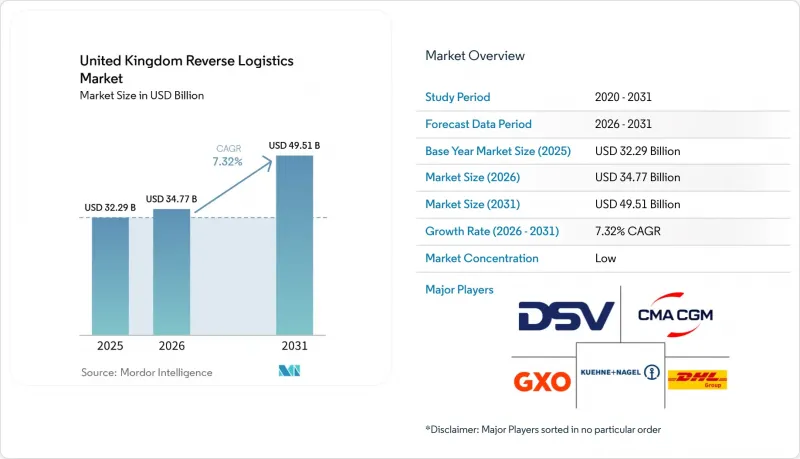
The United Kingdom reverse logistics market is being lifted by tighter recovery and recycling rules, as packaging EPR fees became enforceable in October 2025 and online marketplace obligations under the amended WEEE rules moved into force from August 2025, with financing obligations starting in January 2026. This report is Segmented by Reverse Logistics Function (Transportation (Road, Air, Other Modes), Warehousing (Storage, Distribution, and More), Value-Added Services), by End-User Industry (Consumer and Retail, Home and Decor, Healthcare and Pharmaceuticals, FMCG, and Other End Users), and by Geography (England, Scotland, Wales, and Northern Ireland). The Market Forecasts are Provided in USD.
United Kingdom Reverse Logistics Market Trends and Insights
Rising E-Commerce Return Volumes
The United Kingdom reverse logistics market continues to benefit from elevated online return activity across apparel, footwear, and electronics. The United Kingdom e-commerce return rate remained near 17.5% through 2025, while fashion and footwear categories reached 30% to 40% during peak periods, keeping transport pickup and warehouse intake volumes structurally high. Returnuary 2026 alone generated GBP 1.6 billion (USD 2.14 billion) in returned goods, underscoring the continued concentration of seasonal demand in this country. A growing share of these returns comes from multi-item ordering behavior, meaning more products return in resale-ready condition and can be routed to quicker recovery channels rather than scrap or low-value clearance. That pattern supports greater spending on transport links, disposition tools, and returns platforms because each unit has stronger resale potential when the item is still new or lightly handled.
Retailer Push for Faster Refund Cycles
The United Kingdom reverse logistics market is also being shaped by retailer pressure to shorten the time between customer drop-off and refund confirmation. ASOS introduced a tiered return fee policy in January 2026, under which customers with a return rate above 70% face a GBP 4 (USD 5.35) charge unless they keep at least GBP 40 (USD 53) of goods, which shows how tightly retailers are now managing return economics. These fee changes do not remove the need to process returned items, because the product still has to move back through collection, inspection, and resale or disposal channels. Logistics providers are responding by pushing faster intake, sorting, and restocking workflows so that value is not lost while inventory sits idle. The result is a stronger demand for outsourced partners that can compress processing time from days to hours, especially in high-return categories such as fashion and consumer electronics.
High Per-Item Reverse Handling Costs
High per-item handling costs remain the clearest brake on the United Kingdom reverse logistics market. Every returned unit may require transport, intake, inspection, grading, repacking, and either restocking or disposal, making low-ticket goods hard to recover profitably. In high-return categories, reverse logistics spend can reach 7% of gross sales, which is enough to pressure margins for mid-tier online retailers. This is why some sellers use returnless refunds for items with low resale value, even when that means giving up product recovery entirely. The cost burden supports outsourcing in some cases, but it also limits how much retailers are willing to invest in premium returns handling for low-value goods.
Other drivers and restraints analyzed in the detailed report include:
- Regulation-Led Recovery, Repair, and Recycling Demand
- Dense Urban Return Aggregation Networks in England
- Labor Intensity in Inspection and Sorting
For complete list of drivers and restraints, kindly check the Table Of Contents.
Segment Analysis
Transportation accounted for 46.17% of the United Kingdom reverse logistics market share in 2025, making it the largest function in the current structure of national returns activity. That leadership reflects the volume intensity of road-based collection between drop-off points, local aggregation nodes, and central returns sites. Evri's national parcel access network and InPost's ongoing rollout of parcel lockers and Post Office access points show why transport remains so central to the model, because every additional return touchpoint feeds collection density and line-haul demand. Transportation also absorbs a large share of operating costs because it has to connect dispersed consumers with processing hubs quickly enough to support refund expectations. The United Kingdom reverse logistics market stays road-led in this function because domestic parcel flows are dense and collection speed matters more than modal complexity for most returned goods.
Warehousing is the fastest-growing function, and the United Kingdom reverse logistics market for warehousing is projected to expand at a 13.33% CAGR through 2031. This growth is being driven by a shift from simple storage activities to multi-step returns processing within shared facilities. DHL Supply Chain's Return Network, launched in October 2025, is built around 11 purpose-built facilities that process returns for multiple product types and customers within the same network, shortening the path from receipt to inspection and restocking. The function is gaining importance because retailers want co-located fulfillment and returns operations that can cut idle inventory time and lift recovery value. Other value-added services continue to gain ground in the mix as more returned goods are redirected to refurbishment, restocking, and recommerce channels rather than low-value disposal.
Complete Report Scope:
- By Reverse Logistics Function
- Transportation
- Road
- Air
- Other Modes
- Warehousing (Storage, Distribution, Consolidation)
- Other Value-added Services (Return Processing, Restocking, Refurbishment, Disposition)
- Transportation
- By End-user Industry
- Consumer and Retail
- Home and Decor
- Healthcare and Pharmaceuticals
- FMCG
- Other End Users
- By Geography
- England
- Scotland
- Wales
- Northern Ireland
List of Companies Covered in this Report:
- DHL Group
- GXO Logistics, Inc.
- Wincanton plc
- Kuehne+Nagel International AG
- CEVA Logistics (CMA CGM)
- DSV A/S (incl. DB Schenker)
- Yusen Logistics Co., Ltd.
- UPS Supply Chain Solutions
- FedEx Logistics, Inc.
- Royal Mail Group Ltd.
- Evri
- InPost S.A.
- ZigZag Global Limited
- ReBOUND Returns Ltd. (Now part of Reconomy Group)
- The Europa Worldwide Group
- Geopost
- ArrowXL Limited
- Ingram Micro United Kingdom
- Unipart Group
- Iron Mountain United Kingdom
- Restore Technology
- Sims Lifecycle Services United Kingdom
Additional Benefits:
- The market estimate (ME) sheet in Excel format
- 3 months of analyst support
TABLE OF CONTENTS
1 Introduction
- 1.1 Study Assumptions & Market Definition
- 1.2 Scope of the Study
2 Research Methodology
3 Executive Summary
4 Market Landscape
- 4.1 Market Overview and Role of Reverse Logistics in Logistics
- 4.2 Market Drivers
- 4.2.1 Rising E-Commerce Return Volumes
- 4.2.2 Retailer Push for Faster Refund Cycles
- 4.2.3 Regulation-Led Recovery, Repair, and Recycling Demand
- 4.2.4 Dense Urban Return Aggregation Networks in England
- 4.2.5 Growth of Returnless Refund and Keep-It Decisioning
- 4.2.6 AI-Driven Grading, Triage, and Recommerce Routing
- 4.3 Market Restraints
- 4.3.1 High Per-Item Reverse Handling Costs
- 4.3.2 Labor Intensity in Inspection and Sorting
- 4.3.3 Limited Standardization Across Returns Workflows
- 4.3.4 Inconsistent Product Condition Data at Return Initiation
- 4.4 Regulatory Framework
- 4.5 Value Chain and Distribution Channel Architecture Analysis
- 4.6 Technology Innovations Outlook
- 4.7 Porter's Five Forces
- 4.7.1 Threat of New Entrants
- 4.7.2 Bargaining Power of Suppliers
- 4.7.3 Bargaining Power of Buyers
- 4.7.4 Threat of Substitutes
- 4.7.5 Rivalry Among Competitors
- 4.8 Evolution of Reverse Logistics Requirements
- 4.9 Spotlight - United Kingdom E-commerce Industry
- 4.10 Study on Changing Consumer Behavior and Preferences
- 4.11 Impact of Cost of Returns on Retailers - Analyst View
- 4.12 Impact of Geo-Political Events on Supply Chain Shifts
5 Market Size & Growth Forecasts (Value, 2026-2031)
- 5.1 By Reverse Logistics Function
- 5.1.1 Transportation
- 5.1.1.1 Road
- 5.1.1.2 Air
- 5.1.1.3 Other Modes
- 5.1.2 Warehousing (Storage, Distribution, Consolidation)
- 5.1.3 Other Value-added Services (Return Processing, Restocking, Refurbishment, Disposition)
- 5.1.1 Transportation
- 5.2 By End-user Industry
- 5.2.1 Consumer and Retail
- 5.2.2 Home and Decor
- 5.2.3 Healthcare and Pharmaceuticals
- 5.2.4 FMCG
- 5.2.5 Other End Users
- 5.3 By Geography
- 5.3.1 England
- 5.3.2 Scotland
- 5.3.3 Wales
- 5.3.4 Northern Ireland
6 Competitive Landscape
- 6.1 Market Concentration
- 6.2 Key Strategic Moves
- 6.3 Market Share Analysis
- 6.4 Company Profiles (includes Global level Overview, Market level overview, Core Segments, Financials as available, Strategic Information, Market Rank/Share for key companies, Products & Services, and Recent Developments)
- 6.4.1 DHL Group
- 6.4.2 GXO Logistics, Inc.
- 6.4.3 Wincanton plc
- 6.4.4 Kuehne+Nagel International AG
- 6.4.5 CEVA Logistics (CMA CGM)
- 6.4.6 DSV A/S (incl. DB Schenker)
- 6.4.7 Yusen Logistics Co., Ltd.
- 6.4.8 UPS Supply Chain Solutions
- 6.4.9 FedEx Logistics, Inc.
- 6.4.10 Royal Mail Group Ltd.
- 6.4.11 Evri
- 6.4.12 InPost S.A.
- 6.4.13 ZigZag Global Limited
- 6.4.14 ReBOUND Returns Ltd. (Now part of Reconomy Group)
- 6.4.15 The Europa Worldwide Group
- 6.4.16 Geopost
- 6.4.17 ArrowXL Limited
- 6.4.18 Ingram Micro United Kingdom
- 6.4.19 Unipart Group
- 6.4.20 Iron Mountain United Kingdom
- 6.4.21 Restore Technology
- 6.4.22 Sims Lifecycle Services United Kingdom
7 Market Opportunities & Future Outlook
- 7.1 White-space & Unmet-Need Assessment

