PUBLISHER: Mordor Intelligence | PRODUCT CODE: 2099056

PUBLISHER: Mordor Intelligence | PRODUCT CODE: 2099056
China Reverse Logistics - Market Share Analysis, Industry Trends & Statistics, Growth Forecasts (2026 - 2031)
According to Mordor Intelligence, the China reverse logistics market size is projected to expand from USD 125.73 billion in 2025 to USD 141.67 billion in 2026 and reach USD 250.56 billion by 2031, growing at a CAGR of 12.08% from 2026 to 2031.
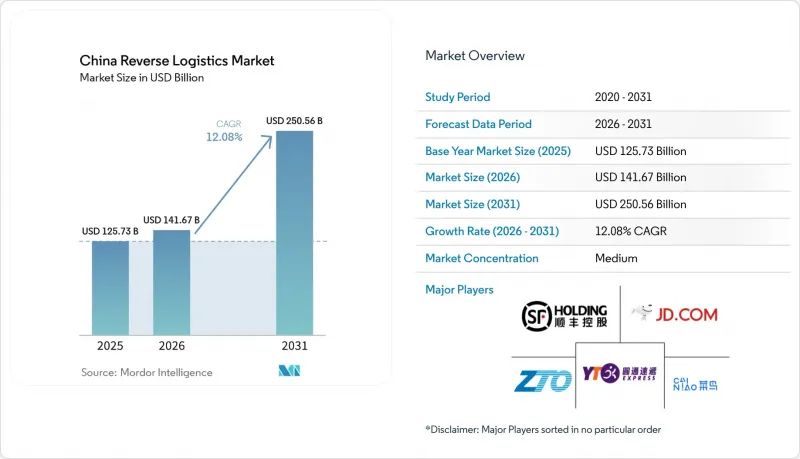
China's reverse logistics market is performing steadily, supported by the country's large e-commerce ecosystem, growing consumer returns, and increasing focus on product recovery and resale. This report is Segmented by Reverse Logistics Function (Transportation (Road, Air, Other Modes), Warehousing, and Other Value-Added Services), by End-User Industry (Consumer and Retail, Home and Decor, Healthcare and Pharmaceuticals, FMCG, and Other End Users), and by Region (North, Northeast, East, Central, South, Southwest, and Northwest). The Market Forecasts are Provided in Terms of Value (USD).
China Reverse Logistics Market Trends and Insights
Rising E-Commerce Return Volumes and Refund Expectations
China's very large online retail base continues to send high volumes of returns into the Country's reverse logistics market. Online retail sales reached USD 2.16 trillion in 2024, which kept parcel density high across the country's main consumption corridors. Faster refunds and easier returns promises are making merchants treat returns as a core service requirement rather than a side process. That shift is pushing more sellers to outsource pickup, sorting, and disposition work to specialist providers across the China reverse logistics market.
Circular Economy and Producer Responsibility Pressures
Circularity and recovery programs are creating a more durable demand layer in the China reverse logistics market. China's battery-tracking push and broader formalization of recycling are moving product recovery into more structured channels. JD Logistics deployed 500,000 reusable cold-chain delivery boxes in June 2025, demonstrating that large-scale packaging reuse is already embedded in logistics operations. These programs create recurring collection, sorting, reuse, and recovery work that lasts throughout product life cycles rather than just during a single sales event. That makes this demand base steadier and helps support long-term capacity build-out in the China reverse logistics market.
High Cost of Sorting, Testing, and Refurbishment
Cost recovery remains a core limit in the China reverse logistics market. For many returned electronics, testing, triage, and refurbishment can consume 30% to 40% of the resale value, leaving little room for operators without high-throughput automation. Caixin reported in June 2026 that less than 30% of retired EV power batteries were collected through formal recycling channels, underscoring the ongoing struggle of compliant processing to overcome cost leakage and informal competition. Lithium price swings add another layer of pressure because lower recovered material values weaken the economics of formal processing. The result is that scale players hold up better, while smaller firms in the China reverse logistics market continue to face margin pressure.
Other drivers and restraints analyzed in the detailed report include:
- EV Battery, Electronics, and High-Value Asset Take-Back Flows
- Urban Consolidation Needs Across Tiered Distribution Hubs
- Fragmented Regional Service Standards and Operating Complexity
For complete list of drivers and restraints, kindly check the Table Of Contents.
Segment Analysis
Transportation held 45.50% of the China reverse logistics market share in 2025, indicating that much of the activity still sits in pickup, line-haul, and consolidation work. Road networks carry most of these flows because returns arise across dense city clusters and dispersed suburban demand points. Air remains important for time-sensitive electronics and pharmaceutical returns where speed and custody matter more than cost. Other modes remain smaller, but rail and intermodal options are gaining relevance where cross-border or long-distance return movements need lower-cost alternatives.
Warehousing is forecast to expand at 18.09% CAGR, the fastest pace in this segmentation, and a clear sign that value recovery is becoming more important in the China reverse logistics market. More returns are now being stored, graded, consolidated, and redirected to specialized processing centers rather than simple delivery stations. Other value-added services are also strengthening, as merchants need restocking, refurbishment, and disposition support within a single operating chain. This is shifting the China reverse logistics industry toward integrated platforms that combine transport with disciplined processing.
Complete Report Scope:
- By Reverse Logistics Function
- Transportation
- Road
- Air
- Other Modes
- Warehousing (Storage, Distribution, Consolidation)
- Other Value-added Services (Return Processing, Restocking, Refurbishment, Disposition)
- Transportation
- By End-user Industry
- Consumer and Retail
- Home and Decor
- Healthcare and Pharmaceuticals
- FMCG
- Other End Users
- By Region
- North
- Northeast
- East
- Central
- South
- Southwest
- Northwest
List of Companies Covered in this Report:
- JD Logistics, Inc.
- SF Holdings Co., Ltd.
- Cainiao Network
- YTO Express Group Co., Ltd.
- ZTO Express (Cayman) Inc.
- STO Express Co., Ltd.
- Yunda Holding Co., Ltd.
- J&T Global Express Limited
- Sinotrans Limited
- GEM Co.,Ltd.
- China Post Group Co., Ltd.
- DHL Supply Chain
- DSV (incl. DB Schenker)
- Kuehne + Nagel International AG
- CEVA Logistics
- FedEx Corporation
- United Parcel Service, Inc.
- Geodis
- Nippon Express Holdings, Inc.
- Yusen Logistics Co., Ltd.
- ANE Logistics
Additional Benefits:
- The market estimate (ME) sheet in Excel format
- 3 months of analyst support
TABLE OF CONTENTS
1 Introduction
- 1.1 Study Assumptions & Market Definition
- 1.2 Scope of the Study
2 Research Methodology
3 Executive Summary
4 Market Landscape
- 4.1 Market Overview and Role of Reverse Logistics in Logistics
- 4.2 Market Drivers
- 4.2.1 Rising E-Commerce Return Volumes and Refund Expectations
- 4.2.2 Circular Economy and Producer Responsibility Pressures
- 4.2.3 EV Battery, Electronics, and High-Value Asset Take-Back Flows
- 4.2.4 Urban Consolidation Needs Across Tiered Distribution Hubs
- 4.2.5 Digitized Return Authorization and Visibility Expectations
- 4.2.6 Cross-Border Return Complexity from International E-Commerce
- 4.3 Market Restraints
- 4.3.1 High Cost of Sorting, Testing, and Refurbishment
- 4.3.2 Fragmented Regional Service Standards and Operating Complexity
- 4.3.3 Margin Erosion on Low-Value, High-Volume Returns
- 4.3.4 Data Sharing, Custody, and Chain-of-Responsibility Risks in Multi-Party Returns
- 4.4 Regulatory Framework
- 4.5 Value Chain and Distribution Channel Architecture Analysis
- 4.6 Technology Innovations Outlook
- 4.7 Porter's Five Forces
- 4.7.1 Threat of New Entrants
- 4.7.2 Bargaining Power of Suppliers
- 4.7.3 Bargaining Power of Buyers
- 4.7.4 Threat of Substitutes
- 4.7.5 Rivalry Among Competitors
- 4.8 Evolution of Reverse Logistics Requirements
- 4.9 Spotlight - United States E-commerce Industry
- 4.10 Study on Changing Consumer Behavior and Preferences
- 4.11 Impact of Cost of Returns on Retailers - Analyst View
- 4.12 Impact of Geo-Political Events on Supply Chain Shifts
5 Market Size & Growth Forecasts (Value, 2026-2031)
- 5.1 By Reverse Logistics Function
- 5.1.1 Transportation
- 5.1.1.1 Road
- 5.1.1.2 Air
- 5.1.1.3 Other Modes
- 5.1.2 Warehousing (Storage, Distribution, Consolidation)
- 5.1.3 Other Value-added Services (Return Processing, Restocking, Refurbishment, Disposition)
- 5.1.1 Transportation
- 5.2 By End-user Industry
- 5.2.1 Consumer and Retail
- 5.2.2 Home and Decor
- 5.2.3 Healthcare and Pharmaceuticals
- 5.2.4 FMCG
- 5.2.5 Other End Users
- 5.3 By Region
- 5.3.1 North
- 5.3.2 Northeast
- 5.3.3 East
- 5.3.4 Central
- 5.3.5 South
- 5.3.6 Southwest
- 5.3.7 Northwest
6 Competitive Landscape
- 6.1 Market Concentration
- 6.2 Key Strategic Moves
- 6.3 Market Share Analysis
- 6.4 Company Profiles (includes Global level Overview, Market level overview, Core Segments, Financials as available, Strategic Information, Market Rank/Share for key companies, Products & Services, and Recent Developments)
- 6.4.1 JD Logistics, Inc.
- 6.4.2 SF Holdings Co., Ltd.
- 6.4.3 Cainiao Network
- 6.4.4 YTO Express Group Co., Ltd.
- 6.4.5 ZTO Express (Cayman) Inc.
- 6.4.6 STO Express Co., Ltd.
- 6.4.7 Yunda Holding Co., Ltd.
- 6.4.8 J&T Global Express Limited
- 6.4.9 Sinotrans Limited
- 6.4.10 GEM Co.,Ltd.
- 6.4.11 China Post Group Co., Ltd.
- 6.4.12 DHL Supply Chain
- 6.4.13 DSV (incl. DB Schenker)
- 6.4.14 Kuehne + Nagel International AG
- 6.4.15 CEVA Logistics
- 6.4.16 FedEx Corporation
- 6.4.17 United Parcel Service, Inc.
- 6.4.18 Geodis
- 6.4.19 Nippon Express Holdings, Inc.
- 6.4.20 Yusen Logistics Co., Ltd.
- 6.4.21 ANE Logistics
7 Market Opportunities & Future Outlook
- 7.1 White-space & Unmet-Need Assessment

