PUBLISHER: Mordor Intelligence | PRODUCT CODE: 2099053

PUBLISHER: Mordor Intelligence | PRODUCT CODE: 2099053
India Reverse Logistics - Market Share Analysis, Industry Trends & Statistics, Growth Forecasts (2026 - 2031)
According to Mordor Intelligence, the India reverse logistics market size is expected to increase from USD 35.04 billion in 2025 to USD 40.77 billion in 2026 and reach USD 84.05 billion by 2031, growing at a CAGR of 15.57% over 2026-2031.
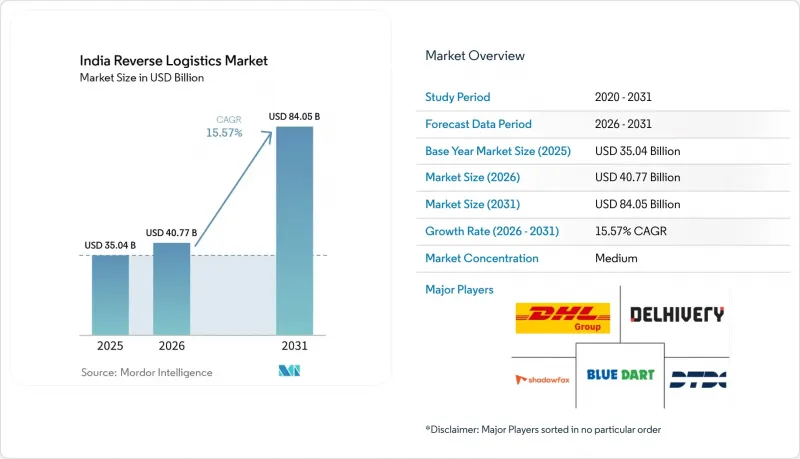
Reverse logistics is now more closely tied to customer retention and inventory recovery, so service quality is becoming more important than pure cost control in the India reverse logistics market. This report is Segmented by Reverse Logistics Function (Transportation (Road, Air, Other Modes), Warehousing (Storage, Distribution, Consolidation), Other Value-Added Services), by End-User Industry (Consumer and Retail, Home and Decor, Healthcare and Pharmaceuticals, FMCG, Other End Users), and by Region (North, Central, West, East, South). The Market Forecasts are Provided in Terms of Value (USD).
India Reverse Logistics Market Trends and Insights
Expansion of E-Commerce Returns and Return-to-Origin Volumes: The Volume Baseline That Cannot Be Managed Away
India's online commerce base continues to expand, keeping a large pool of orders flowing into return and return-to-origin channels within the India reverse logistics market. DHL reported that 81% of internet users in India returned an online purchase in the past 12 months, which shows that returns are now a routine part of digital buying behavior. Fashion and footwear continue to generate especially heavy return traffic because size mismatch and expectation gaps remain common in organized online retail. Blue Dart stated that Tier-2 and Tier-3 cities are expected to contribute nearly 66% of new direct-to-consumer orders in FY 26, so reverse pickup density is moving beyond the largest metros. Consumer return windows under the Consumer Protection framework also keep brands under pressure to run formal return systems rather than informal recovery arrangements. This leaves providers with stronger address validation, customer intent checks, and pin-code-level routing tools better positioned in the India reverse logistics market.
Resale, Refurbishment, and Recommerce Monetization: From Cost Recovery to Revenue Generation
Returned goods are increasingly being handled as recoverable inventory rather than as a sunk cost, and that is changing how service models are built across the India reverse logistics market. Cashify stated that trade-ins grew 15-16% year over year in 2025, which shows that more consumers are entering organized exchange and upgrade programs. This shift favors operators that can inspect, grade, clean, and route goods quickly into resale or refurbishment channels. Attero's Selsmart was active across more than 19 cities and handled more than 30,000 monthly orders by August 2025, which showed that formal doorstep take-back can reach meaningful scale. The informal channel still accounts for a large share of used-device trade, so companies that can capture verified supply at pickup maintain an advantage in formal recovery. Financial Express reported stronger volume expectations for refurbished smartphones in 2026 as new device prices rose, which supports better recovery value for returned electronics.
High Reverse Handling Cost as a Share of Order Value: A Margin Problem Without a Simple Fix
Reverse handling costs continue to compress margin recovery in the India reverse logistics market, especially in low-ticket categories. Blue Dart stated that return-to-origin shipments, more than customer returns alone, are India's biggest e-commerce margin problem. GS1 India estimated in April 2026 that poor product data quality was costing the sector nearly INR 5,000 crore (USD 588 million) a year, including INR 1,900 crore (USD 2.03 billion) linked directly to reverse logistics handling and processing. COD-heavy orders remain the hardest to absorb because failed deliveries can incur forward and reverse shipping costs, with no revenue recovery. That cost floor shows that network efficiency alone is not enough; brands also need better listing quality, stronger prepaid conversion, and sharper checkout screening.
Other drivers and restraints analyzed in the detailed report include:
- E-Waste Compliance and Circular Economy Adoption: A Mandated Demand Floor
- Rapid Growth of 3PL-Led Reverse Logistics Networks: Consolidation Accelerates Capability Concentration
- Fragmented Pickup, Sorting, and Quality-Check Infrastructure Outside Tier 1 Hubs: The Bharat Commerce Gap
For complete list of drivers and restraints, kindly check the Table Of Contents.
Segment Analysis
Transportation accounted for 49.05% of the India reverse logistics market share in 2025, making it the largest functional block. This concentration reflects the scale of first-mile pickup required across millions of delivery addresses. Road transport remains the dominant sub-mode because most returns move across short and medium distances rather than by premium air lanes. The segment also benefits from the spread of reverse pickup requests across COD, exchange, refused, and damaged orders, which keeps route density high. In practice, transportation remains the service layer where pickup success, transit visibility, and resolution speed shape the customer experience most directly.
Warehousing is the fastest-growing function, and the India reverse logistics market size for this part of the chain is projected to grow at 21.58% CAGR through 2031. Returns facilities are no longer used only for storage, and operators are building inspection, grading, refurbishment, restocking, and disposal workflows into the same sites. Other value-added services carry the highest per-unit margins because they combine return processing, restocking, refurbishment, and final disposition into a single service bundle.
Complete Report Scope:
- By Reverse Logistics Function
- Transportation
- Road
- Air
- Other Modes
- Warehousing (Storage, Distribution, Consolidation)
- Other Value-added Services (Return Processing, Restocking, Refurbishment, Disposition)
- Transportation
- By End-user Industry
- Consumer and Retail
- Home and Decor
- Healthcare and Pharmaceuticals
- FMCG
- Other End Users
- By Region
- North
- Central
- West
- East
- South
List of Companies Covered in this Report:
- Blue Dart Express Limited
- Delhivery Limited
- DTDC Express Limited
- Shadowfax Technologies Private Limited
- Safexpress Private Limited
- Xpressbees
- Mahindra Logistics Limited
- TVS Supply Chain Solutions Limited
- Allcargo Gati
- DHL Express
- FedEx Corporation
- DSV (incl. DB Schenker)
- Kuehne + Nagel International AG
- Yusen Logistics Co., Ltd.
- Kintetsu World Express, Inc.
- Aramex PJSC
- Attero Recycling Private Limited
- TCI Supply Chain Solutions (TCI-SCS)
- Ekart Logistics
- CEVA Logistics (CMA CGM)
- WareIQ
Additional Benefits:
- The market estimate (ME) sheet in Excel format
- 3 months of analyst support
TABLE OF CONTENTS
1 Introduction
- 1.1 Study Assumptions & Market Definition
- 1.2 Scope of the Study
2 Research Methodology
3 Executive Summary
4 Market Landscape
- 4.1 Market Overview and Role of Reverse Logistics in Logistics
- 4.2 Market Drivers
- 4.2.1 Expansion of E-Commerce Returns and Return-to-Origin Volumes
- 4.2.2 Rising Consumer Trust Requirements for Frictionless Returns
- 4.2.3 Resale, Refurbishment, and Recommerce Monetization
- 4.2.4 Poor Product Data and Expectation Mismatch in Online Commerce
- 4.2.5 E-Waste Compliance and Circular Economy Adoption
- 4.2.6 Rapid Growth of 3PL-Led Reverse Logistics Networks
- 4.3 Market Restraints
- 4.3.1 High Reverse Handling Cost as a Share of Order Value
- 4.3.2 Fragmented Pickup, Sorting, and Quality-Check Infrastructure Outside Tier 1 Hubs
- 4.3.3 Value Erosion From Delayed Validation and Restocking
- 4.3.4 Complex Dispute Resolution for Open-Box, Damaged, and Refused Returns
- 4.4 Regulatory Framework
- 4.5 Value Chain and Distribution Channel Architecture Analysis
- 4.6 Technology Innovations Outlook
- 4.7 Porter's Five Forces
- 4.7.1 Threat of New Entrants
- 4.7.2 Bargaining Power of Suppliers
- 4.7.3 Bargaining Power of Buyers
- 4.7.4 Threat of Substitutes
- 4.7.5 Rivalry Among Competitors
- 4.8 Evolution of Reverse Logistics Requirements
- 4.9 Spotlight - India E-commerce Industry
- 4.10 Study on Changing Consumer Behavior and Preferences
- 4.11 Impact of Cost of Returns on Retailers - Analyst View
- 4.12 Impact of Geo-Political Events on Supply Chain Shifts
5 Market Size & Growth Forecasts (Value, 2026-2031)
- 5.1 By Reverse Logistics Function
- 5.1.1 Transportation
- 5.1.1.1 Road
- 5.1.1.2 Air
- 5.1.1.3 Other Modes
- 5.1.2 Warehousing (Storage, Distribution, Consolidation)
- 5.1.3 Other Value-added Services (Return Processing, Restocking, Refurbishment, Disposition)
- 5.1.1 Transportation
- 5.2 By End-user Industry
- 5.2.1 Consumer and Retail
- 5.2.2 Home and Decor
- 5.2.3 Healthcare and Pharmaceuticals
- 5.2.4 FMCG
- 5.2.5 Other End Users
- 5.3 By Region
- 5.3.1 North
- 5.3.2 Central
- 5.3.3 West
- 5.3.4 East
- 5.3.5 South
6 Competitive Landscape
- 6.1 Market Concentration
- 6.2 Key Strategic Moves
- 6.3 Market Share Analysis
- 6.4 Company Profiles (includes Global level Overview, Market level overview, Core Segments, Financials as available, Strategic Information, Market Rank/Share for key companies, Products & Services, and Recent Developments)
- 6.4.1 Blue Dart Express Limited
- 6.4.2 Delhivery Limited
- 6.4.3 DTDC Express Limited
- 6.4.4 Shadowfax Technologies Private Limited
- 6.4.5 Safexpress Private Limited
- 6.4.6 Xpressbees
- 6.4.7 Mahindra Logistics Limited
- 6.4.8 TVS Supply Chain Solutions Limited
- 6.4.9 Allcargo Gati
- 6.4.10 DHL Express
- 6.4.11 FedEx Corporation
- 6.4.12 DSV (incl. DB Schenker)
- 6.4.13 Kuehne + Nagel International AG
- 6.4.14 Yusen Logistics Co., Ltd.
- 6.4.15 Kintetsu World Express, Inc.
- 6.4.16 Aramex PJSC
- 6.4.17 Attero Recycling Private Limited
- 6.4.18 TCI Supply Chain Solutions (TCI-SCS)
- 6.4.19 Ekart Logistics
- 6.4.20 CEVA Logistics (CMA CGM)
- 6.4.21 WareIQ
7 Market Opportunities & Future Outlook
- 7.1 White-space & Unmet-Need Assessment

