PUBLISHER: Mordor Intelligence | PRODUCT CODE: 2099138

PUBLISHER: Mordor Intelligence | PRODUCT CODE: 2099138
Parametric Insurance - Market Share Analysis, Industry Trends & Statistics, Growth Forecasts (2026 - 2031)
According to Mordor Intelligence, the parametric insurance market size is expected to increase from USD 3.48 billion in 2025 to USD 4.02 billion in 2026 and reach USD 7.64 billion by 2031, growing at a CAGR of 13.69% over 2026-2031.
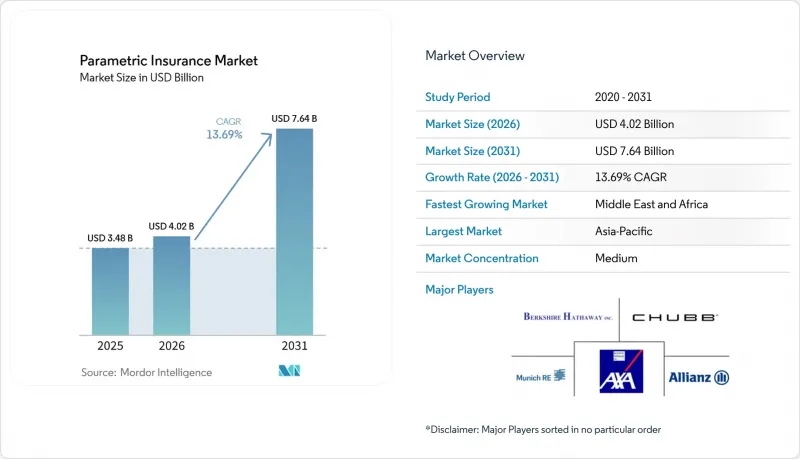
This report is Segmented by Parametric Trigger (Weather & Climate Index, Catastrophe / NatCat Index, and More), by Distribution Channel (Direct Sales, Brokers & Intermediaries, and More), by Industry Vertical (Agriculture, Livestock & Fisheries, Energy & Utilities, and More), and by Geography (North America, South America, and More). The Market Forecasts are Provided in Terms of Value (USD).
Global Parametric Insurance Market Trends and Insights
Rising Frequency of Climate-Linked Loss Events
The parametric insurance market is benefiting from a steady rise in climate-linked loss events, widening the gap between economic damage and insured recovery. Swiss Re Institute projected global insured catastrophe losses of USD 148 billion in 2026, with the total expected to reach USD 186 billion by 2030, extending a long pattern of annual real growth in disaster losses. Wildfire has become one of the clearest examples of this pattern, and the January 2025 Palisades and Eaton wildfires in Los Angeles County generated USD 40 billion in combined insured losses. Aon's 2026 Climate and Catastrophe Insight report recorded global economic losses of USD 260 billion in 2025, and half of that total remained uninsured, with flooding events across South and Southeast Asia standing out as a major gap area. This loss pattern is supporting the parametric insurance market because buyers need faster liquidity, while suppliers also want broader diversification across perils and regions. The result is a parametric insurance market that is growing faster than broader premium pools because it addresses both liquidity timing and coverage gap pressures simultaneously.
Faster Payout Expectations from Corporate Buyers
The parametric insurance market is also being driven by a simple buyer requirement: faster access to funds after an event. Corporate risk managers are now comparing products not only by coverage scope but also by how quickly a payout can be moved to the balance sheet after a verified trigger. Aon's 2025 reinsurance review noted stronger corporate demand for parametric products, with buyers looking for rapid capital relief, immediate liquidity, and capital diversification at renewal. Willis Towers Watson's 2026 Capacity Revenue Protection launch for PJM energy producers showed how trigger-based structures are being tailored to specific revenue risks rather than broad damage scenarios. This shift matters because settlement speed is now being treated as a product feature, and that expectation is helping the parametric insurance market move deeper into mainstream corporate procurement. The parametric insurance market is therefore benefiting from a demand profile that favors quick, predictable transfers of funds over slower claims processes.
Basis Risk and Trigger Mismatch
Basis risk remains the main restraint on the parametric insurance market because buyers want confidence that a trigger outcome will closely track real financial loss. The Geneva Papers on Risk and Insurance published 2025 research showing that portfolio-level basis risk declines as the number of independent parametric contracts increases, suggesting the issue can be managed at scale rather than treated as a structural failure of the product. The same study identified spatial misalignment between exposure locations and weather stations as a key driver, suggesting that better trigger network design is a practical fix. The challenge is not only technical, as many buyers without deep risk teams struggle to assess the gap between index behavior and their expected loss patterns. That expectation gap can create dissatisfaction even when a contract performs exactly as written, and that risk slows adoption in parts of the parametric insurance market where mid-sized buyers are still learning the product.
Other drivers and restraints analyzed in the detailed report include:
- Expansion of Agricultural Index Coverage
- Adoption of Satellite, IoT, and Remote Sensing Inputs
- Regulatory Fragmentation Across Jurisdictions
For complete list of drivers and restraints, kindly check the Table Of Contents.
Segment Analysis
Weather & Climate Index held 56.77% of the parametric insurance market share in 2025, while Catastrophe/NatCat Index is projected to grow at 15.89% CAGR between 2026-2031. Weather triggers remain the largest part of the parametric insurance market because they are supported by long meteorological records and easier standardization across buyers and territories. That maturity is also starting to compress margins, which is making product design more important than simple availability. Catastrophe and NatCat structures are gaining traction because sovereigns and corporate buyers need rapid liquidity for earthquake, cyclone, and wildfire events that can overwhelm traditional claims timelines. Swiss Re's projection of USD 148 billion in insured catastrophe losses in 2026 keeps demand focused on products that can closely align payout timing with the frequency of large events.
The parametric insurance market is also seeing trigger expansion beyond weather into cyber downtime, supply chain disruption, and other non-physical loss structures. These other index-based triggers remain smaller, but they are important because they reach risks that standard indemnity forms often cover only partially or not at all. Liberty Mutual Reinsurance and ICEYE's June 2026 wildfire solution demonstrated how SAR imagery can support more precise NatCat verification at the structure level, thereby improving confidence in trigger performance. The Bermuda Monetary Authority's work on a fully collateralized regulatory class for parametric structures also points to more capital support for NatCat products in the coming years. Research on multi-index design published in 2025 further supports the direction of travel in the parametric insurance industry, where trigger precision is becoming a core part of competition rather than a secondary technical feature.
Complete Report Scope:
- By Parametric Trigger
- Weather & Climate Index
- Catastrophe / NatCat Index
- Other Index-Based Triggers
- By Distribution Channel
- Direct Sales
- Brokers & Intermediaries
- Digital / Online Platforms & Aggregators
- Other Channels
- By Industry Vertical
- Agriculture, Livestock & Fisheries
- Energy & Utilities
- Construction, Infrastructure & Real Estate
- Manufacturing & Supply Chain / Logistics
- Transportation & Aviation
- Government & Public Services
- Other Industry Verticals
- By Geography
- North America
- United States
- Canada
- Mexico
- South America
- Brazil
- Argentina
- Rest of South America
- Europe
- United Kingdom
- Germany
- France
- Italy
- Spain
- Rest of Europe
- Asia-Pacific
- China
- Japan
- India
- South Korea
- Australia
- Indonesia
- Thailand
- Malaysia
- Singapore
- Vietnam
- Rest of Asia-Pacific
- Middle East and Africa
- Saudi Arabia
- United Arab Emirates
- Turkey
- South Africa
- Egypt
- Rest of Middle East and Africa
- North America
Geography Analysis
Asia-Pacific accounted for 34.69% of the parametric insurance market in 2025, making it the largest regional contributor. The region leads because it combines high disaster exposure, large agricultural populations, and active government support for index-based insurance. Japan's established insurers are already moving from pilot work toward broader commercial deployment, with Tokio Marine offering EQuick for earthquake cover and Mitsui Sumitomo launching a weather index insurance product in 2025. Indonesia's March 2026 decision to launch a national parametric scheme for coffee and cocoa smallholder farmers showed that public programs remain central in Southeast Asian expansion. SEADRIF Insurance Company's 2025 household-level policy in Lao PDR, with USD 1.1 million of protection across floods, cyclones, earthquakes, and landslides, provides a model that can be extended to nearby markets with similar risk profiles.
North America and Europe remain major centers of premium concentration in the parametric insurance market, supported by corporate demand for wildfire, hurricane, and severe convective storm coverage. New York's January 2025 legal recognition of parametric insurance removed an important source of uncertainty for product structuring in the United States. In France, the parametric segment was estimated at EUR 130 million to EUR 500 million, which is equivalent to USD 143 million to USD 550 million at 2025 average rates, and the category was reported to be growing at double-digit annual rates. Howden France's 2026 market review also identified parametric solutions as one of the opportunity areas attracting added attention in French reinsurance. Lloyd's capacity reached GBP 56 billion in 2025, and the presence of dedicated parametric syndicates such as NormanMax Syndicate 3939 and Canopius Syndicate 4444's partnership with global parametrics shows how much innovation is concentrated in the London market.
The Middle East and Africa region is projected to grow at a 16.72% CAGR through 2031, giving it the fastest regional outlook in the parametric insurance market. Growth is being supported by sovereign risk pools, a large protection gap, and broader insurance infrastructure development in Gulf and African markets. African Risk Capacity has protected more than 26.4 million people and paid over USD 170 million in indemnities since inception, thereby strengthening the case for greater commercial reinsurance participation. South America is still earlier in commercial development, but Chile's 2025 approval of commercial parametric insurance and Brazil's 2025 expansion in agricultural products show that the regional pipeline is becoming more concrete. McKinsey's 2025 regional insurance review also noted 11% annual premium growth in Latin America between 2019 and 2024, which supports the underlying commercial infrastructure needed for wider parametric distribution.
- Allianz SE
- AXA SA
- Berkshire Hathaway Inc.
- Chubb Limited
- Munich Reinsurance Company
- Swiss Reinsurance Company Ltd.
- Zurich Insurance Group Ltd.
- Hannover Ruck SE
- SCOR SE
- QBE Insurance Group Limited
- Tokio Marine Holdings, Inc.
- Aon plc
- Marsh and McLennan Companies, Inc.
- Willis Towers Watson Public Limited Company
- PartnerRe Ltd.
- AIG
- Beazley plc
- Lloyd's
- FloodFlash Ltd.
- Parametrix Insurance, Inc.
- Global Parametrics
Additional Benefits:
- The market estimate (ME) sheet in Excel format
- 3 months of analyst support
TABLE OF CONTENTS
1 Introduction
- 1.1 Study Assumptions and Market Definition
- 1.2 Scope of the Study
2 Research Methodology
3 Executive Summary
4 Market Landscape
- 4.1 Market Overview
- 4.2 Market Drivers
- 4.2.1 Rising Frequency of Climate-Linked Loss Events
- 4.2.2 Faster Payout Expectations From Corporate Buyers
- 4.2.3 Expansion of Agricultural Index Coverage
- 4.2.4 Adoption of Satellite, IoT, and Remote Sensing Inputs
- 4.2.5 Growth of Non-Physical Risk Transfer Use Cases
- 4.2.6 Reinsurer and Lloyd's Capacity Expansion
- 4.3 Market Restraints
- 4.3.1 Basis Risk and Trigger Mismatch
- 4.3.2 Regulatory Fragmentation Across Jurisdictions
- 4.3.3 Limited Historical Data for Emerging Perils
- 4.3.4 Data Lineage, Auditability, and Model Governance Burden
- 4.4 Value Chain Analysis
- 4.5 Regulatory Landscape
- 4.6 Technological Outlook
- 4.7 Porter's Five Forces Analysis
- 4.7.1 Bargaining Power of Buyers
- 4.7.2 Bargaining Power of Suppliers
- 4.7.3 Threat of New Entrants
- 4.7.4 Threat of Substitutes
- 4.7.5 Competitive Rivalry
- 4.8 Investment Landscape
5 Market Size and Growth Forecasts
- 5.1 By Parametric Trigger
- 5.1.1 Weather & Climate Index
- 5.1.2 Catastrophe / NatCat Index
- 5.1.3 Other Index-Based Triggers
- 5.2 By Distribution Channel
- 5.2.1 Direct Sales
- 5.2.2 Brokers & Intermediaries
- 5.2.3 Digital / Online Platforms & Aggregators
- 5.2.4 Other Channels
- 5.3 By Industry Vertical
- 5.3.1 Agriculture, Livestock & Fisheries
- 5.3.2 Energy & Utilities
- 5.3.3 Construction, Infrastructure & Real Estate
- 5.3.4 Manufacturing & Supply Chain / Logistics
- 5.3.5 Transportation & Aviation
- 5.3.6 Government & Public Services
- 5.3.7 Other Industry Verticals
- 5.4 By Geography
- 5.4.1 North America
- 5.4.1.1 United States
- 5.4.1.2 Canada
- 5.4.1.3 Mexico
- 5.4.2 South America
- 5.4.2.1 Brazil
- 5.4.2.2 Argentina
- 5.4.2.3 Rest of South America
- 5.4.3 Europe
- 5.4.3.1 United Kingdom
- 5.4.3.2 Germany
- 5.4.3.3 France
- 5.4.3.4 Italy
- 5.4.3.5 Spain
- 5.4.3.6 Rest of Europe
- 5.4.4 Asia-Pacific
- 5.4.4.1 China
- 5.4.4.2 Japan
- 5.4.4.3 India
- 5.4.4.4 South Korea
- 5.4.4.5 Australia
- 5.4.4.6 Indonesia
- 5.4.4.7 Thailand
- 5.4.4.8 Malaysia
- 5.4.4.9 Singapore
- 5.4.4.10 Vietnam
- 5.4.4.11 Rest of Asia-Pacific
- 5.4.5 Middle East and Africa
- 5.4.5.1 Saudi Arabia
- 5.4.5.2 United Arab Emirates
- 5.4.5.3 Turkey
- 5.4.5.4 South Africa
- 5.4.5.5 Egypt
- 5.4.5.6 Rest of Middle East and Africa
- 5.4.1 North America
6 Competitive Landscape
- 6.1 Market Concentration
- 6.2 Strategic Moves
- 6.3 Market Share Analysis
- 6.4 Company Profiles (includes Global Level Overview, Market Level Overview, Core Segments, Financials as available, Strategic Information, Market Rank/Share, Products and Services, Recent Developments)
- 6.4.1 Allianz SE
- 6.4.2 AXA SA
- 6.4.3 Berkshire Hathaway Inc.
- 6.4.4 Chubb Limited
- 6.4.5 Munich Reinsurance Company
- 6.4.6 Swiss Reinsurance Company Ltd.
- 6.4.7 Zurich Insurance Group Ltd.
- 6.4.8 Hannover Ruck SE
- 6.4.9 SCOR SE
- 6.4.10 QBE Insurance Group Limited
- 6.4.11 Tokio Marine Holdings, Inc.
- 6.4.12 Aon plc
- 6.4.13 Marsh and McLennan Companies, Inc.
- 6.4.14 Willis Towers Watson Public Limited Company
- 6.4.15 PartnerRe Ltd.
- 6.4.16 AIG
- 6.4.17 Beazley plc
- 6.4.18 Lloyd's
- 6.4.19 FloodFlash Ltd.
- 6.4.20 Parametrix Insurance, Inc.
- 6.4.21 Global Parametrics
7 Market Opportunities and Future Outlook
- 7.1 White-Space and Unmet-Need Assessment

