PUBLISHER: Mordor Intelligence | PRODUCT CODE: 2156875

PUBLISHER: Mordor Intelligence | PRODUCT CODE: 2156875
Environmental Insurance - Market Share Analysis, Industry Trends & Statistics, Growth Forecasts (2026 - 2031)
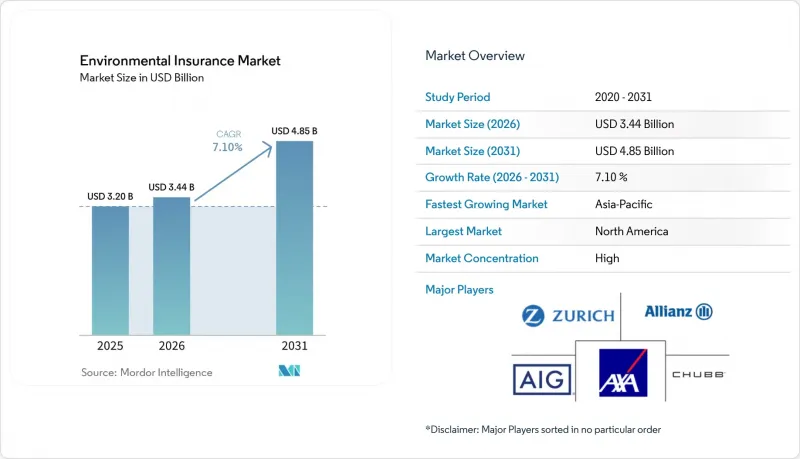
According to Mordor Intelligence, the environmental insurance market size is expected to increase from USD 3.20 billion in 2025 to USD 3.44 billion in 2026 and reach USD 4.85 billion by 2031, growing at a CAGR of 7.10% over 2026-2031.
Global Environmental Insurance Market Trends and Insights
Stricter Environmental Liability and Cleanup Requirements
Environmental liability rules are a consistent source of demand for pollution liability cover. The environmental insurance market benefits when compliance obligations require demonstrable financial assurance. The European Commission evaluated the Environmental Liability Directive in July 2026 and reaffirmed the polluter-pays principle for preventive and remedial environmental damage. The directive requires financial assurance from operators conducting hazardous Annex III activities. China adopted its Ecological Environment Code in March 2026, and Article 169 formally encourages environmental pollution liability insurance while extending joint-and-several civil liability to environmental technical service providers. Hubei issued environmental pollution liability insurance management measures in May 2025, and Shanghai issued a risk-control services standard in July 2025. In the United States, 40 CFR 280.97 requires underground storage tank owners and operators to maintain insurance-backed financial responsibility at federally specified minimum limits.
Expansion of Brownfield Redevelopment, Real Estate Transactions, and Environmental M&A Due Diligence
Environmental insurance is increasingly used to support transactions rather than only to manage post-closing risk. The environmental insurance market is becoming part of the transaction process when buyers seek certainty around known contamination. BC Environmental Insurance found that transactions involving insurers at the letter-of-intent stage closed up to 27% faster than transactions where coverage was arranged after due diligence. In June 2026, Gowling WLG advised Imperial Oil on the sale of a 7.5-million-square-foot former refinery and petroleum operations site in Montreal East. Environmental insurance was a closing condition and a regulatory-engagement tool in that brownfield redevelopment. AXA XL and Ryan Transaction Risk expanded transactional environmental impairment liability and remediation cost-overrun offerings during 2025 and 2026.
PFAS Exclusions and Uncertainty Around Long-Tail Environmental Liabilities
Per- and polyfluoroalkyl substances are disrupting environmental insurance underwriting because their liabilities can persist for extended periods and may trigger claims across multiple policy years. The environmental insurance market must balance demand for coverage against uncertainty over long-tail contamination costs. PFAS exclusions have become increasingly common in liability insurance policies, particularly as insurers seek to limit exposure to potentially significant and difficult-to-model contamination liabilities. The EPA established maximum contaminant levels for PFOA and PFOS at 4.0 parts per trillion each under its drinking-water regulations. Major settlements include up to USD 10.3 billion for 3M in its nationwide public-water-supplier settlement, USD 1.185 billion for DuPont, Chemours, and Corteva in separate litigation, and a USD 875 million settlement with the State of New Jersey involving DuPont, Chemours, and Corteva. In August 2026, New Jersey also received court approval for separate PFAS settlements with DuPont-related entities and 3M valued at approximately USD 2.5 billion combined, including more than USD 2 billion from the DuPont-related entities.
Other drivers and restraints analyzed in the detailed report include:
- Growing Industrial, Energy, Waste, and Infrastructure Pollution Exposures
- Extreme Weather Increasing the Risk of Pollution Releases and Environmental Losses
- Rising Remediation and Cleanup Costs Creating Pricing and Reserve Uncertainty
For complete list of drivers and restraints, kindly check the Table Of Contents.
Segment Analysis
Site/premises pollution liability held 38.2% of the environmental insurance market share in 2025 and remained the largest product category. The coverage supports fixed industrial assets, real estate portfolios, and legacy contamination management. Combined/package environmental is forecast to grow at an 11.2% CAGR from 2026 through 2031, the fastest rate in this segmentation. AXA XL introduced its Environmental Combined Form in March 2026 for United States mid-market manufacturing and distribution clients. The product pairs general liability and pollution cover and offers up to USD 25 million in excess limits for selected classes. The environmental insurance market size is also supported by growing demand for integrated coverage across complex commercial exposures.
Markel Canada introduced two integrated environmental solutions in April 2026 for manufacturers and environmental service firms. Those policies combine general liability, pollution, and professional liability under one form. Contractors' pollution liability continues to record high placement volumes, supported by more than 30 active insurers and soft-to-stable rates. Transactional and remediation cost-cap products are gaining use in M&A and brownfield redevelopment, with transactional PLL terms of 6-12 years and premiums of 0.5%-3% of limit. Storage tank pollution coverage remains supported by underground storage tank financial-responsibility rules, while contingent, transportation, and non-owned disposal cover face closer review of waste manifests and chain-of-custody records.
Complete Report Scope:
- By Product Type
- Site / Premises Pollution Liability
- Contractors Pollution Liability
- Combined / Package Environmental
- Storage Tank Pollution
- Transactional and Remediation-Cost
- Contingent, Transportation and Non-Owned Disposal
- By Risk Occasion
- Operational Premises and Ongoing Activities
- Contracting and Project Operations
- Mergers, Acquisitions and Property Transfer
- Statutory Financial Responsibility and Licence Conditions
- Closure, Post-closure and Active Remediation
- By End User
- Manufacturing and Process Industries
- Energy, Utilities and Extractives
- Construction, Contracting and Engineering
- Real Estate, Property Owners and Developers
- Waste, Water and Environmental Services
- Transportation and Logistics
- Public and Institutional
- Other Commercial Occupancies
- By Geography
- North America
- United States
- Canada
- Mexico
- South America
- Brazil
- Argentina
- Rest of South America
- Europe
- United Kingdom
- Germany
- France
- Italy
- Spain
- Rest of Europe
- Asia-Pacific
- China
- Japan
- India
- South Korea
- Australia
- Indonesia
- Thailand
- Malaysia
- Singapore
- Vietnam
- Rest of Asia-Pacific
- Middle East and Africa
- Saudi Arabia
- United Arab Emirates
- Turkey
- South Africa
- Egypt
- Rest of Middle East and Africa
- North America
Geography Analysis
North America held 68.7% of the environmental insurance market share in 2025, the largest regional position. CERCLA can hold current property owners responsible for remediating historic contamination created by earlier operators, including in cases where fault is not established. The 7.5-million-square-foot Montreal East brownfield transaction in June 2026 used environmental insurance as a deal component and lender condition. Great American Insurance Group plans to launch its contractor's site environmental product in Mexico during 2026. Domestic United States site-pollution and contractors' pollution liability limits exceed USD 500 million, rising to USD 700 million with London capacity.
Europe is the second-largest regional environmental insurance market. The environmental insurance market size in the region is supported by a common regulatory baseline for environmental remediation. Germany, France, the United Kingdom, and Italy account for most regional premium volume. The European Commission's July 2026 evaluation confirmed the Environmental Liability Directive's role in setting common minimum remediation standards. The directive provides a regulatory floor for the financial-assurance obligations of Annex III operators. Combined general liability and pollution products are expected to launch in Europe in 2026, following the United States mid-market model. South America remains an early-stage market, with Brazil offering the greatest latent demand from industrial and agribusiness activities.
Asia-Pacific is forecast to grow at a 12.0% CAGR from 2026 through 2031, the fastest rate among regions. China is strengthening the environmental liability framework through Article 169 of the Ecological Environment Code, Hubei provincial measures, and Shanghai risk-control standards. A 2026 peer-reviewed study found that China's environmental liability insurance policy reduced ESG greenwashing by supporting green innovation and limiting managerial short-termism. India's non-life insurance sector grew 14.1% in fiscal year 2026, while the Insurance for All by 2047 initiative is supporting broader non-life penetration. Southeast Asian countries, including Vietnam, Indonesia, and the Philippines, recorded 15-20% insurance premium growth in 2026, and environmental liability is a growing sub-category. Saudi Arabia and the United Arab Emirates are the most active markets in the Middle East and Africa, where major petrochemical and infrastructure projects increasingly include contractors' pollution liability requirements.
- AIG
- Chubb
- Zurich Insurance Group
- AXA XL
- Allianz Commercial
- Liberty Mutual Insurance
- Berkshire Hathaway Specialty Insurance
- Beazley
- Great American Insurance Group
- Tokio Marine HCC
- Sompo International
- Arch Insurance
- CNA
- Markel
- Aspen Insurance
- Everest Group
- AXIS Capital
- W. R. Berkley / Berkley Environmental
- The Hartford
- Travelers
Additional Benefits:
- The market estimate (ME) sheet in Excel format
- 3 months of analyst support
TABLE OF CONTENTS
1 INTRODUCTION
- 1.1 Study Assumptions and Market Definition
- 1.2 Scope of the Study
2 RESEARCH METHODOLOGY
3 EXECUTIVE SUMMARY
4 MARKET LANDSCAPE
- 4.1 Market Overview
- 4.2 Market Drivers
- 4.2.1 Stricter Environmental Liability and Cleanup Requirements
- 4.2.2 Expansion of Brownfield Redevelopment, Real Estate Transactions, and Environmental M&A Due Diligence
- 4.2.3 Growing Industrial, Energy, Waste, and Infrastructure Pollution Exposures
- 4.2.4 Extreme Weather Increasing the Risk of Pollution Releases and Environmental Losses
- 4.2.5 Growing Environmental Risks from Emerging Contaminants
- 4.2.6 Contractual and Lender Insurance Requirements in Construction and Infrastructure Projects
- 4.3 Market Restraints
- 4.3.1 PFAS Exclusions and Uncertainty Around Long-Tail Environmental Liabilities
- 4.3.2 Rising Remediation and Cleanup Costs Creating Pricing and Reserve Uncertainty
- 4.3.3 Limited Capacity and Restrictive Underwriting for High-Hazard and Legacy-Contamination Risks
- 4.3.4 Fragmented Global Environmental Regulations and Inconsistent Pollution Liability Frameworks
- 4.4 Value Chain Analysis
- 4.4.1 Environmental Risk Assessment, Due Diligence, and Insurance Placement
- 4.4.2 Specialty Underwriting, Distribution, and Risk Capacity Provision
- 4.4.3 Claims, Remediation, and Loss-Management Services
- 4.5 Regulatory Landscape
- 4.5.1 Environmental Liability, Polluter-Pays, and Financial Responsibility Frameworks
- 4.5.2 Contaminated-Site, Hazardous Substance, and Emerging Contaminant Regulation
- 4.5.3 Environmental Compliance, Permitting, and Cross-Border Liability Requirements
- 4.6 Technological Outlook
- 4.6.1 Environmental Risk Analytics, Geospatial Data, and Remote Monitoring
- 4.6.2 AI-Enabled Underwriting and Digital Claims/Loss Assessment
- 4.6.3 Digital and Innovative Environmental Insurance Products and Risk Transfer
- 4.7 Porter's Five Forces Analysis
- 4.7.1 Threat of New Entrants
- 4.7.2 Bargaining Power of Suppliers
- 4.7.3 Bargaining Power of Buyers
- 4.7.4 Threat of Substitutes
- 4.7.5 Intensity of Competitive Rivalry
5 MARKET SIZE AND GROWTH FORECASTS
- 5.1 By Product Type
- 5.1.1 Site / Premises Pollution Liability
- 5.1.2 Contractors Pollution Liability
- 5.1.3 Combined / Package Environmental
- 5.1.4 Storage Tank Pollution
- 5.1.5 Transactional and Remediation-Cost
- 5.1.6 Contingent, Transportation and Non-Owned Disposal
- 5.2 By Risk Occasion
- 5.2.1 Operational Premises and Ongoing Activities
- 5.2.2 Contracting and Project Operations
- 5.2.3 Mergers, Acquisitions and Property Transfer
- 5.2.4 Statutory Financial Responsibility and Licence Conditions
- 5.2.5 Closure, Post-closure and Active Remediation
- 5.3 By End User
- 5.3.1 Manufacturing and Process Industries
- 5.3.2 Energy, Utilities and Extractives
- 5.3.3 Construction, Contracting and Engineering
- 5.3.4 Real Estate, Property Owners and Developers
- 5.3.5 Waste, Water and Environmental Services
- 5.3.6 Transportation and Logistics
- 5.3.7 Public and Institutional
- 5.3.8 Other Commercial Occupancies
- 5.4 By Geography
- 5.4.1 North America
- 5.4.1.1 United States
- 5.4.1.2 Canada
- 5.4.1.3 Mexico
- 5.4.2 South America
- 5.4.2.1 Brazil
- 5.4.2.2 Argentina
- 5.4.2.3 Rest of South America
- 5.4.3 Europe
- 5.4.3.1 United Kingdom
- 5.4.3.2 Germany
- 5.4.3.3 France
- 5.4.3.4 Italy
- 5.4.3.5 Spain
- 5.4.3.6 Rest of Europe
- 5.4.4 Asia-Pacific
- 5.4.4.1 China
- 5.4.4.2 Japan
- 5.4.4.3 India
- 5.4.4.4 South Korea
- 5.4.4.5 Australia
- 5.4.4.6 Indonesia
- 5.4.4.7 Thailand
- 5.4.4.8 Malaysia
- 5.4.4.9 Singapore
- 5.4.4.10 Vietnam
- 5.4.4.11 Rest of Asia-Pacific
- 5.4.5 Middle East and Africa
- 5.4.5.1 Saudi Arabia
- 5.4.5.2 United Arab Emirates
- 5.4.5.3 Turkey
- 5.4.5.4 South Africa
- 5.4.5.5 Egypt
- 5.4.5.6 Rest of Middle East and Africa
- 5.4.1 North America
6 COMPETITIVE LANDSCAPE
- 6.1 Market Concentration
- 6.2 Strategic Moves
- 6.3 Market Share Analysis (Top 5-6 players)
- 6.4 Company Profiles (includes Global Level Overview, Market Level Overview, Core Segments, Financials as available, Strategic Information, Market Rank/Share, Products and Services, Recent Developments)
- 6.4.1 AIG
- 6.4.2 Chubb
- 6.4.3 Zurich Insurance Group
- 6.4.4 AXA XL
- 6.4.5 Allianz Commercial
- 6.4.6 Liberty Mutual Insurance
- 6.4.7 Berkshire Hathaway Specialty Insurance
- 6.4.8 Beazley
- 6.4.9 Great American Insurance Group
- 6.4.10 Tokio Marine HCC
- 6.4.11 Sompo International
- 6.4.12 Arch Insurance
- 6.4.13 CNA
- 6.4.14 Markel
- 6.4.15 Aspen Insurance
- 6.4.16 Everest Group
- 6.4.17 AXIS Capital
- 6.4.18 W. R. Berkley / Berkley Environmental
- 6.4.19 The Hartford
- 6.4.20 Travelers
7 MARKET OPPORTUNITIES AND FUTURE OUTLOOK
- 7.1 White-Space and Unmet-Need Assessment
- 7.1.1 Emerging Contaminant and Complex Remediation Coverage
- 7.1.2 Specialized Coverage for Emerging Assets, Projects, and Environmental Risks
- 7.1.3 Accessible and Integrated Environmental Risk Solutions for Underserved Buyers and Markets
- 7.2 Future Outlook
- 7.2.1 Capacity, Pricing, and Underwriting Outlook
- 7.2.2 Regulatory, Litigation, and Emerging Contaminant Outlook
- 7.2.3 Growth Opportunities and Market Evolution Outlook

