
PUBLISHER: Mordor Intelligence | PRODUCT CODE: 2099202

PUBLISHER: Mordor Intelligence | PRODUCT CODE: 2099202
Spain Co-Living - Market Share Analysis, Industry Trends & Statistics, Growth Forecasts (2026 - 2031)
According to Mordor Intelligence, the Spain co-Living market size is expected to grow from USD 160.60 million in 2025 to USD 180.05 million in 2026 and is forecast to reach USD 318.94 million by 2031 at 12.11% CAGR over 2026-2031.
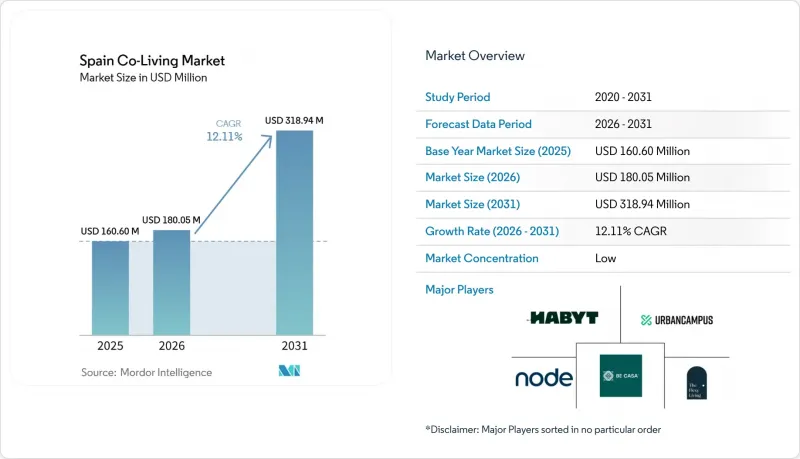
This report is Segmented by Property Configuration (Studio/Entire Unit, Private Room, Shared Room), by Business Model (Asset-Light: Master Lease, Asset-Light: Management Agreement, and More), by Price Band (Economy, Mid-Scale, Premium/Luxury), by End User (Students, Working Professionals), and by Geography (Madrid, Barcelona, Valencia, Rest of Spain). Market Forecasts are in Terms of Value (USD).
Spain Co-Living Market Trends and Insights
Rising Housing Affordability Challenges in Madrid and Barcelona Channel Demand into Co-living Accommodation
The Spain co-living market is benefiting from a housing system that remains short of supply in its largest cities. The 500,000-home gap shows why managed shared housing is becoming a practical option rather than a niche choice. When renters cannot easily secure conventional units, they place greater value on ready-to-move accommodation that includes utilities, furnishings, and community space. This matters because co-living removes several upfront hurdles at once, including deposits across multiple service accounts, furniture costs, and long setup periods. In that setting, the Spain co-living market is not only attracting residents who want lower friction, but also capturing demand from people who would otherwise stay longer in informal or temporary housing arrangements.
Growing Digital Nomad, Expatriate, and Remote Worker Populations Support Flexible Housing Demand
The Spain co-living market is also drawing support from mobile residents whose housing needs differ from those of long-settled local households. The draft shows that digital nomads, expatriates, and remote workers often arrive without local credit records, domestic guarantors, or established banking relationships, which makes obtaining standard lease access more difficult. Co-living fits this group because contracts are simpler, move-in is faster, and the package already includes the daily living services that new arrivals usually need first. This user profile also values location, broadband quality, and shared work areas, so operators that combine housing with a strong digital leasing process are better placed to hold occupancy. As this mobile renter base widens, the Spain co-living market gains a layer of demand linked to labor mobility and cross-border relocation rather than solely to local housing stress.
Regulatory Uncertainty Regarding Short-Term Rentals and Shared Housing Models
The Spain co-living market still operates without a single national statute that clearly defines co-living across all use cases. Spain implemented Royal Decree 1312/2024 on July 1, 2025, which created a unified lease registry and a digital single window for short-term rental data, in line with European Union Regulation 2024/1028. Organic Law 1/2025 also gave residential communities the power to block new tourist-classified accommodations in their buildings with a three-fifths owner majority, adding another layer of approval risk to mixed-use or mixed-ownership properties. Catalonia and Andalusia have moved in different directions, and Catalonia's Law 11/2025 adds another regional layer that operators must track alongside local planning treatment. Because the legal path still varies by city and region, the Spain co-living market remains harder to scale nationally than demand figures alone might suggest.
Other drivers and restraints analyzed in the detailed report include:
- Increasing Investor Interest in Alternative Residential Asset Classes with Stable Occupancy Rates
- Expansion of Co-living Operators Targeting Young Professionals and International Residents
- Rising Construction and Property Acquisition Costs Affecting New Project Development
For complete list of drivers and restraints, kindly check the Table Of Contents.
Segment Analysis
Studio and entire-unit formats accounted for 52.3% of the market in 2025, making them the largest configuration in the Spain co-living market. That lead shows that many residents want privacy in their units while still using shared kitchens, work areas, lounges, or fitness spaces elsewhere in the building. The format also suits operators who want a broader customer base, because self-contained units are easier to market to professionals, relocators, couples, and residents staying for longer periods. Shared rooms are expected to post the fastest growth, with a 12.78% CAGR through 2031, indicating that affordability pressure remains strong and creates room for lower-cost offerings.
This split gives the Spain co-living market a two-track product structure. Studio-led supply supports revenue stability because private formats tend to appeal to residents who can pay more for autonomy, consistency, and predictable occupancy. At the same time, shared rooms are likely to absorb incremental demand where rent pressure remains high and access to standard leases stays difficult. The Spain co-living market, therefore, does not move in a single direction on product design, because the largest segment favors privacy. In contrast, the fastest-growing segment reflects cost sensitivity and the need for lower entry price points.
Asset-light master lease or lease arbitrage accounted for 45.1% of the market in 2025, making it the largest business model in the Spain co-living market. Its lead reflects a practical fit with a market where operators need speed, lower upfront capital, and room to adjust portfolios city by city. Under this structure, the operator secures control of the building through a lease and then manages the resident relationship, pricing, furnishing, and service package directly. The same segment is also projected to record the highest growth at a 13.12% CAGR through 2031, which confirms that capital discipline and operating flexibility remain central to expansion plans.
The asset-heavy own-develop-operate route still matters, especially for firms backed by stronger capital pools and long investment horizons. Neinor Homes and Banco Santander entered flex living through a co-investment structure in February 2025, which shows that development-led participation remains relevant when the project location and exit horizon are attractive. Even so, the Spain co-living market still leans toward models that reduce capital exposure and enable faster city entry, especially while regulation, construction costs, and asset access remain uneven across regions. This is why the largest and fastest-growing models are in the same segment in the current structure.
Complete Report Scope:
- By Property Configuration
- Studio / Entire Unit
- Private Room
- Shared Room
- By Business Model
- Asset-Light: Master Lease / Lease Arbitrage
- Asset-Light: Management Agreement
- Asset-Heavy: Own-Develop-Operate
- By Price Band
- Economy
- Mid-Scale
- Premium/Luxury
- By End User
- Students
- Working Professionals
- By City
- Madrid
- Barcelona
- Valencia
- Rest of Spain
List of Companies Covered in this Report:
- Habyt
- Urban Campus
- Node Living
- The Flexy Living
- Be Casa
- Smart Rental
- Kora Living
- Live It
- Common
- The Social Hub
- Micampus
- Yugo
- Livensa Living
- Nodis
- VITA Student
- Greystar
- Bain Capital
- Stoneshield Capital
- Patrizia
- M&G Investments
Additional Benefits:
- The market estimate (ME) sheet in Excel format
- 3 months of analyst support
TABLE OF CONTENTS
1 INTRODUCTION
- 1.1 Study Assumptions and Market Definition
- 1.2 Scope of the Study
2 RESEARCH METHODOLOGY
3 EXECUTIVE SUMMARY
4 MARKET INSIGHTS AND DYNAMICS
- 4.1 Market Overview
- 4.2 Market Drivers
- 4.2.1 Rising housing affordability challenges in cities such as Madrid and Barcelona driving demand for co-living accommodation
- 4.2.2 Growing digital nomad, expatriate, and remote worker populations supporting flexible housing demand
- 4.2.3 Increasing investor interest in alternative residential asset classes with stable occupancy rates
- 4.2.4 Expansion of co-living operators targeting young professionals and international residents
- 4.2.5 Growth in technology, startup, and service-sector employment creating demand for managed rental housing
- 4.3 Market Restraints
- 4.3.1 Regulatory uncertainty regarding short-term rentals and shared housing models
- 4.3.2 Rising construction and property acquisition costs affecting new project development
- 4.3.3 Limited availability of suitable urban properties for large-scale co-living conversion projects
- 4.4 Value and Supply-Chain Analysis
- 4.5 Regulatory Landscape
- 4.6 Technological Outlook
- 4.7 Porter's Five Forces Analysis
- 4.7.1 Bargaining Power of Suppliers
- 4.7.2 Bargaining Power of Consumers
- 4.7.3 Threat of New Entrants
- 4.7.4 Threat of Substitutes
- 4.7.5 Intensity of Competitive Rivalry
- 4.8 Workspace Utilization and Seat Absorption Trends
- 4.9 Enterprise vs. Non-Enterprise Demand Analysis
- 4.10 Micro-Market Performance Assessment
- 4.11 Operator Profitability and Business Model Evolution
- 4.12 Investment, Funding, and Consolidation Trends
- 4.13 Impact of Geopolitics
- 4.13.1 Changes in Migration and Mobility Patterns
- 4.13.2 Policy and Regulatory Uncertainty
- 4.13.3 Inflation and Cost-of-Living Pressure
- 4.13.4 Funding and Investment Uncertainty
5 SPAIN CO-LIVING MARKET, MARKET SIZE & GROWTH FORECASTS (VALUE IN USD) - 2020-2031
- 5.1 By Property Configuration
- 5.1.1 Studio / Entire Unit
- 5.1.2 Private Room
- 5.1.3 Shared Room
- 5.2 By Business Model
- 5.2.1 Asset-Light: Master Lease / Lease Arbitrage
- 5.2.2 Asset-Light: Management Agreement
- 5.2.3 Asset-Heavy: Own-Develop-Operate
- 5.3 By Price Band
- 5.3.1 Economy
- 5.3.2 Mid-Scale
- 5.3.3 Premium/Luxury
- 5.4 By End User
- 5.4.1 Students
- 5.4.2 Working Professionals
- 5.5 By City
- 5.5.1 Madrid
- 5.5.2 Barcelona
- 5.5.3 Valencia
- 5.5.4 Rest of Spain
6 COMPETITIVE LANDSCAPE
- 6.1 Market Concentration
- 6.2 Strategic Moves
- 6.3 Company Profiles (includes Global Level Overview, Market Level Overview, Core Segments, Financials as available, Strategic Information, Products and Services, Recent Developments)
- 6.3.1 Habyt
- 6.3.2 Urban Campus
- 6.3.3 Node Living
- 6.3.4 The Flexy Living
- 6.3.5 Be Casa
- 6.3.6 Smart Rental
- 6.3.7 Kora Living
- 6.3.8 Live It
- 6.3.9 Common
- 6.3.10 The Social Hub
- 6.3.11 Micampus
- 6.3.12 Yugo
- 6.3.13 Livensa Living
- 6.3.14 Nodis
- 6.3.15 VITA Student
- 6.3.16 Greystar
- 6.3.17 Bain Capital
- 6.3.18 Stoneshield Capital
- 6.3.19 Patrizia
- 6.3.20 M&G Investments
7 MARKET OPPORTUNITIES AND FUTURE OUTLOOK
- 7.1 White-space and Unmet-Need Assessment

