
PUBLISHER: Mordor Intelligence | PRODUCT CODE: 2099210

PUBLISHER: Mordor Intelligence | PRODUCT CODE: 2099210
Singapore Co-Living - Market Share Analysis, Industry Trends & Statistics, Growth Forecasts (2026 - 2031)
According to Mordor Intelligence, the Singapore co-Living market size is projected to be USD 0.18 billion in 2025, USD 0.19 billion in 2026, and reach USD 0.39 billion by 2031, growing at a CAGR of 15.47% from 2026 to 2031.
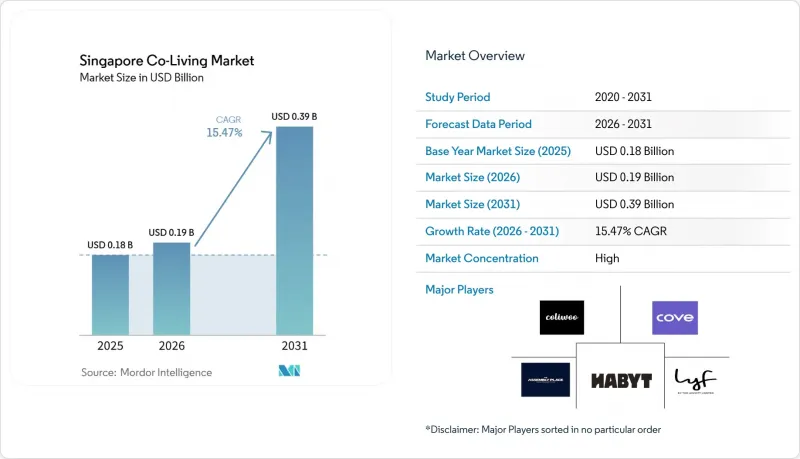
This report is Segmented by Property Configuration (Studio / Entire Unit, Private Room, and Shared Room), Business Model (Asset-Light Master Lease / Lease Arbitrage and More), Price Band (Economy, Mid-Scale, and Premium / Luxury), End User (Students, and Working Professionals), and Region (Central Area, East Region, West Region, and More). The Market Forecasts are Provided in Terms of Value (USD).
Singapore Co-Living Market Trends and Insights
Growing Expatriate and Foreign Professional Population Drives Co-Living Demand
Singapore's non-resident population rose 2.7% to 1.91 million in June 2025, and this group remains one of the clearest demand pools for the Singapore co-living market. Skilled foreign professionals under the Employment Pass and S Pass schemes represent a high-value tenant segment, supporting premium occupancy and stable rental income for operators. As Singapore continues to strengthen its position as a regional financial, technology, and business hub, incoming professionals on project-based and multi-year assignments increasingly prefer fully furnished accommodation with flexible lease terms over conventional long-term rentals. This structural shift toward greater workforce mobility continues to strengthen demand for professionally managed co-living properties.
Growing Young Professional and International Student Population Expands Occupancy
The Singapore co-living market also benefits from rising demand among young professionals and international students seeking flexible, well-connected accommodation near universities and employment hubs. Industry data indicates that Singapore's skilled foreign workforce has grown by 13% since 2018, while the international student population has increased by 47% over the same period, outpacing the expansion of co-living supply. Students accounted for 54.7% of end-user revenue in 2025. Supported by this dual demand base, co-living occupancy remained between 85% and 95% throughout 2025, demonstrating sustained absorption despite continued additions to room supply.
High Property Acquisition and Development Costs Constrain New Supply
Acquisition and development costs remain among the clearest constraints on new supply in the Singapore co-living market. Government Land Sale sites with a residential component recorded average land rate growth of nearly 13% in 2025, and land values in the central region reached SGD 1,820 (USD 1,365) per square foot per plot ratio in recent tenders. Those higher entry costs weaken conversion economics because operators need assets priced below condominium benchmarks to preserve acceptable yields. Suitable conversion properties remain limited, even as acquisition costs rise, making expansion more challenging for both existing platforms and new entrants. The response from larger operators has shifted toward capital recycling, and Coliwoo's March 2026 sale process for 7 freehold assets at SGD 218.5 million (USD 163.9 million) showed that growth can depend as much on asset rotation as on simple portfolio expansion.
Other drivers and restraints analyzed in the detailed report include:
- Preference for Flexible Lease Terms Boosts Co-Living Adoption
- Rising Institutional Investment Supports Co-Living Market Growth
- Stringent Regulatory Framework Increases Compliance Burden
For complete list of drivers and restraints, kindly check the Table Of Contents.
Segment Analysis
Studio / entire-unit configurations held 45.4% of Singapore co-living market share in 2025, and they are projected to grow at 16.90% CAGR through 2031. That lead reflects a clear shift in preference toward layouts that offer privacy, self-contained living, and a stronger sense of home than shared-room formats. The format also fits the dominant 3-month to 12-month stay pattern, because tenants on temporary work or study cycles often want a private base without committing to a full apartment lease. In the Singapore co-living market, this makes studios attractive to both operators and tenants, as they can command higher pricing while still below the cost of many conventional rentals.
The student mix has helped reinforce this pattern, especially as Chinese international students have become a stronger source of demand and often value personal study space over larger shared living areas. Private rooms still matter as an entry product for newly arrived professionals who want to learn the rental market before stepping up to a larger commitment. Shared rooms remain relevant for price-sensitive users, but their role is narrowing as operators convert some of that stock into private-room layouts in response to a higher willingness to pay. Studio formats also expand the potential demand pool because a single unit can serve an individual tenant or a couple on assignment, improving the use of available inventory without changing the basic footprint.
Asset-light master-lease / lease-arbitrage structures accounted for 42% of segment revenue in 2025, making them the largest operating model in the Singapore co-living market. This model has gained scale because it lets operators expand room count without tying up large amounts of capital in asset ownership. The approach is practical in a market where acquisition costs are high and operators still need sufficient flexibility to add supply quickly in strong-demand pockets. It also suits owners who want steady lease income without building their own operating platform.
Asset-light management agreements are the fastest-growing model, with forecast growth of 16.50% through 2031, as property owners increasingly open to hiring specialist operators while retaining ownership and asset upside. This structure transfers much of the day-to-day operating responsibility to the co-living brand and lowers balance sheet risk for the operator. Own-develop-operate models remain more selective because they require a large upfront investment, but they still appeal to groups that want long-term asset value and future monetization options. Industry Association's 2025 survey finding that 77% of investors favored 3-year to 5-year holding periods suggests that owned assets will stay strategically important even if asset-light structures continue to dominate new scaling activity.
Complete Report Scope:
- By Property Configuration
- Studio / Entire Unit
- Private Room
- Shared Room
- By Business Model
- Asset-Light Master Lease / Lease Arbitrage
- Asset-Light Management Agreement
- Asset-Heavy Own-Develop-Operate
- By Price Band
- Economy
- Mid-Scale
- Premium/Luxury
- By End User
- Students
- Working Professionals
- By Region
- Central Area
- East Region
- West Region
- North-East Region
- North Region
List of Companies Covered in this Report:
- Coliwoo
- The Assembly Place
- Cove
- Habyt
- lyf by The Ascott
- Casa Mia Co-Living
- Weave Living
- Hmlet
- Figment
- Dash Living
- Commontown
- Hei Homes
- Wexpats
- Adobha
- Bespoke Habitat
- Homey Co-living
- CasaLyve
- Kaki Coliving
- Ming Coliving
- Whitewinds Coliving
Additional Benefits:
- The market estimate (ME) sheet in Excel format
- 3 months of analyst support
TABLE OF CONTENTS
1 Introduction
- 1.1 Study Assumptions & Market Definition
- 1.2 Scope of the Study
2 Research Methodology
3 Executive Summary
4 Market Insights and Dynamics
- 4.1 Market Overview
- 4.2 Market Drivers
- 4.2.1 Growing Expatriate and Foreign Professional Population Drives Co-Living Demand
- 4.2.2 Growing Young Professional and International Student Population Expands Occupancy
- 4.2.3 Preference for Flexible Lease Terms Boosts Co-Living Adoption
- 4.2.4 Rising Institutional Investment Supports Co-Living Market Growth
- 4.2.5 Urbanization and Limited Land Availability Increases Shared Housing Demand
- 4.2.6 High Residential Rental Costs Encourage Co-Living Adoption
- 4.3 Market Restraints
- 4.3.1 High Property Acquisition and Development Costs Constrain New Supply
- 4.3.2 Limited Availability of Suitable Properties Restricts Market Expansion
- 4.3.3 Stringent Regulatory Framework Increases Compliance Burden
- 4.3.4 Limited Land Availability Constrains Large-Scale Co-Living Developments
- 4.4 Value / Supply-Chain Analysis
- 4.5 Regulatory Landscape
- 4.6 Technological Outlook - Technology Integration in Tenant Management, Booking, and Facility Operations
- 4.7 Porter's Five Forces
- 4.7.1 Bargaining Power of Suppliers
- 4.7.2 Bargaining Power of Consumers
- 4.7.3 Threat of New Entrants
- 4.7.4 Threat of Substitutes
- 4.7.5 Intensity of Competitive Rivalry
- 4.8 Workspace Utilization and Seat Absorption Trends
- 4.9 Enterprise vs. Non-Enterprise Demand Analysis
- 4.10 Micro-Market Performance Assessment
- 4.11 Operator Profitability and Business Model Evolution
- 4.12 Investment, Funding, and Consolidation Trends
- 4.13 Impact of Geopolitics
- 4.13.1 Changes in Migration and Mobility Patterns
- 4.13.2 Policy and Regulatory Uncertainty
- 4.13.3 Inflation and Cost-of-Living Pressure
- 4.13.4 Funding and Investment Uncertainty
5 Market Size & Growth Forecasts (Value, USD)
- 5.1 By Property Configuration
- 5.1.1 Studio / Entire Unit
- 5.1.2 Private Room
- 5.1.3 Shared Room
- 5.2 By Business Model
- 5.2.1 Asset-Light Master Lease / Lease Arbitrage
- 5.2.2 Asset-Light Management Agreement
- 5.2.3 Asset-Heavy Own-Develop-Operate
- 5.3 By Price Band
- 5.3.1 Economy
- 5.3.2 Mid-Scale
- 5.3.3 Premium/Luxury
- 5.4 By End User
- 5.4.1 Students
- 5.4.2 Working Professionals
- 5.5 By Region
- 5.5.1 Central Area
- 5.5.2 East Region
- 5.5.3 West Region
- 5.5.4 North-East Region
- 5.5.5 North Region
6 Competitive Landscape
- 6.1 Market Concentration
- 6.2 Strategic Moves
- 6.3 Market Share Analysis
- 6.4 Company Profiles (Includes Global Level Overview, Market Level Overview, Core Segments, Financials as Available, Strategic Information, Products & Services, and Recent Developments)
- 6.4.1 Coliwoo
- 6.4.2 The Assembly Place
- 6.4.3 Cove
- 6.4.4 Habyt
- 6.4.5 lyf by The Ascott
- 6.4.6 Casa Mia Co-Living
- 6.4.7 Weave Living
- 6.4.8 Hmlet
- 6.4.9 Figment
- 6.4.10 Dash Living
- 6.4.11 Commontown
- 6.4.12 Hei Homes
- 6.4.13 Wexpats
- 6.4.14 Adobha
- 6.4.15 Bespoke Habitat
- 6.4.16 Homey Co-living
- 6.4.17 CasaLyve
- 6.4.18 Kaki Coliving
- 6.4.19 Ming Coliving
- 6.4.20 Whitewinds Coliving
7 Market Opportunities & Future Outlook
- 7.1 White-Space & Unmet-Need Assessment

