PUBLISHER: Mordor Intelligence | PRODUCT CODE: 2099206

PUBLISHER: Mordor Intelligence | PRODUCT CODE: 2099206
North America Healthcare Services - Market Share Analysis, Industry Trends & Statistics, Growth Forecasts (2026 - 2031)
According to Mordor Intelligence, the North America healthcare services market size is projected to expand from USD 3.74 trillion in 2025 and USD 4.04 trillion in 2026 to USD 6.14 trillion by 2031, registering a CAGR of 8.73% between 2026 to 2031.
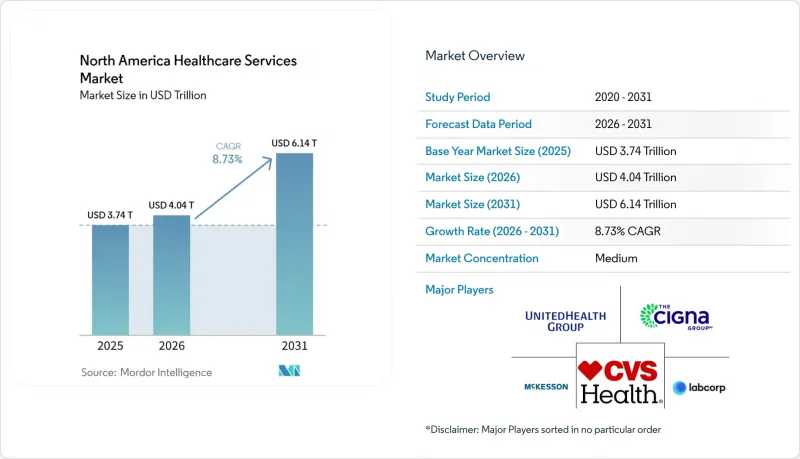
This report is Segmented by Service Type (Inpatient, Outpatient, Emergency, Primary Care, Long-Term Care, Home Healthcare, Diagnostic, Rehabilitation Services), Service Delivery (Public, Private Healthcare Services), End User (Adult, Geriatric, Pediatric Care), and Geography (United States, Canada, Mexico). The Market Forecasts are Provided in Terms of Value (USD).
North America Healthcare Services Market Trends and Insights
Rising Demand for Outpatient and Ambulatory Care
The North America healthcare services market is getting a direct push from Medicare's site-neutral payment reform in 2026. CMS finalizes a 60% rate reduction for drug administration at off-campus hospital outpatient departments, which reduces the appeal of high-cost hospital-based settings. This change is moving elective, diagnostic, and specialty procedures toward ambulatory surgery centers and freestanding clinics. Commercial insurers are extending the same logic, and Blue Cross Blue Shield of Wyoming launches CarePath in August 2026 for total knee procedures. Providers with established outpatient networks are better placed to absorb this shift, while hospital systems that still depend on hospital-based outpatient revenue face margin pressure.
Aging Population and Chronic Disease Burden
The North American healthcare services market continues to grow on the back of older populations and more chronic diseases. The U.S. median age reached 39.4 in 2025, up from 39.2 in 2024, and this older age mix will keep raising demand for ongoing treatment. This demand fits poorly with care models that were built around episodic acute treatment rather than continuous management. Humana expands its senior-focused delivery footprint in Q1 2026 by adding 54 CenterWell Senior Primary Care centers and 59,000 patients through the MaxHealth acquisition. Canada faces the same pressure, and Ontario Health projects 3.1 million residents living with major illness by 2040.
Clinician Shortages and Burnout
The North America healthcare services market continues to face a labor ceiling that technology cannot fully offset. HRSA projects a shortage of 270,000 registered nurses by 2028, with additional shortages in licensed practical nurses and primary care physicians. Physician burnout improved in 2025, but it still remains high at 41.9%. Nursing pressure worsens, and Cross Country Healthcare's 2026 survey shows burnout rising to 67% and concerns over short staffing rising to 61%. Canada is also pulling in U.S.-trained nurses, which may ease provincial shortages there but can tighten supply for U.S. providers.
Other drivers and restraints analyzed in the detailed report include:
- Expansion of Hospital-at-Home and Home Health Models
- AI-Enabled Care Navigation and Operational Efficiency
- Reimbursement Compression and Payment Uncertainty
For complete list of drivers and restraints, kindly check the Table Of Contents.
Segment Analysis
Outpatient services held 38.13% share of the North America healthcare services market size in 2025, while home healthcare services are projected to grow fastest at 8.85% CAGR from 2026 to 2031. That split shows how the North America healthcare services market is shifting care away from hospital stays and toward lower-acuity settings. The 2026 policy backdrop gives providers more confidence to build home-based acute care programs and related support infrastructure. Diagnostic services are also benefiting as decentralized testing networks widen community access. Rehabilitation services are tracking higher recovery needs linked to musculoskeletal and neurological conditions in older patients.
Inpatient services still account for substantial facility revenue in the North America healthcare services market, but they face pressure from site-neutral payment reform, hospital-at-home alternatives, and labor inflation. Long-term care services are seeing stronger demand from aging patients, yet staffing shortages make delivery harder to scale. Primary care services are being redesigned around easier access, and CVS Health is expanding small pharmacy-focused primary care locations in 2026. Emergency services continue to experience heavy utilization when patients cannot access timely primary care, which keeps pressure on the region's highest-cost care setting.
Complete Report Scope:
- By Service Type
- Inpatient Services
- Outpatient Services
- Emergency Services
- Primary Care Services
- Long-Term Care Services
- Home Healthcare Services
- Diagnostic Services
- Rehabilitation Services
- By Service Delivery
- Public Healthcare Services
- Private Healthcare Services
- By End User
- Adult Care
- Geriatric Care
- Pediatric Care
- By Country
- United States
- Canada
- Mexico
List of Companies Covered in this Report:
- Amedisys
- Ascension
- Cardinal Health
- CommonSpirit Health
- CVS Health
- DaVita
- Enhabit, Inc.
- Fresenius Medical Care AG and Co. KGaA
- HCA Healthcare, Inc.
- Humana Inc.
- Kaiser Permanente
- Labcorp Holdings Inc.
- Mckesson
- Optum
- Quest Diagnostics
- Surgery Partners, Inc.
- Tenet Healthcare
- The Cigna Group
- United Health Group
- Universal Health Services
Additional Benefits:
- The market estimate (ME) sheet in Excel format
- 3 months of analyst support
TABLE OF CONTENTS
1 Introduction
- 1.1 Study Assumptions & Market Definition
- 1.2 Scope of the Study
2 Research Methodology
3 Executive Summary
4 Market Landscape
- 4.1 Market Overview
- 4.2 Market Drivers
- 4.2.1 Rising Demand for Outpatient and Ambulatory Care
- 4.2.2 Aging Population and Chronic Disease Burden
- 4.2.3 Expansion of Hospital-at-Home and Home Health Models
- 4.2.4 Payer Push Toward Site-of-Care Optimization
- 4.2.5 AI-Enabled Care Navigation and Operational Efficiency
- 4.2.6 Cross-Border Care and Medical Tourism in Mexico
- 4.3 Market Restraints
- 4.3.1 Clinician Shortages and Burnout
- 4.3.2 Reimbursement Compression and Payment Uncertainty
- 4.3.3 Cybersecurity and Data Interoperability Gaps
- 4.3.4 High Labor, Compliance, and Facility Operating Costs
- 4.4 Value / Supply-Chain Analysis
- 4.5 Regulatory Landscape
- 4.6 Technological Outlook
- 4.7 Porter's Five Forces Analysis
- 4.7.1 Threat of New Entrants
- 4.7.2 Bargaining Power of Suppliers
- 4.7.3 Bargaining Power of Buyers
- 4.7.4 Threat of Substitutes
- 4.7.5 Industry Rivalry
5 Market Size & Growth Forecasts
- 5.1 By Service Type
- 5.1.1 Inpatient Services
- 5.1.2 Outpatient Services
- 5.1.3 Emergency Services
- 5.1.4 Primary Care Services
- 5.1.5 Long-Term Care Services
- 5.1.6 Home Healthcare Services
- 5.1.7 Diagnostic Services
- 5.1.8 Rehabilitation Services
- 5.2 By Service Delivery
- 5.2.1 Public Healthcare Services
- 5.2.2 Private Healthcare Services
- 5.3 By End User
- 5.3.1 Adult Care
- 5.3.2 Geriatric Care
- 5.3.3 Pediatric Care
- 5.4 By Country
- 5.4.1 United States
- 5.4.2 Canada
- 5.4.3 Mexico
6 Competitive Landscape
- 6.1 Market Concentration
- 6.2 Market Share Analysis
- 6.3 Company Profiles (includes Global Level Overview, Market-level Overview, Core Segments, Financials, Strategic Information, Market Rank/Share, Products & Services, Recent Developments)
- 6.3.1 Amedisys, Inc.
- 6.3.2 Ascension
- 6.3.3 Cardinal Health, Inc.
- 6.3.4 CommonSpirit Health
- 6.3.5 CVS Health
- 6.3.6 DaVita Inc.
- 6.3.7 Enhabit, Inc.
- 6.3.8 Fresenius Medical Care AG and Co. KGaA
- 6.3.9 HCA Healthcare, Inc.
- 6.3.10 Humana Inc.
- 6.3.11 Kaiser Permanente
- 6.3.12 Labcorp Holdings Inc.
- 6.3.13 McKesson Corporation
- 6.3.14 Optum, Inc.
- 6.3.15 Quest Diagnostics Incorporated
- 6.3.16 Surgery Partners, Inc.
- 6.3.17 Tenet Healthcare Corporation
- 6.3.18 The Cigna Group
- 6.3.19 UnitedHealth Group
- 6.3.20 Universal Health Services, Inc.
7 Market Opportunities & Future Outlook
- 7.1 White-space & Unmet-need Assessment

