PUBLISHER: Mordor Intelligence | PRODUCT CODE: 2099244

PUBLISHER: Mordor Intelligence | PRODUCT CODE: 2099244
United States Cold Storage - Market Share Analysis, Industry Trends & Statistics, Growth Forecasts (2026 - 2031)
According to Mordor Intelligence, the United States cold storage market was valued at USD 52.40 billion in 2025 and is estimated to grow from USD 55.61 billion in 2026 to reach USD 73.83 billion by 2031, at a CAGR of 5.83% during the forecast period 2026-2031.
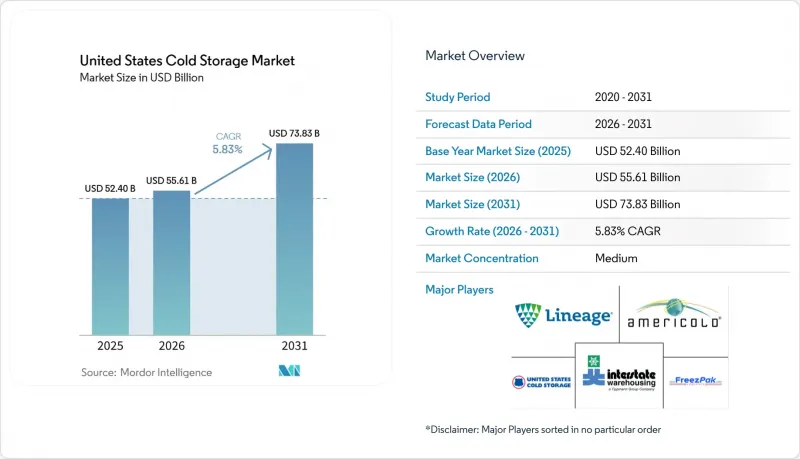
The current expansion of the United States' cold storage market reflects a wider shift in food distribution and pharmaceutical logistics toward regional temperature-controlled networks rather than short-cycle inventory additions. This report is Segmented by Temperature Type (Chilled, Frozen, and More), by Automation Level (Conventional Facilities and Automated Cold Stores), by Application (Fruits and Vegetables, Meat and Poultry, Fish and Seafood, Dairy and Frozen Desserts, Ready-To-Eat Meals, and More), and by Region (Northeast, Southeast, Midwest, and More). The Market Forecasts are Provided in Terms of Value (USD).
United States Cold Storage Market Trends and Insights
Rising Demand for Temperature-Controlled Grocery Fulfillment
The United States cold storage market is benefiting from the steady buildout of refrigerated fulfillment infrastructure tied to online grocery and direct-to-consumer food delivery. Grocery retailers are reworking their distribution networks so that fresh, frozen, and prepared foods can move through more controlled handling points rather than general warehouse space. This raises the need for multi-temperature rooms, fast dock turnover, and urban cold nodes that can support repeat delivery cycles. NAIOP noted that the United States online grocery sales are on track to surpass USD 150 billion in 2026, supporting the case for continued investment in specialized refrigerated real estate. As larger regional food distribution assets come online, the United States cold storage market is also seeing linked demand for smaller infill locations closer to dense metro delivery zones.
Pharmaceutical Cold Chain Expansion Beyond Food Logistics
The United States cold storage market is also being lifted by the rapid expansion of pharmaceutical logistics beyond the food-centered warehouse model. Biologics, biosimilars, and advanced therapies require tighter storage protocols, deeper validation, and more consistent chain-of-custody controls than typical food accounts. This pushes operators to invest in qualified chilled and ultra-low environments that can support higher-value products and stricter audit requirements. Demand remains concentrated in the Northeast, but the footprint is broadening as life sciences manufacturing activity grows in states such as Texas and North Carolina. This makes pharmaceutical handling one of the strongest quality-driven growth paths in the United States cold storage market, especially for operators that can combine temperature control, documentation, and modern infrastructure within a single network.
High Cost of Refrigeration Power and Peak Load Exposure
The United States' cold storage market faces persistent margin pressure from electricity costs, as refrigeration is the main power draw in most facilities. Operators in large demand centers also face high peak-load exposure, which can sharply lift bills during summer and high-utilization periods. This is especially difficult in regions where power pricing is already elevated and where demand charges punish short periods of load spikes. Central Valley Cold Storage showed PG&E commercial peak-period rates of USD 0.32 to USD 0.45 per kWh in 2026, underscoring the cost pressure major California operators must manage. The AIM Act transition adds another layer of cost because refrigeration system upgrades may improve long-run performance but require upfront spending before savings are fully realized.
Other drivers and restraints analyzed in the detailed report include:
- Automation-Ready Modern Facilities Capturing Occupier Demand
- Energy-Efficiency Retrofits Improving Operating Economics
- Very High Capital Intensity for New Build and Modernization
For complete list of drivers and restraints, kindly check the Table Of Contents.
Segment Analysis
Frozen (-18-0 °C) storage accounted for 46.44% of the United States cold storage market share in 2025, making it the largest temperature band by value. That position reflects the scale of protein processing, frozen meals, vegetables, and food service distribution across long-established supply chains. The segment also benefits from a deep installed base in the Midwest and Southeast, where manufacturers and processors generate steady throughput. Chilled storage remains important for fresh food, dairy, and some pharmaceutical flows, especially where retail replenishment requires faster cycling closer to demand centers. Ambient cold storage continues to serve narrower needs such as chocolates, wines, and temperature-sensitive materials that need control without full refrigeration.
Deep-frozen/ultra-low (less than -20 °C) is projected to grow at a 11.09% CAGR, giving it one of the most attractive expansion profiles in the United States cold storage market through 2031. The segment is being supported by cell and gene therapy storage, vaccine handling, and the broader need for validated ultra-low infrastructure. This is shifting investment toward facilities that can handle multiple temperature bands and maintain tighter monitoring standards. NewCold's Lebanon Phase 3 project in Indiana shows how operators are building chilled and frozen capability together to improve flexibility across high-specification demand streams. In the United States, older deep-freeze capacity without automation or advanced controls is less likely to compete for premium biologics and specialty healthcare contracts.
Complete Report Scope:
- By Temperature Type
- Chilled (0-5 °C)
- Frozen (-18-0 °C)
- Ambient
- Deep-Frozen / Ultra-Low (Less than -20 °C)
- By Automation Level (Storage)
- Conventional Facilities
- Automated Cold Stores (AS/RS, Robotics)
- By Application
- Fruits & Vegetables
- Meat & Poultry
- Fish & Seafood
- Dairy & Frozen Desserts
- Bakery & Confectionery
- Ready-to-Eat Meals
- Pharmaceuticals & Biologics
- Vaccines & Clinical Trial Materials
- Chemicals & Specialty Materials
- Other Perishables
- By Region
- Northeast
- Southeast
- Midwest
- Southwest
- West
List of Companies Covered in this Report:
- Lineage, Inc.
- Americold Realty Trust
- United States Cold Storage
- Interstate Warehousing
- FreezPak Logistics
- Vertical Cold Storage
- Arcadia Cold Storage & Logistics
- NewCold
- Burris Logistics
- RLS Logistics
- NFI Industries
- Penske Logistics
- Kenco Logistics
- Tippmann Group
- Congebec
- Conestoga Cold Storage
- ColdPoint Logistics
- Seafrigo Group
- Envision Cold
- Eskimo Cold Storage
- Nordic Logistics & Warehousing
- Frialsa USA
Additional Benefits:
- The market estimate (ME) sheet in Excel format
- 3 months of analyst support
TABLE OF CONTENTS
1 Introduction
- 1.1 Study Assumptions & Market Definition
- 1.2 Scope of the Study
2 Research Methodology
3 Executive Summary
4 Market Landscape
- 4.1 Market Overview and Role of Cold Storage in Logistics
- 4.2 Market Drivers
- 4.2.1 Rising Demand for Temperature-Controlled Grocery Fulfillment
- 4.2.2 Pharmaceutical Cold Chain Expansion Beyond Food Logistics
- 4.2.3 Automation-Ready Modern Facilities Capturing Occupier Demand
- 4.2.4 Energy-Efficiency Retrofits Improving Operating Economics
- 4.2.5 Contracted Capacity as a Hedge Against Volatile Spot Inventory Cycles
- 4.2.6 GLP-1 Driven Shifts in Food Mix and Cold-Chain Health Products
- 4.3 Market Restraints
- 4.3.1 High Cost of Refrigeration Power and Peak Load Exposure
- 4.3.2 Very High Capital Intensity for New Build and Modernization
- 4.3.3 Shortage of Skilled Labor for Cold-Room and Automation Operations
- 4.3.4 Legacy Asset Obsolescence and Occupier Flight to Quality
- 4.4 Regulatory Framework
- 4.5 Value Chain and Distribution Channel Architecture Analysis
- 4.6 Technology Innovations Outlook
- 4.7 Porter's Five Forces Analysis
- 4.7.1 Threat of New Entrants
- 4.7.2 Bargaining Power of Suppliers
- 4.7.3 Bargaining Power of Buyers
- 4.7.4 Threat of Substitutes
- 4.7.5 Rivalry Among Competitors
- 4.8 Evolution of the Cold Storage Industry
- 4.9 Cold Storage Installed Capacity and Expansion Trend Analysis
- 4.10 Public vs Private Capacity Split
- 4.11 Key Infrastructure Projects
- 4.12 Sustainability and ESG Assessment
- 4.13 Impact of Geo-Political Events on Supply Chain Shifts
5 Market Size & Growth Forecasts (Value, 2026-2031)
- 5.1 By Temperature Type
- 5.1.1 Chilled (0-5 °C)
- 5.1.2 Frozen (-18-0 °C)
- 5.1.3 Ambient
- 5.1.4 Deep-Frozen / Ultra-Low (Less than -20 °C)
- 5.2 By Automation Level (Storage)
- 5.2.1 Conventional Facilities
- 5.2.2 Automated Cold Stores (AS/RS, Robotics)
- 5.3 By Application
- 5.3.1 Fruits & Vegetables
- 5.3.2 Meat & Poultry
- 5.3.3 Fish & Seafood
- 5.3.4 Dairy & Frozen Desserts
- 5.3.5 Bakery & Confectionery
- 5.3.6 Ready-to-Eat Meals
- 5.3.7 Pharmaceuticals & Biologics
- 5.3.8 Vaccines & Clinical Trial Materials
- 5.3.9 Chemicals & Specialty Materials
- 5.3.10 Other Perishables
- 5.4 By Region
- 5.4.1 Northeast
- 5.4.2 Southeast
- 5.4.3 Midwest
- 5.4.4 Southwest
- 5.4.5 West
6 Competitive Landscape
- 6.1 Market Concentration
- 6.2 Key Strategic Moves
- 6.3 Market Share Analysis
- 6.4 Company Profiles (includes Global level Overview, Market level overview, Core Segments, Financials as available, Strategic Information, Market Rank/Share for key companies, Products & Services, and Recent Developments)
- 6.4.1 Lineage, Inc.
- 6.4.2 Americold Realty Trust
- 6.4.3 United States Cold Storage
- 6.4.4 Interstate Warehousing
- 6.4.5 FreezPak Logistics
- 6.4.6 Vertical Cold Storage
- 6.4.7 Arcadia Cold Storage & Logistics
- 6.4.8 NewCold
- 6.4.9 Burris Logistics
- 6.4.10 RLS Logistics
- 6.4.11 NFI Industries
- 6.4.12 Penske Logistics
- 6.4.13 Kenco Logistics
- 6.4.14 Tippmann Group
- 6.4.15 Congebec
- 6.4.16 Conestoga Cold Storage
- 6.4.17 ColdPoint Logistics
- 6.4.18 Seafrigo Group
- 6.4.19 Envision Cold
- 6.4.20 Eskimo Cold Storage
- 6.4.21 Nordic Logistics & Warehousing
- 6.4.22 Frialsa USA
7 Market Opportunities & Future Outlook
- 7.1 White-space & Unmet-Need Assessment

