PUBLISHER: Mordor Intelligence | PRODUCT CODE: 2119698

PUBLISHER: Mordor Intelligence | PRODUCT CODE: 2119698
Cold Storage - Market Share Analysis, Industry Trends & Statistics, Growth Forecasts (2026 - 2031)
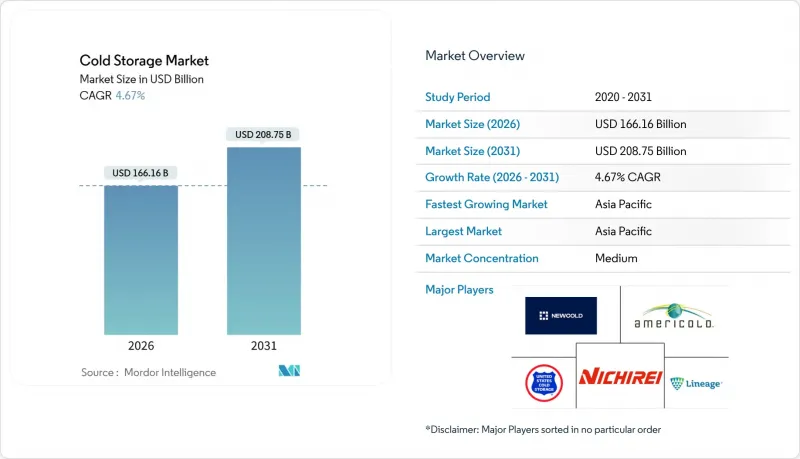
According to Mordor Intelligence, the cold storage market size is estimated at USD 166.16 billion in 2026, and is expected to reach USD 208.75 billion by 2031, at a CAGR of 4.67% during the forecast period (2026-2031).
This report is Segmented by Temperature Type (Chilled, Frozen, Ambient, Deep-Frozen/Ultra-Low), by Automation Level (Conventional, Automated Stores), by Application (Fruits & Vegetables, Meat, Poultry, Seafood, Dairy, Bakery, Ready-To-Eat Meals, Pharmaceuticals, Vaccines, Chemicals, and Others), by Geography (North America, Europe, Asia-Pacific, and More). Market Forecasts are Provided in Value (USD).
Global Cold Storage Market Trends and Insights
Growth of Organized Retail & E-grocery
Online grocery is on track to capture 21.5% of total U.S. grocery sales by 2025, reaching the critical mass that justifies purpose-built urban cold stores positioned within 10-15 miles of large population centers. Modern trade formats in India alone are set to rise from USD 790 billion in 2024 to USD 850 billion in 2025, and these outlets require temperature-controlled back-end logistics that legacy wholesale networks cannot supply. Micro-fulfillment designs maximize cubic utilization, often serving more than 100,000 households with a 30-minute delivery window while cutting last-mile costs by up to 50%. The upside is balanced by forecasting challenges: stockouts or spoilage in high-rent urban nodes rapidly erode margin advantages, pushing operators toward sophisticated demand-planning software and advanced analytics.
Expansion of Pharmaceutical Cold Chains
Biologics, cell therapies, and gene therapies now demand storage from -40 °C down to -196 °C, a range far beyond traditional vaccine requirements. SCHOTT Pharma's polymer syringe validated to -180 °C, launched in 2025, underscores the pace of packaging innovation. GDP certification, automated temperature monitoring, and validated chain-of-custody protocols have raised compliance costs but also created durable barriers to entry, allowing certified facilities to charge 30-50% pricing premiums. Geography is diversifying as manufacturers establish regional depots for resilience, opening opportunities for cold storage operators in secondary markets previously overlooked by pharmaceutical logistics.
High Energy Consumption & Electricity Costs
Energy accounts for 50-70% of operating expense in a typical cold store, leaving profitability highly sensitive to tariff swings. In parts of Sub-Saharan Africa, grid unreliability forces diesel backup that can raise operating costs by 25%. Facilities are upgrading building envelopes, installing variable-speed drives, and adopting low-GWP refrigerants such as Honeywell's Solstice ze, reported to cut energy use by 46%. Capital outlays, however, range from USD 1 million to USD 3 million per 100,000 ft2, slowing adoption in lower-margin facilities.
Other drivers and restraints analyzed in the detailed report include:
- Rising Demand for Frozen & Convenience Foods
- Government Incentives for Cold-Chain Infrastructure
- Heavy Upfront CapEx & Regulatory Compliance
For complete list of drivers and restraints, kindly check the Table Of Contents.
Segment Analysis
Frozen storage continues to anchor 62.34% of the cold storage market in 2025 by value. Yet the deep-frozen and ultra-low segment, defined as below -20 °C, is climbing at a 13.01% CAGR to 2031, nearly triple the overall cold storage market growth. Ultra-low freezers operating between -40 °C and -86 °C are indispensable for cell and gene therapies, and demand for cryogenic liquid nitrogen storage below -150 °C is emerging. This high-specification space commands rental rates two to three times higher than standard frozen rooms, cushioning capital costs and supporting premium margins.
Operators investing early enjoy durable advantages. Ultra-low rooms require redundant compressors, backup generators sized for extended outages, stainless-steel racks compatible with cryogenic exposure, and continuous monitoring that integrates with validated laboratory information systems. Upfront capex per pallet slot can exceed USD 1,500, but high utilization and multi-year take-or-pay contracts common in pharma logistics provide revenue certainty. Conversely, the chilled 0-5 °C band retains steady demand for dairy, produce, and non-frozen pharmaceuticals. Pricing pressure is more acute in chilled rooms, prompting consolidation as operators seek scale to spread fixed energy and compliance costs. Hybrid facilities that flex zones among chilled, frozen, and ambient conditions are gaining traction, maximizing cubic throughput and diversifying revenue streams within a single site.
Complete Report Scope:
- By Temperature Type
- Chilled (0-5 °C)
- Frozen (-18-0 °C)
- Ambient
- Deep-Frozen / Ultra-Low (<-20 °C)
- By Automation Level (Storage)
- Conventional Facilities
- Automated Cold Stores (AS/RS, Robotics)
- By Application
- Fruits & Vegetables
- Meat & Poultry
- Fish & Seafood
- Dairy & Frozen Desserts
- Bakery & Confectionery
- Ready-to-Eat Meals
- Pharmaceuticals & Biologics
- Vaccines & Clinical Trial Materials
- Chemicals & Specialty Materials
- Other Perishables
- By Geography
- North America
- United States
- Canada
- Mexico
- South America
- Brazil
- Peru
- Chile
- Argentina
- Rest of South America
- Asia Pacific
- India
- China
- Japan
- Australia
- South Korea
- South East Asia (Singapore, Malaysia, Thailand, Indonesia, Vietnam, and Philippines)
- Rest of Asia-Pacific
- Europe
- United Kingdom
- Germany
- France
- Spain
- Italy
- BENELUX (Belgium, Netherlands, and Luxembourg)
- NORDICS (Denmark, Finland, Iceland, Norway, and Sweden)
- Rest of Europe
- Middle East And Africa
- United Arab of Emirates
- Saudi Arabia
- South Africa
- Nigeria
- Rest of Middle East And Africa
- North America
Geography Analysis
Asia-Pacific held 36.61% of the cold storage market value in 2025 and is set to outpace all other regions with a 12.02% CAGR to 2031. China's provincial subsidies and mandatory green-design codes spur investment in energy-efficient warehouses, while India's government programs underwrite integrated networks from farmgate to megacity. Southeast Asia is maturing into a regional transshipment hub, channeling seafood and pharmaceuticals through Singapore's and Malaysia's temperature-controlled ports. Fragmented regulatory frameworks and skills gaps persist, yet savvy operators leverage joint ventures with local partners to navigate permitting and land acquisition hurdles.
North America exhibits a mature yet dynamic landscape. The United States alone controls roughly 3.7 billion cubic feet of refrigerated storage, but average facility age exceeds 40 years, prompting a modernization wave. E-grocery penetration and pharmaceutical growth are redirecting investment toward urban micro-fulfillment nodes and automated mega-warehouses near intermodal corridors. Land scarcity in Tier-1 coastal markets inflates ground rents, pushing development inland along rail-served logistics parks. Canada and Mexico are expanding capacity to support export-oriented agriculture and near-shoring trends, respectively, cementing the region's integrated supply networks.
South America, Europe, and the Middle East-Africa offer contrasting profiles. Brazil and Peru expand capacity for meat and fruit exports, though currency volatility and high borrowing costs limit smaller projects. Europe's cold storage market is undergoing a regulatory-driven overhaul as the F-gas ban accelerates adoption of natural refrigerants. Germany, the BENELUX, and the Nordics lead in automation and renewable integration, while Southern Europe deploys hybrid solar-powered plants to offset high electricity tariffs. In the Middle East, the UAE and Saudi Arabia position themselves as regional hubs, while Sub-Saharan Africa experiments with solar-linked micro-storage to cut post-harvest losses, highlighting diverse pathways toward cold chain maturity.
- Lineage Logistics Holdings, LLC
- Americold Realty Trust, Inc.
- United States Cold Storage, Inc.
- Burris Logistics, Inc.
- NewCold Cooperatief U.A.
- United States Cold Storage, Inc. (USCS)
- Nichirei
- Emergent Cold Latin America
- FreezPak Logistics
- Interstate Warehousing, Inc
- Cube Cold Europe NL HoldCo B.V. (CubeCold)
- SuperFrio Logistica Frigorificada
- Vertical Cold Storage
- Magnavale Ltd
- Conestoga Cold Storage
- Agile Cold Storage LLC
- Arcadia Cold Storage & Logistics
- Congebec Inc.
- Cold-Link Logistics
Additional Benefits:
- The market estimate (ME) sheet in Excel format
- 3 months of analyst support
TABLE OF CONTENTS
1 Introduction
- 1.1 Study Assumptions & Market Definition
- 1.2 Scope of the Study
2 Research Methodology
3 Executive Summary
4 Market Landscape
- 4.1 Market Overview
- 4.2 Market Drivers
- 4.2.1 Growth of organized retail & e-grocery
- 4.2.2 Expansion of pharmaceutical cold chains
- 4.2.3 Rising demand for frozen & convenience foods
- 4.2.4 Government incentives for cold-chain infrastructure
- 4.2.5 Solar-powered refrigeration in emerging markets
- 4.2.6 Warehouse automation (AS/RS, robotics) adoption
- 4.3 Market Restraints
- 4.3.1 High energy consumption & electricity costs
- 4.3.2 Heavy upfront CapEx & regulatory compliance
- 4.3.3 Shortage of skilled refrigeration technicians
- 4.3.4 Rising insurance premiums for ammonia systems
- 4.4 Value / Supply-Chain Analysis
- 4.5 Regulatory or Technological Outlook
- 4.6 Porter's Five Forces
- 4.6.1 Bargaining Power of Suppliers
- 4.6.2 Bargaining Power of Buyers
- 4.6.3 Threat of New Entrants
- 4.6.4 Threat of Substitutes
- 4.6.5 Intensity of Competitive Rivalry
- 4.7 Cold Storage Capacity Expansion Trend Analysis
5 Market Size & Growth Forecasts - Value (USD)
- 5.1 By Temperature Type
- 5.1.1 Chilled (0-5 °C)
- 5.1.2 Frozen (-18-0 °C)
- 5.1.3 Ambient
- 5.1.4 Deep-Frozen / Ultra-Low (<-20 °C)
- 5.2 By Automation Level (Storage)
- 5.2.1 Conventional Facilities
- 5.2.2 Automated Cold Stores (AS/RS, Robotics)
- 5.3 By Application
- 5.3.1 Fruits & Vegetables
- 5.3.2 Meat & Poultry
- 5.3.3 Fish & Seafood
- 5.3.4 Dairy & Frozen Desserts
- 5.3.5 Bakery & Confectionery
- 5.3.6 Ready-to-Eat Meals
- 5.3.7 Pharmaceuticals & Biologics
- 5.3.8 Vaccines & Clinical Trial Materials
- 5.3.9 Chemicals & Specialty Materials
- 5.3.10 Other Perishables
- 5.4 By Geography
- 5.4.1 North America
- 5.4.1.1 United States
- 5.4.1.2 Canada
- 5.4.1.3 Mexico
- 5.4.2 South America
- 5.4.2.1 Brazil
- 5.4.2.2 Peru
- 5.4.2.3 Chile
- 5.4.2.4 Argentina
- 5.4.2.5 Rest of South America
- 5.4.3 Asia Pacific
- 5.4.3.1 India
- 5.4.3.2 China
- 5.4.3.3 Japan
- 5.4.3.4 Australia
- 5.4.3.5 South Korea
- 5.4.3.6 South East Asia (Singapore, Malaysia, Thailand, Indonesia, Vietnam, and Philippines)
- 5.4.3.7 Rest of Asia-Pacific
- 5.4.4 Europe
- 5.4.4.1 United Kingdom
- 5.4.4.2 Germany
- 5.4.4.3 France
- 5.4.4.4 Spain
- 5.4.4.5 Italy
- 5.4.4.6 BENELUX (Belgium, Netherlands, and Luxembourg)
- 5.4.4.7 NORDICS (Denmark, Finland, Iceland, Norway, and Sweden)
- 5.4.4.8 Rest of Europe
- 5.4.5 Middle East And Africa
- 5.4.5.1 United Arab of Emirates
- 5.4.5.2 Saudi Arabia
- 5.4.5.3 South Africa
- 5.4.5.4 Nigeria
- 5.4.5.5 Rest of Middle East And Africa
- 5.4.1 North America
6 Competitive Landscape
- 6.1 Market Concentration
- 6.2 Strategic Moves
- 6.3 Market Share Analysis
- 6.4 Company Profiles (includes Global level Overview, Market level overview, Core Segments, Financials as available, Strategic Information, Market Rank/Share for key companies, Products & Services, and Recent Developments)
- 6.4.1 Lineage Logistics Holdings, LLC
- 6.4.2 Americold Realty Trust, Inc.
- 6.4.3 United States Cold Storage, Inc.
- 6.4.4 Burris Logistics, Inc.
- 6.4.5 NewCold Cooperatief U.A.
- 6.4.6 United States Cold Storage, Inc. (USCS)
- 6.4.7 Nichirei
- 6.4.8 Emergent Cold Latin America
- 6.4.9 FreezPak Logistics
- 6.4.10 Interstate Warehousing, Inc
- 6.4.11 Cube Cold Europe NL HoldCo B.V. (CubeCold)
- 6.4.12 SuperFrio Logistica Frigorificada
- 6.4.13 Vertical Cold Storage
- 6.4.14 Magnavale Ltd
- 6.4.15 Conestoga Cold Storage
- 6.4.16 Agile Cold Storage LLC
- 6.4.17 Arcadia Cold Storage & Logistics
- 6.4.18 Congebec Inc.
- 6.4.19 Cold-Link Logistics
7 Market Opportunities & Future Outlook

