PUBLISHER: Mordor Intelligence | PRODUCT CODE: 2099453

PUBLISHER: Mordor Intelligence | PRODUCT CODE: 2099453
China Cold Storage - Market Share Analysis, Industry Trends & Statistics, Growth Forecasts (2026 - 2031)
According to Mordor Intelligence, the China cold storage market size was valued at USD 47.78 billion in 2025 and is projected to grow to USD 51.98 billion in 2026 and reach USD 77.66 billion by 2031, growing at a CAGR of 8.36% from 2026 to 2031.
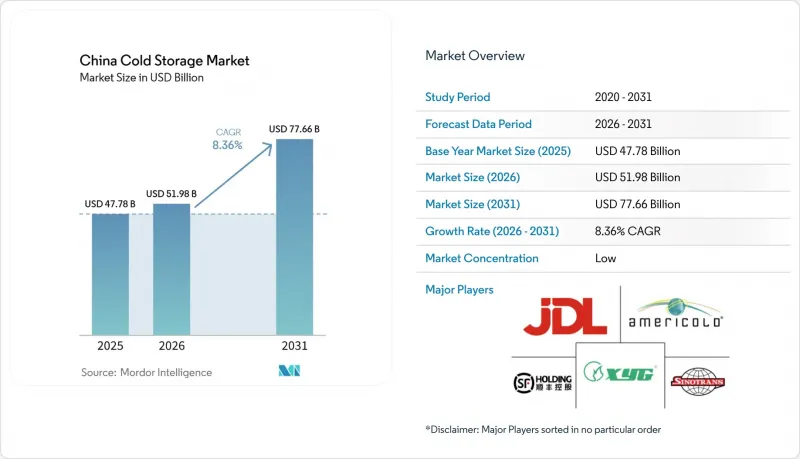
Demand in the China cold storage market is now coming from a broader mix of food retail, biologics, premium convenience foods, and last-mile urban fulfillment, lifting the value of higher-specification storage beyond its capacity needs. This report is Segmented by Temperature Type (Chilled, Frozen, Ambient, and More), by Automation Level (Conventional Facilities and Automated Cold Stores), by Application (Fruits and Vegetables, Meat and Poultry, Fish and Seafood, Dairy and Frozen Desserts, Ready-To-Eat Meals, and More), and by Region (North, Northeast, South, and More). The Market Forecasts are Provided in Terms of Value USD.
China Cold Storage Market Trends and Insights
Expansion Of Online Grocery And Fresh E-Commerce
Fresh e-commerce penetration reached 48.6% in 2025, while China's urbanization rate reached 67.2%, which kept a large consumer base within reach of dense urban delivery networks in the China cold storage market. The same pattern is pushing operators to place more chilled inventory inside or near residential clusters because short delivery windows now matter as much as bulk storage capacity for many food categories. Micro-fulfillment hubs are changing the sizing logic of the China cold storage market because distributed 500- to 2,000-m2 nodes can serve urban demand more efficiently than relying solely on distant mega sites. This shift is creating pressure on standard-specification assets in outer industrial parks, where supply is easier to add but access to fast urban demand is weaker. It also supports greater investment in software-enabled inventory visibility, routing, and replenishment, as city-level cold chain performance is now closely tied to response speed and location quality, not just pallet volume.
Rising Pharmaceutical And Biologics Cold Chain Demand
The China cold storage market is seeing stronger demand from pharmaceutical and biologics customers that need tighter validation, higher traceability, and better temperature discipline than conventional food-grade storage usually provides. The national standard GB/T 46204-2025 increased the traceability burden upon its October 2025 implementation, strengthening the position of operators that already run validated processes and digital temperature monitoring systems. Demand is also shifting toward ultra-low-temperature lanes for biologics, mRNA-related handling, and advanced therapy logistics, which is narrowing the field of providers able to serve premium contracts. As a result, the China cold storage market is moving toward higher-quality revenue by facilities that combine compliant storage, validated handling, and dependable last-mile service for healthcare customers.
High Land And Electricity Costs In Core Logistics Corridors
Energy and land remain major cost limits in the China cold storage market because refrigerated facilities are more power-intensive than standard warehouses, and core logistics corridors continue to see pricing pressure on industrial sites. This issue is most visible around Shanghai, Guangzhou, and Shenzhen, where the economics of older facilities are weaker if operators have not invested in green refrigerants, solar support, or better energy management. Smaller operators are under the most pressure because they often lack the capital needed for retrofits that could lower recurring utility exposure and reduce future compliance risk. Developers are therefore moving some new projects toward satellite cities and second-ring industrial zones, where land is cheaper even if transport distances become longer. The result is that profitability in the China cold storage market depends more on site selection, energy efficiency, and customer mix than on storage scale alone.
Other drivers and restraints analyzed in the detailed report include:
- Government-Led Cold Chain Infrastructure Investment
- Automation Adoption In High-Density Urban Logistics Hubs
- Fragmented Operator Base And Uneven Cold Chain Standardization
For complete list of drivers and restraints, kindly check the Table Of Contents.
Segment Analysis
Chilled (0-5 °C) storage accounted for 46.51% of China cold storage market share in 2025, making it the largest temperature segment by value. That position came from the large flow of fresh produce, dairy, chilled meat, and ready-to-sell food items moving through East and South China distribution networks. Chilled assets are important for throughput and network density, but they often serve food retail contracts with lower margins than more specialized low-temperature applications. Frozen storage remains central for processed meat, imports, and central kitchen supply because longer dwell times and more predictable throughput support steadier operating patterns in the China cold storage market.
Deep-frozen/ultra-low (-20 °C or lower) storage is projected to grow at a 13.62% CAGR through 2031, making it the fastest-expanding temperature segment in the China cold storage market. This demand is coming from both biologics handling and premium seafood or ice cream imports, which require more stable sub-zero performance than conventional food storage. Operators that entered this segment earlier are better placed because ultra-low chambers require more capex, tighter monitoring, and stronger engineering discipline than standard frozen rooms. The China cold storage industry is therefore seeing a clearer divide between volume-heavy chilled infrastructure and higher-yield ultra-low assets that serve fewer but more demanding customers.
Complete Report Scope:
- By Temperature Type
- Chilled (0-5 °C)
- Frozen (-18-0 °C)
- Ambient
- Deep-Frozen / Ultra-Low (Less than -20 °C)
- By Automation Level (Storage)
- Conventional Facilities
- Automated Cold Stores (AS/RS, Robotics)
- By Application
- Fruits and Vegetables
- Meat and Poultry
- Fish and Seafood
- Dairy and Frozen Desserts
- Bakery and Confectionery
- Ready-to-Eat Meals
- Pharmaceuticals and Biologics
- Vaccines and Clinical Trial Materials
- Chemicals and Specialty Materials
- Other Perishables
- By Region
- North
- Northeast
- East
- Central
- South
- Southwest
- Northwest
List of Companies Covered in this Report:
- China Merchants Americold Holdings Co., Ltd.
- JD Logistics, Inc.
- SF Cold Chain (SF Holding)
- Sinotrans Ltd.
- Xianyi Holdings Group
- Swire Cold Chain Logistics
- YH Global (Yuan Hong Holdings)
- COFCO Cold Chain Logistics
- Beijing Shounong Food Group Co., Ltd.
- CJ Rokin Logistics and Supply Chain Co., Ltd.
- China Logistics Group Cold Chain
- China Railway Special Cargo Logistics
- Shenzhen Agricultural Products Group (SZAP)
- Shandong Gaishi International Logistics Group
- Zhengming Logistics (ZM Logistics)
- Rongqing Logistics
- Wanwei Logistics
- Shanghai Speed Fresh Logistics Co. Ltd.
- Qingdao Port International Co. Ltd.
- Nichirei Logistics Group
- Henan Fresh Easy Supply Chain Co. Ltd.
- Hunan Hongxing Frozen Food Co. Ltd.
Additional Benefits:
- The market estimate (ME) sheet in Excel format
- 3 months of analyst support
TABLE OF CONTENTS
1 Introduction
- 1.1 Study Assumptions and Market Definition
- 1.2 Scope of the Study
2 Research Methodology
3 Executive Summary
4 Market Landscape
- 4.1 Market Overview and Role of Cold Storage in Logistics
- 4.2 Market Drivers
- 4.2.1 Expansion of Online Grocery and Fresh E-Commerce
- 4.2.2 Rising Pharmaceutical and Biologics Cold Chain Demand
- 4.2.3 Government-Led Cold Chain Infrastructure Investment
- 4.2.4 Rising Demand for Premium Frozen and Ready-To-Eat Foods
- 4.2.5 Automation Adoption in High-Density Urban Logistics Hubs
- 4.2.6 Export-Oriented Compliance for Seafood and Processed Food
- 4.3 Market Restraints
- 4.3.1 High Land and Electricity Costs in Core Logistics Corridors
- 4.3.2 Fragmented Operator Base and Uneven Cold Chain Standardization
- 4.3.3 Skilled Labor Shortages for Automation, Maintenance, and QA
- 4.3.4 Grid Reliability and Carbon Compliance Pressure on Energy-Intensive Facilities
- 4.4 Regulatory Framework
- 4.5 Value Chain and Distribution Channel Architecture Analysis
- 4.6 Technology Innovations Outlook
- 4.7 Porter's Five Forces Analysis
- 4.7.1 Threat of New Entrants
- 4.7.2 Bargaining Power of Suppliers
- 4.7.3 Bargaining Power of Buyers
- 4.7.4 Threat of Substitutes
- 4.7.5 Rivalry Among Competitors
- 4.8 Evolution of the Cold Storage Industry
- 4.9 Cold Storage Installed Capacity and Expansion Trend Analysis
- 4.10 Public vs Private Capacity Split
- 4.11 Key Infrastructure Projects
- 4.12 Sustainability and ESG Assessment
- 4.13 Impact of Geo-Political Events on Supply Chain Shifts
5 Market Size & Growth Forecasts (Value, 2026-2031)
- 5.1 By Temperature Type
- 5.1.1 Chilled (0-5 °C)
- 5.1.2 Frozen (-18-0 °C)
- 5.1.3 Ambient
- 5.1.4 Deep-Frozen / Ultra-Low (Less than -20 °C)
- 5.2 By Automation Level (Storage)
- 5.2.1 Conventional Facilities
- 5.2.2 Automated Cold Stores (AS/RS, Robotics)
- 5.3 By Application
- 5.3.1 Fruits and Vegetables
- 5.3.2 Meat and Poultry
- 5.3.3 Fish and Seafood
- 5.3.4 Dairy and Frozen Desserts
- 5.3.5 Bakery and Confectionery
- 5.3.6 Ready-to-Eat Meals
- 5.3.7 Pharmaceuticals and Biologics
- 5.3.8 Vaccines and Clinical Trial Materials
- 5.3.9 Chemicals and Specialty Materials
- 5.3.10 Other Perishables
- 5.4 By Region
- 5.4.1 North
- 5.4.2 Northeast
- 5.4.3 East
- 5.4.4 Central
- 5.4.5 South
- 5.4.6 Southwest
- 5.4.7 Northwest
6 Competitive Landscape
- 6.1 Market Concentration
- 6.2 Key Strategic Moves
- 6.3 Market Share Analysis
- 6.4 Company Profiles (includes Global level Overview, Market level overview, Core Segments, Financials as available, Strategic Information, Market Rank/Share for key companies, Products & Services, and Recent Developments)
- 6.4.1 China Merchants Americold Holdings Co., Ltd.
- 6.4.2 JD Logistics, Inc.
- 6.4.3 SF Cold Chain (SF Holding)
- 6.4.4 Sinotrans Ltd.
- 6.4.5 Xianyi Holdings Group
- 6.4.6 Swire Cold Chain Logistics
- 6.4.7 YH Global (Yuan Hong Holdings)
- 6.4.8 COFCO Cold Chain Logistics
- 6.4.9 Beijing Shounong Food Group Co., Ltd.
- 6.4.10 CJ Rokin Logistics and Supply Chain Co., Ltd.
- 6.4.11 China Logistics Group Cold Chain
- 6.4.12 China Railway Special Cargo Logistics
- 6.4.13 Shenzhen Agricultural Products Group (SZAP)
- 6.4.14 Shandong Gaishi International Logistics Group
- 6.4.15 Zhengming Logistics (ZM Logistics)
- 6.4.16 Rongqing Logistics
- 6.4.17 Wanwei Logistics
- 6.4.18 Shanghai Speed Fresh Logistics Co. Ltd.
- 6.4.19 Qingdao Port International Co. Ltd.
- 6.4.20 Nichirei Logistics Group
- 6.4.21 Henan Fresh Easy Supply Chain Co. Ltd.
- 6.4.22 Hunan Hongxing Frozen Food Co. Ltd.
7 Market Opportunities and Future Outlook
- 7.1 White-space and Unmet-Need Assessment

