PUBLISHER: Mordor Intelligence | PRODUCT CODE: 2099335

PUBLISHER: Mordor Intelligence | PRODUCT CODE: 2099335
Japan Customer Data Platform - Market Share Analysis, Industry Trends & Statistics, Growth Forecasts (2026 - 2031)
According to Mordor Intelligence, the Japan customer data platform market size is expected to increase from USD 0.29 billion in 2025 to USD 0.36 billion in 2026 and reach USD 1.22 billion by 2031, growing at a CAGR of 27.65% over 2026-2031.
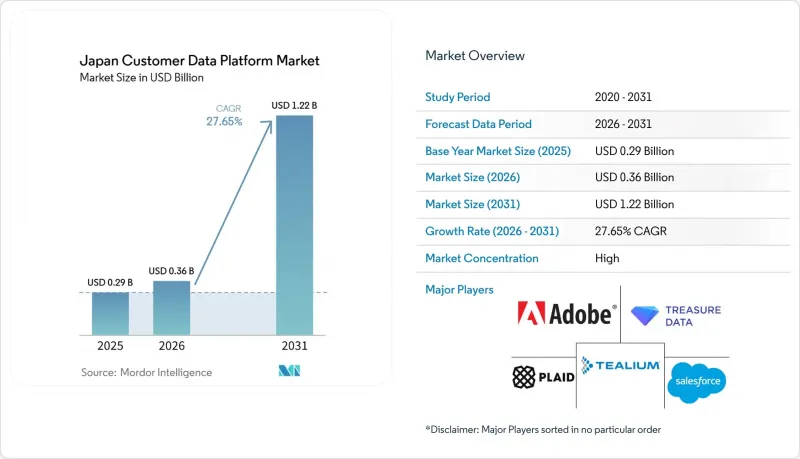
This report is Segmented by Offering (Software, and Services), Deployment Mode (Cloud, On-Premises, and Hybrid), Organization Size (Large Enterprises, and Small and Medium Enterprises), Application (Customer Data Collection and Profile Unification, and More), and End-User Industry (Retail and E-Commerce, BFSI, and More). The Market Forecasts are Provided in Terms of Value (USD).
Japan Customer Data Platform Market Trends and Insights
Accelerated AI and Machine Learning Adoption in Marketing Decisioning
AI is becoming a structural part of enterprise marketing operations, and that shift is speeding up refresh cycles across the Japan customer data platform market as buyers reassess older platforms against newer agent-led models. Treasure Data launched Marketing Super Agent in January 2026, bringing audience intelligence, strategy support, creative development, activation, and real-time optimization into a single, governed enterprise workspace. Treasure Data then repositioned its broader platform in May 2026 as Treasure AI, which showed that vendors now view the CDP less as a passive database and more as a live context layer for autonomous execution. Salesforce Japan took a similar path in March 2026, combining Data 360, MuleSoft, and Informatica into a unified, trusted context model to provide AI agents with cleaner, governed customer data across systems. That vendor behavior is changing evaluation criteria across the Japan customer data platform market because procurement now depends more on workflow automation and live context delivery than on audience building alone. It also favors platforms that can connect governed data, decision logic, and execution in a single environment rather than relying on loosely linked external tools.
Rising Need for Unified Customer Profiles Across Offline and Digital Touchpoints
A large share of customer activity in Japan still sits across physical stores, loyalty programs, e-commerce systems, and LINE-linked business accounts, which keeps identity resolution central to the Japan customer data platform market. Kao's My Kao platform handled close to 10 million annual visitors and 1.6 million monthly unique users, underscoring why simple data stitching is no longer enough for enterprise profile management. TOPPAN and Treasure Data launched a hybrid customer experience service in November 2025 that connected CDP data with direct mail, sampling, and contact center activity, reflecting the need to bridge physical and digital contact points into a single flow. That operating model is especially important in the Japan customer data platform market because the local commerce environment still depends heavily on offline conversion paths that global digital-first products often treat as secondary. The Digital Agency's June 2025 priority plan also included data linkage and utilization in the country's formal digital agenda, providing enterprises with stronger backing for broader rollout decisions. As a result, vendors that can unify retail, loyalty, service, and messaging identities are in a stronger position than those that build mainly for browser-led activation.
High Integration Complexity With Legacy CRM, POS, And Marketing Stacks
Legacy integration remains a major brake on the Japan customer data platform market, as many enterprises still run customized ERP, CRM, and POS systems that were not built for real-time profile orchestration. Chiba Bank's 2025 rollout required NTT Nippon Info to build a custom layer with Snowflake as an intermediary before Treasure Data CDP could unify account data and digital behavior signals. That example showed that even well-resourced institutions face multi-step architecture work before the platform can reach day-to-day business use. Dentsu Soken launched DendroBium in November 2025 as a composable CDP construction service on Databricks, directly addressing this integration burden through a lakehouse-led model with implementation support. Even so, the approach still depends on data engineering capability and coordinated system work that many mid-sized firms do not yet manage internally. Longer integration cycles delay value realization, widen implementation risk, and keep services demand high across the Japan customer data platform market.
Other drivers and restraints analyzed in the detailed report include:
- Rapid Shift Toward Retail Media, E-Commerce, and First-Party Data Activation
- Increased Regulatory Pressure on Consent Management And Data Governance
- Shortage of In-House Data Engineering and CDP Administration Talent
For complete list of drivers and restraints, kindly check the Table Of Contents.
Segment Analysis
Software held 58.42% of the Japan customer data platform market share in 2025, and that lead reflected the scale of existing platform subscriptions across retail, banking, and manufacturing accounts that had already committed to formal customer data programs. The software layer remained the base of most deployments because enterprises first needed the core identity, profile, segmentation, and orchestration engine before they could expand into broader service-led operating models. Large organizations also tended to buy into broader ecosystems, which meant software renewals were often tied to existing cloud, CRM, or analytics contracts rather than evaluated as isolated purchases. That purchasing pattern gave the software segment a durable installed base, particularly in areas where CDP adoption had already moved beyond proof-of-concept work into ongoing enterprise programs. It also explains why software leadership remained intact even as implementation burdens made the operating side of the business increasingly important with each new rollout.
Services are projected to expand at a 29.73% CAGR, and that pace shows where the Japan customer data platform market size is moving fastest as deployment complexity rises faster than in-house readiness. PrimeNumber's prime Insight-First CDP, launched in June 2026, used AI agents to generate insight reports and design blueprints, promised live deployment in as few as 2 months, and targeted close to half the cost of traditional packaged platforms. Dentsu Soken's DendroBium followed a similar approach by combining lakehouse architecture, analytics design, and implementation consulting within a single client engagement. These offers show that buyers are paying for operational delivery, migration support, and architecture simplification as much as for software capability. The services segment is therefore benefiting from the same issues that restrain adoption, meaning implementation difficulty is also creating a larger revenue pool for providers that can carry projects from design to production.
Cloud held 63.19% of the Japan customer data platform market in 2025, and that lead came from enterprise-standardization in hyperscaler environments with local data center support and greater operational flexibility. Cloud deployments also aligned well with faster activation needs, as marketing teams sought more scalable access to analytics, audience tools, and orchestration layers without waiting for internal infrastructure buildouts. For many commercial users, the cloud model reduced deployment friction by keeping CDP functions closer to the rest of the modern marketing and analytics stack. This helped the cloud segment stay ahead even as compliance debates became sharper and more detailed across regulated verticals. It also gave global vendors a clearer entry path, with local data center readiness and platform ecosystem depth already in place.
Hybrid deployment is expected to record the fastest growth at a 31.84% CAGR, indicating that the Japan customer data platform market is adapting to residency, governance, and workload separation needs rather than abandoning cloud adoption. Large banks, insurers, and manufacturers often need cloud-scale compute for AI and analytics while still keeping selected records or systems under tighter internal control. Treasure Data's Composable Audience Studio answered that requirement with a zero-copy federated query model that runs against customer environments in Snowflake or Databricks without relocating batch data. That approach matters in Japan because privacy obligations and legacy estates often make full data movement harder than theoretical platform diagrams suggest. On-premises deployments still retained relevance in older regulated institutions, but the faster growth path clearly sat with flexible hybrid models that let enterprises balance cloud agility with control.
Complete Report Scope:
- By Offering
- Software
- Services
- By Deployment Mode
- Cloud
- On-Premises
- Hybrid
- By Organization Size
- Large Enterprises
- Small and Medium Enterprises
- By Application
- Customer Data Collection and Profile Unification
- Audience Segmentation and Personalization
- Marketing Campaign and Customer Journey Orchestration
- Customer Analytics and Insights
- Consent and Preference Management
- Other Applications
- By End-User Industry
- Retail and E-Commerce
- BFSI
- Healthcare and Life Sciences
- IT and Telecom
- Media and Entertainment
- Industrial Manufacturing
- Government and Public Administration
- Other End-User Industries
List of Companies Covered in this Report:
- Treasure Data, Inc.
- Salesforce, Inc.
- Tealium, Inc.
- beBit TECH Co., Ltd
- Adobe Inc.
- Braze, Inc.
- Twilio, Inc.
- SAP SE
- Oracle Corporation
- Microsoft Corporation
- Amperity, Inc.
- mParticle, Inc.
- Bloomreach, Inc.
- Insider
- Acquia Inc.
- Lytics, Inc.
- SAS Institute Inc.
- Nice Ltd.
- Simon Data, Inc.
- BlueConic, Inc.
Additional Benefits:
- The market estimate (ME) sheet in Excel format
- 3 months of analyst support
TABLE OF CONTENTS
1 INTRODUCTION
- 1.1 Study Assumptions and Market Definition
- 1.2 Scope of the Study
2 RESEARCH METHODOLOGY
3 EXECUTIVE SUMMARY
4 MARKET LANDSCAPE
- 4.1 Market Overview
- 4.2 Market Drivers
- 4.2.1 Rising Need for Unified Customer Profiles Across Offline and Digital Touchpoints
- 4.2.2 Accelerated AI and Machine Learning Adoption in Marketing Decisioning
- 4.2.3 Increased Regulatory Pressure on Consent Management and Data Governance
- 4.2.4 Rapid Shift Toward Retail Media, E-Commerce, and First-Party Data Activation
- 4.2.5 Rising Demand for Composable CDP Architectures in Data-Mature Enterprises
- 4.2.6 LINE-Centric Customer Engagement Requires Higher Identity Resolution Quality
- 4.3 Market Restraints
- 4.3.1 High Integration Complexity With Legacy CRM, POS, and Marketing Stacks
- 4.3.2 Shortage of In-House Data Engineering and CDP Administration Talent
- 4.3.3 Difficult ROI Justification for Mid-Sized and Traditional B2B Users
- 4.3.4 Rising Implementation Friction From Identity Matching and Data Quality Gaps
- 4.4 Impact of Macroeconomic Factors on the Market
- 4.5 Industry Value Chain Analysis
- 4.6 Technology Outlook
- 4.7 Regulatory Landscape
- 4.8 Porter's Five Forces Analysis
- 4.8.1 Threat of New Entrants
- 4.8.2 Bargaining Power of Suppliers
- 4.8.3 Bargaining Power of Buyers
- 4.8.4 Threat of Substitutes
- 4.8.5 Intensity of Competitive Rivalry
5 MARKET SIZE AND GROWTH FORECASTS (VALUE)
- 5.1 By Offering
- 5.1.1 Software
- 5.1.2 Services
- 5.2 By Deployment Mode
- 5.2.1 Cloud
- 5.2.2 On-Premises
- 5.2.3 Hybrid
- 5.3 By Organization Size
- 5.3.1 Large Enterprises
- 5.3.2 Small and Medium Enterprises
- 5.4 By Application
- 5.4.1 Customer Data Collection and Profile Unification
- 5.4.2 Audience Segmentation and Personalization
- 5.4.3 Marketing Campaign and Customer Journey Orchestration
- 5.4.4 Customer Analytics and Insights
- 5.4.5 Consent and Preference Management
- 5.4.6 Other Applications
- 5.5 By End-User Industry
- 5.5.1 Retail and E-Commerce
- 5.5.2 BFSI
- 5.5.3 Healthcare and Life Sciences
- 5.5.4 IT and Telecom
- 5.5.5 Media and Entertainment
- 5.5.6 Industrial Manufacturing
- 5.5.7 Government and Public Administration
- 5.5.8 Other End-User Industries
6 COMPETITIVE LANDSCAPE
- 6.1 Market Concentration
- 6.2 Strategic Moves
- 6.3 Market Share Analysis
- 6.4 Company Profiles (includes Global Level Overview, Market Level Overview, Core Segments, Financials as available, Strategic Information, Market Rank/Share, Products and Services, Recent Developments)
- 6.4.1 Treasure Data, Inc.
- 6.4.2 Salesforce, Inc.
- 6.4.3 Tealium, Inc.
- 6.4.4 beBit TECH Co., Ltd
- 6.4.5 Adobe Inc.
- 6.4.6 Braze, Inc.
- 6.4.7 Twilio, Inc.
- 6.4.8 SAP SE
- 6.4.9 Oracle Corporation
- 6.4.10 Microsoft Corporation
- 6.4.11 Amperity, Inc.
- 6.4.12 mParticle, Inc.
- 6.4.13 Bloomreach, Inc.
- 6.4.14 Insider
- 6.4.15 Acquia Inc.
- 6.4.16 Lytics, Inc.
- 6.4.17 SAS Institute Inc.
- 6.4.18 Nice Ltd.
- 6.4.19 Simon Data, Inc.
- 6.4.20 BlueConic, Inc.
7 MARKET OPPORTUNITIES AND FUTURE OUTLOOK
- 7.1 White-Space and Unmet-Need Assessment

