PUBLISHER: Mordor Intelligence | PRODUCT CODE: 2099451

PUBLISHER: Mordor Intelligence | PRODUCT CODE: 2099451
South Asia Customer Data Platform - Market Share Analysis, Industry Trends & Statistics, Growth Forecasts (2026 - 2031)
According to Mordor Intelligence, the south Asia customer data platform market was valued at USD 0.39 billion in 2025 and estimated to grow from USD 0.53 billion in 2026 to reach USD 2.39 billion by 2031, at a CAGR of 35.15% during the forecast period (2026-2031).
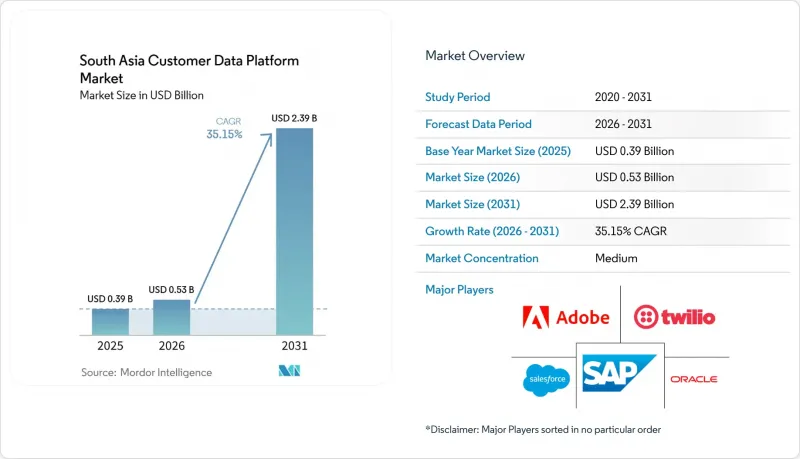
This report is Segmented by Offering (Software, and Services), Deployment Mode (Cloud, On-Premises, and Hybrid), Organization Size (Large Enterprises, and Small and Medium Enterprises), Application (Customer Data Collection and Profile Unification, and More), End-User Industry (Retail and E-Commerce, and More), and Country. The Market Forecasts are Provided in Terms of Value (USD).
South Asia Customer Data Platform Market Trends and Insights
Rising First-Party Data Monetization Pressure Across Retail and BFSI
The South Asia customer data platform market is benefiting from the rapid shift away from loose and fragmented customer targeting models toward consent-based first-party data activation. India's 2025 DPDP Rules made it harder for regulated sectors to rely on weak consent practices, which pushed banks, insurers, and organized retailers toward systems that can capture, store, and apply customer permissions across channels. This pressure is commercial as well as regulatory, because marketers still need unified profiles to improve conversion efficiency, retention, and cross-sell performance in mobile-first customer journeys. Salesforce reported in 2026 that 81% of marketers in India had adopted AI, but fragmented and irrelevant data were still limiting results, which raised the value of a stronger data foundation. When customer records sit across 5 or more systems, the South Asia customer data platform market gains relevance because profile unification becomes necessary for both compliance and revenue generation.
Privacy-By-Design Demand From India's Data Localization and Consent Rules
The South Asia customer data platform market is also being pushed forward by the need to build privacy controls directly into customer data operations. The official 2025 DPDP Rules required clear and purpose-specific consent, easier withdrawal, breach reporting obligations, and stronger control over how personal data is processed, which closely matches the governance features that many CDPs are designed to support. This shift matters because older CRM and campaign tools were not built to act as a central layer for consent tracking, purpose limitation, and controlled customer activation. For healthcare, the pressure is even sharper because digital health workflows depend on consent-linked data exchange, and that has made unified patient engagement infrastructure more relevant across providers and private hospital networks. The South Asia customer data platform market is therefore seeing stronger buying urgency from regulated sectors that need systems capable of joining personalization with auditability.
High Implementation Complexity Across Fragmented Enterprise Data Stacks
The South Asia customer data platform market still faces friction because many enterprises keep customer records across disconnected CRM, ERP, analytics, commerce, and campaign systems. That setup makes profile unification a long integration program rather than a quick software rollout. The challenge is sharper in South Asia because many companies added new cloud tools on top of older systems during the last wave of digital transformation, which widened the gap between data sources instead of simplifying it. Buyers in Bangladesh and Pakistan often face extra work because local connectors, regional payment integrations, and implementation support remain less mature than in India. This is why the South Asia customer data platform market is creating more room for vendors and partners that can provide prebuilt connectors, managed services, and stronger deployment support.
Other drivers and restraints analyzed in the detailed report include:
- Rapid Growth of Omnichannel Commerce and Super-App Data Streams
- AI-Enabled Next-Best-Action Orchestration in Customer Engagement
- Shortage of Reverse-ETL, Identity Resolution, and CDP Architecture Talent
For complete list of drivers and restraints, kindly check the Table Of Contents.
Segment Analysis
Software accounted for 73.81% share of the South Asia customer data platform market size in 2025, while services are projected to expand at a 35.91% CAGR through 2031. This pattern shows that the South Asia customer data platform market still relies on packaged platforms for initial entry because software deployment usually offers a faster path to operational use. It also shows that buyers are not stopping at the license layer, because more advanced activation use cases need sustained configuration, integration, and optimization support. The software base remains important, but growth is shifting toward the support work needed to make the platform effective in live business environments.
The customer data platform industry in South Asia is following a path where services grow as implementations become deeper and more business critical. Once buyers move from profile unification into real-time identity resolution, consent-linked activation, and AI-supported decisioning, the amount of partner and service work rises with them. RudderStack's warehouse-native model reflects this shift because open and composable architectures usually need more specialized implementation and tuning work than simpler boxed deployments. This means service revenue is expanding not because software is weakening, but because the South Asia customer data platform market is moving into a more operational and embedded stage of use.
Cloud held 69.53% revenue share in 2025, while hybrid is projected to record the highest CAGR at 36.19% through 2031. The current lead for cloud shows that most buyers still favor managed infrastructure that reduces hardware burden and shortens deployment time. This is especially important for mid-market companies that need scale and flexibility without building heavy internal infrastructure first. At the same time, the faster growth of hybrid shows that compliance and agility now need to coexist in the same architecture.
The South Asia customer data platform market is therefore not moving in a simple direction where cloud fully replaces all other models. On-premises remains relevant for government and highly regulated BFSI use cases where audit controls, security rules, and sovereignty concerns still carry more weight than speed alone. Hybrid growth reflects the need to keep sensitive data and consent controls closer to local infrastructure while using cloud layers for broader processing and activation. Vendors with clearer hybrid blueprints and stronger compliance controls are likely to stay more competitive in regulated buying cycles.
Complete Report Scope:
- By Offering
- Software
- Services
- By Deployment Mode
- Cloud
- On-Premises
- Hybrid
- By Organization Size
- Large Enterprises
- Small and Medium Enterprises
- By Application
- Customer Data Collection and Profile Unification
- Audience Segmentation and Personalization
- Marketing Campaign and Customer Journey Orchestration
- Customer Analytics and Insights
- Consent and Preference Management
- Other Applications
- By End-User Industry
- Retail and E-Commerce
- Banking, Financial Services, and Insurance (BFSI)
- Healthcare and Life Sciences
- IT and Telecom
- Media and Entertainment
- Industrial Manufacturing
- Government and Public Administration
- Other End-User Industries
- By Country
- India
- Bangladesh
- Pakistan
- Sri Lanka
- Rest of South Asia
List of Companies Covered in this Report:
- Salesforce, Inc.
- Adobe Inc.
- Oracle Corporation
- SAP SE
- Twilio Inc.
- Tealium Inc.
- Treasure Data, Inc.
- mParticle, Inc.
- BlueConic, Inc.
- Acquia, Inc.
- Amperity, Inc.
- Lytics, Inc.
- Zeta Global Corp.
- RudderStack, Inc.
- Bloomreach, Inc.
- WebEngage
- MoEngage, Inc.
- CleverTap, Inc.
- Uniphore Technologies Inc.
- Netcore Cloud Pvt. Ltd.
Additional Benefits:
- The market estimate (ME) sheet in Excel format
- 3 months of analyst support
TABLE OF CONTENTS
1 INTRODUCTION
- 1.1 Study Assumptions and Market Definition
- 1.2 Scope of the Study
2 RESEARCH METHODOLOGY
3 EXECUTIVE SUMMARY
4 MARKET LANDSCAPE
- 4.1 Market Overview
- 4.2 Market Drivers
- 4.2.1 Rising First-Party Data Monetization Pressure Across Retail and BFSI
- 4.2.2 Rapid Growth of Omnichannel Commerce and Super-App Data Streams
- 4.2.3 Privacy-By-Design Demand from India's Data Localization and Consent Rules
- 4.2.4 Rising Demand for Real-Time Identity Resolution and Event-Driven Activation
- 4.2.5 Expansion of Warehouse-Native and Composable Data Architectures
- 4.2.6 AI-Enabled Next-Best-Action Orchestration in Customer Engagement
- 4.3 Market Restraints
- 4.3.1 High Implementation Complexity Across Fragmented Enterprise Data Stacks
- 4.3.2 Shortage of Reverse-ETL, Identity Resolution, and CDP Architecture Talent
- 4.3.3 Vendor Lock-In Concerns in Suite-Led CDP Purchasing Decisions
- 4.3.4 Compliance Costs From Data Residency, Consent, and Audit Requirements
- 4.4 Industry Value-Chain Analysis
- 4.5 Regulatory Landscape
- 4.6 Technological Outlook
- 4.7 Porter's Five Forces Analysis
- 4.7.1 Bargaining Power of Suppliers
- 4.7.2 Bargaining Power of Buyers
- 4.7.3 Threat of New Entrants
- 4.7.4 Threat of Substitutes
- 4.7.5 Intensity of Competitive Rivalry
- 4.8 Impact of Macroeconomic Factors on the Market
5 MARKET SIZE AND GROWTH FORECASTS (VALUE)
- 5.1 By Offering
- 5.1.1 Software
- 5.1.2 Services
- 5.2 By Deployment Mode
- 5.2.1 Cloud
- 5.2.2 On-Premises
- 5.2.3 Hybrid
- 5.3 By Organization Size
- 5.3.1 Large Enterprises
- 5.3.2 Small and Medium Enterprises
- 5.4 By Application
- 5.4.1 Customer Data Collection and Profile Unification
- 5.4.2 Audience Segmentation and Personalization
- 5.4.3 Marketing Campaign and Customer Journey Orchestration
- 5.4.4 Customer Analytics and Insights
- 5.4.5 Consent and Preference Management
- 5.4.6 Other Applications
- 5.5 By End-User Industry
- 5.5.1 Retail and E-Commerce
- 5.5.2 Banking, Financial Services, and Insurance (BFSI)
- 5.5.3 Healthcare and Life Sciences
- 5.5.4 IT and Telecom
- 5.5.5 Media and Entertainment
- 5.5.6 Industrial Manufacturing
- 5.5.7 Government and Public Administration
- 5.5.8 Other End-User Industries
- 5.6 By Country
- 5.6.1 India
- 5.6.2 Bangladesh
- 5.6.3 Pakistan
- 5.6.4 Sri Lanka
- 5.6.5 Rest of South Asia
6 COMPETITIVE LANDSCAPE
- 6.1 Market Concentration
- 6.2 Strategic Moves
- 6.3 Market Share Analysis
- 6.4 Company Profiles (includes Global Level Overview, Market Level Overview, Core Segments, Financials as available, Strategic Information, Market Rank/Share, Products and Services, Recent Developments)
- 6.4.1 Salesforce, Inc.
- 6.4.2 Adobe Inc.
- 6.4.3 Oracle Corporation
- 6.4.4 SAP SE
- 6.4.5 Twilio Inc.
- 6.4.6 Tealium Inc.
- 6.4.7 Treasure Data, Inc.
- 6.4.8 mParticle, Inc.
- 6.4.9 BlueConic, Inc.
- 6.4.10 Acquia, Inc.
- 6.4.11 Amperity, Inc.
- 6.4.12 Lytics, Inc.
- 6.4.13 Zeta Global Corp.
- 6.4.14 RudderStack, Inc.
- 6.4.15 Bloomreach, Inc.
- 6.4.16 WebEngage
- 6.4.17 MoEngage, Inc.
- 6.4.18 CleverTap, Inc.
- 6.4.19 Uniphore Technologies Inc.
- 6.4.20 Netcore Cloud Pvt. Ltd.
7 MARKET OPPORTUNITIES AND FUTURE OUTLOOK
8 White-Space and Unmet-Need Assessment

