PUBLISHER: Mordor Intelligence | PRODUCT CODE: 2116497

PUBLISHER: Mordor Intelligence | PRODUCT CODE: 2116497
Healthcare Customer Data Platform - Market Share Analysis, Industry Trends & Statistics, Growth Forecasts (2026 - 2031)
According to Mordor Intelligence, the healthcare customer data platform market size is expected to grow from USD 0.65 billion in 2025 to USD 0.83 billion in 2026 and is forecast to reach USD 2.72 billion by 2031 at 26.92% CAGR over 2026-2031.
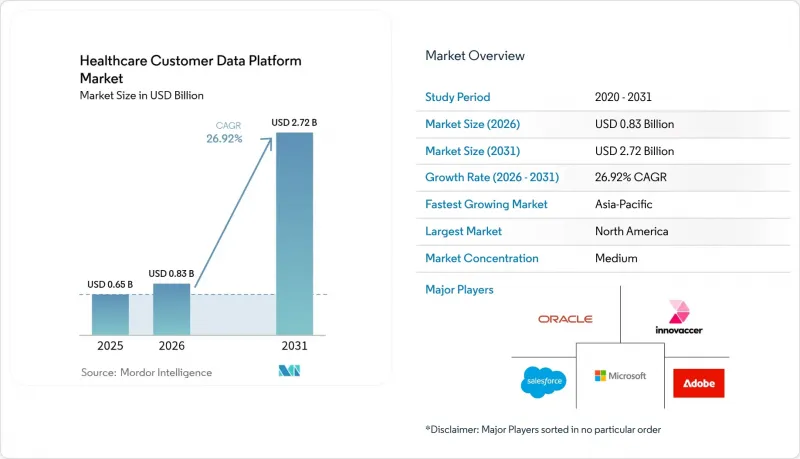
This report is Segmented by Component (Software and Services), Deployment Mode (On-Premise, and More), Organization Size (Large Enterprises, and More), Application (Predictive Analytics, and More), End User (Healthcare Providers, and More), Geography (North America, Europe, Asia-Pacific, The Middle East and Africa, and South America). The Market Forecasts are Provided in Terms of Value (USD).
Global Healthcare Customer Data Platform Market Trends and Insights
Accelerating Digital Transformation Across Healthcare Ecosystem
Hospitals, payers, and life-science firms are modernizing data stacks to break silos, support omnichannel care, and cut operating cost. A multinational drugmaker now processes 9 TB of multi-source data daily to power 200+ analytics use cases that span clinical trial optimization, supply-chain visibility, and patient services. Similar modernizations are multiplying as CIOs replace patchwork integrations with unified customer data environments capable of real-time rules-based orchestration. The healthcare customer data platform market is consequently shifting toward native connectors for leading EHR suites, FHIR-compliant data models, and low-code configuration that reduces implementation windows from quarters to weeks. Demand is strongest where cloud spending and DevOps culture are mature; yet even conservative systems adopt pilot platforms to prepare for inevitable interoperability mandates.
Regulatory Push for Data Interoperability Standards
The Trusted Exchange Framework and Common Agreement (TEFCA) rollout and the HTI-2 rule compel providers to offer FHIR-based APIs and expanded USCDI v4 data sets. Compliance deadlines mean organizations must unify consent, identity reconciliation, and audit logging in a scalable platform rather than bolt-on modules. Vendors that provide pre-certified policy engines and automated data provenance tracking gain clear advantage in the healthcare customer data platform market. Forward-thinking health systems treat the rule set as a catalyst to monetize data partnerships and enable pan-regional care coordination.
Persistent Fragmentation of Legacy Health-IT Systems
Decades of acquisitions and departmental best-of-breed purchases leave health systems juggling multiple EHR instances, radiology archives, and bespoke registries that resist open standards. Harmonizing vocabularies, patient identifiers, and master data is costly and slow, delaying platform rollouts and dampening near-term ROI. Organizations often consult third-party integrators to map old interfaces to HL7 FHIR while sustaining daily operations. This complexity subtracts 4.6 percentage points from the forecast CAGR, making legacy rationalization a prerequisite for broad platform penetration.
Other drivers and restraints analyzed in the detailed report include:
- Rising Demand for Personalized Patient Engagement
- Growth of Value-Based Care and Risk-Sharing Models
- Acute Shortage of Skilled Health Data Professionals
For complete list of drivers and restraints, kindly check the Table Of Contents.
Segment Analysis
Software captured 64.08% revenue in 2025 as buyers gravitated toward end-to-end suites that deliver patient identity resolution, consent management, and predictive analytics out of the box. The healthcare customer data platform market size for software stood at USD 0.42 billion and is tracking a healthy double-digit CAGR supported by modular upgrades and subscription pricing. Services, however, are climbing faster at 27.74% per year because complex migrations require deployment, data-mapping, and change-management expertise.
Over 2026-2031, managed services bundling hosting, monitoring, and template analytics are expected to gain share as hospitals move to opex-friendly contracts. Vendors increasingly package clinical content libraries and pre-trained AI to compress time-to-value for mid-tier providers. This momentum will gradually narrow the gap, yet software will remain the primary revenue engine of the healthcare customer data platform market.
Cloud deployments held 30.22% of the healthcare customer data platform market share in 2025, fueled by the scalability needed for compute-hungry AI workloads and remote-care use cases. Many networks adopt hybrid models, retaining PHI-heavy workloads on-premise while bursting analytics into public clouds, to meet sovereignty rules.
On-premise solutions, growing 27.22% annually, still appeal to institutions bound by stricter regional privacy statutes or limited bandwidth. Edge appliances that synchronize with cloud cores are bridging the divide, enabling algorithm training without exporting raw patient data. This coexistence will persist, reflecting divergent risk appetites and regulatory nuance across jurisdictions.
Complete Report Scope:
- By Component
- Software
- Services
- By Deployment Mode
- On-Premise
- Cloud-Based
- By Organization Size
- Large Enterprises
- Small & Medium-Sized Enterprises
- By Application
- Personalized Recommendations
- Predictive Analytics
- Marketing Data Segmentation
- Customer Retention & Engagement
- Security Management
- Other Applications
- By End User
- Healthcare Providers
- Payers
- Life-Science & Med-Tech Firms
- Healthtech Start-Ups
- Geography
- North America
- United States
- Canada
- Mexico
- Europe
- Germany
- United Kingdom
- France
- Italy
- Spain
- Rest of Europe
- Asia-Pacific
- China
- Japan
- India
- Australia
- South Korea
- Rest of Asia-Pacific
- Middle East & Africa
- GCC
- South Africa
- Rest of Middle East & Africa
- South America
- Brazil
- Argentina
- Rest of South America
- North America
Geography Analysis
North America held 41.98% of global revenue in 2025, a position reinforced by early TEFCA milestones, mature cloud penetration, and large-scale value-based contracts that depend on robust data orchestration. Multi-state networks such as Kaiser Permanente deploy enterprise platforms that span claims, EHR, and consumer apps, validating scalability and influencing procurement standards across the healthcare customer data platform market.
Asia-Pacific is on a 27.96% CAGR trajectory to 2031 thanks to government-funded digital-health programs, fast-growing middle classes, and venture-backed provider disruptors. China, India, Japan, and Australia lead spend, but Southeast Asia's hospital chains and insurance hybrids are closing the gap through cloud-first greenfield builds. As electronic health-record density rises, regional stakeholders harness platforms to enable remote consults, chronic-disease management, and cross-border medical tourism.
Europe's steady progression is shaped by stringent GDPR safeguards that elevate demand for consent orchestration, federated analytics, and anonymization modules. Initiatives to create pan-EU health-data spaces position customer data platforms as foundational infrastructure for research and secondary-use governance. Emerging markets in the Middle East, Africa, and South America remain nascent yet increasingly prioritize national-level interoperability frameworks that mirror TEFCA principles, opening long-tail expansion opportunities over the next decade.
- Microsoft
- Salesforce
- Adobe
- Oracle
- Innovaccer
- Treasure Data Inc.
- Tealium
- Reltio
- SkyPoint Cloud
- Solix Technologies Inc.
- WebMD (Mercury Healthcare)
- Epic Systems Corp.
- Health Catalyst
- Snowflake Inc.
- Redpoint Global Inc.
- Hightouch
- Segment (Twilio)
- SAS Institute
- Cerner Corporation (Oracle Health)
- IBM Corp.
Additional Benefits:
- The market estimate (ME) sheet in Excel format
- 3 months of analyst support
TABLE OF CONTENTS
1 Introduction
- 1.1 Study Assumptions & Market Definition
- 1.2 Scope of the Study
2 Research Methodology
3 Executive Summary
4 Market Landscape
- 4.1 Market Overview
- 4.2 Market Drivers
- 4.2.1 Accelerating Digital Transformation Across Healthcare Ecosystem
- 4.2.2 Regulatory Push for Data Interoperability Standards
- 4.2.3 Rising Demand for Personalized Patient Engagement
- 4.2.4 Growth of Value-Based Care and Risk-Sharing Models
- 4.2.5 Proliferation of Cloud-Native And Composable Data Platforms
- 4.2.6 Expansion of Retail And Consumer-Led Healthcare Channels
- 4.3 Market Restraints
- 4.3.1 Persistent Fragmentation of Legacy Health IT Systems
- 4.3.2 Escalating Compliance and Data Privacy Expenditures
- 4.3.3 Acute Shortage of Skilled Health Data Professionals
- 4.3.4 Vendor Lock-In and Integration Complexity
- 4.4 Regulatory Landscape
- 4.5 Porter's Five Forces
- 4.5.1 Threat Of New Entrants
- 4.5.2 Bargaining Power Of Buyers
- 4.5.3 Bargaining Power Of Suppliers
- 4.5.4 Threat Of Substitutes
- 4.5.5 Intensity Of Competitive Rivalry
5 Market Size & Growth Forecasts (Value, USD)
- 5.1 By Component
- 5.1.1 Software
- 5.1.2 Services
- 5.2 By Deployment Mode
- 5.2.1 On-Premise
- 5.2.2 Cloud-Based
- 5.3 By Organization Size
- 5.3.1 Large Enterprises
- 5.3.2 Small & Medium-Sized Enterprises
- 5.4 By Application
- 5.4.1 Personalized Recommendations
- 5.4.2 Predictive Analytics
- 5.4.3 Marketing Data Segmentation
- 5.4.4 Customer Retention & Engagement
- 5.4.5 Security Management
- 5.4.6 Other Applications
- 5.5 By End User
- 5.5.1 Healthcare Providers
- 5.5.2 Payers
- 5.5.3 Life-Science & Med-Tech Firms
- 5.5.4 Healthtech Start-Ups
- 5.6 Geography
- 5.6.1 North America
- 5.6.1.1 United States
- 5.6.1.2 Canada
- 5.6.1.3 Mexico
- 5.6.2 Europe
- 5.6.2.1 Germany
- 5.6.2.2 United Kingdom
- 5.6.2.3 France
- 5.6.2.4 Italy
- 5.6.2.5 Spain
- 5.6.2.6 Rest of Europe
- 5.6.3 Asia-Pacific
- 5.6.3.1 China
- 5.6.3.2 Japan
- 5.6.3.3 India
- 5.6.3.4 Australia
- 5.6.3.5 South Korea
- 5.6.3.6 Rest of Asia-Pacific
- 5.6.4 Middle East & Africa
- 5.6.4.1 GCC
- 5.6.4.2 South Africa
- 5.6.4.3 Rest of Middle East & Africa
- 5.6.5 South America
- 5.6.5.1 Brazil
- 5.6.5.2 Argentina
- 5.6.5.3 Rest of South America
- 5.6.1 North America
6 Competitive Landscape
- 6.1 Market Concentration
- 6.2 Market Share Analysis
- 6.3 Company Profiles (includes Global level Overview, Market level overview, Core Business Segments, Financials, Headcount, Key Information, Market Rank, Market Share, Products and Services, and analysis of Recent Developments)
- 6.3.1 Microsoft
- 6.3.2 Salesforce.com
- 6.3.3 Adobe
- 6.3.4 Oracle
- 6.3.5 Innovaccer Inc.
- 6.3.6 Treasure Data Inc.
- 6.3.7 Tealium
- 6.3.8 Reltio
- 6.3.9 SkyPoint Cloud Inc.
- 6.3.10 Solix Technologies Inc.
- 6.3.11 WebMD (Mercury Healthcare)
- 6.3.12 Epic Systems Corp.
- 6.3.13 Health Catalyst
- 6.3.14 Snowflake Inc.
- 6.3.15 Redpoint Global Inc.
- 6.3.16 Hightouch
- 6.3.17 Segment (Twilio)
- 6.3.18 SAS Institute
- 6.3.19 Cerner Corporation (Oracle Health)
- 6.3.20 IBM Corp.
7 Market Opportunities & Future Outlook
- 7.1 White-Space & Unmet-Need Assessment

