PUBLISHER: Mordor Intelligence | PRODUCT CODE: 2099397

PUBLISHER: Mordor Intelligence | PRODUCT CODE: 2099397
Italy Customer Data Platform - Market Share Analysis, Industry Trends & Statistics, Growth Forecasts (2026 - 2031)
According to Mordor Intelligence, the Italy customer data platform market size was valued at USD 168.88 million in 2025 and is forecast to reach USD 793.79 million by 2031 at a CAGR of 30.06% from 2026 to 2031.
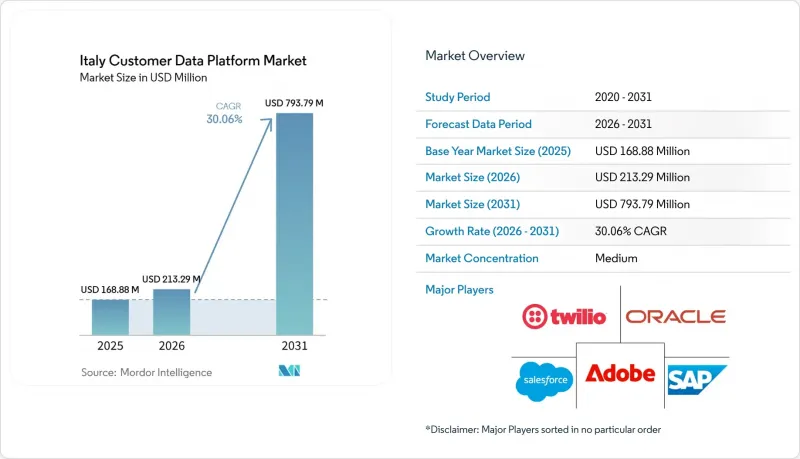
This report is Segmented by Offering (Software, and Services), Deployment Mode (Cloud, On-Premises, and Hybrid), Organization Size (Large Enterprises, and Small and Medium Enterprises), Application (Marketing Campaign and Customer Journey Orchestration, and More), and End-User Industry (Government and Public Administration, and More). The Market Forecasts are Provided in Terms of Value (USD).
Italy Customer Data Platform Market Trends and Insights
GDPR-Driven First-Party Data Shift
The Italy customer data platform market is being shaped by a stronger preference for first-party data models, as organizations are under greater pressure to demonstrate that customer information is collected, governed, and activated in a controlled manner. Italy's digital policy environment is becoming more structured through the national AI strategy for 2024-2026 and Law n. 132/2025, which adds weight to governance, auditability, and responsible data handling in customer-facing systems. This is changing how platforms are evaluated, since consent controls, data lineage, and traceable workflows now matter alongside campaign execution and analytics quality. Procurement is therefore moving beyond the marketing function, with IT, legal, and security teams becoming more active in platform selection when customer data flows across multiple channels and automated processes. The result is that the Italy customer data platform market is increasingly tied to compliance readiness, which gives an advantage to vendors that can support both activation and governance in the same environment.
Customer Journey Unification Across Fragmented Channels
The Italy customer data platform market is also gaining momentum because consumer journeys span multiple touchpoints, while many organizations still manage disconnected systems for commerce, loyalty, service, and CRM. In 2026, Italy's online consumers consulted an average of 4 touchpoints before completing a purchase, underscoring fragmented identity and event data as a direct barrier to conversion and retention. Once this fragmentation begins to affect both acquisition efficiency and service quality, profile unification becomes a core business requirement rather than a technical enhancement. The same pattern is visible in large enterprise deployments, where unified profiles support more consistent cross-sell activity, better service continuity, and stronger orchestration across digital and assisted channels. This is why the Italy customer data platform market is drawing budget from broader customer experience programs, not only from traditional campaign technology lines.
Legacy CRM and Data Warehouse Lock-In
The Italy customer data platform market still faces slow decision cycles in organizations where customer information is tied to older CRM systems, data warehouses, and custom interfaces that were not designed for real-time activation. In the Italian finance sector, 55% of institutions still relied on on-premises architectures for core systems, and more than 60% cited technical debt as a major barrier to cloud migration. That creates a clear mismatch, because many of the buyers with the richest customer records also face the longest and most complex implementation paths. Platform selection, therefore, depends as much on connector depth and migration practicality as it does on feature strength, especially when legacy estates need to remain active during phased deployment. This slows the Italy customer data platform market where the value case is strong but the operating environment still resists fast change.
Other drivers and restraints analyzed in the detailed report include:
- AI-Led Real-Time Personalization Demand
- Cloud Migration of MarTech Stacks
- Shortage of CDP Integration Talent
For complete list of drivers and restraints, kindly check the Table Of Contents.
Segment Analysis
Software held 68.87% of the Italy customer data platform market share in 2025, which kept core licensing, analytics modules, and platform subscriptions at the center of vendor revenue. This base shows that most organizations still begin their commitment with the platform layer itself before expanding into deeper operational support. It also gives larger vendors a stable foundation in enterprise accounts, where contract duration and platform standardization matter more than short-term price differences. In the Italy customer data platform market, software remains the anchor because buyers still need a single environment for identity, profile, and activation workflows.
Services are projected to grow at a 32.76% CAGR through 2031, making them the fastest-growing part of the offering mix. The Italy customer data platform industry is showing this pattern because implementation, governance design, training, and integration work continue well after the initial platform decision. Buyers often need help translating fragmented source systems into usable customer models, and that requirement stretches beyond technical setup into operating process design. The result is that vendors with strong partner networks, sector delivery depth, and managed support capability are better placed to expand account value over time.
Cloud accounted for 65.11% of the market in 2025 and is projected to expand at a 32.12% CAGR through 2031, giving it both the largest installed base and the fastest growth rate. This pairing matters because it shows that the preferred deployment model is not only established but still gaining momentum. In the Italy customer data platform market, cloud appeals to organizations that want easier scalability, faster rollout across channels, and better alignment with modern analytics and personalization tools. It also reduces the need to build new activation capability around fixed internal infrastructure.
Hybrid still holds an important place, especially in banking and insurance, where sensitive data handling and existing operational structures continue to shape deployment choices. Many financial institutions in Italy still run core environments on-premises and identify technical debt as a significant obstacle to migration, underscoring the continued relevance of mixed architectures. That means the Italy customer data platform market is not moving through a simple replacement cycle, since many buyers are connecting cloud activation to older system estates rather than removing those estates immediately. Vendors that support phased deployment and strong interoperability are therefore more likely to succeed than those that assume full migration at the start.
Complete Report Scope:
- By Offering
- Software
- Services
- By Deployment Mode
- Cloud
- On-Premises
- Hybrid
- By Organization Size
- Large Enterprises
- Small and Medium Enterprises
- By Application
- Customer Data Collection and Profile Unification
- Audience Segmentation and Personalization
- Marketing Campaign and Customer Journey Orchestration
- Customer Analytics and Insights
- Consent and Preference Management
- Other Applications
- By End-User Industry
- Retail and E-Commerce
- Banking, Financial Services, and Insurance (BFSI)
- Healthcare and Life Sciences
- Information Technology and Telecom
- Media and Entertainment
- Industrial Manufacturing
- Government and Public Administration
- Other End-User Industries
List of Companies Covered in this Report:
- Twilio Inc.
- Tealium Inc.
- Adobe Inc.
- Salesforce, Inc.
- Oracle Corporation
- SAP SE
- mParticle, Inc.
- BlueConic, Inc.
- Amperity, Inc.
- Treasure Data, Inc.
- ActionIQ, Inc.
- Bloomreach, Inc.
- Zeotap GmbH
- RudderStack, Inc.
- Simon Data, Inc.
- Lytics, Inc.
- Optimove Inc.
- Acquia, Inc.
- Redpoint Global Inc.
- Celebrus Technologies Limited
Additional Benefits:
- The market estimate (ME) sheet in Excel format
- 3 months of analyst support
TABLE OF CONTENTS
1 INTRODUCTION
- 1.1 Study Assumptions and Market Definition
- 1.2 Scope of the Study
2 RESEARCH METHODOLOGY
3 EXECUTIVE SUMMARY
4 MARKET LANDSCAPE
- 4.1 Market Overview
- 4.2 Market Drivers
- 4.2.1 GDPR-Driven First-Party Data Shift
- 4.2.2 Customer Journey Unification across Fragmented Channels
- 4.2.3 AI-Led Real-Time Personalization Demand
- 4.2.4 Cloud Migration of MarTech Stacks
- 4.2.5 Retail Media and Commerce Activation Use Cases
- 4.2.6 Consent-Oriented Identity Resolution Demand
- 4.3 Market Restraints
- 4.3.1 Legacy CRM and Data Warehouse Lock-In
- 4.3.2 Shortage of CDP Integration Talent
- 4.3.3 Privacy Risk and Consent Governance Complexity
- 4.3.4 Attribution Uncertainty Across Walled Gardens
- 4.4 Industry Value Chain Analysis
- 4.5 Impact of Macroeconomic Factors on the Market
- 4.6 Technological Outlook
- 4.7 Regulatory Landscape
- 4.8 Porter's Five Forces Analysis
- 4.8.1 Threat of New Entrants
- 4.8.2 Bargaining Power of Suppliers
- 4.8.3 Bargaining Power of Buyers
- 4.8.4 Threat of Substitutes
- 4.8.5 Competitive Rivalry
5 MARKET SIZE AND GROWTH FORECASTS (VALUE)
- 5.1 By Offering
- 5.1.1 Software
- 5.1.2 Services
- 5.2 By Deployment Mode
- 5.2.1 Cloud
- 5.2.2 On-Premises
- 5.2.3 Hybrid
- 5.3 By Organization Size
- 5.3.1 Large Enterprises
- 5.3.2 Small and Medium Enterprises
- 5.4 By Application
- 5.4.1 Customer Data Collection and Profile Unification
- 5.4.2 Audience Segmentation and Personalization
- 5.4.3 Marketing Campaign and Customer Journey Orchestration
- 5.4.4 Customer Analytics and Insights
- 5.4.5 Consent and Preference Management
- 5.4.6 Other Applications
- 5.5 By End-User Industry
- 5.5.1 Retail and E-Commerce
- 5.5.2 Banking, Financial Services, and Insurance (BFSI)
- 5.5.3 Healthcare and Life Sciences
- 5.5.4 Information Technology and Telecom
- 5.5.5 Media and Entertainment
- 5.5.6 Industrial Manufacturing
- 5.5.7 Government and Public Administration
- 5.5.8 Other End-User Industries
6 COMPETITIVE LANDSCAPE
- 6.1 Market Concentration
- 6.2 Strategic Moves
- 6.3 Market Share Analysis
- 6.4 Company Profiles (includes Global Level Overview, Market Level Overview, Core Segments, Financials as available, Strategic Information, Market Rank/Share, Products and Services, Recent Developments)
- 6.4.1 Twilio Inc.
- 6.4.2 Tealium Inc.
- 6.4.3 Adobe Inc.
- 6.4.4 Salesforce, Inc.
- 6.4.5 Oracle Corporation
- 6.4.6 SAP SE
- 6.4.7 mParticle, Inc.
- 6.4.8 BlueConic, Inc.
- 6.4.9 Amperity, Inc.
- 6.4.10 Treasure Data, Inc.
- 6.4.11 ActionIQ, Inc.
- 6.4.12 Bloomreach, Inc.
- 6.4.13 Zeotap GmbH
- 6.4.14 RudderStack, Inc.
- 6.4.15 Simon Data, Inc.
- 6.4.16 Lytics, Inc.
- 6.4.17 Optimove Inc.
- 6.4.18 Acquia, Inc.
- 6.4.19 Redpoint Global Inc.
- 6.4.20 Celebrus Technologies Limited
7 MARKET OPPORTUNITIES AND FUTURE OUTLOOK
- 7.1 White-Space and Unmet-Need Assessment

