PUBLISHER: Mordor Intelligence | PRODUCT CODE: 2099952

PUBLISHER: Mordor Intelligence | PRODUCT CODE: 2099952
Software As A Medical Device (SaMD) For Neurology - Market Share Analysis, Industry Trends & Statistics, Growth Forecasts (2026 - 2031)
According to Mordor Intelligence, the software as a Medical Device for Neurology Market size was valued at USD 13.33 billion in 2025 and is estimated to grow from USD 15.36 billion in 2026 to reach USD 31.24 billion by 2031, at a CAGR of 15.25% during the forecast period (2026-2031).
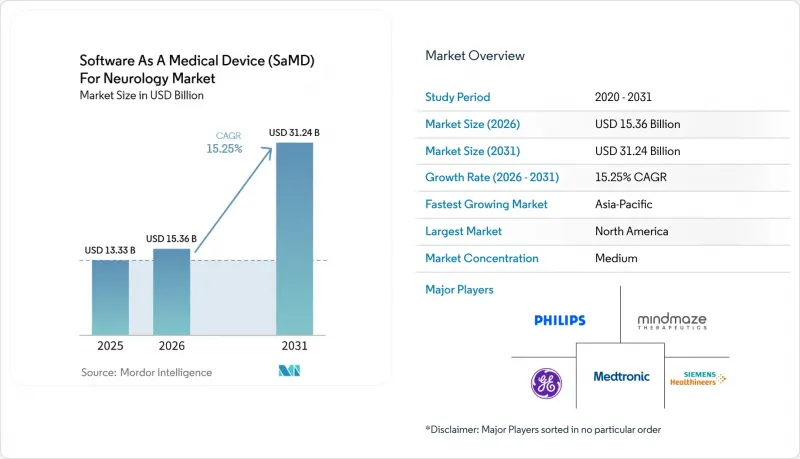
This report is Segmented by Component (Software, Services), Deployment Mode (Cloud-Based, On-Premises, Hybrid), Application (Epilepsy, Stroke, Parkinson's Disease, and More), End User (Hospitals, Ambulatory Care Centers, Home Care, Research Institutes), and Geography (North America, Europe, and More). The Market Forecasts are in Value (USD).
Global Software As A Medical Device (SaMD) For Neurology Market Trends and Insights
AI-Enabled Neurology Triage and Decision Support Adoption
The Software as a Medical Device (SaMD) for Neurology market gained momentum as clinicians adopted software to identify urgent neurological events and support earlier intervention across care pathways. Hospitals increasingly treated triage software as a core component of acute neurology workflows, especially where faster imaging interpretation influenced downstream intervention decisions. RapidAI secured FDA clearance in November 2025 for five new deep clinical AI imaging modules, including Rapid LMVO and Rapid OH, expanding its role in stroke and hydrocephalus workflows. Ceribell also expanded EEG-based AI use in November 2025, when its Clarity algorithm received 510(k) clearance for neonates, making it the first AI-powered point-of-care EEG system cleared for seizure detection across all ages, from pre-term neonates to adults.
Remote Monitoring of Epilepsy and Movement Disorders
The Software as a Medical Device (SaMD) for Neurology market also expanded into remote monitoring as neurological care moved beyond conventional inpatient settings. Wearable and implant-linked software gained value by supporting continuous observation, signal classification, and event detection outside high-cost care environments. A Phase III study published in 2026 reported that EpiWatch achieved 98% overall sensitivity for tonic-clonic seizure detection across 16,189 hours of home monitoring, with a false alarm rate of 0.08 per 24 hours. Medtronic received FDA approval in February 2025 for BrainSense Adaptive deep brain stimulation, while its base of more than 40,000 Percept DBS patients worldwide supported recurring software-driven clinical engagement.
Clinical Validation Burden Across Diverse Neurological Patient Populations
The Software as a Medical Device (SaMD) for Neurology market continues to face a major constraint as vendors must prove consistent model performance across diverse patient groups and care settings. Neurology software can perform differently across age groups, comorbidity patterns, signal quality conditions, and imaging protocols, making broad clinical scaling more complex than initial authorization may indicate. A 2025 study noted that AI medical software required continuous monitoring and real-world evaluation of generalizability, especially in neurology, where clinical presentations varied widely across cohorts. Ceribell's neonatal clearance in November 2025 was supported by data from more than 700 patients, highlighting how population-specific evidence requirements increased development timelines and costs before wider adoption.
Other drivers and restraints analyzed in the detailed report include:
- Expansion of FDA and Other Regulator-Specific SaMD Frameworks
- Reimbursement Support for Digital Biomarkers and Remote Monitoring
- Interoperability Gaps Between Neurology Devices, Imaging Systems, and EHR Platforms
For complete list of drivers and restraints, kindly check the Table Of Contents.
Segment Analysis
Software held a 62.34% share in 2025, showing that core clinical value in the Software as a Medical Device (SaMD) for Neurology market remained concentrated in algorithm-driven tools rather than adjacent support functions. Products that interpret EEG activity, identify stroke-related findings, or support clinical decision-making within neurology workflows continued to account for the largest revenue pool. Buyers prioritized measurable diagnostic or monitoring outputs before investing in service layers for deployment and maintenance.
Services was the fastest-growing component segment at an 18.93% CAGR, as customers increasingly sought ongoing support after initial installation. In May 2026, NeuroPace received FDA approval for ECoG Assistant, an AI-driven clinician feature for its RNS System developed from 124,450 epileptologist-labeled iEEG records. NeuroPace also submitted its next-generation patient data management system for FDA review, indicating a broader platform strategy around scalable software infrastructure and future AI-enabled workflow tools. As a result, the Software as a Medical Device (SaMD) for Neurology market shifted toward contracts covering monitoring, maintenance, post-market support, and compliance-related services.
Cloud-based deployment accounted for 64.77% of the Software as a Medical Device (SaMD) for Neurology market size in 2025, driven by the need for multi-site workflows, shared access, and centralized software management across larger provider systems. Cloud environments supported stroke alerting, cross-site imaging review, and longitudinal monitoring programs that benefited from consolidated oversight. They also helped large health systems scale software faster by reducing local infrastructure requirements across facilities.
On-premises deployment was the fastest-growing deployment segment at a 17.67% CAGR through 2031, as data sovereignty and latency remained key priorities in clinical settings. Providers managing sensitive neurological data, internal research protocols, or stricter privacy obligations favored architectures with tighter control over storage and processing. Hybrid setups also gained traction by enabling local inference while supporting centralized analytics or model improvement over time.
Complete Report Scope:
- By Component
- Software
- Services
- By Deployment Mode
- Cloud-Based
- On-Premises
- Hybrid
- By Application
- Epilepsy
- Stroke
- Parkinson's Disease
- Alzheimer's Disease and Dementia
- Sleep Disorders
- Multiple Sclerosis
- Traumatic Brain Injury
- Migraine
- Other Neurology Applications
- By End User
- Hospitals and Neurology Centers
- Ambulatory Care Centers
- Home Care Settings
- Research and Academic Institutes
- By Geography
- North America
- United States
- Canada
- Mexico
- Europe
- Germany
- United Kingdom
- France
- Italy
- Spain
- Rest of Europe
- Asia-Pacific
- China
- India
- Japan
- Australia
- South Korea
- Rest of Asia-Pacific
- Middle East and Africa
- GCC
- South Africa
- Rest of Middle East and Africa
- South America
- Brazil
- Argentina
- Rest of South America
- North America
Geography Analysis
North America held 40.56% of the Software as a Medical Device (SaMD) for Neurology market share in 2025, maintaining its position as the largest regional contributor. Strong regulatory visibility, early adoption of AI-enabled medical software, and a broad base of academic medical centers supported the region's leadership. Active reimbursement discussions around remote monitoring and digital software services further supported commercial expansion.
Asia-Pacific is forecast to grow at a CAGR of 17.56% through 2031, making it the fastest-growing regional market in this category. Large undiagnosed neurological populations, expanding specialist infrastructure, and digital health investments across China, India, Japan, South Korea, and Australia support this growth. Private hospital groups in India are using cloud-based neurology platforms to extend specialist coverage beyond major urban centers, while East Asian markets support advanced imaging and EEG software deployment. A 2026 study in BMC Biomedical Engineering confirmed the feasibility of edge-AI wearable systems for real-time epileptic seizure detection with geolocated alerting, supporting distributed care across rural and connectivity-variable settings.
Europe remains a mature adoption environment, especially in Germany, the United Kingdom, and France, where data protection and post-market surveillance obligations influence deployment decisions. These requirements support investment in locally hosted or tightly governed software environments and favor vendors with stronger compliance capabilities. The Middle East and Africa and South America remain at earlier adoption stages, with rising interest in stroke triage, remote monitoring, and digitally supported specialist access. Saudi Arabia and the United Arab Emirates are advancing national digital health programs, while Brazil and Argentina are emerging as active South American markets for software-enabled neurological diagnostics.
- Abbott Laboratories
- Boston Scientific
- Brain Lab
- Cadwell
- Ceribell, Inc.
- Compumedics
- Cortex Research, Inc.
- Elekta AB (publ)
- GE HealthCare Technologies Inc.
- IQVIA
- Koninklijke Philips
- Koninklijke Veldkamp B.V.
- Medtronic
- MindMaze Group SA
- Natus Medical
- Neuronetics, Inc.
- NeuroPace
- Nihon Kohden
- RapidAI, Inc.
- Siemens Healthineers
Additional Benefits:
- The market estimate (ME) sheet in Excel format
- 3 months of analyst support
TABLE OF CONTENTS
1 INTRODUCTION
- 1.1 Study Assumptions and Market Definition
- 1.2 Scope of the Study
2 RESEARCH METHODOLOGY
3 EXECUTIVE SUMMARY
4 MARKET LANDSCAPE
- 4.1 Market Overview
- 4.2 Market Drivers
- 4.2.1 AI-Enabled Neurology Triage and Decision Support Adoption
- 4.2.2 Remote Monitoring of Epilepsy and Movement Disorders
- 4.2.3 Expansion of FDA and Other Regulator-Specific SaMD Pathways
- 4.2.4 Reimbursement Support for Digital Biomarkers and Remote Care Workflows
- 4.2.5 Cloud-Native Clinical Data Integration Across EEG, Imaging, and EHR Workflows
- 4.2.6 AI-Driven Personalization for Neurorehabilitation and Chronic Disease Management
- 4.3 Market Restraints
- 4.3.1 Clinical Validation Burden Across Diverse Neurological Subpopulations
- 4.3.2 Interoperability Gaps Between Neurology Devices, Imaging Systems, and Hospital IT
- 4.3.3 Cybersecurity, Privacy, and Model Governance Risk
- 4.3.4 Slow Workflow Adoption Due to Liability, Change Management, and Reimbursement Friction
- 4.4 Supply/Value Chain Analysis
- 4.5 Regulatory Landscape
- 4.6 Technological Outlook
- 4.7 Porter's Five Forces Analysis
- 4.7.1 Bargaining Power of Suppliers
- 4.7.2 Bargaining Power of Buyers
- 4.7.3 Threat of New Entrants
- 4.7.4 Threat of Substitutes
- 4.7.5 Industry Rivalry
5 MARKET SIZE AND GROWTH FORECASTS (VALUE, USD)
- 5.1 By Component
- 5.1.1 Software
- 5.1.2 Services
- 5.2 By Deployment Mode
- 5.2.1 Cloud-Based
- 5.2.2 On-Premises
- 5.2.3 Hybrid
- 5.3 By Application
- 5.3.1 Epilepsy
- 5.3.2 Stroke
- 5.3.3 Parkinson's Disease
- 5.3.4 Alzheimer's Disease and Dementia
- 5.3.5 Sleep Disorders
- 5.3.6 Multiple Sclerosis
- 5.3.7 Traumatic Brain Injury
- 5.3.8 Migraine
- 5.3.9 Other Neurology Applications
- 5.4 By End User
- 5.4.1 Hospitals and Neurology Centers
- 5.4.2 Ambulatory Care Centers
- 5.4.3 Home Care Settings
- 5.4.4 Research and Academic Institutes
- 5.5 By Geography
- 5.5.1 North America
- 5.5.1.1 United States
- 5.5.1.2 Canada
- 5.5.1.3 Mexico
- 5.5.2 Europe
- 5.5.2.1 Germany
- 5.5.2.2 United Kingdom
- 5.5.2.3 France
- 5.5.2.4 Italy
- 5.5.2.5 Spain
- 5.5.2.6 Rest of Europe
- 5.5.3 Asia-Pacific
- 5.5.3.1 China
- 5.5.3.2 India
- 5.5.3.3 Japan
- 5.5.3.4 Australia
- 5.5.3.5 South Korea
- 5.5.3.6 Rest of Asia-Pacific
- 5.5.4 Middle East and Africa
- 5.5.4.1 GCC
- 5.5.4.2 South Africa
- 5.5.4.3 Rest of Middle East and Africa
- 5.5.5 South America
- 5.5.5.1 Brazil
- 5.5.5.2 Argentina
- 5.5.5.3 Rest of South America
- 5.5.1 North America
6 COMPETITIVE LANDSCAPE
- 6.1 Market Concentration
- 6.2 Market Share Analysis
- 6.3 Company Profiles (includes Global Level Overview, Market Level Overview, Core Segments, Financials as available, Strategic Information, Market Rank/Share, Products and Services, Recent Developments)
- 6.3.1 Abbott Laboratories
- 6.3.2 Boston Scientific Corporation
- 6.3.3 Brainlab AG
- 6.3.4 Cadwell Industries, Inc.
- 6.3.5 Ceribell, Inc.
- 6.3.6 Compumedics Limited
- 6.3.7 Cortex Research, Inc.
- 6.3.8 Elekta AB (publ)
- 6.3.9 GE HealthCare Technologies Inc.
- 6.3.10 IQVIA Holdings Inc.
- 6.3.11 Koninklijke Philips N.V.
- 6.3.12 Koninklijke Veldkamp B.V.
- 6.3.13 Medtronic plc
- 6.3.14 MindMaze Group SA
- 6.3.15 Natus Medical Incorporated
- 6.3.16 Neuronetics, Inc.
- 6.3.17 NeuroPace, Inc.
- 6.3.18 Nihon Kohden Corporation
- 6.3.19 RapidAI, Inc.
- 6.3.20 Siemens Healthineers AG
7 MARKET OPPORTUNITIES AND FUTURE OUTLOOK
- 7.1 White-Space and Unmet-Need Assessment

