PUBLISHER: Mordor Intelligence | PRODUCT CODE: 2099983

PUBLISHER: Mordor Intelligence | PRODUCT CODE: 2099983
United States Kiwi Fruit - Market Share Analysis, Industry Trends & Statistics, Growth Forecasts (2026 - 2031)
According to Mordor Intelligence, the United States kiwi fruit market was valued at USD 319.0 million in 2025 and is projected to grow from USD 331.80 million in 2026 to USD 381.0 million by 2031, at a CAGR of 2.80% during the forecast period (2026-2031).
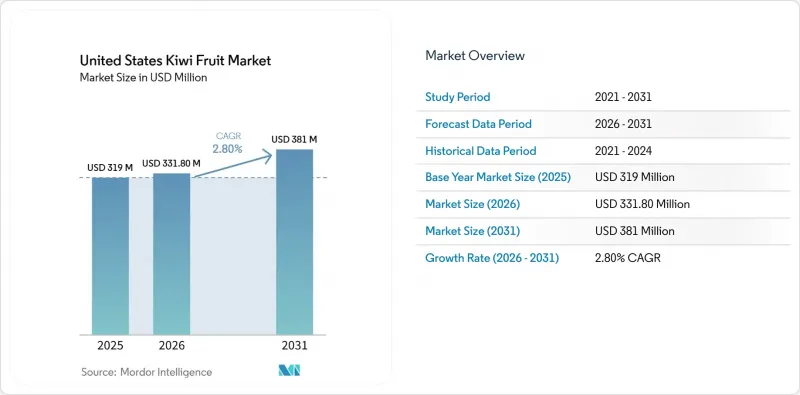
The United States Kiwi Fruit Market Report Includes Production Analysis (Volume, Area Harvested, and Yield), Consumption Analysis (Value and Volume), Import Analysis (Value and Volume), Export Analysis (Value and Volume), Wholesale Price Trend Analysis and Forecast, Regulatory Framework, Logistics and Infrastructure, and Seasonality Analysis. The Market Forecasts are Provided in Terms of Value (USD) and Volume (Metric Tons).
United States Kiwi Fruit Market Trends and Insights
Rising Demand for Nutrient-Dense Fruit Snacking
Consumer preference for nutrient-dense fresh fruit is increasing as healthy snacking increasingly replaces processed alternatives in the United States. Kiwifruit is well-positioned in this trend due to its high levels of vitamin C, dietary fiber, potassium, folate, vitamin E, and antioxidants, making it attractive to health-conscious consumers. The United States Department of Agriculture National Retail Report recorded 443 retail advertisements for Hayward kiwifruit sold individually during the week ending January 10, 2025, compared with 206 the previous week, indicating stronger retail promotion and consumer demand. This growing retail presence continues to support sustained kiwifruit consumption nationwide.
Premiumization Through Gold and Red Varieties
Premium kiwi varieties are influencing consumer purchasing patterns by offering enhanced flavor, distinctive appearance, and stronger nutritional appeal, enabling retailers to capture higher value per sale. Gold- and red-fleshed kiwifruit continue to gain shelf space as consumers increasingly seek premium fresh produce. According to Zespri International Limited's Five-Year Outlook 2025, red kiwifruit achieves an average retail price 15% above gold varieties, indicating consumers' willingness to pay more for differentiated premium fruit. This pricing environment encourages continued investment in premium cultivar development and supports value growth across the United States kiwi fruit market.
High Perishability and Cold Chain Cost Sensitivity
Kiwifruit requires strict postharvest handling and continuous cold-chain management to preserve quality during storage, transportation, and distribution, thereby increasing logistics costs across the supply chain. Specialized storage infrastructure and precise temperature control are essential to minimize quality deterioration, particularly for imported fruit traveling long distances. According to a 2025 review published in Current Issues in Molecular Biology, kiwifruit is highly perishable, with postharvest life constrained by rapid softening, chilling injury, pathogen-induced soft rot, off-flavor development, and uneven ripening. These physiological challenges increase handling costs, elevate spoilage risks, and limit market expansion in the United States.
Other drivers and restraints analyzed in the detailed report include:
- Retail Promotion and In-Store Merchandising Intensity
- Growth in Organic and Clean-Label Produce Demand
- Limited Domestic Orchard Scale and Yield Concentration
For complete list of drivers and restraints, kindly check the Table Of Contents.
Complete Report Scope:
- Production Analysis
- Production Volume
- Area Harvested and Yield
- Consumption Analysis (Value and Volume)
- Trade Analysis (Value and Volume)
- Import Market Analysis
- Import Value and Volume
- Key Supplying Markets
- Export Market Analysis
- Export Value and Volume
- Key Destinations Markets
- Import Market Analysis
- Wholesale Price Trend Analysis and Forecast
- Regulatory Framework
- Logistics and Infrastructure
- Seasonality Analysis
Additional Benefits:
- The market estimate (ME) sheet in Excel format
- 3 months of analyst support
TABLE OF CONTENTS
1 Introduction
- 1.1 Study Assumptions and Market Definition
- 1.2 Scope of the Study
2 Research Methodology
3 Executive Summary
4 Market Landscape
- 4.1 Market Overview
- 4.2 Market Drivers
- 4.2.1 Rising demand for nutrient-dense fruit snacking
- 4.2.2 Premiumization through gold and red varieties
- 4.2.3 Retail promotion and in-store merchandising intensity
- 4.2.4 Growth in organic and clean-label produce demand
- 4.2.5 Wider availability through controlled ripening and cold chain execution
- 4.2.6 Export diversification by supplier markets into the United States
- 4.3 Market Restraints
- 4.3.1 Heavy dependence on imported supply
- 4.3.2 High perishability and cold chain cost sensitivity
- 4.3.3 Seasonal supply gaps and retail price volatility
- 4.3.4 Limited domestic orchard scale and yield concentration
- 4.4 Opportunities
- 4.5 Challenges
- 4.6 Value Chain Analysis
- 4.7 Technologies and usage of AI in the Industry
- 4.8 Input Market Analysis
- 4.8.1 Seeds
- 4.8.2 Fertilizers
- 4.8.3 Crop Protection Chemicals
- 4.9 Distribution Channel Analysis
- 4.10 Market Sentiment Analysis
- 4.11 PESTLE Analysis
5 Market Size and Growth Forecasts (Value and Volume)
- 5.1 Production Analysis
- 5.1.1 Production Volume
- 5.1.2 Area Harvested and Yield
- 5.2 Consumption Analysis (Value and Volume)
- 5.3 Trade Analysis (Value and Volume)
- 5.3.1 Import Market Analysis
- 5.3.1.1 Import Value and Volume
- 5.3.1.2 Key Supplying Markets
- 5.3.2 Export Market Analysis
- 5.3.2.1 Export Value and Volume
- 5.3.2.2 Key Destinations Markets
- 5.3.1 Import Market Analysis
- 5.4 Wholesale Price Trend Analysis and Forecast
- 5.5 Regulatory Framework
- 5.6 Logistics and Infrastructure
- 5.7 Seasonality Analysis
6 End Use and Application
- 6.1 Primary Applications and Emerging Applications
- 6.2 Consumption Breakdown by Industries
7 Competitive Landscape
- 7.1 Overview of the Competition
- 7.2 Recent Developments
- 7.3 Market Concentration Analysis
- 7.4 List of Key Players
- 7.4.1 Zespri International Limited
- 7.4.2 Dole plc
- 7.4.3 Fresh Del Monte Produce Inc.
- 7.4.4 Frieda's, LLC
- 7.4.5 Rainier Fruit Company
- 7.4.6 The Giumarra Companies
- 7.4.7 Seeka Limited
- 7.4.8 The Fruit Company, Inc.
- 7.4.9 Coosemans Los Angeles, Inc.
- 7.4.10 Sun Pacific Farming Cooperative, Inc.
- 7.4.11 Baldor Specialty Foods, Inc.
- 7.4.12 Trucco, Inc.
8 Market Opportunity and Future Outlook

