PUBLISHER: Mordor Intelligence | PRODUCT CODE: 2113423

PUBLISHER: Mordor Intelligence | PRODUCT CODE: 2113423
Europe Kiwi Fruit - Market Share Analysis, Industry Trends & Statistics, Growth Forecasts (2026 - 2031)
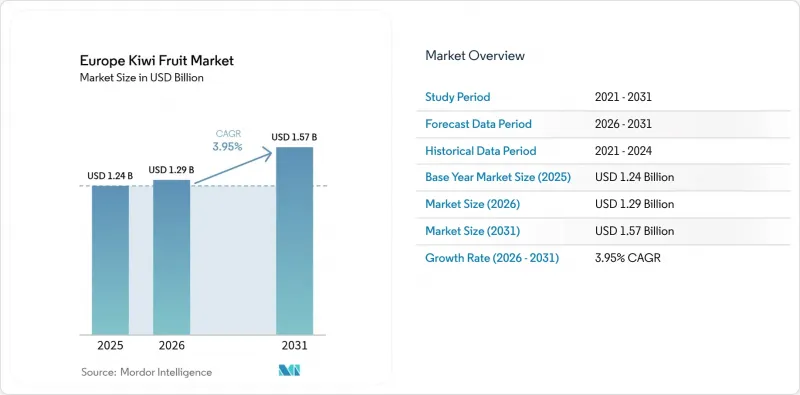
According to Mordor Intelligence, the Europe kiwi fruit market size was valued at USD 1.24 billion in 2025 and estimated to grow from USD 1.29 billion in 2026 to reach USD 1.57 billion by 2031, at a CAGR of 3.95% during the forecast period (2026-2031).
This report is Segmented by Geography (Germany, United Kingdom, France, Spain, and Italy). The Report Includes Production Analysis (Volume), Consumption Analysis (Value and Volume), Import Analysis (Value and Volume), Export Analysis (Value and Volume), and Price Trend Analysis. The Market Forecasts are Provided in Terms of Value (USD) and Volume (Metric Tons).
Europe Kiwi Fruit Market Trends and Insights
Farm-to-Fork Traceability Premiums
Consumer demand for transparent supply chains is transforming procurement practices in Germany and France. Retail audits indicate widespread implementation of QR-enabled origin tracking systems that monitor orchard practices, pesticide usage, and carbon footprints in near real time. Consumers are willing to pay a 15-25% premium for traceable fruit, prompting growers in Italy and Spain to implement orchard-to-checkout blockchain systems for verifying harvest dates and cold-chain compliance. The European Union's farm-to-fork legislation requires enhanced labeling transparency, providing regional producers a competitive advantage over non-EU suppliers. The resulting price premiums enhance grower margins and support continued investment in digital infrastructure. As downstream audit requirements increase, supply chain traceability has evolved from a market differentiator to an essential requirement in the European kiwi fruit market.
Expansion of Premium Yellow and Red-flesh Kiwi Varieties
Golden and red kiwifruit cultivars command 40-60% higher retail prices compared to traditional Hayward varieties. Golden varieties constitute approximately 25% of global kiwifruit volume, but generate a significantly larger share of category revenue due to their enhanced sweetness and attractive coloring. Zespri's SunGold expansion across Europe demonstrates strong consumer demand, which has prompted Italian and Spanish breeding programs to develop cultivars adapted to Mediterranean growing conditions. The adoption of genomic selection and marker-assisted breeding techniques has accelerated cultivar development timelines, enabling European producers to compete with New Zealand's market position. French and German supermarkets have increased premium kiwifruit shelf space by 100% in the past two seasons, indicating that premium varieties will continue to influence retail assortments throughout the forecast period.
Bacterial Canker (Psa) Flare-ups
Pseudomonas syringae pv. actinidiae (Psa) reduces kiwifruit orchard longevity and necessitates replanting cycles. In Italy, Psa outbreaks decreased regional yields and caused growers to increase their integrated pest-management costs by three times in the past five seasons. Research indicates that iron deficiency and water stress intensify disease symptoms, highlighting the importance of proper fertilization and canopy management. While breeding programs are developing resistant varieties, their commercial implementation requires several years, leaving current production vulnerable. Despite early warning systems through coordinated monitoring across Greek and Spanish growing regions, Psa continues to be the primary biological threat affecting the European kiwifruit market.
Other drivers and restraints analyzed in the detailed report include:
- Expansion of Controlled-Atmosphere Storage Capacity
- Post-Brexit Tariff Realignments Boosting Intra-EU Trade
- Labor Shortages During Peak Harvest
For complete list of drivers and restraints, kindly check the Table Of Contents.
Complete Report Scope:
- By Geography
- Germany
- Production Analysis (Volume)
- Consumption Analysis (Value and Volume)
- Import Analysis (Value and Volume)
- Export Analysis (Value and Volume)
- Price Trend Analysis
- United Kingdom
- Production Analysis (Volume)
- Consumption Analysis (Value and Volume)
- Import Analysis (Value and Volume)
- Export Analysis (Value and Volume)
- Price Trend Analysis
- France
- Production Analysis (Volume)
- Consumption Analysis (Value and Volume)
- Import Analysis (Value and Volume)
- Export Analysis (Value and Volume)
- Price Trend Analysis
- Spain
- Production Analysis (Volume)
- Consumption Analysis (Value and Volume)
- Import Analysis (Value and Volume)
- Export Analysis (Value and Volume)
- Price Trend Analysis
- Italy
- Production Analysis (Volume)
- Consumption Analysis (Value and Volume)
- Import Analysis (Value and Volume)
- Export Analysis (Value and Volume)
- Price Trend Analysis
- Germany
Additional Benefits:
- The market estimate (ME) sheet in Excel format
- 3 months of analyst support
TABLE OF CONTENTS
1 Introduction
- 1.1 Study Assumptions and Market Definition
- 1.2 Scope of the Study
2 Research Methodology
3 Executive Summary
4 Market Landscape
- 4.1 Market Overview
- 4.2 Market Drivers
- 4.2.1 Farm-to-Fork Traceability Premiums
- 4.2.2 Expansion of Premium Yellow and Red-flesh Kiwi Varieties
- 4.2.3 EU-funded Varietal Research and Development Programs
- 4.2.4 Expansion of Controlled-atmosphere Storage Capacity
- 4.2.5 Rising Per-capita Fresh-fruit Intake
- 4.2.6 Post-Brexit Tariff Realignments Boosting Intra-EU Trade
- 4.3 Market Restraints
- 4.3.1 Bacterial Canker (Psa) Flare-ups
- 4.3.2 Labor Shortages During Peak Harvest
- 4.3.3 Exchange-rate Volatility
- 4.3.4 Intensifying Competition from Southern-hemisphere Off-season Supply
- 4.4 Regulatory Landscape
- 4.5 Technological Outlook
- 4.6 Value/Supply-Chain Analysis
- 4.7 PESTLE Analysis
5 Market Size and Growth Forecasts (Value and Volume)
- 5.1 By Geography
- 5.1.1 Germany
- 5.1.1.1 Production Analysis (Volume)
- 5.1.1.2 Consumption Analysis (Value and Volume)
- 5.1.1.3 Import Analysis (Value and Volume)
- 5.1.1.4 Export Analysis (Value and Volume)
- 5.1.1.5 Price Trend Analysis
- 5.1.2 United Kingdom
- 5.1.2.1 Production Analysis (Volume)
- 5.1.2.2 Consumption Analysis (Value and Volume)
- 5.1.2.3 Import Analysis (Value and Volume)
- 5.1.2.4 Export Analysis (Value and Volume)
- 5.1.2.5 Price Trend Analysis
- 5.1.3 France
- 5.1.3.1 Production Analysis (Volume)
- 5.1.3.2 Consumption Analysis (Value and Volume)
- 5.1.3.3 Import Analysis (Value and Volume)
- 5.1.3.4 Export Analysis (Value and Volume)
- 5.1.3.5 Price Trend Analysis
- 5.1.4 Spain
- 5.1.4.1 Production Analysis (Volume)
- 5.1.4.2 Consumption Analysis (Value and Volume)
- 5.1.4.3 Import Analysis (Value and Volume)
- 5.1.4.4 Export Analysis (Value and Volume)
- 5.1.4.5 Price Trend Analysis
- 5.1.5 Italy
- 5.1.5.1 Production Analysis (Volume)
- 5.1.5.2 Consumption Analysis (Value and Volume)
- 5.1.5.3 Import Analysis (Value and Volume)
- 5.1.5.4 Export Analysis (Value and Volume)
- 5.1.5.5 Price Trend Analysis
- 5.1.1 Germany
6 Competitive Landscape
- 6.1 List of Stakeholders
- 6.1.1 Zespri Group Limited
- 6.1.2 Jingold S.p.A
- 6.1.3 Granfrutta Zani Societa Cooperativa Agricola
- 6.1.4 Kiwi Atlantico, S.A.
- 6.1.5 Ortofruit Italia Societa Agricola Cooperativa
- 6.1.6 SanLucar Fruit S.L.
- 6.1.7 Consoezio Kiwi Passion S.C.A.R.L.
- 6.1.8 Zeus Kiwi S.A.
- 6.1.9 Minikiwi Farm Sp. z o.o.
- 6.1.10 Societa Agricola Salvi Vivai S.S.
7 Market Opportunities and Future Outlook

