PUBLISHER: Mordor Intelligence | PRODUCT CODE: 2100006

PUBLISHER: Mordor Intelligence | PRODUCT CODE: 2100006
Asia-Pacific Semiconductor Device For Processing Applications - Market Share Analysis, Industry Trends & Statistics, Growth Forecasts (2026 - 2031)
According to Mordor Intelligence, the Asia-Pacific semiconductor device market size for processing applications was valued at USD 162.08 billion in 2025 and estimated to grow from USD 173.29 billion in 2026 to reach USD 242.16 billion by 2031, at a CAGR of 6.92% during the forecast period (2026-2031).
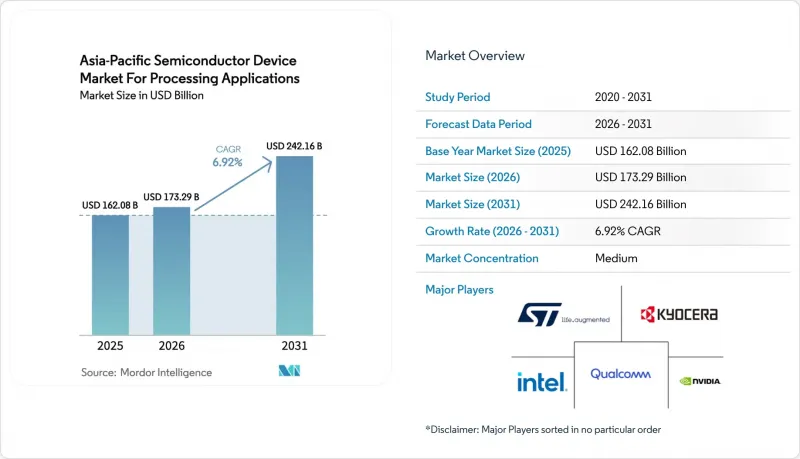
This report is Segmented by Device Type (Discrete Semiconductors, Optoelectronics, and More), Processing Architecture (x86, ARM, and More), Fabrication Node (Below 7 Nm, 8-16 Nm, and More), End-User Industry (Consumer Electronics, Automotive, Industrial and Manufacturing, and More), and Geography. The Market Forecasts are Provided in Terms of Value (USD).
Insights and Trends of Asia-Pacific Semiconductor Device Market For Processing Applications
AI/ML and Data-center Demand Surge
Generative-AI clusters deploy domain-specific accelerators that pair every GPU with eight HBM3 stacks, boosting memory ASPs and stressing advanced packaging capacity.TSMC increased CoWoS lines by 50% in 2024 and committed USD 11 billion for an additional site in Kumamoto to support 2.5D and 3D integration. Cloud operators are rolling out ARM-based Graviton and Ampere CPUs, which captured 28% of Asia-Pacific instance launches in 2024, underscoring the shift away from x86. China's sovereign-AI mandate obliges local clouds to adopt domestically fabricated inference chips even at 14-nanometer nodes, redirecting demand toward SMIC and Huawei HiSilicon. Meanwhile, rack-power densities approaching 100 kW favor Singapore and Malaysia, where liquid-cooling infrastructure is colocated with chip-assembly operations.
5G-enabled IoT Device Proliferation
Asia-Pacific surpassed 2.1 billion cellular-IoT connections in 2024 as utilities deployed NB-IoT smart meters and logistics firms embedded Cat-M modules in cold-chain containers. Each endpoint carries three to five semiconductors, yet sub-USD 2 ASPs compress margins, pushing high-volume work to foundries running mature 28- and 40-nanometer lines. India's 5G rollout covers 400 cities, driving demand for sub-6 GHz RF filters sourced from Taiwanese and Japanese specialists. Automotive telematics modules are migrating to 5G RedCap, a shift that benefits Renesas and NXP owing to functional-safety credentials.
Export-control Geopolitics on Advanced Tools
The United States barred servicing of DUV immersion scanners at Chinese fabs in October 2024 and Japan restricted 23 classes of chip-equipment exports, forcing Chinese foundries to rely on multi-patterning at 14 nanometer nodes, lengthening wafer cycles and inflating cost-per-transistor by one-third. With TSMC and Samsung pre-ordering 62 High-NA EUV systems, ASML's backlog stretches 18 months, leaving no near-term capacity for new entrants even if licenses loosen.
Other drivers and restraints analyzed in the detailed report include:
- Government Fab Incentives Across Asia-Pacific
- Memory-cycle Rebound and HBM Adoption
- EUV-talent Bottleneck in Asia-Pacific Fabs
For complete list of drivers and restraints, kindly check the Table Of Contents.
Segment Analysis
Integrated circuits accounted for 45.12% of 2025 revenue within the Asia-Pacific semiconductor device market and will advance at an 7.85% CAGR through 2031, outpacing discretes as hyperscalers migrate from board-level to monolithic AI accelerators. Logic products lead the surge, with NVIDIA's H200 on TSMC's N3E node delivering 40% more TOPS-per-watt than its predecessor, pushing average wafer values higher.
Discrete semiconductors, optoelectronics, and sensors collectively held a 54.88% share; however, growth trails ICs at a 6.35% CAGR, as price competition dilutes ASP gains. Silicon-carbide device revenue is constrained by 150 mm wafer shortages, which stretch lead times to 52 weeks, while co-packaged optics trim the module bill of materials by 22%, compressing photonics margins.
ARM designs commanded 72.45% share in 2025, powering smartphones, cloud servers and automotive compute, whereas RISC-V cores will expand at 8.48% CAGR as governments prioritize instruction-set autonomy.
The Asia-Pacific semiconductor device market size for RISC-V solutions is growing from a small base, benefiting from royalty-free licensing and rapidly maturing toolchains. Alibaba's Xuantie C920 matched ARM Cortex-A76 integer performance at lower recurring fees, while India's Shakti core delivers secure variants for defense avionics. In contrast, x86 clings to an 17.85% share confined to high-performance servers, posting the slowest 4.62% CAGR.
Complete Report Scope:
- By Device Type
- Discrete Semiconductors
- Optoelectronics
- Sensors
- Integrated Circuits
- Analog
- Logic
- Memory
- Micro
- By Processing Architecture
- x86
- ARM
- RISC-V
- MIPS and Other Processing Architectures
- By Fabrication Node
- Below 7 nm (N7, N5, N3 and below)
- 8-16 nm
- 22-28 nm
- Above 32 nm (Legacy and Specialty)
- By End-User Industry
- Consumer Electronics
- Automotive
- Industrial and Manufacturing
- Data Centre and Cloud
- Telecommunications
- Healthcare Devices
- Aerospace and Defence
- Other End-User Industries
- By Country
- China
- India
- Japan
- South Korea
- Taiwan
- Singapore
- Rest of Asia-Pacific
List of Companies Covered in this Report:
- Taiwan Semiconductor Manufacturing Company Limited
- Samsung Electronics Co., Ltd.
- SK hynix Inc.
- Intel Corporation
- NVIDIA Corporation
- Qualcomm Incorporated
- Micron Technology, Inc.
- Advanced Micro Devices, Inc.
- Broadcom Inc.
- Texas Instruments Incorporated
- STMicroelectronics N.V.
- NXP Semiconductors N.V.
- Renesas Electronics Corporation
- Infineon Technologies AG
- Kyocera Corporation
- Rohm Co., Ltd.
- Toshiba Electronic Devices and Storage Corporation
- ON Semiconductor Corporation
- Xilinx Inc. (AMD Adaptive Computing)
- United Microelectronics Corporation
- Semiconductor Manufacturing International Corporation
- GlobalFoundries Inc.
- Powerchip Semiconductor Manufacturing Co. Ltd.
- ASE Technology Holding Co., Ltd.
Additional Benefits:
- The market estimate (ME) sheet in Excel format
- 3 months of analyst support
TABLE OF CONTENTS
1 INTRODUCTION
- 1.1 Study Assumptions and Market Definition
- 1.2 Scope of the Study
2 RESEARCH METHODOLOGY
3 EXECUTIVE SUMMARY
4 MARKET LANDSCAPE
- 4.1 Market Overview
- 4.2 Market Drivers
- 4.2.1 AI/ML And Data-Centre Demand Surge
- 4.2.2 5G-Enabled IoT Device Proliferation
- 4.2.3 Government Fab Incentives Across Asia-Pacific
- 4.2.4 Memory-Cycle Rebound And HBM Adoption
- 4.2.5 RISC-V Localisation Push In China And India
- 4.2.6 Edge-AI Modules For Smart Factories In SEA
- 4.3 Market Restraints
- 4.3.1 Supply-Chain Fragility And Material Shortages
- 4.3.2 Export-Control Geopolitics On Advanced Tools
- 4.3.3 EUV-Talent Bottleneck In Asia-Pacific Fabs
- 4.3.4 Water-Scarcity Risk At Leading Foundries
- 4.4 Industry Value Chain Analysis
- 4.5 Technological Outlook
- 4.6 Regulatory Landscape
- 4.7 Porter's Five Forces Analysis
- 4.7.1 Threat of New Entrants
- 4.7.2 Bargaining Power of Buyers
- 4.7.3 Bargaining Power of Suppliers
- 4.7.4 Threat of Substitutes
- 4.7.5 Competitive Rivalry
- 4.8 Impact of Macroeconomic Factors on the Market
- 4.9 Semiconductor Foundry Landscape
5 MARKET SIZE AND GROWTH FORECASTS (VALUE)
- 5.1 By Device Type
- 5.1.1 Discrete Semiconductors
- 5.1.2 Optoelectronics
- 5.1.3 Sensors
- 5.1.4 Integrated Circuits
- 5.1.4.1 Analog
- 5.1.4.2 Logic
- 5.1.4.3 Memory
- 5.1.4.4 Micro
- 5.2 By Processing Architecture
- 5.2.1 x86
- 5.2.2 ARM
- 5.2.3 RISC-V
- 5.2.4 MIPS and Other Processing Architectures
- 5.3 By Fabrication Node
- 5.3.1 Below 7 nm (N7, N5, N3 and below)
- 5.3.2 8-16 nm
- 5.3.3 22-28 nm
- 5.3.4 Above 32 nm (Legacy and Specialty)
- 5.4 By End-User Industry
- 5.4.1 Consumer Electronics
- 5.4.2 Automotive
- 5.4.3 Industrial and Manufacturing
- 5.4.4 Data Centre and Cloud
- 5.4.5 Telecommunications
- 5.4.6 Healthcare Devices
- 5.4.7 Aerospace and Defence
- 5.4.8 Other End-User Industries
- 5.5 By Country
- 5.5.1 China
- 5.5.2 India
- 5.5.3 Japan
- 5.5.4 South Korea
- 5.5.5 Taiwan
- 5.5.6 Singapore
- 5.5.7 Rest of Asia-Pacific
6 COMPETITIVE LANDSCAPE
- 6.1 Market Concentration
- 6.2 Strategic Moves
- 6.3 Market Share Analysis
- 6.4 Company Profiles (includes Global level Overview, Market level overview, Core Segments, Financials as available, Strategic Information, Market Rank/Share for key companies, Products and Services, and Recent Developments)
- 6.4.1 Taiwan Semiconductor Manufacturing Company Limited
- 6.4.2 Samsung Electronics Co., Ltd.
- 6.4.3 SK hynix Inc.
- 6.4.4 Intel Corporation
- 6.4.5 NVIDIA Corporation
- 6.4.6 Qualcomm Incorporated
- 6.4.7 Micron Technology, Inc.
- 6.4.8 Advanced Micro Devices, Inc.
- 6.4.9 Broadcom Inc.
- 6.4.10 Texas Instruments Incorporated
- 6.4.11 STMicroelectronics N.V.
- 6.4.12 NXP Semiconductors N.V.
- 6.4.13 Renesas Electronics Corporation
- 6.4.14 Infineon Technologies AG
- 6.4.15 Kyocera Corporation
- 6.4.16 Rohm Co., Ltd.
- 6.4.17 Toshiba Electronic Devices and Storage Corporation
- 6.4.18 ON Semiconductor Corporation
- 6.4.19 Xilinx Inc. (AMD Adaptive Computing)
- 6.4.20 United Microelectronics Corporation
- 6.4.21 Semiconductor Manufacturing International Corporation
- 6.4.22 GlobalFoundries Inc.
- 6.4.23 Powerchip Semiconductor Manufacturing Co. Ltd.
- 6.4.24 ASE Technology Holding Co., Ltd.
7 MARKET OPPORTUNITIES AND FUTURE OUTLOOK
- 7.1 White-space and Unmet-Need Assessment

