PUBLISHER: Mordor Intelligence | PRODUCT CODE: 2119578

PUBLISHER: Mordor Intelligence | PRODUCT CODE: 2119578
Americas Semiconductor Device - Market Share Analysis, Industry Trends & Statistics, Growth Forecasts (2026 - 2031)
According to Mordor Intelligence, the americas semiconductor device market size is expected to grow from USD 188.46 billion in 2025 to USD 198.07 billion in 2026 and is forecast to reach USD 253.99 billion by 2031 at 5.1% CAGR over 2026-2031.
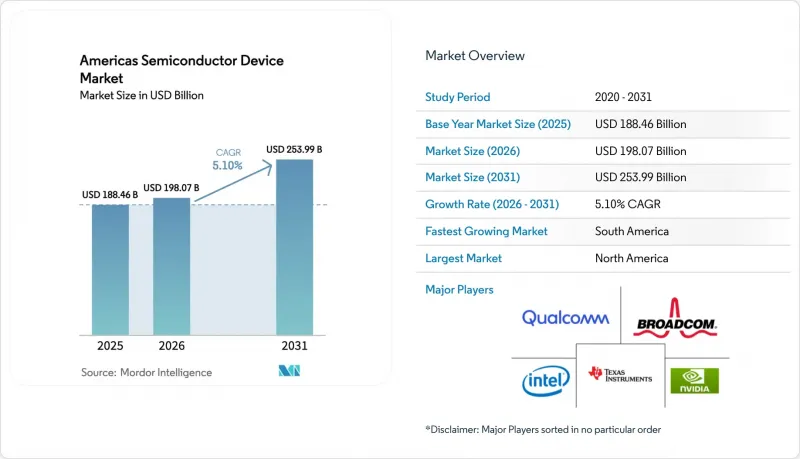
This report is Segmented by Device Type (Discrete Semiconductors, Optoelectronics, Sensors, and Integrated Circuits), Wafer Size (<= 200 Mm, 300 Mm, and >= 450 Mm), Technology Node (>= 65 Nm, 45-28 Nm, 22-16 Nm, and More), Semiconductor Material (Silicon, Silicon Carbide, and More), End-User Vertical (Automotive, Communication, Consumer, Industrial, and More), and by Region (North America, and South America).
Americas Semiconductor Device Market Trends and Insights
CHIPS Act-Driven Fabrication Capacity Expansion in North America
Massive federal incentives under the CHIPS and Science Act unlocked more than USD 450 billion in private commitments that aimed to triple domestic wafer output by 2032. Intel secured USD 8.5 billion in grants for multistate expansions, while TSMC received USD 6.6 billion for its two Arizona megafabs. Supplier ecosystems clustered around those projects, as over 40 tier-one chemical and equipment firms co-located nearby to shorten lead times. These clusters improved logistics costs and accelerated knowledge transfer, yet a 60% dependence on imported specialty gases and chemicals still forced new capital outlays for on-shore materials capacity. Ultimately, the investment surge positioned the Americas semiconductor device market for higher self-sufficiency without fully insulating it from resource constraints.
ADAS-Enabled Vehicle Demand in Mexico and Brazil
Electrification and Level-2 driver-assistance adoption pushed automotive semiconductor content per vehicle up 35% in leading Mexican and Brazilian assembly lines during 2024. Local plants integrated radar, lidar, and image-sensor arrays that required high-reliability microcontrollers and power devices. Bosch and Continental pursued joint ventures for on-shore packaging lines to mitigate import tariffs that could rise to 25%. Policymakers signalled additional fiscal credits for auto-grade chips, encouraging further capacity moves. As a result, automotive orders buffered the Americas semiconductor device market against consumer-electronics cyclicality and created a dependable mid-term revenue uplift.
Water and Power Supply Constraints in U.S. Southwest Fabs
New fabs in Arizona and Texas consumed up to 10 million gallons of ultrapure water daily, creating direct competition with municipal users. Intel invested USD 200 million in reclamation systems that recycled 90% of process water, yet those eco-projects added 2% to operating expenses and did not fully mitigate long-term drought risk. Rising electricity demand forced utilities to accelerate grid upgrades, further lifting production costs. These constraints reduced effective capacity gains from CHIPS Act incentives and threatened the cost competitiveness of the Americas semiconductor device market over the long horizon.
Other drivers and restraints analyzed in the detailed report include:
- 5G Stand-Alone Roll-out Elevating RF Front-End IC Consumption
- Hyperscale AI Server Build-out Increasing HBM and GPU Requirements
- Scarcity of Skilled Semiconductor Engineers across the Americas
For complete list of drivers and restraints, kindly check the Table Of Contents.
Segment Analysis
Integrated circuits captured 80.65% revenue in 2025 and advanced on a 7.45% CAGR projection, keeping the Americas semiconductor device market size firmly weighted toward complex logic and memory. AI training, autonomous driving, and industrial edge computing each increased silicon content per system, lifting average selling prices for high-bandwidth memory and inference accelerators. Discrete power devices, though smaller in value, gained strategic importance as silicon-carbide and gallium-nitride switches replaced silicon IGBTs in electric vehicles, improving powertrain efficiency and thermal margins. The Americas semiconductor device industry also saw optoelectronics broaden into lidar and image-sensing, providing incremental diversification against the cyclic smartphone segment.
A widening array of embedded applications drove resilient sensor volumes, yet price pressure persisted because many designs relied on mature process lines with fully depreciated assets. Analog ICs offered stable cash flow due to legacy automotive and industrial sockets that require decades-long supply continuity. Meanwhile, logic and memory displayed higher volatility in line with hyperscale capex cycles. Despite those swings, the integrated-circuits category delivered steady ecosystem investment, reinforcing design talent retention inside the Americas semiconductor device market.
In 2025, 300 mm lines accounted for 57.60% of production and underpinned nearly every leading-edge node, anchoring the largest slice of the Americas semiconductor device market size. Foundries noted 30% lower unit costs after migrating mature analog products from 200 mm to 300 mm substrates, widening gross-margin cushions. Equipment makers concurrently refined 450 mm pilot tools; although that diameter remained niche, it logged a 16.4% CAGR outlook to 2031 as manufacturers chased further economies of scale.
<=200 mm fabs preserved relevance because automotive and industrial buyers valued proven reliability over raw compute density. These fabs also benefited from the near-shoring of backend assembly in Mexico, which reduced cycle times for legacy components. The Americas semiconductor device market continued to balance investments across diameters to hedge against cyclical oversupply at any single node or wafer size.
Complete Report Scope:
- By Device Type
- Discrete Semiconductors
- Optoelectronics
- Sensors
- Integrated Circuits
- Analog ICs
- Logic ICs
- Memory ICs
- Micro ICs
- Microprocessors (MPU)
- Microcontrollers (MCU)
- Digital Signal Processors (DSP)
- By Wafer Size
- <= 200 mm
- 300 mm
- >= 450 mm
- By Technology Node
- >= 65 nm
- 45-28 nm
- 22-16 nm
- 10-7 nm
- <= 5 nm
- By Semiconductor Material
- Silicon (Si)
- Silicon Carbide (SiC)
- Gallium Nitride (GaN)
- Others (GaAs, InP, etc.)
- By End-User Vertical
- Automotive
- Communication (Wired and Wireless)
- Consumer Electronics
- Industrial
- Computing and Data Storage
- Aerospace and Defense
- Healthcare and Medical Devices
- By Region
- North America
- United States
- Canada
- South America
- Brazil
- Argentina
- Mexico
- Rest of South America
- North America
List of Companies Covered in this Report:
- Intel Corporation
- NVIDIA Corporation
- Qualcomm Incorporated
- Micron Technology Inc.
- Texas Instruments Incorporated
- Broadcom Inc.
- Advanced Micro Devices Inc.
- onsemi (ON Semiconductor Corporation)
- NXP Semiconductors N.V.
- Infineon Technologies AG
- STMicroelectronics N.V.
- Analog Devices Inc.
- Microchip Technology Inc.
- Skyworks Solutions Inc.
- GlobalFoundries Inc.
- Taiwan Semiconductor Manufacturing Company Limited
- Samsung Electronics Co., Ltd.
- Marvell Technology Inc.
- Monolithic Power Systems
- Wolfspeed Inc.
- Lattice Semiconductor
Additional Benefits:
- The market estimate (ME) sheet in Excel format
- 3 months of analyst support
TABLE OF CONTENTS
1 INTRODUCTION
- 1.1 Study Assumptions and Market Definition
- 1.2 Scope of the Study
2 RESEARCH METHODOLOGY
3 EXECUTIVE SUMMARY
4 MARKET LANDSCAPE
- 4.1 Market Overview
- 4.2 Market Drivers
- 4.2.1 CHIPS Act-Driven Fabrication Capacity Expansion in North America
- 4.2.2 ADAS-Enabled Vehicle Demand in Mexico and Brazil
- 4.2.3 5G Stand-Alone Roll-out Elevating RF Front-End IC Consumption
- 4.2.4 Hyperscale AI Server Build-out Increasing HBM and GPU Requirements
- 4.2.5 Renewable-Energy Incentives Boosting Power Semiconductor Adoption in Brazil and Chile
- 4.2.6 Nearshoring of Backend Assembly and Test to Mexico
- 4.3 Market Restraints
- 4.3.1 Water and Power Supply Constraints in US Southwest Fabs
- 4.3.2 Scarcity of Skilled Semiconductor Engineers across Americas
- 4.3.3 Export Controls on Advanced Equipment and IP
- 4.3.4 Volatile Silicon Wafer Pricing due to Limited Regional Supply
- 4.4 Value Chain Analysis
- 4.5 Regulatory Outlook
- 4.6 Porter's Five Forces
- 4.6.1 Bargaining Power of Suppliers
- 4.6.2 Bargaining Power of Buyers
- 4.6.3 Threat of New Entrants
- 4.6.4 Threat of Substitutes
- 4.6.5 Intensity of Competitive Rivalry
- 4.7 Investment and Capacity Analysis
- 4.8 Impact of Macroeconomic Factors
5 MARKET SIZE AND GROWTH FORECASTS (VALUE)
- 5.1 By Device Type
- 5.1.1 Discrete Semiconductors
- 5.1.2 Optoelectronics
- 5.1.3 Sensors
- 5.1.4 Integrated Circuits
- 5.1.4.1 Analog ICs
- 5.1.4.2 Logic ICs
- 5.1.4.3 Memory ICs
- 5.1.4.4 Micro ICs
- 5.1.4.4.1 Microprocessors (MPU)
- 5.1.4.4.2 Microcontrollers (MCU)
- 5.1.4.4.3 Digital Signal Processors (DSP)
- 5.2 By Wafer Size
- 5.2.1 <= 200 mm
- 5.2.2 300 mm
- 5.2.3 >= 450 mm
- 5.3 By Technology Node
- 5.3.1 >= 65 nm
- 5.3.2 45-28 nm
- 5.3.3 22-16 nm
- 5.3.4 10-7 nm
- 5.3.5 <= 5 nm
- 5.4 By Semiconductor Material
- 5.4.1 Silicon (Si)
- 5.4.2 Silicon Carbide (SiC)
- 5.4.3 Gallium Nitride (GaN)
- 5.4.4 Others (GaAs, InP, etc.)
- 5.5 By End-User Vertical
- 5.5.1 Automotive
- 5.5.2 Communication (Wired and Wireless)
- 5.5.3 Consumer Electronics
- 5.5.4 Industrial
- 5.5.5 Computing and Data Storage
- 5.5.6 Aerospace and Defense
- 5.5.7 Healthcare and Medical Devices
- 5.6 By Region
- 5.6.1 North America
- 5.6.1.1 United States
- 5.6.1.2 Canada
- 5.6.2 South America
- 5.6.2.1 Brazil
- 5.6.2.2 Argentina
- 5.6.2.3 Mexico
- 5.6.2.4 Rest of South America
- 5.6.1 North America
6 COMPETITIVE LANDSCAPE
- 6.1 Market Concentration
- 6.2 Strategic Moves
- 6.3 Market Share Analysis
- 6.4 Company Profiles (includes Global level Overview, Market level overview, Core Segments, Financials as available, Strategic Information, Market Rank/Share for key companies, Products and Services, and Recent Developments)
- 6.4.1 Intel Corporation
- 6.4.2 NVIDIA Corporation
- 6.4.3 Qualcomm Incorporated
- 6.4.4 Micron Technology Inc.
- 6.4.5 Texas Instruments Incorporated
- 6.4.6 Broadcom Inc.
- 6.4.7 Advanced Micro Devices Inc.
- 6.4.8 onsemi (ON Semiconductor Corporation)
- 6.4.9 NXP Semiconductors N.V.
- 6.4.10 Infineon Technologies AG
- 6.4.11 STMicroelectronics N.V.
- 6.4.12 Analog Devices Inc.
- 6.4.13 Microchip Technology Inc.
- 6.4.14 Skyworks Solutions Inc.
- 6.4.15 GlobalFoundries Inc.
- 6.4.16 Taiwan Semiconductor Manufacturing Company Limited
- 6.4.17 Samsung Electronics Co., Ltd.
- 6.4.18 Marvell Technology Inc.
- 6.4.19 Monolithic Power Systems
- 6.4.20 Wolfspeed Inc.
- 6.4.21 Lattice Semiconductor
7 MARKET OPPORTUNITIES AND FUTURE OUTLOOK
- 7.1 White-space and Unmet-Need Assessment

