PUBLISHER: Mordor Intelligence | PRODUCT CODE: 2125642

PUBLISHER: Mordor Intelligence | PRODUCT CODE: 2125642
Europe Semiconductor Device - Market Share Analysis, Industry Trends & Statistics, Growth Forecasts (2026 - 2031)
According to Mordor Intelligence, the Europe semiconductor device market size is projected to be USD 66.35 billion in 2025, USD 68.72 billion in 2026, and USD 90.71 billion by 2031, growing at a CAGR of 5.71% from 2026 to 2031.
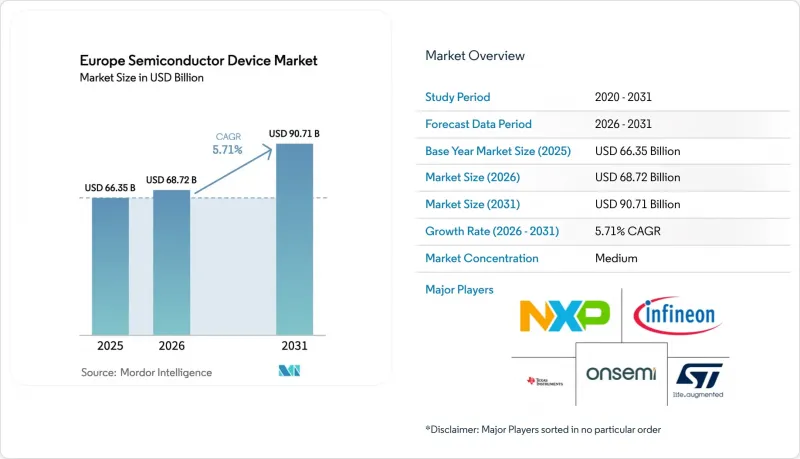
This report is Segmented by Device Type (Discrete Semiconductors, Optoelectronics, Sensors and MEMS, and Integrated Circuits), Business Model (IDM, and Design/Fabless Vendor), End-User Industry (Automotive, Communication, Consumer, Industrial, Computing, Data Center, and Government), Technology Node (5 Nm, 7 Nm, and More), and Geography. The Market Forecasts are Provided in Terms of Value (USD).
Europe Semiconductor Device Market Trends and Insights
AI-Optimized Logic IC Demand From European Hyperscale Datacenters
Hyperscale operators are tripling artificial-intelligence server capacity across Europe, consolidating clusters in Germany and the Netherlands where renewable-energy credits and dense fiber interconnects reduce total cost of ownership. Nvidia's June 2025 "sovereign AI" pitch persuaded policymakers to prioritize on-premise inference accelerators, reducing dependence on extra-regional clouds. Infineon expects AI-related power-management revenue to reach EUR 1.5 billion (USD 1.7 billion) in fiscal 2026 as silicon-carbide uninterrupted-power-supply modules scale to hyperscale deployments. By targeting the power and mixed-signal periphery rather than leading-edge logic, European fabs secure higher value capture even when wafer volumes migrate offshore. This dynamic also enlarges design-win opportunities for regional analog specialists that co-engineer thermal and voltage-regulation stacks with datacenter architects.
Electric-Vehicle Power Electronics Pulling SiC Devices in Germany and France
Automotive semiconductor content rose sharply after major German and French brands adopted 800-volt battery-electric architectures that mandate silicon-carbide traction inverters for fast-charging and reduced cable mass. Infineon and Stellantis signed a memorandum of understanding in 2025 to co-develop SiC power modules, accelerating CoolSiC ramp-up at Infineon's Dresden expansion backed by EU Chips Act incentives. France-based Soitec supplies Power-SOI substrates that remain foundational for low-loss power management despite fiscal-2025 inventory corrections. Multi-year wafer-supply agreements now bundle raw-wafer, epitaxy, and device procurement in a bid to secure scarce SiC capacity, tightening supplier lock-in and raising switching costs across the Europe semiconductor device market.
Tight EU27 Talent Pipeline for Analog and Mixed-Signal Design Engineers
SEMI Europe's October 2024 "Skills for Chips" report warned that 1 million semiconductor jobs must be filled by 2030, with analog and mixed-signal specialists in shortest supply. Although the European Chips Skills Academy targets 100,000 trainees, the curriculum refresh lags rapid shifts toward cryogenic CMOS and wide-bandgap power modeling. German automotive suppliers cite 18-month hiring lead times for senior analog engineers, compelling reliance on contract design houses outside the region. The scarcity inflates acquisition premiums, exemplified by STMicroelectronics paying USD 950 million for NXP's MEMS unit partly to secure 200 sensor-design engineers. Absent accelerated workforce development, fab ramps may be bottlenecked by IP validation cycles rather than equipment installations.
Other drivers and restraints analyzed in the detailed report include:
- Rapid 5G SA Roll-outs Elevating RF Front-End Module Content per Smartphone
- EU Chips Act-Funded 300 mm Fab Expansions, Lowering Local Sourcing Risk
- Capital-Intensity Barrier For New SiC And GaN Substrate Lines
For complete list of drivers and restraints, kindly check the Table Of Contents.
Segment Analysis
Integrated circuits held 61.72% of Europe semiconductor device market share in 2025, supported by entrenched design wins in automotive body control, industrial PLCs, and datacenter voltage regulation. STMicroelectronics' STM32V8 microcontroller family, launched in November 2025 on an 18 nm process, targets advanced driver-assistance and electric-vehicle zone controllers. Optoelectronics maintained a mid-teens slice, buoyed by ams-OSRAM's EUR 5 billion (USD 5.65 billion) in 2025 design-win announcements for 2D direct time-of-flight sensing. Discrete power devices continued migrating from silicon IGBTs to silicon-carbide MOSFETs as 800-volt battery-electric platforms scale.
Sensors and microelectromechanical systems are projected to grow at a 6.11% CAGR, the fastest among device classes. Melexis posted EUR 222.2 million (USD 251.1 million) in Q3-2025 revenue, driven by rising demand for magnetic-position and current sensors. Fraunhofer IMS crossed the 1-million-unit mark for its digital silicon-photomultiplier in December 2025, validating research-institute-to-fab transfer pathways. As centralized vehicle architectures proliferate, distributed sensing becomes the primary data source, explaining why the Europe semiconductor device market size attached to sensor content is expanding faster than logic or memory subsectors.
Integrated device manufacturers controlled 67.33% of 2025 revenues. Infineon's Dresden expansion, backed by EU Chips Act grants, underscores the sovereign-manufacturing advantage inherent in the IDM model. ON Semiconductor's Czech site serves image-sensor and SiC-diode demand for European automakers, contributing to USD 1.76 billion Q3-2025 corporate revenue.
Design and fabless vendors will nonetheless expand at a 5.89% CAGR as X-FAB and GlobalFoundries open foundry portals democratize application-specific integrated circuit tape-outs. X-FAB's Q3-2025 revenue reached USD 166.4 million despite soft consumer end markets, a testament to sustained automotive and industrial prototype demand. The European semiconductor device industry is witnessing hybrid strategies: Renesas' 2024 acquisition of design-automation firm Altium illustrates vertical integration moves by microcontroller suppliers, while fabless start-ups negotiate forward-capacity contracts to protect margins in tight allocation cycles.
Complete Report Scope:
- By Device Type
- Discrete Semiconductors
- Diodes
- Transistors
- Power Transistors
- Rectifier and Thyristor
- Other Discrete Semiconductors
- Optoelectronics
- Light-Emitting Diodes (LEDs)
- Laser Diodes
- Image Sensors
- Optocouplers
- Other Optoelectronics
- Sensors and MEMS
- Pressure
- Magnetic Field
- Actuators
- Acceleration and Yaw Rate
- Other Sensors and MEMS
- Integrated Circuits
- By IC Type
- Analog
- Micro
- Microprocessors (MPU)
- Microcontrollers (MCU)
- Digital Signal Processors
- Logic
- Memory
- By IC Type
- Discrete Semiconductors
- By Business Model
- Integrated Device Manufacturer (IDM)
- Design / Fabless Vendor
- By End-user Industry
- Automotive
- Communication (Wired and Wireless)
- Consumer
- Industrial
- Computing / Data Storage
- Data Center
- Artificial Intelligence
- Government
- By Technology Node
- Less than or Equal to 3nm
- 5 nm
- 7 nm
- 16 nm
- Less than or Equal to 28nm
- By Country
- Germany
- United Kingdom
- France
- Italy
- Netherlands
- Spain
- Rest of Europe
List of Companies Covered in this Report:
- STMicroelectronics N.V.
- Infineon Technologies AG
- NXP Semiconductors N.V.
- ON Semiconductor Corporation
- Texas Instruments Incorporated
- Analog Devices, Inc.
- Intel Corporation
- Advanced Micro Devices, Inc.
- Microchip Technology Incorporated
- Renesas Electronics Corporation
- Micron Technology, Inc.
- SK hynix Inc.
- Samsung Electronics Co., Ltd.
- Wolfspeed, Inc.
- Melexis N.V.
- Elmos Semiconductor SE
- ams-OSRAM AG
- GlobalFoundries Inc.
- Taiwan Semiconductor Manufacturing Company Limited
- X-FAB Silicon Foundries SE
- ROHM Co., Ltd.
- Soitec S.A.
- Semikron Danfoss GmbH & Co. KG
- ASM International N.V.
- IQE plc
Additional Benefits:
- The market estimate (ME) sheet in Excel format
- 3 months of analyst support
TABLE OF CONTENTS
1 INTRODUCTION
- 1.1 Study Assumptions and Market Definition
- 1.2 Scope of the Study
2 RESEARCH METHODOLOGY
3 EXECUTIVE SUMMARY
4 MARKET LANDSCAPE
- 4.1 Market Overview
- 4.2 Market Drivers
- 4.2.1 AI-Optimised Logic IC Demand from European Hyperscale Data Centres
- 4.2.2 Electric-Vehicle Power Electronics Pulling SiC Devices in Germany and France
- 4.2.3 Rapid 5G SA Roll-outs Elevating RF Front-End Module Content per Smartphone
- 4.2.4 EU Chips Act- Funded 300 mm Fab Expansions Lowering Local Sourcing Risk
- 4.2.5 Quantum-Computing Pilot Lines Spurring Cryogenic CMOS Controller Demand in Finland and Netherlands
- 4.2.6 Silicon Photomultiplier Adoption in Medical Imaging Start-ups Accelerating Niche Sensor Volumes
- 4.3 Market Restraints
- 4.3.1 Tight EU27 Talent Pipeline for Analog and Mixed-Signal Design Engineers
- 4.3.2 Capital-Intensity Barrier for New SiC and GaN Substrate Lines
- 4.3.3 PFAS Phase-Out under REACH Raising Dielectric Material Re-qualification Costs
- 4.3.4 Fragmented Sub-200 mm Foundry Ecosystem Limiting IoT Prototyping Scalability
- 4.4 Industry Value Chain Analysis
- 4.5 Regulatory Landscape
- 4.6 Porter's Five Forces Analysis
- 4.6.1 Bargaining Power of Suppliers
- 4.6.2 Bargaining Power of Buyers
- 4.6.3 Threat of New Entrants
- 4.6.4 Threat of Substitutes
- 4.6.5 Intensity of Competitive Rivalry
5 MARKET SIZE AND GROWTH FORECASTS (VALUE)
- 5.1 By Device Type
- 5.1.1 Discrete Semiconductors
- 5.1.1.1 Diodes
- 5.1.1.2 Transistors
- 5.1.1.3 Power Transistors
- 5.1.1.4 Rectifier and Thyristor
- 5.1.1.5 Other Discrete Semiconductors
- 5.1.2 Optoelectronics
- 5.1.2.1 Light-Emitting Diodes (LEDs)
- 5.1.2.2 Laser Diodes
- 5.1.2.3 Image Sensors
- 5.1.2.4 Optocouplers
- 5.1.2.5 Other Optoelectronics
- 5.1.3 Sensors and MEMS
- 5.1.3.1 Pressure
- 5.1.3.2 Magnetic Field
- 5.1.3.3 Actuators
- 5.1.3.4 Acceleration and Yaw Rate
- 5.1.3.5 Other Sensors and MEMS
- 5.1.4 Integrated Circuits
- 5.1.4.1 By IC Type
- 5.1.4.1.1 Analog
- 5.1.4.1.2 Micro
- 5.1.4.1.2.1 Microprocessors (MPU)
- 5.1.4.1.2.2 Microcontrollers (MCU)
- 5.1.4.1.2.3 Digital Signal Processors
- 5.1.4.1.3 Logic
- 5.1.4.1.4 Memory
- 5.1.4.1 By IC Type
- 5.1.1 Discrete Semiconductors
- 5.2 By Business Model
- 5.2.1 Integrated Device Manufacturer (IDM)
- 5.2.2 Design / Fabless Vendor
- 5.3 By End-user Industry
- 5.3.1 Automotive
- 5.3.2 Communication (Wired and Wireless)
- 5.3.3 Consumer
- 5.3.4 Industrial
- 5.3.5 Computing / Data Storage
- 5.3.6 Data Center
- 5.3.7 Artificial Intelligence
- 5.3.8 Government
- 5.4 By Technology Node
- 5.4.1 Less than or Equal to 3nm
- 5.4.2 5 nm
- 5.4.3 7 nm
- 5.4.4 16 nm
- 5.4.5 Less than or Equal to 28nm
- 5.5 By Country
- 5.5.1 Germany
- 5.5.2 United Kingdom
- 5.5.3 France
- 5.5.4 Italy
- 5.5.5 Netherlands
- 5.5.6 Spain
- 5.5.7 Rest of Europe
6 COMPETITIVE LANDSCAPE
- 6.1 Market Concentration
- 6.2 Strategic Moves
- 6.3 Market Share Analysis
- 6.4 Company Profiles {(includes Global level Overview, Market level overview, Core Segments, Financials as available, Strategic Information, Market Rank/Share for key companies, Products and Services, and Recent Developments)}
- 6.4.1 STMicroelectronics N.V.
- 6.4.2 Infineon Technologies AG
- 6.4.3 NXP Semiconductors N.V.
- 6.4.4 ON Semiconductor Corporation
- 6.4.5 Texas Instruments Incorporated
- 6.4.6 Analog Devices, Inc.
- 6.4.7 Intel Corporation
- 6.4.8 Advanced Micro Devices, Inc.
- 6.4.9 Microchip Technology Incorporated
- 6.4.10 Renesas Electronics Corporation
- 6.4.11 Micron Technology, Inc.
- 6.4.12 SK hynix Inc.
- 6.4.13 Samsung Electronics Co., Ltd.
- 6.4.14 Wolfspeed, Inc.
- 6.4.15 Melexis N.V.
- 6.4.16 Elmos Semiconductor SE
- 6.4.17 ams-OSRAM AG
- 6.4.18 GlobalFoundries Inc.
- 6.4.19 Taiwan Semiconductor Manufacturing Company Limited
- 6.4.20 X-FAB Silicon Foundries SE
- 6.4.21 ROHM Co., Ltd.
- 6.4.22 Soitec S.A.
- 6.4.23 Semikron Danfoss GmbH & Co. KG
- 6.4.24 ASM International N.V.
- 6.4.25 IQE plc
7 MARKET OPPORTUNITIES AND FUTURE OUTLOOK
- 7.1 White-Space and Unmet-Need Assessment

