PUBLISHER: Mordor Intelligence | PRODUCT CODE: 2100040

PUBLISHER: Mordor Intelligence | PRODUCT CODE: 2100040
North America Pharmaceutical Plastic Packaging - Market Share Analysis, Industry Trends & Statistics, Growth Forecasts (2026 - 2031)
According to Mordor Intelligence, the North America pharmaceutical plastic packaging market size was valued at USD 18.25 billion in 2025 and estimated to grow from USD 19.35 billion in 2026 to reach USD 25.93 billion by 2031, at a CAGR of 6.03% during the forecast period (2026-2031).
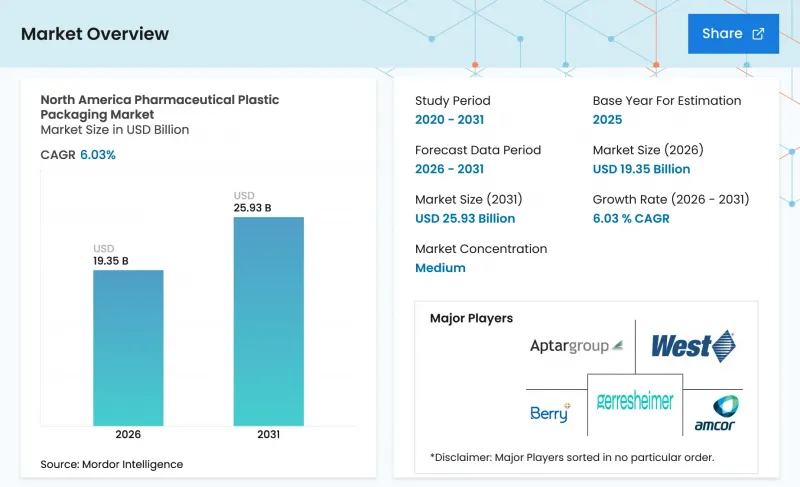
This report is Segmented by Raw Material (Polypropylene, and More), Product Type (Bottles - Solid-Oral, Bottles - Liquid, and More), Packaging Category (Primary Containers, and More), Drug-Delivery Route (Oral, Parenteral, Ophthalmic, and More), End-User (Branded Pharma, Generic Pharma, and More), and Country. The Market Forecasts are Provided in Terms of Value (USD).
North America Pharmaceutical Plastic Packaging Market Trends and Insights
Surge in Sterile, Ready-to-Fill Formats for Biologics
Biologic manufacturers increasingly favor pre-sterilized plastic packaging that shortens filling lines and protects high-value actives throughout cold-chain movement. Regulatory pathways for biologics have streamlined in the United States, propelling demand for systems such as Thermo Fisher's Fill Finish Solution, which maximizes drug recovery and ensures helium-tested bag integrity. West Pharmaceutical Services' Ready Pack(TM) kits add value for early-stage programs by eliminating on-site sterilization steps and minimizing waste. Rapid uptake of these platforms is trimming time-to-market for temperature-sensitive therapies and reinforcing the competitiveness of the North America pharmaceutical plastic packaging market.
Shift from Glass to Lightweight, Shatter-Proof Plastics
Weight savings of up to 60% versus glass translate into lower freight emissions and fewer breakage-related recalls. Polypropylene vials produced via blow-fill-seal technology now replace glass in large-volume parenterals, improving chemical resistance and reducing particulate risk. Drug Plastics reports growing customer migration to plastic bottles for both cost and safety gains. The North America pharmaceutical plastic packaging market is therefore positioned to capitalize on lower logistics costs and enhanced patient safety profiles.
API/Plastic Chemical Incompatibilities in Novel Drugs
Highly active biologics and emerging modalities such as mRNA vaccines display sensitivity to common polymer additives, complicating container selection. Revisions to USP <661.1> and <661.2> underscore tougher extractables standards. Small biotech firms face six-to-twelve-month launch delays when compatibility data are insufficient, tempering growth in the North America pharmaceutical plastic packaging market.
Other drivers and restraints analyzed in the detailed report include:
- Growth of Home-Care/Self-Administration Therapies
- Adoption of PCR and Bio-Based Resins to Meet ESG Targets
- Shortage of Medical-Grade rPET/HDPE Supply Chains
For complete list of drivers and restraints, kindly check the Table Of Contents.
Segment Analysis
HDPE contributed 34.78% of revenue in 2025, owing to chemical inertia and affordability. PET, bolstered by 7.47% CAGR, is favored for transparency and high moisture-barrier performance. The North America pharmaceutical plastic packaging market benefits as PET's recyclability supports ESG scorecards. Polypropylene remains indispensable for high-temperature sterilization, whereas LDPE satisfies flexible dropper needs. Premium cyclic olefin copolymers address low-extractables requirements in biologics. The nascent PCR stream shows rapid but supply-constrained uptake, reflecting EPR deadlines in Canada.
Emerging grades of bio-based PET could further accelerate PET adoption. Suppliers emphasize migration-tested masterbatches to keep extractables within USP limits. Price differentials between virgin and recycled PET narrowed during 2025, improving project ROIs. Strategic procurement alliances are increasingly common as drug firms secure long-term capacity for food-contact-grade rPET. HDPE converters respond with lightweighting innovations and tethered cap solutions to retain volumes within the North America pharmaceutical plastic packaging market.
Liquid bottles delivered 39.72% of 2025 sales, reflecting steady prescription and OTC cough remedies. However, nasal spray devices are advancing at 7.26% CAGR, capturing allergy, migraine, and rescue-therapy launches. Enhanced metered-dose accuracy, combined with patient aversion to needles, spurs adoption. Prefillable syringes and cartridges capture self-injecting diabetics and GLP-1 users. Vials and ampoules stay relevant for hospital injectables, though polypropylene formats steadily displace glass to cut breakage. Closures and lids integrate RFID-enabled seals that aid Drug Supply Chain Security Act compliance.
Demand for ophthalmic droppers benefits from aging demographics and dry-eye formulation growth. Unit-dose pouches support hospital compounding and reduce microbial contamination risk. Producers add multi-layer coatings to prevent oxygen ingress in peroxide-sensitive drugs. With regulatory appetite for serialized smart packs intensifying, product-type diversification will keep the North America pharmaceutical plastic packaging market on a robust upward track.
Complete Report Scope:
- By Raw Material
- Polypropylene (PP)
- Polyethylene Terephthalate (PET)
- High-density Polyethylene (HDPE)
- Low-density Polyethylene (LDPE)
- Cyclic Olefin Copolymer (COC)
- Post-consumer Recycled (PCR) Plastics
- By Product Type
- Bottles - Solid-oral
- Bottles - Liquid
- Vials and Ampoules
- Prefillable Syringes and Cartridges
- Nasal Spray Devices
- Dropper and Ophthalmic Containers
- Pouches and Sachets
- Closures and Lids
- By Packaging Category
- Primary Containers
- Secondary Components (closures, liners)
- Tertiary and Protective Systems
- By Drug-delivery Route
- Oral
- Parenteral
- Ophthalmic
- Nasal/Inhalation
- Topical/Transdermal
- By End-user
- Branded Pharma
- Generic Pharma
- Biotech and Cell-/Gene-therapy Firms
- Contract Development and Manufacturing Orgs (CDMOs)
- By Country
- United States
- Canada
- Mexico
List of Companies Covered in this Report:
- Amcor PLC
- Gerresheimer AG
- AptarGroup Inc.
- West Pharmaceutical Services Inc.
- Silgan Holdings Inc.
- Schott Pharma AG & Co. KG
- Comar LLC
- Tekni-Plex Inc.
- Drug Plastics & Glass Company Inc.
- Pretium Packaging LLC
- Bormioli Pharma S.p.A.
- Placon Corporation
- Alpla Werke Alwin Lehner GmbH
- Wipak Oy
- Plastipak Holdings Inc.
- O.Berk Company, L.L.C.
- DWK Life Sciences GmbH
- Plastek Group
Additional Benefits:
- The market estimate (ME) sheet in Excel format
- 3 months of analyst support
TABLE OF CONTENTS
1 INTRODUCTION
- 1.1 Study Assumptions and Market Definition
- 1.2 Scope of the Study
2 RESEARCH METHODOLOGY
3 EXECUTIVE SUMMARY
4 MARKET LANDSCAPE
- 4.1 Market Overview
- 4.2 Market Drivers
- 4.2.1 Demand for child-resistant closures in pediatric Rx drugs
- 4.2.2 Shift from glass to lightweight, shatter-proof plastics
- 4.2.3 Surge in sterile, ready-to-fill formats for biologics
- 4.2.4 Growth of home-care/self-administration therapies
- 4.2.5 Adoption of PCR and bio-based resins to meet ESG targets
- 4.2.6 Expansion of digital-printed smart packs for anti-counterfeit
- 4.3 Market Restraints
- 4.3.1 API/plastic chemical incompatibilities in novel drugs
- 4.3.2 Complex U.S.-Canada EPR and recycling mandates
- 4.3.3 Shortage of medical-grade rPET/HDPE supply chain
- 4.3.4 Inflation-driven resin price volatility
- 4.4 Industry Value Chain Analysis
- 4.5 Regulatory Landscape
- 4.6 Technological Outlook
- 4.7 Industry Attractiveness - Porter's Five Forces Analysis
- 4.7.1 Bargaining Power of Suppliers
- 4.7.2 Bargaining Power of Buyers
- 4.7.3 Threat of New Entrants
- 4.7.4 Threat of Substitutes
- 4.7.5 Intensity of Competitive Rivalry
- 4.8 Impact of Macroeconomic Factors on the Market
5 MARKET SIZE AND GROWTH FORECASTS (VALUES)
- 5.1 By Raw Material
- 5.1.1 Polypropylene (PP)
- 5.1.2 Polyethylene Terephthalate (PET)
- 5.1.3 High-density Polyethylene (HDPE)
- 5.1.4 Low-density Polyethylene (LDPE)
- 5.1.5 Cyclic Olefin Copolymer (COC)
- 5.1.6 Post-consumer Recycled (PCR) Plastics
- 5.2 By Product Type
- 5.2.1 Bottles - Solid-oral
- 5.2.2 Bottles - Liquid
- 5.2.3 Vials and Ampoules
- 5.2.4 Prefillable Syringes and Cartridges
- 5.2.5 Nasal Spray Devices
- 5.2.6 Dropper and Ophthalmic Containers
- 5.2.7 Pouches and Sachets
- 5.2.8 Closures and Lids
- 5.3 By Packaging Category
- 5.3.1 Primary Containers
- 5.3.2 Secondary Components (closures, liners)
- 5.3.3 Tertiary and Protective Systems
- 5.4 By Drug-delivery Route
- 5.4.1 Oral
- 5.4.2 Parenteral
- 5.4.3 Ophthalmic
- 5.4.4 Nasal/Inhalation
- 5.4.5 Topical/Transdermal
- 5.5 By End-user
- 5.5.1 Branded Pharma
- 5.5.2 Generic Pharma
- 5.5.3 Biotech and Cell-/Gene-therapy Firms
- 5.5.4 Contract Development and Manufacturing Orgs (CDMOs)
- 5.6 By Country
- 5.6.1 United States
- 5.6.2 Canada
- 5.6.3 Mexico
6 COMPETITIVE LANDSCAPE
- 6.1 Market Concentration
- 6.2 Strategic Moves
- 6.3 Market Share Analysis
- 6.4 Company Profiles (includes Global level Overview, Market level overview, Core Segments, Financials as available, Strategic Information, Market Rank/Share for key companies, Products and Services, and Recent Developments)
- 6.4.1 Amcor PLC
- 6.4.2 Gerresheimer AG
- 6.4.3 AptarGroup Inc.
- 6.4.4 West Pharmaceutical Services Inc.
- 6.4.5 Silgan Holdings Inc.
- 6.4.6 Schott Pharma AG & Co. KG
- 6.4.7 Comar LLC
- 6.4.8 Tekni-Plex Inc.
- 6.4.9 Drug Plastics & Glass Company Inc.
- 6.4.10 Pretium Packaging LLC
- 6.4.11 Bormioli Pharma S.p.A.
- 6.4.12 Placon Corporation
- 6.4.13 Alpla Werke Alwin Lehner GmbH
- 6.4.14 Wipak Oy
- 6.4.15 Plastipak Holdings Inc.
- 6.4.16 O.Berk Company, L.L.C.
- 6.4.17 DWK Life Sciences GmbH
- 6.4.18 Plastek Group
7 MARKET OPPORTUNITIES AND FUTURE TRENDS
- 7.1 White-Space and Unmet-Need Assessment

