PUBLISHER: Mordor Intelligence | PRODUCT CODE: 2100252

PUBLISHER: Mordor Intelligence | PRODUCT CODE: 2100252
KYC - Market Share Analysis, Industry Trends & Statistics, Growth Forecasts (2026 - 2031)
According to Mordor Intelligence, the KYC market size is expected to grow from USD 6.73 billion in 2025 to USD 7.8 billion in 2026 and is forecast to reach USD 16.31 billion by 2031 at 15.88% CAGR over 2026-2031.
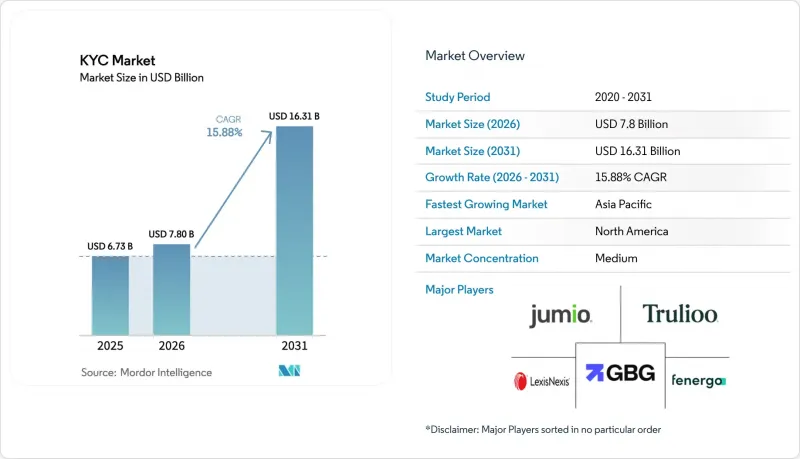
This report is Segmented by Component (Solution, and Services), by Deployment Mode (Cloud, On-Premise, and Hybrid), End-User Enterprise Size (Small and Medium Enterprises, and Large Enterprises), End-User Industry (Banking, Fintech and Payment Service Providers, Insurance, and More), Verification Technology (Biometrics, Document Authentication, and More) and Geography. The Market Forecasts are Provided in Terms of Value (USD).
Global KYC Market Trends and Insights
Rising regulatory penalties for non-compliance
Record fines such as the USD 3 billion assessment against TD Bank in 2024 have elevated non-compliance from an operational cost to an existential threat, prompting banks to fund automated verification projects that eliminate manual backlogs and reduce investigative cycles from weeks to seconds. FinCEN's 2026 AML/CFT rules will extend customer-identification obligations to investment advisers, further enlarging addressable demand. In Europe, eIDAS 2.0 obliges every member state to accept interoperable digital-ID wallets by 2026, widening the remit of KYC obligations beyond banking into ecommerce and telecom. Together these measures can push annual non-compliance costs above USD 100 million for a single global institution, making advanced KYC technologies a risk-mitigation staple rather than discretionary spend.
Surge in remote digital onboarding
Traditional onboarding lost 67% of prospects in 2024, which spurred firms to deploy AI engines that complete identity checks in under two seconds while holding 99%-plus accuracy. The pandemic embedded digital-first habits, and embedded-finance operators now demand low-friction KYC modules that slot directly into existing customer journeys. Regulators have responded: the FFIEC explicitly endorsed fully digital processes that still meet enhanced due-diligence thresholds, removing a major adoption barrier. As embedded finance spreads to non-bank brands, digital onboarding capability has become a baseline competitive requirement.
Data-privacy regulation fragmentation
Conflicting mandates-GDPR, CCPA and 20-plus emerging frameworks-create a patchwork of data-localization and consent rules that often clash with AML record-keeping requirements . Global KYC platforms must therefore build costly privacy-by-design architectures featuring encryption, data-minimization and automated-deletion functions. Banks hesitate to commit capital as looming revisions can invalidate deployed solutions, stretching procurement cycles and stalling adoption.
Other drivers and restraints analyzed in the detailed report include:
- AI/ML-driven false-positive reduction
- DeFi on-ramp compliance needs
- Legacy-system integration complexity
For complete list of drivers and restraints, kindly check the Table Of Contents.
Segment Analysis
Solutions generated 69.92% of 2025 revenue, confirming that end-to-end platforms sit at the heart of the KYC market. Institutional buyers demand single-API suites that merge biometric authentication, document forensics and real-time risk scoring, allowing 94% automated decisions and cutting manual review queues to hours . Services, however, post a 22.35% CAGR as firms lean on system integrators for multi-jurisdiction rollouts and perpetual-KYC tuning. Managed offerings appeal to SMEs that lack the talent or capital to run advanced stacks in-house, steering vendors toward compliance-as-a-service business models.
The services boom extends vendor stickiness beyond initial license fees. Professional teams translate changing statutes into rule updates, refine ML models against fresh fraud typologies and support zero-knowledge-proof pilots. As perpetual KYC transitions from optional to mainstream, continuous-monitoring subscriptions will contribute an ever-larger slice of overall KYC market revenue.
Cloud already holds 64.85% of the KYC market share and is compounding at 20.15% annually as institutions retire hardware-bound verification nodes. Elastic infrastructure absorbs onboarding spikes-often millions of checks per day-without procurement lead-times. Vendor roadmaps now put SOC 2 controls, data-residency zoning and sovereign-cloud options at the center, persuading regulators that risk can be lower in the cloud than on-prem. Consequently, the KYC market size attributable to cloud instances is slated for double-digit gains through 2031.
On-prem solutions persist for defense and public-sector segments with absolute sovereignty mandates, but hybrid architectures bridge the two worlds. Edge-computing containers keep high-risk checks local yet dispatch low-risk data to the cloud for bulk processing and analytics. Multi-cloud strategies are becoming standard, driving demand for orchestration layers that abstract away underlying infrastructure.
Complete Report Scope:
- By Component
- Solutions
- Services
- By Deployment Mode
- Cloud
- On-Premises
- Hybrid
- By End-user Enterprise Size
- Small and Medium Enterprises
- Large Enterprises
- By End-user Industry
- Banking
- FinTech and Payment Service Providers
- Insurance
- Telecom
- Government and Public Sector
- Healthcare
- Gaming and iGaming
- Others
- By Verification Technology
- Biometrics
- Document Authentication
- Database/API-based
- Liveness and Anti-spoofing
- Blockchain-based KYC
- By Geography
- North America
- United States
- Canada
- Mexico
- South America
- Brazil
- Argentina
- Rest of South America
- Europe
- Germany
- United Kingdom
- France
- Italy
- Spain
- Russia
- Rest of Europe
- Asia-Pacific
- China
- Japan
- India
- South Korea
- Australia and New Zealand
- Rest of Asia-Pacific
- Middle East and Africa
- Middle East
- Saudi Arabia
- United Arab Emirates
- Turkey
- Rest of Middle East
- Africa
- South Africa
- Nigeria
- Egypt
- Rest of Africa
- Middle East
- North America
Geography Analysis
North America remains the epicenter with 34.10% revenue in 2025, underpinned by well-funded banks and an active venture-capital universe that poured more than USD 6 billion into ID-tech startups. FinCEN's expanded AML program will add thousands of investment advisers to the mandatory-KYC roster in 2026, reinforcing demand for cloud-native verification suites. Canada's 2025 AML overhaul, including tighter controls on white-label ATMs, further enlarges the regional opportunity set.
Asia-Pacific posts the strongest growth at 18.05% CAGR as mobile-first consumers flock to super-apps and digital wallets. Government identity frameworks such as India's Aadhaar Pay and Singapore's Singpass Pay prove that national e-ID rails can accelerate financial inclusion and lower onboarding cost. With hundreds of millions still unbanked, scalable KYC modules that can process mass onboarding in vernacular languages stand to capture outsized growth.
Europe's trajectory hinges on eIDAS 2.0. Universal acceptance of EU Digital Identity Wallets by 2026 will standardize verification workflows, giving European providers a home-field advantage in privacy-preserving KYC. GDPR compliance also forces vendors to build highly granular consent and deletion mechanisms, turning data protection into a competitive differentiator. Middle East and Africa trail in absolute terms but display rising deal activity: the UAE launched a national KYC platform in 2024 to streamline fintech licensing, signaling government commitment to digital compliance.
- GB Group plc
- ACTICO GmbH
- ComplyAdvantage.com Ltd.
- Equiniti KYC Solutions B.V.
- Experian plc
- Fenergo Group Holdings Ltd.
- GB Group plc
- iDenfy UAB
- IDnow GmbH
- iProov Ltd.
- Jumio Corporation
- LexisNexis Risk Solutions Inc.
- Mitek Systems Inc.
- NICE Actimize (NICE Ltd.)
- Onfido Ltd.
- Pegasystems Inc.
- SEON Technologies Ltd.
- Signicat AS
- Socure Inc.
- Trulioo Information Services Inc.
Additional Benefits:
- The market estimate (ME) sheet in Excel format
- 3 months of analyst support
TABLE OF CONTENTS
1 INTRODUCTION
- 1.1 Market Definition and Study Assumptions
- 1.2 Scope of the Study
2 RESEARCH METHODOLOGY
3 EXECUTIVE SUMMARY
4 MARKET LANDSCAPE
- 4.1 Market Overview
- 4.2 Market Drivers
- 4.2.1 Rising regulatory penalties for non-compliance
- 4.2.2 Surge in remote digital onboarding
- 4.2.3 AI/ML driven false-positive reduction
- 4.2.4 DeFi on-ramp compliance needs
- 4.2.5 Reusable digital ID wallets (eIDAS 2.0)
- 4.2.6 ISO 20022 real-time cross-border payments
- 4.3 Market Restraints
- 4.3.1 Data-privacy regulation fragmentation
- 4.3.2 Legacy system integration complexity
- 4.3.3 Privacy-preserving ID (ZK-proof) adoption
- 4.3.4 Analytics-talent shortage in emerging markets
- 4.4 Value / Supply-Chain Analysis
- 4.5 Evaluation of Critical Regulatory Framework
- 4.6 Impact Assessment of Key Stakeholders
- 4.7 Technological Outlook
- 4.8 Porter's Five Forces Analysis
- 4.8.1 Bargaining Power of Suppliers
- 4.8.2 Bargaining Power of Consumers
- 4.8.3 Threat of New Entrants
- 4.8.4 Threat of Substitutes
- 4.8.5 Intensity of Competitive Rivalry
- 4.9 Impact of Macro-economic Factors
5 MARKET SIZE AND GROWTH FORECASTS (VALUE)
- 5.1 By Component
- 5.1.1 Solutions
- 5.1.2 Services
- 5.2 By Deployment Mode
- 5.2.1 Cloud
- 5.2.2 On-Premises
- 5.2.3 Hybrid
- 5.3 By End-user Enterprise Size
- 5.3.1 Small and Medium Enterprises
- 5.3.2 Large Enterprises
- 5.4 By End-user Industry
- 5.4.1 Banking
- 5.4.2 FinTech and Payment Service Providers
- 5.4.3 Insurance
- 5.4.4 Telecom
- 5.4.5 Government and Public Sector
- 5.4.6 Healthcare
- 5.4.7 Gaming and iGaming
- 5.4.8 Others
- 5.5 By Verification Technology
- 5.5.1 Biometrics
- 5.5.2 Document Authentication
- 5.5.3 Database/API-based
- 5.5.4 Liveness and Anti-spoofing
- 5.5.5 Blockchain-based KYC
- 5.6 By Geography
- 5.6.1 North America
- 5.6.1.1 United States
- 5.6.1.2 Canada
- 5.6.1.3 Mexico
- 5.6.2 South America
- 5.6.2.1 Brazil
- 5.6.2.2 Argentina
- 5.6.2.3 Rest of South America
- 5.6.3 Europe
- 5.6.3.1 Germany
- 5.6.3.2 United Kingdom
- 5.6.3.3 France
- 5.6.3.4 Italy
- 5.6.3.5 Spain
- 5.6.3.6 Russia
- 5.6.3.7 Rest of Europe
- 5.6.4 Asia-Pacific
- 5.6.4.1 China
- 5.6.4.2 Japan
- 5.6.4.3 India
- 5.6.4.4 South Korea
- 5.6.4.5 Australia and New Zealand
- 5.6.4.6 Rest of Asia-Pacific
- 5.6.5 Middle East and Africa
- 5.6.5.1 Middle East
- 5.6.5.1.1 Saudi Arabia
- 5.6.5.1.2 United Arab Emirates
- 5.6.5.1.3 Turkey
- 5.6.5.1.4 Rest of Middle East
- 5.6.5.2 Africa
- 5.6.5.2.1 South Africa
- 5.6.5.2.2 Nigeria
- 5.6.5.2.3 Egypt
- 5.6.5.2.4 Rest of Africa
- 5.6.5.1 Middle East
- 5.6.1 North America
6 COMPETITIVE LANDSCAPE
- 6.1 Market Concentration
- 6.2 Strategic Moves
- 6.3 Market Share Analysis
- 6.4 Company Profiles (includes Global level Overview, Market level overview, Core Segments, Financials as available, Strategic Information, Market Rank/Share for key companies, Products and Services, and Recent Developments)
- 6.4.1 GB Group plc
- 6.4.2 ACTICO GmbH
- 6.4.3 ComplyAdvantage.com Ltd.
- 6.4.4 Equiniti KYC Solutions B.V.
- 6.4.5 Experian plc
- 6.4.6 Fenergo Group Holdings Ltd.
- 6.4.7 GB Group plc
- 6.4.8 iDenfy UAB
- 6.4.9 IDnow GmbH
- 6.4.10 iProov Ltd.
- 6.4.11 Jumio Corporation
- 6.4.12 LexisNexis Risk Solutions Inc.
- 6.4.13 Mitek Systems Inc.
- 6.4.14 NICE Actimize (NICE Ltd.)
- 6.4.15 Onfido Ltd.
- 6.4.16 Pegasystems Inc.
- 6.4.17 SEON Technologies Ltd.
- 6.4.18 Signicat AS
- 6.4.19 Socure Inc.
- 6.4.20 Trulioo Information Services Inc.
7 MARKET OPPORTUNITIES AND FUTURE TRENDS
- 7.1 White-space and Unmet-need Assessment

