PUBLISHER: Mordor Intelligence | PRODUCT CODE: 2125733

PUBLISHER: Mordor Intelligence | PRODUCT CODE: 2125733
Thailand CRM - Market Share Analysis, Industry Trends & Statistics, Growth Forecasts (2026 - 2031)
According to Mordor Intelligence, the Thailand CRM market size is expected to grow from USD 176.55 million in 2025 to USD 197.6 million in 2026 and is forecast to reach USD 346.52 million by 2031 at 11.90% CAGR over 2026-2031.
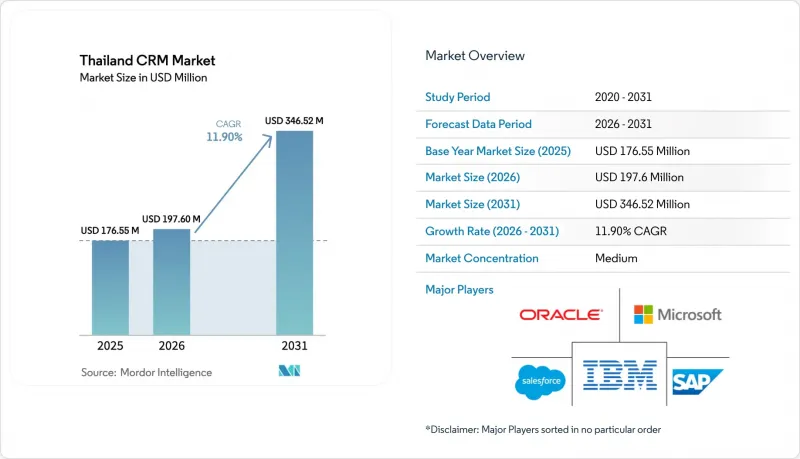
This report is Segmented by Organization Size (Small and Medium Enterprises, and Large Enterprises), Deployment Mode (Cloud, On-Premise, and Hybrid), End-User Vertical (BFSI, Retail and E-Logistics, Manufacturing, and More), CRM Function (Sales Force Automation, Marketing Automation, and More), and Region. The Market Forecasts are Provided in Terms of Value (USD).
Thailand CRM Market Trends and Insights
Rapid adoption of cloud-based CRM among Thai SMEs
Soft-loan programs offering 1% interest and locally hosted hyperscale infrastructure have combined to remove historic cost and data-sovereignty barriers for small firms. Thai vendors such as Zanroo and Choco CRM provide native language interfaces and templated workflows that slash implementation time. The result is a decisive shift away from on-premise installations toward subscription-based platforms that deliver predictable cash-flow benefits and automatic feature updates. As cloud penetration rises, vendors offering bundled managed services gain traction among SMEs with minimal in-house IT resources.
Government's Thailand 4.0 digital-transformation push
Policies under Thailand 4.0 embed digital-first standards across public procurement, e-government, and new virtual-bank licensing, compelling private firms to match service-delivery benchmarks. Enterprises integrating CRM platforms now view compliance with government digital expectations as table stakes for bidding on contracts and maintaining competitive relevance. Long-term stimulus funding and regulatory clarity ensure durable market momentum even during broader economic cycles.
Scarcity of skilled CRM implementation consultants
The talent pool remains shallow: local consultancies average fewer than 10 certified specialists, extending deployment cycles and inflating project costs. Offshore firms bridge gaps yet face cultural and language barriers, compelling many enterprises to adopt vendor-managed services that raise long-run operating expenses.
Other drivers and restraints analyzed in the detailed report include:
- Mobile-first consumer behavior driving omnichannel CRM
- Surge in Line OA social-commerce integrations
- Data-privacy compliance burden after PDPA enforcement
For complete list of drivers and restraints, kindly check the Table Of Contents.
Segment Analysis
The Thailand CRM market size for large enterprises remained dominant at USD 110.42 million in 2025, yet SMEs are forecast to contribute the bulk of incremental revenue through 2031. Government soft-loan schemes and low-cost cloud subscriptions are shrinking adoption barriers. Vendors targeting SMEs emphasize template-driven setups, Thai-language UIs, and bundled compliance modules, positioning themselves for double-digit expansion. As SMEs graduate from basic contact management to analytics modules, upselling opportunities expand throughout the forecast.
Local suppliers like Choco CRM bundle pre-built Line OA connectors and PDPA consent tools, allowing SMEs to deploy functional systems within weeks. International vendors respond by establishing tier-two pricing tiers and self-service app stores. This democratization fuels geographic diffusion beyond Bangkok, reinforcing the Thailand CRM market's long-run diversification.
Cloud installations lead, but concerns over latency-sensitive operations, legacy data synchronization, and regulatory mandates are driving hybrid architectures. Banking, aviation, and logistics players increasingly combine on-premise analytics engines with cloud-based engagement layers to balance control with scalability. Hybrid's 13.05% CAGR underscores its role as the bridge strategy for firms undertaking phased modernization.
Case in point, Bangkok Airways moved ERP workloads to AWS while retaining certain customer-service databases on-premise for real-time operational continuity. Such dual-stack environments catalyze demand for integration middleware and API-first CRM suites.
Complete Report Scope:
- By Organization Size
- Small and Medium Enterprises (SMEs)
- Large Enterprises
- By Deployment Mode
- Cloud
- On-premise
- Hybrid
- By End-user Vertical
- BFSI
- Retail and E-logistics
- Manufacturing
- Services (IT, BPO, etc.)
- Government and Public-Sector
- Other End-user Verticals
- By CRM Function
- Sales Force Automation
- Marketing Automation
- Customer Service and Support
- Analytics and Reporting
List of Companies Covered in this Report:
- Salesforce Inc.
- Microsoft Corporation
- Oracle Corporation
- SAP SE
- IBM Corporation
- Pegasystems Inc.
- Actran Systems Co., Ltd.
- Choco CRM Co., Ltd.
- Insightera Co., Ltd.
- Zoho Corporation Pvt. Ltd.
- Buzzebees Co., Ltd.
- Freshworks Inc.
- SugarCRM Inc.
- HubSpot, Inc.
- Insightly, Inc.
- Zendesk, Inc.
- Creatio Company (USA) d/b/a Creatio
- VTiger Systems India Private Limited
- Copper CRM, Inc.
- Agile CRM Inc.
- Monday.com Ltd.
- Pipedrive Inc.
Additional Benefits:
- The market estimate (ME) sheet in Excel format
- 3 months of analyst support
TABLE OF CONTENTS
1 INTRODUCTION
- 1.1 Study Assumptions and Market Definition
- 1.2 Scope of the Study
2 RESEARCH METHODOLOGY
3 EXECUTIVE SUMMARY
4 MARKET LANDSCAPE
- 4.1 Market Overview
- 4.2 Market Drivers
- 4.2.1 Rapid adoption of cloud-based CRM among Thai SMEs
- 4.2.2 Government's Thailand 4.0 digital-transformation push
- 4.2.3 Mobile-first consumer behaviour driving omnichannel CRM
- 4.2.4 Surge in Line OA social-commerce integrations
- 4.2.5 Thai-language NLP chatbots unlocking analytics value
- 4.2.6 Loyalty-as-a-Service uptake with tourism rebound
- 4.3 Market Restraints
- 4.3.1 Scarcity of skilled CRM implementation consultants
- 4.3.2 Data-privacy compliance burden after PDPA enforcement
- 4.3.3 Legacy Thai-script ERP systems with limited API support
- 4.3.4 Patchy broadband outside Bangkok hurting SaaS uptime
- 4.4 Industry Value Chain Analysis
- 4.5 Regulatory Landscape
- 4.6 Technological Outlook
- 4.7 Porter's Five Forces Analysis
- 4.7.1 Bargaining Power of Suppliers
- 4.7.2 Bargaining Power of Buyers
- 4.7.3 Threat of New Entrants
- 4.7.4 Threat of Substitutes
- 4.7.5 Intensity of Competitive Rivalry
- 4.8 Pricing Analysis
- 4.9 Impact of Macroeconomic Trends on the Market
5 MARKET SIZE AND GROWTH FORECASTS (VALUES)
- 5.1 By Organization Size
- 5.1.1 Small and Medium Enterprises (SMEs)
- 5.1.2 Large Enterprises
- 5.2 By Deployment Mode
- 5.2.1 Cloud
- 5.2.2 On-premise
- 5.2.3 Hybrid
- 5.3 By End-user Vertical
- 5.3.1 BFSI
- 5.3.2 Retail and E-logistics
- 5.3.3 Manufacturing
- 5.3.4 Services (IT, BPO, etc.)
- 5.3.5 Government and Public-Sector
- 5.3.6 Other End-user Verticals
- 5.4 By CRM Function
- 5.4.1 Sales Force Automation
- 5.4.2 Marketing Automation
- 5.4.3 Customer Service and Support
- 5.4.4 Analytics and Reporting
6 COMPETITIVE LANDSCAPE
- 6.1 Market Concentration
- 6.2 Strategic Moves
- 6.3 Market Share Analysis
- 6.4 Company Profiles (includes Global level Overview, Market level overview, Core Segments, Financials as available, Strategic Information, Market Rank/Share for key companies, Products and Services, and Recent Developments)
- 6.4.1 Salesforce Inc.
- 6.4.2 Microsoft Corporation
- 6.4.3 Oracle Corporation
- 6.4.4 SAP SE
- 6.4.5 IBM Corporation
- 6.4.6 Pegasystems Inc.
- 6.4.7 Actran Systems Co., Ltd.
- 6.4.8 Choco CRM Co., Ltd.
- 6.4.9 Insightera Co., Ltd.
- 6.4.10 Zoho Corporation Pvt. Ltd.
- 6.4.11 Buzzebees Co., Ltd.
- 6.4.12 Freshworks Inc.
- 6.4.13 SugarCRM Inc.
- 6.4.14 HubSpot, Inc.
- 6.4.15 Insightly, Inc.
- 6.4.16 Zendesk, Inc.
- 6.4.17 Creatio Company (USA) d/b/a Creatio
- 6.4.18 VTiger Systems India Private Limited
- 6.4.19 Copper CRM, Inc.
- 6.4.20 Agile CRM Inc.
- 6.4.21 Monday.com Ltd.
- 6.4.22 Pipedrive Inc.
7 MARKET OPPORTUNITIES AND FUTURE OUTLOOK
- 7.1 White-space and Unmet-Need Assessment

