PUBLISHER: Mordor Intelligence | PRODUCT CODE: 2100273

PUBLISHER: Mordor Intelligence | PRODUCT CODE: 2100273
Animation Outsourcing - Market Share Analysis, Industry Trends & Statistics, Growth Forecasts (2026 - 2031)
According to Mordor Intelligence, the animation outsourcing market size in 2026 is estimated at USD 226.71 billion, growing from 2025 value of USD 205.22 billion with 2031 projections showing USD 373.18 billion, growing at 10.47% CAGR over 2026-2031.
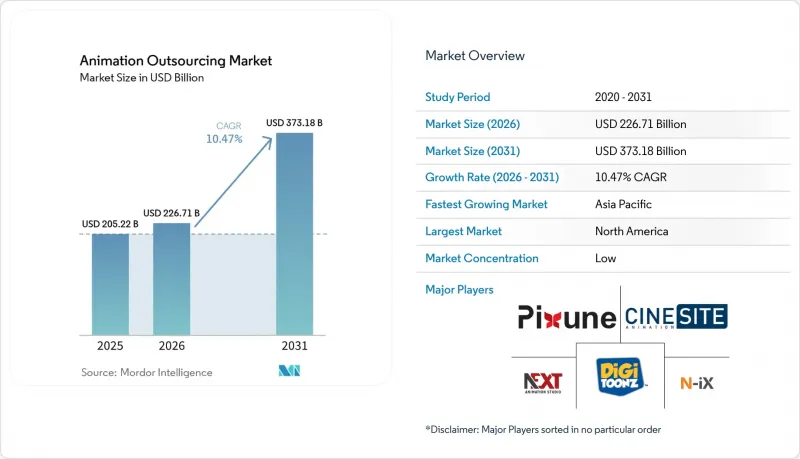
This report is Segmented by Animation Type (2D Animation, Stop-Motion Animation, and More), Production Stage (Pre-Production Services, Production Services, and Post-Production and VFX), End-Use Industry (Media and Entertainment, Gaming, and More), Platform (Film and Television, Video Games, OTT/Streaming Originals, and More), and Geography. The Market Forecasts are Provided in Terms of Value (USD).
Global Animation Outsourcing Market Trends and Insights
Surge in original content spend by streaming giants fueling APAC 3D pipelines
Global platforms prioritized volume in 2025, commissioning entire seasons of animated series upfront to accelerate subscriber growth. Disney's multiyear content budget and similar allocations from Netflix and Amazon overloaded domestic facilities, pushing 3D series work into Indian and South Korean studios where labor pools scaled rapidly. Regional vendors upgraded pipelines with USD 200 million in combined investments to meet HDR and Dolby Atmos standards demanded by clients. Government support amplified momentum, with South Korea funding R&D grants that subsidize up to 30% of real-time engine adoption costs. As deal flow rises, APAC suppliers secure longer retainer contracts that stabilize utilization rates. These factors collectively elevate the Animation Outsourcing market growth path through mid-decade.
Tight studio release windows driving near-shore hybrid production
Franchise sequels and streaming spin-offs now target 18-month turnarounds, compressing traditional schedules by nearly 25%. To bridge gaps, Hollywood showrunners increasingly lean on Guadalajara and Mexico City boutiques that synchronize daily reviews over shared daylight hours. Bilingual teams reduce revision cycles, while cross-border co-production treaties simplify asset transfers under aligned IP law. Mexican facilities reported a 38% rise in Storyboard Pro license counts in 2024, signaling deeper integration into pre-visualization stages. This hybrid approach anchors critical path tasks near the U.S. creative core and delegates render-intensive shots southward, reinforcing agility in the Animation Outsourcing market pipeline.
Wage Inflation in Traditional Hubs Eroding Cost Advantage
Salary growth in Bangalore and Manila rose by 8-12% each year during 2024, pushing average senior-animator pay to USD 38,000 The higher payroll narrows the historic cost gap with Eastern Europe, making price the sole selling point less persuasive. Vendors answer by adding automation plug-ins that remove routine scene-assembly steps and save up to 20% of staff hours. Some firms are also opening satellite studios in Vietnam and inland China where wage pressure is lower. Clients respond by splitting projects across multiple hubs to balance budgets and talent depth. These shifts keep the Animation Outsourcing market focused on productivity gains rather than simple labor arbitrage.
Other drivers and restraints analyzed in the detailed report include:
- Tax-incentive race in Canada, UK and France boosting outsourced post-production
- Mobile gaming boom in China and India elevating demand for cost-efficient character rigging
- IP leakage concerns limiting high-budget feature film work
For complete list of drivers and restraints, kindly check the Table Of Contents.
Segment Analysis
3D held 57.40% of Animation Outsourcing market share in 2025, because its assets travel easily across film, streaming, and high-end games. Producers favor 3D pipelines that now combine real-time renders and AI-assisted clean-ups to trim delivery days without lowering polish. These gains keep the segment firmly ahead even as smaller studios join the field. Motion graphics follows as the fastest riser, helped by the low cost of a 60-second corporate clip that averaged USD 3,130 in 2025. Marketing teams want punchy explainer videos for social feeds, and that demand funnels steady briefs to boutique vendors.
The Animation Outsourcing market responds by pairing senior 3D leads with junior motion-graphics teams so each project balances creativity and budget. Character creation services stay relevant because mobile games need fresh avatars every season, while stop-motion keeps a loyal niche of storytellers. Greater software interoperability means crews can pivot from motion graphics to 3D within the same toolset, raising utilization. Together these shifts diversify revenue sources and lock in a broad skills mix across the global vendor base.
Production services commanded 51.30% of the Animation Outsourcing market size in 2025, reflecting long-established workflows that external teams can scale quickly. Studios share clear model sheets and shot lists, letting overseas partners animate large volumes while home offices focus on art direction. Post-production and VFX, however, post the strongest 12.92% CAGR through 2031 as hybrid live-action shows call for heavier compositing. The increasing adoption of Animation and VFX services across OTT platforms, gaming studios, and virtual production projects is further supporting outsourcing demand globally.
Vendors chase this margin by investing in secure render farms that clear studio security audits, a must for tent-pole titles. Pre-production tasks also grow because generative AI can spit out three storyboard options overnight, cutting early-phase costs. Clients then lock animatics faster and slide savings downstream. These changes shift bargaining power toward suppliers that cover every stage inside one pipeline, strengthening project continuity within the Animation Outsourcing market.
Complete Report Scope:
- By Animation Type
- 2D Animation
- 3D Animation
- Character Creation
- Stop-Motion Animation
- Motion Graphics
- Others
- By Production Stage
- Pre-production Services
- Production Services
- Post-production and VFX
- By End-use Industry
- Media and Entertainment
- Gaming
- Education (e-Learning, EdTech)
- Healthcare and Scientific Visualisation
- Advertising and Marketing
- Others
- By Platform
- Film and Television
- Video Games (Console, PC, Mobile)
- OTT/Streaming Originals
- AR/VR and Metaverse Experiences
- Web and Social Media Content
- By Geography
- North America
- United States
- Canada
- Mexico
- South America
- Brazil
- Argentina
- Rest of South America
- Europe
- Germany
- United Kingdom
- France
- Italy
- Spain
- Rest of Europe
- Asia-Pacific
- China
- Japan
- South Korea
- India
- Australia
- New Zealand
- Rest of Asia-Pacific
- Middle East
- United Arab Emirates
- Saudi Arabia
- Rest of Middle East
- Africa
- South Africa
- Rest of Africa
- North America
Geography Analysis
North America retained a 33.60% revenue share worth USD 68.95 billion in 2025, anchored by the major studios that commission premium projects. California's headcount dipped after productions chased richer rebates in British Columbia, where animation jobs rose 72% since 2019. Local guilds lobby for stronger state incentives to stem the work drain.
Asia-Pacific posts the fastest 11.82% CAGR as governments back the sector with grants and training. South Korea pledged USD 106 million for AI-enabled pipelines, while India's AVGC roadmap targets 5% of worldwide demand. Chinese studios excel at high-volume rigging for mobile games, driving continual asset flow. The region now supplies a growing share of 3D series for global platforms, lifting the Animation Outsourcing market outlook.
Europe leverages attractive tax credits, such as the UK's Audio-Visual Expenditure Credit and Spain's 60% rebate, to win complex compositing gigs. Brexit-led paperwork adds delays but has not reversed inbound work. Latin America, led by Mexico, benefits from timezone alignment with U.S. showrunners, while South African shops in the Middle East and Africa carve niches in multilingual e-learning. These cross-regional dynamics reduce concentration risk and broaden client choice.
- Technicolor Creative Studios
- Keywords Studios plc
- Cinesite Studios
- DNEG Animation
- Framestore Ltd.
- Digital Domain Holdings
- Weta FX
- Deluxe Animation Studios
- Toon City Animation
- Virtuos Holdings
- Room 8 Studio
- Pixune Studios
- N-iX LLC
- Digitoonz
- G-angle Co. Ltd.
- Innovecs
- Motion Story
- Axis Studios
- Animal Logic
- Bardel Entertainment
- Reel FX
Additional Benefits:
- The market estimate (ME) sheet in Excel format
- 3 months of analyst support
TABLE OF CONTENTS
1 Introduction
- 1.1 Study Assumptions and Market Definition
- 1.2 Scope of the Study
2 Research Methodology
3 Executive Summary
4 Market Landscape
- 4.1 Market Overview
- 4.2 Market Drivers
- 4.2.1 Surge in Original Content Spend by Streaming Giants Fueling APAC 3D Pipelines
- 4.2.2 Tight Studio Release Windows Driving Near-shore Hybrid Production (US-Mexico)
- 4.2.3 Tax-Incentive Race in Canada, UK and France Boosting Outsourced Post-Production
- 4.2.4 Mobile Gaming Boom in China and India Elevating Demand for Cost-Efficient Character Rigging
- 4.2.5 Real-time Engines (Unreal/Unity) Enabling Virtual Production Outsourcing for Advertisers
- 4.2.6 Generative-AI-Powered Rapid Concept Art Increasing Outsourcing Volumes
- 4.3 Market Restraints
- 4.3.1 Wage Inflation in Traditional Hubs (Bangalore, Manila) Eroding Cost Advantage
- 4.3.2 IP Leakage Concerns Limiting High-Budget Feature Film Work to Tier-1 Vendors
- 4.3.3 Scarcity of Senior Technical Directors Creating Capacity Bottlenecks
- 4.3.4 Currency Volatility in Emerging Centers (Argentina, Turkey) Raising Contracting Risk
- 4.4 Technological Outlook
- 4.5 Porter's Five Forces Analysis
- 4.5.1 Threat of New Entrants
- 4.5.2 Bargaining Power of Buyers/Studios
- 4.5.3 Bargaining Power of Suppliers/Vendors
- 4.5.4 Threat of Substitutes (In-house and Automation)
- 4.5.5 Intensity of Competitive Rivalry
5 Market Size and Growth Forecasts (Value)
- 5.1 By Animation Type
- 5.1.1 2D Animation
- 5.1.2 3D Animation
- 5.1.3 Character Creation
- 5.1.4 Stop-Motion Animation
- 5.1.5 Motion Graphics
- 5.1.6 Others
- 5.2 By Production Stage
- 5.2.1 Pre-production Services
- 5.2.2 Production Services
- 5.2.3 Post-production and VFX
- 5.3 By End-use Industry
- 5.3.1 Media and Entertainment
- 5.3.2 Gaming
- 5.3.3 Education (e-Learning, EdTech)
- 5.3.4 Healthcare and Scientific Visualisation
- 5.3.5 Advertising and Marketing
- 5.3.6 Others
- 5.4 By Platform
- 5.4.1 Film and Television
- 5.4.2 Video Games (Console, PC, Mobile)
- 5.4.3 OTT/Streaming Originals
- 5.4.4 AR/VR and Metaverse Experiences
- 5.4.5 Web and Social Media Content
- 5.5 By Geography
- 5.5.1 North America
- 5.5.1.1 United States
- 5.5.1.2 Canada
- 5.5.1.3 Mexico
- 5.5.2 South America
- 5.5.2.1 Brazil
- 5.5.2.2 Argentina
- 5.5.2.3 Rest of South America
- 5.5.3 Europe
- 5.5.3.1 Germany
- 5.5.3.2 United Kingdom
- 5.5.3.3 France
- 5.5.3.4 Italy
- 5.5.3.5 Spain
- 5.5.3.6 Rest of Europe
- 5.5.4 Asia-Pacific
- 5.5.4.1 China
- 5.5.4.2 Japan
- 5.5.4.3 South Korea
- 5.5.4.4 India
- 5.5.4.5 Australia
- 5.5.4.6 New Zealand
- 5.5.4.7 Rest of Asia-Pacific
- 5.5.5 Middle East
- 5.5.5.1 United Arab Emirates
- 5.5.5.2 Saudi Arabia
- 5.5.5.3 Rest of Middle East
- 5.5.6 Africa
- 5.5.6.1 South Africa
- 5.5.6.2 Rest of Africa
- 5.5.1 North America
6 Competitive Landscape
- 6.1 Strategic Developments
- 6.2 Vendor Positioning Analysis
- 6.3 Company Profiles (includes Global level Overview, Market level overview, Core Segments, Financials as available, Strategic Information, Products and Services, and Recent Developments)
- 6.3.1 Technicolor Creative Studios
- 6.3.2 Keywords Studios plc
- 6.3.3 Cinesite Studios
- 6.3.4 DNEG Animation
- 6.3.5 Framestore Ltd.
- 6.3.6 Digital Domain Holdings
- 6.3.7 Weta FX
- 6.3.8 Deluxe Animation Studios
- 6.3.9 Toon City Animation
- 6.3.10 Virtuos Holdings
- 6.3.11 Room 8 Studio
- 6.3.12 Pixune Studios
- 6.3.13 N-iX LLC
- 6.3.14 Digitoonz
- 6.3.15 G-angle Co. Ltd.
- 6.3.16 Innovecs
- 6.3.17 Motion Story
- 6.3.18 Axis Studios
- 6.3.19 Animal Logic
- 6.3.20 Bardel Entertainment
- 6.3.21 Reel FX
7 Market Opportunities and Future Outlook
- 7.1 White-space and Unmet-Need Assessment

