PUBLISHER: Mordor Intelligence | PRODUCT CODE: 2100274

PUBLISHER: Mordor Intelligence | PRODUCT CODE: 2100274
Nutrigenomics Bioinformatics - Market Share Analysis, Industry Trends & Statistics, Growth Forecasts (2026 - 2031)
According to Mordor Intelligence, the nutrigenomics bioinformatics market size was valued at USD 0.61 billion in 2025 and estimated to grow from USD 0.67 billion in 2026 to reach USD 1.05 billion by 2031, at a CAGR of 10.42% during the forecast period (2026-2031).
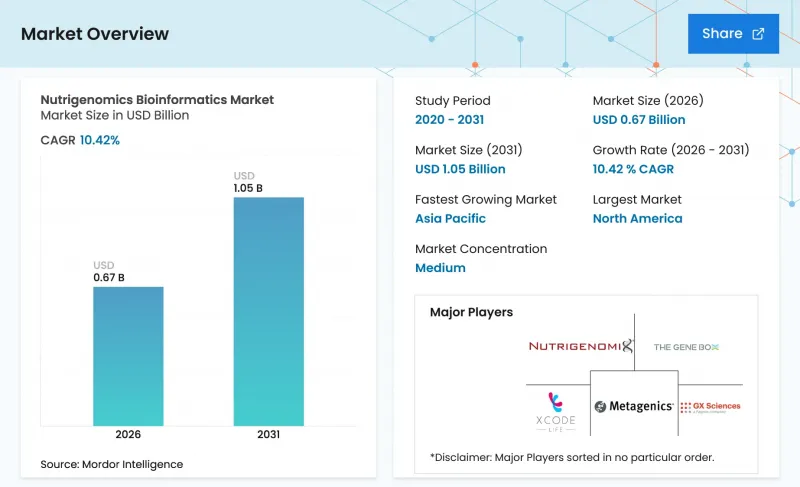
This report is Segmented by Component (Software Platforms, Reagents and Kits, and More), Application (Obesity, Cardiovascular Diseases, and More), End User (Research & Academic Institutes, Pharmaceutical & Biotech Companies, and More), Test Sample (Saliva, Buccal Swab, Blood), and Geography (North America, Europe, and More). The Market Forecasts are Provided in Terms of Value.
Global Nutrigenomics Bioinformatics Market Trends and Insights
Rising Uptake of Cloud-Native Bioinformatics Platforms
Large-scale genomic analytics increasingly rely on cloud infrastructure that provides elastic compute and secure data storage. Solutions such as Almaden Genomics' g.nome(TM) slash workflow development time from months to hours, making enterprise-grade pipelines accessible to mid-sized laboratories and start-ups alike. Lower entry barriers encourage new service providers to participate in the nutrigenomics bioinformatics market, intensifying competition and stimulating pricing innovation. Interoperability standards improve cross-institution collaboration, while real-time data sharing supports distributed clinical trials. The resulting ecosystem accelerates algorithm refinement because models can be retrained continuously on larger, more diverse datasets, ultimately enhancing prediction accuracy for individualized diet plans.
Mainstream Adoption of Direct-to-Consumer Nutrigenomic Tests
Retail-integrated genetic testing is moving beyond curiosity-driven ancestry reports toward actionable grocery recommendations delivered at point of purchase. GenoPalate's partnership with Earth Fare links in-store QR codes to genotype-based meal plans, translating complex variant data into everyday food choices. The FDA's 2024 laboratory-developed-test rule imposes stringent validation requirements that favor firms with deep regulatory capabilities. Higher compliance costs could consolidate market share among established players, but consumer trust may rise as accuracy improves, driving expanded volume. The trend broadens the nutrigenomics bioinformatics industry user base by engaging mainstream shoppers rather than health-enthusiast early adopters.
High Cost & Low Reimbursement for Gene-Based Diet Tests
Consumer panels typically cost USD 200-500, well above out-of-pocket thresholds in middle-income populations. A 2025 review of US health-plan policies found broad MolDX coverage but limited adoption by major commercial insurers. Preventive nutrition is often excluded from existing reimbursement frameworks, forcing payers to weigh long-term savings against short-term expenditures. Price elasticity could slow uptake in the nutrigenomics bioinformatics industry until evidence demonstrates robust ROI for insurers. Market leaders are responding with subscription models and bundled coaching services that spread payment over time.
Other drivers and restraints analyzed in the detailed report include:
- Integration of AI/ML for Multi-Omics Data Interpretation
- Clinical Guidelines Endorsing Gene-Based Nutrition for Obesity Care
- Data-Privacy Concerns Over Nutrigenomic Datasets
For complete list of drivers and restraints, kindly check the Table Of Contents.
Segment Analysis
The nutrigenomics bioinformatics market size for reagents and kits represented USD 0.29 billion in 2025, translating into 48.12% of revenue, yet growth moderates as laboratories transition from wet-lab throughput to digital insight generation. Software platforms deliver the fastest expansion, recording a 10.79% CAGR that is projected to lift their share materially by 2031. Platform vendors monetize recurring licenses, AI-powered analytics subscriptions, and data-interoperability layers. Reagents retain importance for sample integrity, but declining per-unit costs and commoditization pressure erode margins. Service providers occupy the middle ground, converting raw reads into actionable nutrition advice, and increasingly bundle virtual coaching to differentiate.
Modular workflow builders allow bench scientists to design pipelines without coding, collapsing development timelines and democratizing experimentation. Multi-tenant architectures support secure collaboration among geographically dispersed clinics, shortening feedback loops between discovery and clinical translation. The resulting ecosystem encourages niche applications, such as microbiome-specific nutrient scoring algorithms, which drive incremental demand for high-quality metadata. As cloud capabilities expand, software's contribution to the nutrigenomics bioinformatics market share will likely surpass physical consumables, completing the shift from product-led to platform-led value capture.
Obesity continues to dominate revenue, yet its 36.92% hold on the nutrigenomics bioinformatics market share is gradually diluted by surging demand for diabetes & metabolic disorder solutions. The latter segment is forecast to post an 10.98% CAGR, indicating that clinicians increasingly deploy genotype-guided diets to complement pharmacologic glycemic control. Cardiovascular and oncology applications maintain steady adoption as companion diagnostics explore nutrient-drug interactions. Anti-aging & wellness remains a consumer-centric niche but serves as a pipeline for early-stage behavioral data that later inform therapeutic programs.
Outcome evidence strengthens payer confidence. The ASPIRE-DNA trial's 26-week results showed clinically meaningful HbA1c improvements, reinforcing coverage arguments for metabolic panels. Hospital networks now pilot nutrigenomic protocols within endocrinology clinics, integrating dietitian consultations directly into electronic health records. Software vendors respond by embedding decision-support widgets that translate SNP results into recipe-level recommendations aligned with cultural food preferences, thereby increasing adherence. This virtuous cycle between validation and utilization expands the nutrigenomics bioinformatics market size across medical specialties.
Complete Report Scope:
- By Component
- Software Platforms
- Reagents and Kits
- Services
- By Application
- Obesity
- Cardiovascular Diseases
- Cancer Research
- Diabetes & Metabolic Disorders
- Anti-Aging & Wellness
- By End User
- Research & Academic Institutes
- Pharmaceutical & Biotech Companies
- Nutraceutical / Functional-Food Companies
- Direct-to-Consumer Testing Companies
- By Test Sample
- Saliva
- Buccal Swab
- Blood
- By Geography
- North America
- United States
- Canada
- Mexico
- Europe
- Germany
- United Kingdom
- France
- Italy
- Spain
- Rest of Europe
- Asia-Pacific
- China
- India
- Japan
- South Korea
- Australia
- Rest of Asia-Pacific
- South America
- Brazil
- Argentina
- Rest of South America
- Middle East and Africa
- GCC
- South Africa
- Rest of Middle East and Africa
- North America
Geography Analysis
North America generated 44.75% of global revenue in 2025, equal to USD 0.27 billion, reflecting mature reimbursement pathways for companion diagnostics and a tech-savvy consumer base. Early adoption of AI-driven analytics within academic medical centers drives continuous algorithm refinement, reinforcing the region's innovation lead. Federal grants such as the USD 156 million NIH precision nutrition program supply training data that underpin model accuracy. At the same time, the new laboratory-developed-test rule elevates compliance costs, tilting competitive advantage toward well-capitalized firms.
Asia-Pacific is forecast to capture the fastest growth, with an 11.34% CAGR. Government strategies in China and India integrate bio-manufacturing with AI, creating tax incentives for precision nutrition start-ups. High smartphone penetration supports mobile-first genotype reporting, while community-health initiatives translate dietary advice into culturally relevant meal plans. Cost sensitivity remains a hurdle, but local manufacturing of reagents helps narrow price gaps.
Europe occupies a middle position, balancing strict data-privacy mandates with strong public funding for translational nutrition science. The proposed European Health Data Space promises secure cross-border sharing, potentially unlocking multi-country cohort analyses that enhance statistical power. Vendor roadmaps therefore emphasize privacy-preserving analytics that satisfy General Data Protection Regulation requirements. South America and the Middle East & Africa trail in adoption but register double-digit growth as regional research consortia incorporate nutrigenomics modules into non-communicable-disease prevention programs.
- Illumina
- Thermo Fisher Scientific
- Agilent Technologies
- Danaher Corp. (Integrated DNA Technologies & Cytiva)
- BASF
- Koninklijke DSM-Firmenich N.V.
- QIAGEN
- DNAnexus Inc.
- Nutrigenomix
- 3X4 Genetics Ltd.
- WellGen Inc.
- Genova Diagnostics Inc.
- 23andMe Holding Co.
- GeneSmart Pty Ltd.
- Microba Life Sciences Ltd.
- Centogene
- Helix OpCo
- DayTwo Ltd.
Additional Benefits:
- The market estimate (ME) sheet in Excel format
- 3 months of analyst support
TABLE OF CONTENTS
1 Introduction
- 1.1 Study Assumptions & Market Definition
- 1.2 Scope of the Study
2 Research Methodology
3 Executive Summary
4 Market Landscape
- 4.1 Market Overview
- 4.2 Market Drivers
- 4.2.1 Rising uptake of cloud-native bioinformatics platforms
- 4.2.2 Mainstream adoption of direct-to-consumer (DTC) nutrigenomic tests
- 4.2.3 Integration of AI/ML for multi-omics data interpretation (under-the-radar)
- 4.2.4 Clinical guidelines endorsing gene-based nutrition for obesity care
- 4.2.5 Emergence of microbiome-nutrigenomic co-analysis services (under-the-radar)
- 4.2.6 Government precision-nutrition pilots in China & India (under-the-radar)
- 4.3 Market Restraints
- 4.3.1 High cost & low reimbursement for gene-based diet tests
- 4.3.2 Data-privacy concerns over nutrigenomic datasets
- 4.3.3 Scarcity of validated gene-diet clinical trials (under-the-radar)
- 4.3.4 Fragmented regulatory oversight on DTC tests (under-the-radar)
- 4.4 Value / Supply-Chain Analysis
- 4.5 Regulatory Landscape
- 4.6 Technological Outlook
- 4.7 Porter's Five Forces
- 4.7.1 Threat of New Entrants
- 4.7.2 Bargaining Power of Suppliers
- 4.7.3 Bargaining Power of Buyers
- 4.7.4 Threat of Substitutes
- 4.7.5 Competitive Rivalry
5 Market Size & Growth Forecasts (Value, 2022-2030)
- 5.1 By Component
- 5.1.1 Software Platforms
- 5.1.2 Reagents and Kits
- 5.1.3 Services
- 5.2 By Application
- 5.2.1 Obesity
- 5.2.2 Cardiovascular Diseases
- 5.2.3 Cancer Research
- 5.2.4 Diabetes & Metabolic Disorders
- 5.2.5 Anti-Aging & Wellness
- 5.3 By End User
- 5.3.1 Research & Academic Institutes
- 5.3.2 Pharmaceutical & Biotech Companies
- 5.3.3 Nutraceutical / Functional-Food Companies
- 5.3.4 Direct-to-Consumer Testing Companies
- 5.4 By Test Sample
- 5.4.1 Saliva
- 5.4.2 Buccal Swab
- 5.4.3 Blood
- 5.5 By Geography
- 5.5.1 North America
- 5.5.1.1 United States
- 5.5.1.2 Canada
- 5.5.1.3 Mexico
- 5.5.2 Europe
- 5.5.2.1 Germany
- 5.5.2.2 United Kingdom
- 5.5.2.3 France
- 5.5.2.4 Italy
- 5.5.2.5 Spain
- 5.5.2.6 Rest of Europe
- 5.5.3 Asia-Pacific
- 5.5.3.1 China
- 5.5.3.2 India
- 5.5.3.3 Japan
- 5.5.3.4 South Korea
- 5.5.3.5 Australia
- 5.5.3.6 Rest of Asia-Pacific
- 5.5.4 South America
- 5.5.4.1 Brazil
- 5.5.4.2 Argentina
- 5.5.4.3 Rest of South America
- 5.5.5 Middle East and Africa
- 5.5.5.1 GCC
- 5.5.5.2 South Africa
- 5.5.5.3 Rest of Middle East and Africa
- 5.5.1 North America
6 Competitive Landscape
- 6.1 Market Concentration
- 6.2 Market Share Analysis
- 6.3 Company Profiles (includes Global level Overview, Market level overview, Core Segments, Financials as available, Strategic Information, Market Rank/Share for key companies, Products & Services, and Recent Developments)
- 6.3.1 Illumina Inc.
- 6.3.2 Thermo Fisher Scientific Inc.
- 6.3.3 Agilent Technologies Inc.
- 6.3.4 Danaher Corp. (Integrated DNA Technologies & Cytiva)
- 6.3.5 BASF SE
- 6.3.6 Koninklijke DSM-Firmenich N.V.
- 6.3.7 Qiagen N.V.
- 6.3.8 DNAnexus Inc.
- 6.3.9 Nutrigenomix Inc.
- 6.3.10 3X4 Genetics Ltd.
- 6.3.11 WellGen Inc.
- 6.3.12 Genova Diagnostics Inc.
- 6.3.13 23andMe Holding Co.
- 6.3.14 GeneSmart Pty Ltd.
- 6.3.15 Microba Life Sciences Ltd.
- 6.3.16 Centogene N.V.
- 6.3.17 Helix OpCo LLC
- 6.3.18 DayTwo Ltd.
7 Market Opportunities & Future Outlook
- 7.1 White-space & unmet-need assessment

