PUBLISHER: Mordor Intelligence | PRODUCT CODE: 2100545

PUBLISHER: Mordor Intelligence | PRODUCT CODE: 2100545
Digital Transformation In Manufacturing - Market Share Analysis, Industry Trends & Statistics, Growth Forecasts (2026 - 2031)
According to Mordor Intelligence, the digital transformation in manufacturing market size is projected to be USD 426.68 billion in 2025, USD 439.56 billion in 2026, and reach USD 499.43 billion by 2031, growing at a CAGR of 2.59% from 2026 to 2031.
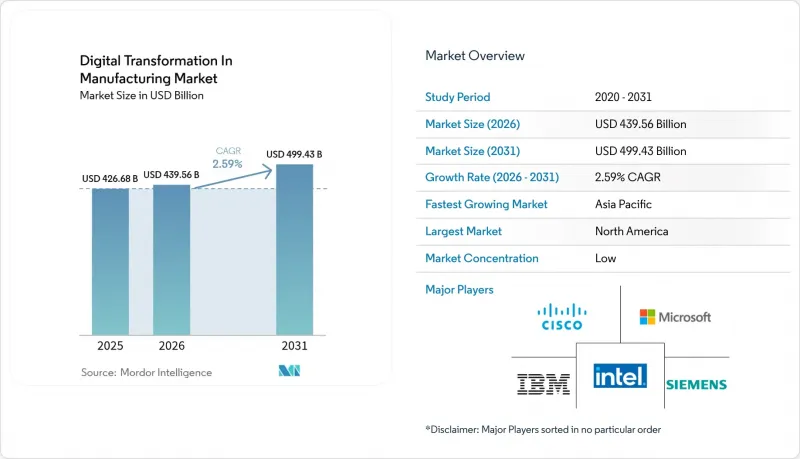
This report is Segmented by Technology Type (Industrial IoT Platforms, Robotics and Automation, and More), Deployment Mode (On-Premises, Cloud, and More), Enterprise Size (Large Enterprises, and SMEs), End-User Industry (Automotive, Aerospace and Defense, Chemicals and Materials, Food and Beverage, and More), and Geography. The Market Forecasts are Provided in Terms of Value (USD).
Global Digital Transformation In Manufacturing Market Trends and Insights
Proliferation of Industrial IoT Platforms
Industrial IoT platforms now embed predictive maintenance and in-line quality analytics directly in production cells, cutting unplanned downtime for automotive and aerospace producers by up to 40%. Automakers that unify robots, automated guided vehicles and test benches under one digital thread have shortened model changeovers from weeks to days, which frees capacity for personalized trim packages. Private 5G removes the latency that once forced controllers to stay hard-wired, making IoT the de facto nervous system of next-generation plants. Early adopters report yield gains that compound every quarter because anomaly-detection algorithms continuously retrain on streaming sensor data. Delayed adopters risk permanent cost disadvantages as digital work-instructions and self-healing lines become standard procurement requirements.
Rapid Shift to Cloud-Native MES and SaaS Solutions
Subscription MES platforms replace cap-ex heavy historians and supervisory systems, allowing multi-site planners to rebalance production with a browser instead of weeks of ERP reconfiguration. More than one thousand plants moved core execution to the cloud during 2025, attracted by pay-as-you-go pricing that falls well below the half-million-dollar perpetual licenses of legacy suites. Virtualized controllers hosted on local outposts let safety-critical loops stay on-premises, while dashboards, machine learning training and supplier portals scale elastically off-premises. The model lowers barriers for small and medium enterprises that previously lacked data centers or DevOps teams, leveling the playing field across the digital transformation in manufacturing market.
Skills Shortage in OT-IT Convergence
Manufacturers lack engineers who can code Python and also troubleshoot ladder logic, stretching project timelines by up to two years. Training academies graduate hundreds yet demand runs into thousands, making talent the scarcest resource in the digital transformation in manufacturing industry. The deficit widens competitive gaps because large enterprises fund internal boot camps, while mid-tiers must wait for vendor professional services, adding direct cost and lost opportunity. Automation suppliers respond with low-code interfaces, but complex edge analytics still requires domain specialists, so human capital remains the bottleneck.
Other drivers and restraints analyzed in the detailed report include:
- Government Incentives for Industry 4.0 Adoption
- Availability of Private 5G Networks for Ultra-Reliable Low-Latency Control
- Escalating Cybersecurity Vulnerabilities Across Brown-Field Assets
For complete list of drivers and restraints, kindly check the Table Of Contents.
Segment Analysis
Industrial IoT platforms captured 34.42% of the digital transformation in manufacturing market share in 2025, underscoring their position as the first layer of connectivity that links shop-floor sensors, controllers and enterprise applications. This portion of the digital transformation in manufacturing market size channels real-time machine data into unified data lakes, allowing predictive maintenance algorithms to cut unplanned downtime by double-digit percentages. IoT adoption is now broad enough that incremental value shifts toward higher-order applications, and that shift explains why digital twin and simulation tools are scaling at a 3.47% CAGR through 2031. Manufacturers use virtual replicas to stress-test assembly sequences, validate ergonomics and pre-train machine-learning models before hardware is on the floor, shrinking program launches from months to weeks.
Spending on robotics, additive manufacturing and augmented reality remains meaningful but grows more slowly, because most early movers prefer to extract additional yield from existing cells rather than install more hardware. Cybersecurity, once an afterthought, now appears on capital budgets as a distinct line item because every new device widens the threat surface. Edge processors packed into vision systems keep terabytes of images local, slashing bandwidth fees and enabling sub-second inspection feedback loops that human eyes cannot match. Over the forecast window, technology choices will be driven less by feature counts and more by how seamlessly each layer plugs into open APIs, so that future upgrades can happen without re-engineering the entire stack.
On-premises installations held 56.91% of spending in 2025, reflecting a long-standing preference for tight control over safety-critical loops and intellectual property. That dominance is eroding as hybrid and edge configurations record the fastest 4.82% CAGR, removing the binary choice between plant-floor responsiveness and cloud scalability. Production teams now place deterministic motion control on micro-data-centers a few meters from the line, while training deep-learning models in hyperscale regions overnight. This split architecture trims image-transfer bandwidth by roughly 80% and lets manufacturers stay compliant with data-sovereignty clauses without forgoing analytics firepower.
Pure cloud models still appeal for supplier collaboration, energy dashboards and sustainability reporting, where millisecond latency is not mission-critical. The lesson for buyers is that deployment is becoming an ongoing workload-balancing exercise rather than a one-time infrastructure bet. Vendors that automate this orchestration create tangible cost and performance advantages, because plant personnel no longer need to manage IP addresses or spin up virtual machines on Friday night shifts. As private 5G and containerized control software mature, the digital transformation in manufacturing market will treat connectivity and compute location as levers that can be pulled and reset whenever takt times, regulatory demands or product mixes change.
Complete Report Scope:
- By Technology Type
- Industrial IoT Platforms
- Robotics and Automation
- Additive Manufacturing and 3D Printing
- Digital Twin and Simulation
- Cyber-Security Solutions
- Cloud Manufacturing Execution Systems
- Artificial Intelligence and Advanced Analytics
- Augmented and Virtual Reality
- Edge Computing Infrastructure
- Other Technology Types
- By Deployment Mode
- On-Premises
- Cloud
- Hybrid and Edge
- By Enterprise Size
- Large Enterprises
- Small and Medium Enterprises (SMEs)
- By End-User Industry
- Automotive
- Aerospace and Defense
- Electronics and Semiconductors
- Chemicals and Materials
- Food and Beverage
- Pharmaceuticals and Medical Devices
- Heavy Machinery and Industrial Equipment
- Consumer Goods
- Other End-User Industries
- By Geography
- North America
- United States
- Canada
- Mexico
- South America
- Brazil
- Argentina
- Rest of South America
- Europe
- Germany
- United Kingdom
- France
- Italy
- Spain
- Russia
- Rest of Europe
- Asia-Pacific
- China
- Japan
- India
- South Korea
- South East Asia
- Australia and New Zealand
- Rest of Asia-Pacific
- Middle East
- Saudi Arabia
- United Arab Emirates
- Turkey
- Rest of Middle East
- Africa
- South Africa
- Nigeria
- Egypt
- Rest of Africa
- North America
Geography Analysis
Asia-Pacific posts the highest 3.54% annual growth as Beijing and New Delhi channel USD 57 billion of incentives into domestic IoT and analytics providers. Chinese subsidies mandate local stack procurement, fostering parallel ecosystems around Huawei and Alibaba Cloud and reshaping competitive dynamics of the digital transformation in manufacturing market. Indian disbursements reward ISO 9001 certification tied to sensor-based quality, pulling small component makers onto data platforms. Japan and South Korea focus on robotics and front-end semiconductor automation, while Southeast Asian electronics hubs demand end-to-end digital traceability to win European orders.
North America retains 38.41% of 2025 sales thanks to early electric-vehicle and aerospace adopters and the presence of the three largest hyperscale clouds. U.S. gigafactories already coordinate thousands of autonomous mobile robots over private 5G, and federal energy-efficiency grants steer plants toward edge AI that trims electricity peaks. Canada pilots digital twins for battery assembly, and Mexico attracts near-shored suppliers that need real-time visibility to guarantee two-hour delivery windows.
Europe sits between rapid adoption and regulatory friction. The Digital Product Passport rule, enforceable in 2027, forces battery and textile producers to embed immutable serialization, accelerating migration to blockchain-ready clouds yet splintering analytics across data-sovereign zones. Germany's EUR 140 million (USD 158 million) Manufacturing-X vouchers subsidize half of small enterprise platform costs, France funds aerospace inspection automation, and the United Kingdom offers twenty-five percent tax relief on robotics. South America concentrates spending in Brazil and Argentina across automotive and food chains, while the Middle East funds greenfield smart factories through sovereign wealth channels. Africa's pilots remain small but rising power-stability investments may unlock broader programs later in the decade.
- Siemens AG
- Schneider Electric SE
- Cisco Systems Inc.
- IBM Corporation
- Microsoft Corporation
- Intel Corporation
- SAP SE
- Oracle Corporation
- Honeywell International Inc.
- Rockwell Automation Inc.
- PTC Inc.
- Dassault Systemes SE
- ABB Ltd.
- Fanuc Corporation
- Mitsubishi Electric Corporation
- General Electric Company
- Bosch Rexroth AG
- Aveva Group plc
- Autodesk Inc.
- Emerson Electric Co.
- Yokogawa Electric Corporation
- Plex Systems Inc.
- Tulip Interfaces Inc.
- Hewlett Packard Enterprise Company
- Nokia Corporation
- Stratasys Ltd.
- UiPath Inc.
- Tata Consultancy Services Ltd.
Additional Benefits:
- The market estimate (ME) sheet in Excel format
- 3 months of analyst support
TABLE OF CONTENTS
1 INTRODUCTION
- 1.1 Study Assumptions and Market Definition
- 1.2 Scope of the Study
2 RESEARCH METHODOLOGY
3 EXECUTIVE SUMMARY
4 MARKET LANDSCAPE
- 4.1 Market Overview
- 4.2 Market Drivers
- 4.2.1 Proliferation of Industrial IoT Platforms
- 4.2.2 Rapid Shift to Cloud-Native MES and SaaS Solutions
- 4.2.3 Government Incentives for Industry 4.0 Adoption
- 4.2.4 Availability of Private 5G Networks for Ultra-Reliable, Low-Latency Control
- 4.2.5 Integration of Quantum-Inspired Optimization for Complex Scheduling
- 4.2.6 Surge in Digital Product Passports Mandating End-to-End Traceability
- 4.3 Market Restraints
- 4.3.1 Skills Shortage in OT-IT Convergence
- 4.3.2 Escalating Cybersecurity Vulnerabilities Across Brown-Field Assets
- 4.3.3 Rising Proprietary Data-Sovereignty Clauses Restricting Multi-Plant Analytics
- 4.3.4 Hidden Carbon Footprint of High-Performance Compute Clusters
- 4.4 Industry Value Chain Analysis
- 4.5 Regulatory Landscape
- 4.6 Technological Outlook
- 4.7 Impact of Macroeconomic Factors on the Market
- 4.8 Porter's Five Forces Analysis
- 4.8.1 Bargaining Power of Suppliers
- 4.8.2 Bargaining Power of Buyers
- 4.8.3 Threat of New Entrants
- 4.8.4 Threat of Substitutes
- 4.8.5 Intensity of Competitive Rivalry
5 MARKET SIZE AND GROWTH FORECASTS (VALUE)
- 5.1 By Technology Type
- 5.1.1 Industrial IoT Platforms
- 5.1.2 Robotics and Automation
- 5.1.3 Additive Manufacturing and 3D Printing
- 5.1.4 Digital Twin and Simulation
- 5.1.5 Cyber-Security Solutions
- 5.1.6 Cloud Manufacturing Execution Systems
- 5.1.7 Artificial Intelligence and Advanced Analytics
- 5.1.8 Augmented and Virtual Reality
- 5.1.9 Edge Computing Infrastructure
- 5.1.10 Other Technology Types
- 5.2 By Deployment Mode
- 5.2.1 On-Premises
- 5.2.2 Cloud
- 5.2.3 Hybrid and Edge
- 5.3 By Enterprise Size
- 5.3.1 Large Enterprises
- 5.3.2 Small and Medium Enterprises (SMEs)
- 5.4 By End-User Industry
- 5.4.1 Automotive
- 5.4.2 Aerospace and Defense
- 5.4.3 Electronics and Semiconductors
- 5.4.4 Chemicals and Materials
- 5.4.5 Food and Beverage
- 5.4.6 Pharmaceuticals and Medical Devices
- 5.4.7 Heavy Machinery and Industrial Equipment
- 5.4.8 Consumer Goods
- 5.4.9 Other End-User Industries
- 5.5 By Geography
- 5.5.1 North America
- 5.5.1.1 United States
- 5.5.1.2 Canada
- 5.5.1.3 Mexico
- 5.5.2 South America
- 5.5.2.1 Brazil
- 5.5.2.2 Argentina
- 5.5.2.3 Rest of South America
- 5.5.3 Europe
- 5.5.3.1 Germany
- 5.5.3.2 United Kingdom
- 5.5.3.3 France
- 5.5.3.4 Italy
- 5.5.3.5 Spain
- 5.5.3.6 Russia
- 5.5.3.7 Rest of Europe
- 5.5.4 Asia-Pacific
- 5.5.4.1 China
- 5.5.4.2 Japan
- 5.5.4.3 India
- 5.5.4.4 South Korea
- 5.5.4.5 South East Asia
- 5.5.4.6 Australia and New Zealand
- 5.5.4.7 Rest of Asia-Pacific
- 5.5.5 Middle East
- 5.5.5.1 Saudi Arabia
- 5.5.5.2 United Arab Emirates
- 5.5.5.3 Turkey
- 5.5.5.4 Rest of Middle East
- 5.5.6 Africa
- 5.5.6.1 South Africa
- 5.5.6.2 Nigeria
- 5.5.6.3 Egypt
- 5.5.6.4 Rest of Africa
- 5.5.1 North America
6 COMPETITIVE LANDSCAPE
- 6.1 Market Concentration
- 6.2 Strategic Moves
- 6.3 Market Share Analysis
- 6.4 Company Profiles (includes Global Level Overview, Market Level Overview, Core Segments, Financials as available, Strategic Information, Market Rank/Share, Products and Services, Recent Developments)
- 6.4.1 Siemens AG
- 6.4.2 Schneider Electric SE
- 6.4.3 Cisco Systems Inc.
- 6.4.4 IBM Corporation
- 6.4.5 Microsoft Corporation
- 6.4.6 Intel Corporation
- 6.4.7 SAP SE
- 6.4.8 Oracle Corporation
- 6.4.9 Honeywell International Inc.
- 6.4.10 Rockwell Automation Inc.
- 6.4.11 PTC Inc.
- 6.4.12 Dassault Systemes SE
- 6.4.13 ABB Ltd.
- 6.4.14 Fanuc Corporation
- 6.4.15 Mitsubishi Electric Corporation
- 6.4.16 General Electric Company
- 6.4.17 Bosch Rexroth AG
- 6.4.18 Aveva Group plc
- 6.4.19 Autodesk Inc.
- 6.4.20 Emerson Electric Co.
- 6.4.21 Yokogawa Electric Corporation
- 6.4.22 Plex Systems Inc.
- 6.4.23 Tulip Interfaces Inc.
- 6.4.24 Hewlett Packard Enterprise Company
- 6.4.25 Nokia Corporation
- 6.4.26 Stratasys Ltd.
- 6.4.27 UiPath Inc.
- 6.4.28 Tata Consultancy Services Ltd.
7 MARKET OPPORTUNITIES AND FUTURE OUTLOOK
- 7.1 White-Space and Unmet-Need Assessment

