PUBLISHER: Mordor Intelligence | PRODUCT CODE: 2118961

PUBLISHER: Mordor Intelligence | PRODUCT CODE: 2118961
Marketing Transformation Services - Market Share Analysis, Industry Trends & Statistics, Growth Forecasts (2026 - 2031)
According to Mordor Intelligence, the marketing transformation services market size is projected to expand from USD 31.11 billion in 2025 and USD 34.12 billion in 2026 to USD 55.41 billion by 2031, registering a CAGR of 10.18% between 2026 and 2031.
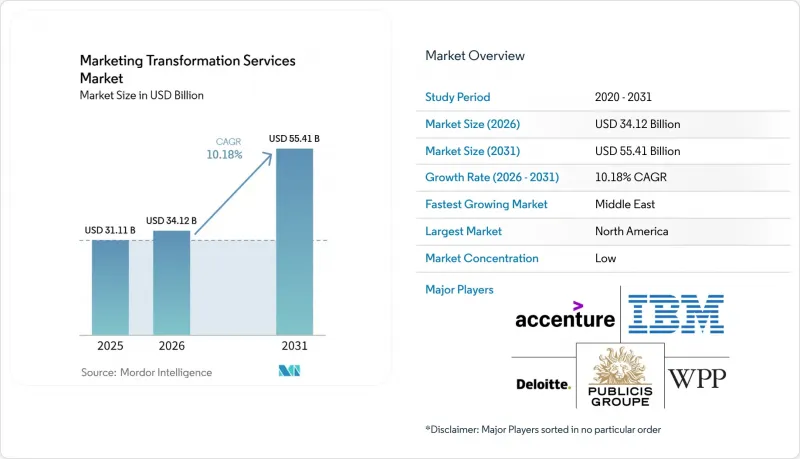
This report is Segmented by Service Line (Strategy and Operating Model Transformation, Technology and MarTech Transformation, and More), Engagement Model (Project-Based, Subscription and Retainer, and More), End User Industry (BFSI, Retail and E-Commerce, Media and Entertainment, Healthcare and Life Sciences, and More), and Geography. The Market Forecasts are Provided in Terms of Value (USD).
Global Marketing Transformation Services Market Trends and Insights
AI-Led Marketing Operating Model Redesign
The Marketing Transformation Services Market is moving beyond isolated campaign tools toward wider changes in how marketing teams work. A 2026 survey of nearly 300 global CMOs found that 96% viewed AI as a force in end-to-end marketing transformation, although only 1 in 3 had progressed beyond basic uses. This gap creates work around process design, team responsibilities, and controls for AI-supported decisions. Providers are increasingly asked to help clients move pilots into operating models that can run across several functions. Deloitte launched an agentic transformation practice with Google Cloud in April 2026, showing the commercial focus on this implementation need. European transparency requirements for AI-assisted marketing content also widen the scope of governance work in the Marketing Transformation Services Market.
Personalization and First-Party Data Activation Demand
In the Marketing Transformation Services Market, first-party data programs are now tied to commercial execution as well as privacy compliance. Google found that brands with mature first-party data programs can grow 2.9 times faster and generate 1.5 times the return from similar marketing spending. The distinction lies in the ability to activate data, rather than simply collect a larger volume of it. This favors work on data design, identity controls, and activation processes. A 2026 Supermetrics survey reported that 38% of marketing decision-makers prioritized personalization at scale, followed by 35% that prioritized real-time campaign optimization. Saudi Arabia's Personal Data Protection Law is adding demand for privacy-safe data architectures in the Middle East.
Budget Pressure and Consulting Roster Rationalization
In the Marketing Transformation Services Market, enterprise buyers are reducing the number of external partners and directing more work to a smaller group of accountable providers. Gartner reported that marketing budgets were 7.8% of company revenue in 2026 and that organizations were reallocating existing funds to AI rather than receiving additional budget. This structure supports large integrators that can show results across several services. It also pressures smaller practices that cannot differentiate through cost, outcome assurance, or owned tools. Procurement freezes can affect providers heavily when their revenue is concentrated in a limited number of large accounts. These conditions can slow spending in the Marketing Transformation Services Market even as clients continue to prioritize AI adoption.
Other drivers and restraints analyzed in the detailed report include:
- Omnichannel Journey Orchestration Complexity
- Pressure to Prove Marketing ROI and Productivity
- Scarcity of AI, Martech, and Measurement Talent
For complete list of drivers and restraints, kindly check the Table Of Contents.
Segment Analysis
Strategy and Operating Model Transformation accounted for 26.28% of the Marketing Transformation Services Market size in 2025. The leading position reflects continued enterprise work on marketing technology modernization, customer data infrastructure, digital channel redesign, and the operating practices that connect these areas. Many CRM, customer data platform, and marketing automation investments made from 2020 to 2022 now need AI capabilities, clearer ownership, and revised workflows. This creates follow-on work that combines architecture assessment, organization design, governance, and implementation planning. Strategy and operating model work remains central because organizations need stable data, defined responsibilities, and practical processes before they can scale AI use across customer experience and campaign operations.
Data, AI, and Automation Enablement is projected to expand at a 13.21% CAGR between 2026 and 2031. Enterprises are shifting from narrow AI tasks toward connected systems that support data activation, content workflows, decisioning, and marketing automation. This shift requires rules for approvals, content quality, data access, accountability, and performance measurement. Technology and MarTech Transformation remains important as organizations adopt composable architectures and warehouse-native customer data platforms. Content Supply Chain and Creative Automation is also attracting budgets, and WPP's June 2026 AWS collaboration reported up to 90% lower content production time and 40% lower content costs in early deployments
Complete Report Scope:
- By Service Line
- Strategy and Operating Model Transformation
- Technology and MarTech Transformation
- Data, AI and Automation Enablement
- Content Supply Chain and Creative Automation
- Other Service Lines
- By Engagement Model
- Project-Based
- Subscription and Retainer
- Managed Services
- Outcome-Based and Risk-Sharing
- By End User Industry
- BFSI
- Retail and E-commerce
- Media and Entertainment
- Healthcare and Life Sciences
- Travel and Hospitality
- Consumer Goods
- Other End User Industries (Education, Automotive, and IT and Telecom amongst Others)
- By Geography
- North America
- United States
- Canada
- Mexico
- South America
- Brazil
- Argentina
- Chile
- Rest of South America
- Europe
- Germany
- United Kingdom
- France
- Italy
- Spain
- Rest of Europe
- Asia-Pacific
- China
- Japan
- India
- South Korea
- Australia
- Rest of Asia-Pacific
- Middle East
- United Arab Emirates
- Saudi Arabia
- Qatar
- Rest of Middle East
- Africa
- South Africa
- Egypt
- Nigeria
- Rest of Africa
- North America
Geography Analysis
North America held a 40.22% share in the Marketing Transformation Services Market in 2025. The region benefits from a concentration of large corporate marketing budgets, a mature managed services base, and early adoption of AI-led operating model changes. Large enterprises are consolidating transformation work with fewer strategic integrators, while mid-market companies are more likely to use subscription platforms and regional specialist firms. California's privacy framework is supporting demand for privacy-compliant data activation architecture. Canada and Mexico are growing markets where financial services and retail are major buyers.
Europe is a significant demand center in the Marketing Transformation Services Market because compliance needs sit alongside commercial transformation goals. The EU AI Act is creating demand for marketing operating model audits and governance redesign, particularly in Germany, France, and the UK. Deloitte and Google Cloud launched a London AI Studio in June 2026, and Deloitte committed to training 1,000 UK-based AI and data engineers on Gemini Enterprise architecture. This investment indicates confidence in European demand, while South America, led by Brazil, is developing as e-commerce growth prompts retail and financial services firms to begin foundational programs.
The Middle East is projected to expand at a 12.67% CAGR in the Marketing Transformation Services Market from 2026 to 2031. National digitalization plans and investment in digital infrastructure are supporting demand in the region. Saudi Vision 2030 has supported more than USD 6.4 billion in digital infrastructure investment since 2021, according to the referenced 2026 regional report. Digital advertising spending in the Middle East and North Africa exceeded USD 15 billion in 2025, with Saudi Arabia and the UAE leading the region, while more than 30% of Saudi consumers said local brand advertising lacked cultural relevance. Africa is smaller but developing through mobile-first marketing ecosystems, while Asia-Pacific remains varied, with India and South Korea supporting AI-powered personalization demand and China and Japan following different regulatory and adoption paths.
- Accenture plc
- Deloitte Touche Tohmatsu Limited
- International Business Machines Corporation
- Capgemini SE
- Publicis Groupe S.A.
- Cognizant Technology Solutions Corporation
- Infosys Limited
- Tata Consultancy Services Limited
- Wipro Limited
- HCL Technologies Limited
- Ernst & Young Global Limited
- KPMG International Limited
- Concentrix Corporation
- Genpact Limited
- Tech Mahindra Limited
- NTT DATA Group Corporation
- Slalom, LLC
- dentsu Group Inc.
- WPP plc
- PricewaterhouseCoopers International Limited
Additional Benefits:
- The market estimate (ME) sheet in Excel format
- 3 months of analyst support
TABLE OF CONTENTS
1 INTRODUCTION
- 1.1 Study Assumptions and Market Definition
- 1.2 Scope of the Study
2 RESEARCH METHODOLOGY
3 EXECUTIVE SUMMARY
4 MARKET LANDSCAPE
- 4.1 Market Overview
- 4.2 Market Drivers
- 4.2.1 AI-Led Marketing Operating Model Redesign
- 4.2.2 Personalization and First-Party Data Activation Demand
- 4.2.3 Omnichannel Journey Orchestration Complexity
- 4.2.4 Pressure to Prove Marketing ROI and Productivity
- 4.2.5 Agentic AI Governance and Content Supply Chain Modernization
- 4.2.6 Composable Martech and CDP-Warehouse Integration Cycles
- 4.3 Market Restraints
- 4.3.1 Budget Pressure and Consulting Roster Rationalization
- 4.3.2 Scarcity of AI, Martech, and Measurement Talent
- 4.3.3 Centralized Budget Governance Slowing Transformation Approvals
- 4.3.4 AI Search and Signal Loss Undermining Legacy Attribution
- 4.4 Impact of Macroeconomic Factors on the Market
- 4.5 Industry Value-Chain Analysis
- 4.6 Technology Outlook
- 4.7 Regulatory Landscape
- 4.8 Porter's Five Forces Analysis
- 4.8.1 Threat of New Entrants
- 4.8.2 Bargaining Power of Suppliers
- 4.8.3 Bargaining Power of Buyers
- 4.8.4 Threat of Substitutes
- 4.8.5 Intensity of Competitive Rivalry
5 MARKET SIZE AND GROWTH FORECASTS (VALUE)
- 5.1 By Service Line
- 5.1.1 Strategy and Operating Model Transformation
- 5.1.2 Technology and MarTech Transformation
- 5.1.3 Data, AI and Automation Enablement
- 5.1.4 Content Supply Chain and Creative Automation
- 5.1.5 Other Service Lines
- 5.2 By Engagement Model
- 5.2.1 Project-Based
- 5.2.2 Subscription and Retainer
- 5.2.3 Managed Services
- 5.2.4 Outcome-Based and Risk-Sharing
- 5.3 By End User Industry
- 5.3.1 BFSI
- 5.3.2 Retail and E-commerce
- 5.3.3 Media and Entertainment
- 5.3.4 Healthcare and Life Sciences
- 5.3.5 Travel and Hospitality
- 5.3.6 Consumer Goods
- 5.3.7 Other End User Industries (Education, Automotive, and IT and Telecom amongst Others)
- 5.4 By Geography
- 5.4.1 North America
- 5.4.1.1 United States
- 5.4.1.2 Canada
- 5.4.1.3 Mexico
- 5.4.2 South America
- 5.4.2.1 Brazil
- 5.4.2.2 Argentina
- 5.4.2.3 Chile
- 5.4.2.4 Rest of South America
- 5.4.3 Europe
- 5.4.3.1 Germany
- 5.4.3.2 United Kingdom
- 5.4.3.3 France
- 5.4.3.4 Italy
- 5.4.3.5 Spain
- 5.4.3.6 Rest of Europe
- 5.4.4 Asia-Pacific
- 5.4.4.1 China
- 5.4.4.2 Japan
- 5.4.4.3 India
- 5.4.4.4 South Korea
- 5.4.4.5 Australia
- 5.4.4.6 Rest of Asia-Pacific
- 5.4.5 Middle East
- 5.4.5.1 United Arab Emirates
- 5.4.5.2 Saudi Arabia
- 5.4.5.3 Qatar
- 5.4.5.4 Rest of Middle East
- 5.4.6 Africa
- 5.4.6.1 South Africa
- 5.4.6.2 Egypt
- 5.4.6.3 Nigeria
- 5.4.6.4 Rest of Africa
- 5.4.1 North America
6 COMPETITIVE LANDSCAPE
- 6.1 Market Concentration
- 6.2 Strategic Moves
- 6.3 Market Share Analysis
- 6.4 Company Profiles (includes Global Level Overview, Market Level Overview, Core Segments, Financials as available, Strategic Information, Market Rank/Share, Products and Services, Recent Developments)
- 6.4.1 Accenture plc
- 6.4.2 Deloitte Touche Tohmatsu Limited
- 6.4.3 International Business Machines Corporation
- 6.4.4 Capgemini SE
- 6.4.5 Publicis Groupe S.A.
- 6.4.6 Cognizant Technology Solutions Corporation
- 6.4.7 Infosys Limited
- 6.4.8 Tata Consultancy Services Limited
- 6.4.9 Wipro Limited
- 6.4.10 HCL Technologies Limited
- 6.4.11 Ernst & Young Global Limited
- 6.4.12 KPMG International Limited
- 6.4.13 Concentrix Corporation
- 6.4.14 Genpact Limited
- 6.4.15 Tech Mahindra Limited
- 6.4.16 NTT DATA Group Corporation
- 6.4.17 Slalom, LLC
- 6.4.18 dentsu Group Inc.
- 6.4.19 WPP plc
- 6.4.20 PricewaterhouseCoopers International Limited
7 MARKET OPPORTUNITIES AND FUTURE OUTLOOK
- 7.1 White-Space and Unmet-Need Assessment

